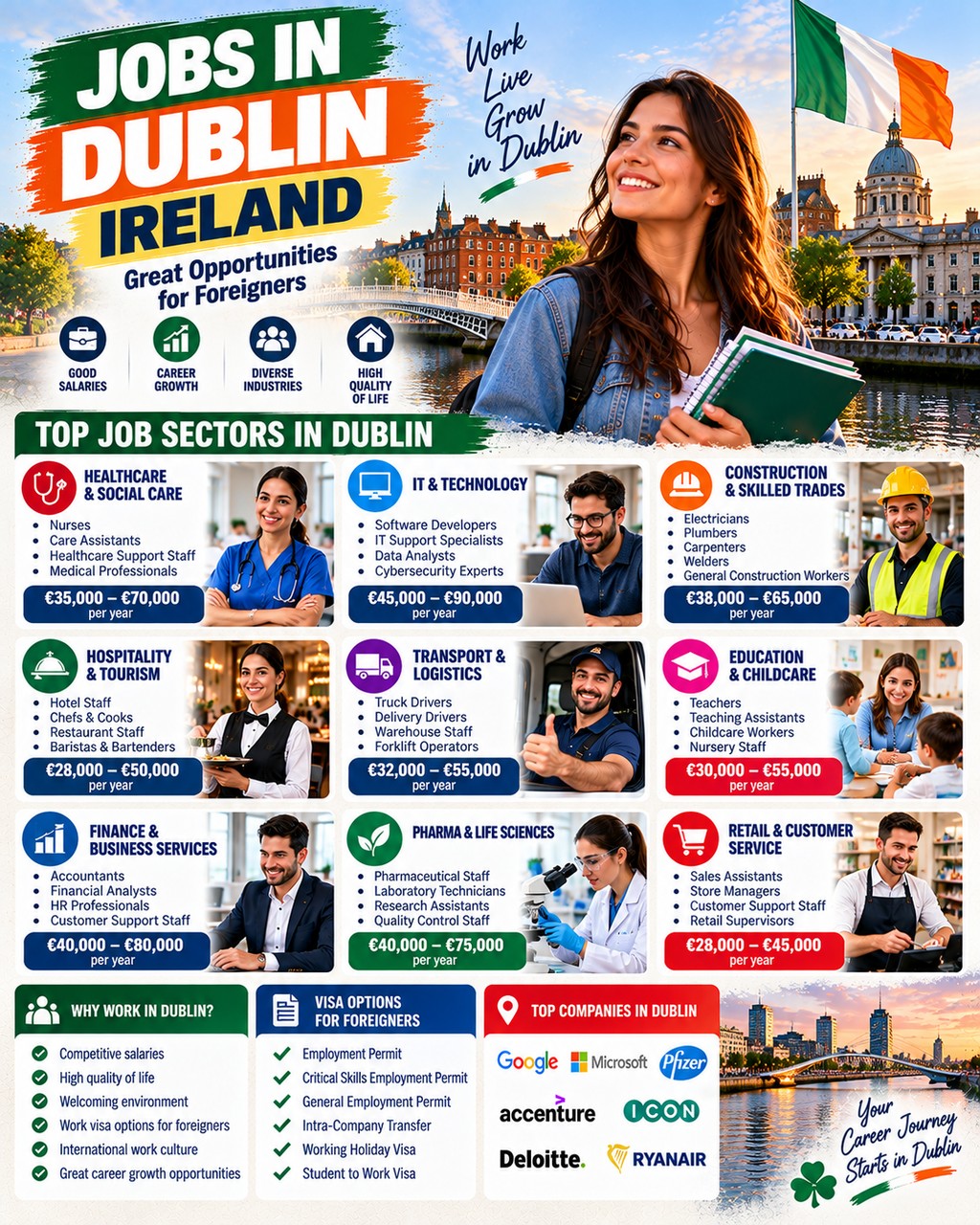
Dublin is the largest employment centre in Ireland and remains one of the country’s most important destinations for professionals, skilled workers, graduates, international workers and people looking to build a career in Europe.
The city has a diverse economy covering technology, financial services, pharmaceuticals, healthcare, construction, hospitality, retail, logistics, professional services and education. Dublin is also home to a large concentration of international companies, making it particularly attractive to workers with technology, business, finance, engineering and professional qualifications.
For people searching for Dublin jobs, there are opportunities at many different career levels. Current listings on Ireland’s public JobsIreland service show more than 1,000 vacancies in Dublin, including roles in healthcare, construction, hospitality, maintenance, motor vehicle technology, catering and professional services.
Dublin is particularly interesting for foreign workers because some of the occupations in demand in the city can qualify for Ireland’s employment-permit system. However, simply finding a vacancy does not automatically give a non-EEA worker the right to work in Ireland. The occupation, salary, employer and permit category all need to meet the relevant requirements.
This guide explains the best jobs in Dublin in 2026, the sectors hiring, opportunities for people without degrees, jobs for foreign workers, employment permits, how to apply and how to avoid common scams.
Why Work in Dublin?
Dublin has several characteristics that make it one of Ireland’s strongest employment markets.
Major advantages include:
- Ireland’s largest concentration of employment
- Large technology sector
- Strong financial-services industry
- Pharmaceutical and life-sciences opportunities
- International companies and multinational employers
- Healthcare employment
- Construction and infrastructure work
- Hospitality and tourism jobs
- Professional and business services
- English-speaking working environment
- Opportunities for skilled international workers
Government employment data shows that Dublin has experienced particularly strong long-term employment growth. Between 2016 and 2025, employment in companies supported by Enterprise Ireland, IDA Ireland and Údarás na Gaeltachta increased by 56.2% in the Dublin region, equivalent to approximately 78,981 additional jobs.
The wider Irish labour market also remained strong in 2026. Total employment reached approximately 2.84 million in Q2 2026, with 21,200 jobs created over the previous year.
Most In-Demand Jobs in Dublin
Dublin’s economy is broad, so job opportunities exist across many industries.
Some of the major categories include:
- IT and technology
- Finance and accounting
- Healthcare
- Engineering
- Construction
- Pharmaceuticals
- Financial technology
- Professional services
- Hospitality and hotels
- Retail
- Logistics and transportation
- Manufacturing
- Education
- Administration
- Sales and marketing
- Skilled trades
Let’s look at these opportunities in more detail.
1. IT and Technology Jobs in Dublin
Technology is one of Dublin’s most important employment sectors.
Potential positions include:
- Software developers
- Software engineers
- Cloud engineers
- Cybersecurity specialists
- Data analysts
- Data engineers
- DevOps engineers
- Systems administrators
- Network engineers
- Database administrators
- IT support specialists
- Business analysts
- Technical project managers
- AI and machine-learning specialists
- Product managers
Dublin is particularly attractive to technology professionals because of its large multinational business presence.
The Irish employment-permit system also identifies specific technology and other specialised occupations under the Critical Skills Occupations List. The current list took effect on 13 May 2026. Importantly, eligibility can depend on the exact specialisation within a broad occupational category.
For international technology professionals, this makes Dublin one of the most interesting Irish markets to investigate.
2. Finance and Accounting Jobs
Dublin is one of Ireland’s major financial-services centres.
Jobs include:
- Accountants
- Financial analysts
- Auditors
- Risk analysts
- Compliance officers
- Tax specialists
- Banking professionals
- Insurance specialists
- Investment operations professionals
- Financial controllers
- Payroll specialists
- Corporate finance professionals
- FinTech professionals
Ireland’s financial-services sector continued to expand in 2025. Employment in financial services increased by 2.7% to 43,282 jobs, with significant employment expansion in Dublin.
Professionals with qualifications such as ACCA, ACA, CIMA or relevant university degrees may find opportunities in accounting and finance, although the exact requirements vary by employer and occupation.
3. Healthcare Jobs in Dublin
Healthcare is another major source of employment.
Potential Dublin jobs include:
- Registered nurses
- Healthcare assistants
- Care workers
- Physiotherapists
- Occupational therapists
- Radiographers
- Pharmacists
- Medical laboratory professionals
- Social care workers
- Home-care workers
- Healthcare administrators
- Medical receptionists
Current JobsIreland listings include healthcare assistant vacancies in Dublin, demonstrating that healthcare opportunities are available in the city’s current employment market.
International healthcare professionals should remember that some occupations are regulated. Professional registration, qualification recognition and other requirements may apply.
Ireland also made changes to employment-permit eligibility in 2026 to address shortages in healthcare and other sectors.
4. Construction Jobs in Dublin
Construction is an important source of employment as Dublin continues to develop housing, commercial buildings and infrastructure.
Potential jobs include:
- Construction managers
- Site managers
- Quantity surveyors
- Civil engineers
- Construction planners
- Surveyors
- Electricians
- Plumbers
- Welders
- Steel workers
- Plant operators
- Maintenance workers
- General construction workers
Ireland’s 2026 employment-permit review specifically targeted skills shortages in construction and infrastructure.
Several construction-related occupations were added or adjusted within the employment-permit system during 2026.
For foreign workers with construction experience, it is therefore worth checking the exact occupation against the current permit lists.
5. Pharmaceutical and Life-Science Jobs
Dublin and the wider Irish market offer opportunities connected with pharmaceuticals, chemicals and medical products.
Potential positions include:
- Pharmaceutical technicians
- Laboratory technicians
- Quality-control technicians
- Quality-assurance specialists
- Manufacturing technicians
- Process technicians
- Validation specialists
- Production operators
- Regulatory specialists
- Chemical engineers
- Microbiologists
- Biochemists
Ireland’s chemicals sector recorded 4.4% employment growth in 2025, reaching 47,771 jobs across the relevant enterprise-supported companies.
The medical-device sector also grew by 3.3% in 2025 to 47,112 jobs nationally.
These sectors can be especially attractive to candidates with backgrounds in chemistry, biology, engineering, laboratory science and manufacturing.
6. Hospitality and Hotel Jobs in Dublin
Dublin is one of Ireland’s biggest tourism and hospitality markets.
Potential positions include:
- Hotel receptionists
- Front-office staff
- Housekeeping staff
- Chefs
- Sous chefs
- Chef de partie
- Kitchen assistants
- Waiters
- Restaurant supervisors
- Baristas
- Hotel managers
- Restaurant managers
- Maintenance staff
- Catering assistants
Current JobsIreland listings include positions such as Chef de Partie and catering-related roles in Dublin.
Hospitality can be particularly attractive for people who do not have university degrees.
However, foreign workers should check immigration eligibility carefully. Not every hospitality position is eligible for an employment permit.
7. Skilled Trade Jobs in Dublin
A university degree is not necessarily required for every good career in Dublin.
Skilled workers may find opportunities in:
- Electrical work
- Plumbing
- Welding
- Mechanical maintenance
- Vehicle repair
- Construction
- Industrial maintenance
- Machine operation
- Engineering technician roles
- Building maintenance
Current Dublin listings include roles such as Motor Vehicle Technician, Construction Plant Fitter and maintenance positions.
Ireland’s 2026 employment-permit review also expanded eligibility for a number of occupations connected with construction, transport, healthcare and agri-food.
8. Manufacturing Jobs
Although Dublin is better known internationally for technology and finance, manufacturing is also an important employment sector.
Potential jobs include:
- Production operators
- Machine operators
- Manufacturing technicians
- Maintenance technicians
- Quality inspectors
- Packaging operators
- Production supervisors
- Process technicians
- Warehouse operators
- Engineering technicians
Manufacturing-related employment is particularly relevant to pharmaceutical, medical-device, food and industrial companies.
9. Logistics and Warehouse Jobs
Dublin is an important distribution and transportation centre.
Potential positions include:
- Warehouse operatives
- Forklift operators
- Logistics coordinators
- Inventory controllers
- Transport planners
- Delivery drivers
- Supply-chain specialists
- Procurement assistants
- Distribution managers
- Freight coordinators
The wider Irish economy recorded employment growth in transportation and storage during 2026.
For international applicants, however, a logistics vacancy should not automatically be assumed to qualify for a work permit. The specific occupation must be checked.
10. Retail Jobs in Dublin
Dublin has a large retail sector covering shopping centres, supermarkets, department stores, specialist shops and online retail.
Common roles include:
- Sales assistants
- Retail supervisors
- Store managers
- Cashiers
- Customer-service representatives
- Stockroom assistants
- Visual-merchandising staff
- E-commerce assistants
Retail can be accessible to people without university qualifications, although competition can be strong.
For non-EEA applicants, immigration rules are especially important because some lower-skilled retail occupations may be on Ireland’s ineligible occupations list.
Best Areas of Dublin for Employment
Job seekers should consider the wider Dublin metropolitan employment area rather than focusing only on Dublin city centre.
Important employment locations include:
Dublin City Centre
Strong in:
- Finance
- Technology
- Hospitality
- Retail
- Professional services
- Education
- Healthcare
Dublin 2
Known for:
- Financial services
- Professional services
- Technology
- Restaurants
- Hotels
- Corporate offices
Dublin 4
Important for:
- Technology
- Finance
- Professional services
- International organisations
- Healthcare
- Business services
Dublin 8
Opportunities can include:
- Healthcare
- Hospitality
- Retail
- Construction
- Public services
- Education
Dublin 12
Employment opportunities include:
- Warehousing
- Logistics
- Maintenance
- Healthcare
- Manufacturing
- Retail
Dublin 15
A growing suburban employment area with opportunities in:
- Healthcare
- Retail
- Logistics
- Business services
- Construction
Current JobsIreland vacancies demonstrate that jobs are distributed across many parts of Dublin, including Dublin 6, Dublin 7, Dublin 9, Dublin 12 and Dublin 15.
Dublin Jobs for Foreign Workers
Dublin is one of the most attractive Irish cities for international workers, but immigration status is critical.
If you are a non-EEA national, you generally need an employment permit unless you fall within an exemption.
Ireland’s employment-permit system includes different categories, including:
- Critical Skills Employment Permit
- General Employment Permit
- Intra-Company Transfer Employment Permit
- Other specialised permit categories
The Critical Skills Occupations List identifies occupations where Ireland has shortages in qualifications, experience or skills.
The General Employment Permit provides a broader route for eligible occupations, subject to the relevant requirements.
Dublin Jobs With Work Permit Opportunities
For international applicants, some of the most interesting categories are:
Technology
- Software development
- Cybersecurity
- Data
- Cloud computing
- Engineering-related IT
Healthcare
- Nursing
- Certain healthcare occupations
- Social care and care-related roles subject to applicable rules
Engineering
- Civil engineering
- Mechanical engineering
- Electrical engineering
- Process engineering
- Specialist technical roles
Construction
- Construction planning
- Quantity surveying
- Certain skilled construction occupations
Science
- Pharmaceutical
- Laboratory
- Chemical
- Biotechnology-related positions
Ireland reviewed its employment-permit occupation lists in 2026 and approved 32 changes, including new Critical Skills and General Employment Permit occupations and renewed quotas for certain occupations.
Dublin Employment Permit Salary Requirements
Salary is extremely important for international workers.
From 1 March 2026, the standard minimum annual remuneration for a General Employment Permit increased to €36,605. The standard Critical Skills threshold for relevant qualifications increased to approximately €40,904/€40,909, depending on the applicable category and current official wording.
There are separate thresholds and special rules for certain occupations, including some healthcare and agri-food roles.
This means an overseas applicant should ask:
Does this specific job meet the salary requirement for the employment permit I would need?
before spending money on relocation or an agent.
Can Pakistani Workers Get Jobs in Dublin?
Yes, Pakistani citizens can apply for eligible jobs in Dublin.
However, the process should be approached carefully.
A realistic pathway can be:
- Identify your occupation.
- Check whether your occupation is eligible.
- Find genuine Dublin employers.
- Apply for suitable vacancies.
- Receive a legitimate employment offer.
- Confirm salary and contract conditions.
- Determine the correct employment-permit category.
- Complete the employment-permit process.
- Complete the relevant immigration requirements.
- Travel only after receiving the necessary authorisation.
The most important point is that a job offer and permission to work are not the same thing.
How to Find Dublin Jobs
1. JobsIreland
JobsIreland is one of the best places to start because it is Ireland’s public employment service.
The Dublin section currently shows more than 1,000 vacancies across different sectors.
2. EURES
EURES provides European employment information and vacancy resources and can be useful for international job seekers researching opportunities in Ireland.
3. Company Websites
Large employers often publish vacancies directly.
Search:
Company Name + Careers + Dublin
or:
Company Name + Jobs Ireland
4. Recruitment Agencies
Recruitment agencies can help connect candidates with employers.
However, applicants should verify that the agency and vacancy are genuine.
Never assume that paying a large “processing fee” guarantees employment.
How to Search for Dublin Jobs on Google
Instead of searching only:
Dublin jobs
use more specific searches such as:
- Dublin software developer jobs
- Dublin nursing jobs
- Dublin construction jobs
- Dublin hotel jobs
- Dublin chef jobs
- Dublin warehouse jobs
- Dublin electrician jobs
- Dublin engineering jobs
- Dublin pharmaceutical jobs
- Dublin healthcare assistant jobs
- Dublin finance jobs
- Dublin accounting jobs
- Dublin logistics jobs
- Dublin manufacturing jobs
If you are applying from outside Ireland, add:
“employment permit”
or:
“visa sponsorship”
to your research — but always verify the employer’s actual permit position directly.
How to Prepare Your CV for Dublin Jobs
A strong CV can make a major difference.
Your CV should clearly show:
- Name
- Contact details
- Professional summary
- Employment history
- Education
- Certifications
- Technical skills
- Languages
- Relevant achievements
For skilled workers, put your most relevant experience near the top.
For example, instead of:
Worked in construction for several years.
write:
Construction professional with 7 years of experience in commercial building projects, site coordination and health-and-safety procedures.
Quantify achievements whenever possible.
Skills That Can Improve Your Chances in Dublin
Depending on the industry, useful skills include:
IT
- Programming
- Cloud computing
- Cybersecurity
- Data analytics
- DevOps
- Database management
Construction
- Quantity surveying
- Site management
- CAD
- Project management
- Surveying
- Health and safety
Manufacturing
- CNC
- Quality control
- Automation
- Lean manufacturing
- Maintenance
- Production systems
Finance
- Accounting
- Financial modelling
- Compliance
- Audit
- Risk management
- Tax
Healthcare
- Professional registration
- Clinical experience
- Patient care
- Communication
- Specialist qualifications
Jobs in Dublin Without a Degree
There are many occupations where a university degree is not necessarily required.
Examples can include:
- Chefs
- Skilled trades
- Vehicle technicians
- Construction workers
- Maintenance workers
- Warehouse workers
- Catering workers
- Hospitality workers
- Production operators
- Care-related workers
Current JobsIreland vacancies include roles such as Chef de Partie, Motor Vehicle Technician, Construction Plant Fitter, Catering Assistant and maintenance positions.
However, international workers need to make an important distinction:
No degree required does not mean no immigration requirements.
A job may be open to someone without a degree but still be unsuitable for a non-EEA applicant if the occupation is not eligible for an employment permit.
Dublin Jobs and Cost of Living
One of the biggest challenges of working in Dublin is the cost of accommodation.
Before accepting a job, calculate:
- Monthly salary
- Income tax and deductions
- Rent
- Utilities
- Food
- Transportation
- Health and insurance costs
- Mobile phone
- Other living expenses
A high gross salary does not automatically mean a high amount of disposable income.
Someone earning more in Dublin may still have significant housing expenses.
For international workers, it is therefore important to research accommodation before moving.
Current Employment Permit Processing
Applicants should also consider processing times.
As of 7 October 2026, Ireland’s Department of Enterprise reported that it was processing:
- Critical Skills Employment Permit applications received on 30 September 2026
- New General Employment Permit applications received on 31 August 2026
- Other new applications received on 18 August 2026
Processing dates change over time, so applicants should check the official government page before making travel or employment plans.
Dublin Jobs: Common Scams to Avoid
International job seekers are frequent targets for employment scams.
Be cautious if someone promises:
- Guaranteed Dublin employment
- Guaranteed work visa
- Guaranteed employment permit
- Guaranteed accommodation
- A job without an interview
- A job with unusually high salary
- A visa in exchange for a large cash payment
Always verify:
- Company name
- Company website
- Employer contact details
- Job advertisement
- Employment contract
- Salary
- Job location
- Employment-permit eligibility
Ireland maintains an official list of occupations that are ineligible for employment permits, so applicants should check their occupation rather than relying entirely on an agent’s claims.
Frequently Asked Questions
What are the best jobs in Dublin?
Technology, healthcare, finance, engineering, pharmaceuticals, construction, professional services, hospitality, logistics and skilled trades are among the major employment areas.
Is Dublin good for foreign workers?
Yes, particularly for workers with skills in occupations that are eligible for Irish employment permits.
Can Pakistani citizens work in Dublin?
Yes, provided they meet the applicable immigration and employment-permit requirements.
Can I get a Dublin job without a degree?
Yes. Some hospitality, construction, maintenance, manufacturing, logistics and skilled-trade positions do not require university degrees.
What is the minimum salary for a General Employment Permit in Ireland?
The standard minimum annual remuneration for a General Employment Permit is €36,605 from 1 March 2026, subject to applicable exceptions and special categories.
Are Dublin IT jobs good for foreign workers?
Dublin’s technology sector can be particularly attractive because certain specialised technology occupations appear on Ireland’s Critical Skills Occupations List.
Is Dublin the only good city for jobs in Ireland?
No. Cork, Galway, Limerick, Waterford and other locations also offer employment opportunities. Dublin is simply the country’s largest concentration of many corporate and professional jobs.
Where can I search for Dublin jobs?
Start with JobsIreland, EURES, employer career pages and reputable recruitment agencies.
Can an agent guarantee an Ireland work visa?
No legitimate agent should promise a guaranteed immigration outcome simply because you pay a fee. The application must meet Ireland’s legal requirements.
Final Thoughts
Dublin remains one of the strongest job markets in Ireland and an important destination for international professionals.
The city offers opportunities across technology, finance, healthcare, engineering, pharmaceuticals, construction, manufacturing, hospitality, logistics and professional services.
Current public employment listings show that vacancies are available across a wide range of occupations, while government data demonstrates Dublin’s strong long-term employment growth.
For international applicants, however, the best strategy is not simply to search for the highest-paying Dublin job.
Instead:
- Identify your occupation.
- Check whether it is eligible for an employment permit.
- Check the salary requirement.
- Target genuine employers.
- Prepare a strong CV.
- Apply directly through reliable sources.
- Verify every job offer.
- Never pay someone for a supposed guaranteed visa.
For skilled professionals, Dublin can provide a particularly strong combination of international employers, career opportunities and access to Ireland’s employment-permit system.
For workers without degrees, opportunities also exist, particularly in skilled trades, construction, hospitality, manufacturing, maintenance and selected care-related occupations — but immigration eligibility must always be checked separately.
The best Dublin job is the one that matches your skills, provides a genuine employment contract and gives you a legally realistic pathway to work in Ireland.
Leave a Reply