Ireland has become one of Europe’s most attractive employment markets for highly skilled professionals, particularly in technology, pharmaceuticals, financial services, healthcare, engineering and professional services.
But which jobs actually pay the most in Ireland in 2026?
The answer depends heavily on experience, qualifications, location, industry and seniority. A newly qualified professional may earn considerably less than a senior manager or specialist in the same occupation. Dublin also tends to offer higher pay than many other parts of the country.
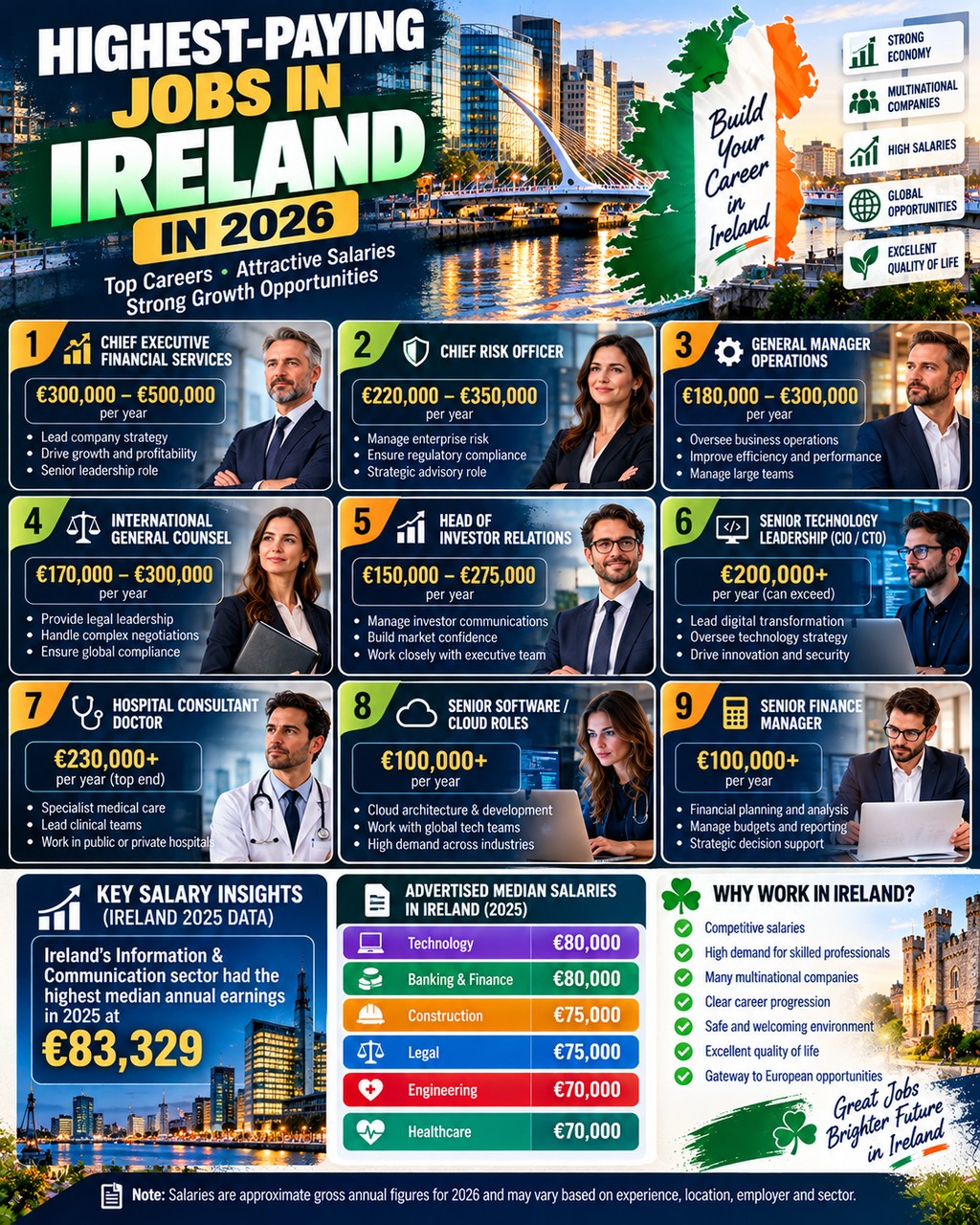
The latest Central Statistics Office (CSO) data provides an important picture of the Irish earnings market. Median annual earnings for employments active for at least 50 weeks were €46,305 in 2025, up 3.3% from €44,816 in 2024. Median weekly earnings were €759.21. The Information & Communication sector recorded the highest median weekly earnings at €1,515.67, followed by Financial, Insurance & Real Estate at €1,086.76.
For professionals looking to build a career in Ireland, this means the highest earning potential is concentrated in sectors where specialist skills are difficult to find.
This article looks at some of the highest-paying jobs in Ireland in 2026, what these professionals do, typical salary potential, qualifications required, locations where opportunities are concentrated and whether these careers may be suitable for foreign workers.
Ireland’s Highest-Paying Job Market in 2026
Ireland’s highest-paying positions are concentrated in several major sectors:
- Technology and software
- Financial services
- Pharmaceuticals
- Life sciences
- Healthcare and medicine
- Engineering
- Data and artificial intelligence
- Legal services
- Senior management
- Professional services
- Construction and property
- Cybersecurity
Recruitment specialist Morgan McKinley describes the 2026 Irish market as increasingly focused on specialist professionals who can solve complex business problems, with employers concentrating hiring budgets on critical skills rather than broad recruitment.
Ireland’s employment-permit system also reflects this demand. The current Critical Skills Occupations List includes occupations across ICT, engineering, medicine, science, nursing, finance and other specialist areas. The current list took effect on 13 May 2026.
1. Medical Doctors and Specialists
Potential salary: €70,000–€250,000+ depending on speciality and seniority
Medicine remains one of Ireland’s strongest high-income career paths.
Doctors can work in:
- Public hospitals
- Private hospitals
- Specialist clinics
- General practice
- Medical research
- Universities
- Pharmaceutical companies
Specialist doctors and consultants can command substantially higher salaries than junior doctors.
Medical specialties that can have particularly strong earning potential include:
- Surgery
- Anaesthetics
- Radiology
- Cardiology
- Psychiatry
- Oncology
- Emergency medicine
- General practice
- Dermatology
Salary should not be interpreted as a guaranteed figure because Irish medical compensation varies significantly by grade, employer, contracts, overtime, allowances and private practice.
Medical practitioners are included on Ireland’s current Critical Skills Occupations List.
Qualifications
Typically required:
- Medical degree
- Medical Council registration
- Internship/training
- Specialist training for consultant positions
- Relevant professional experience
Foreign doctors must complete the appropriate recognition and registration process before practising medicine in Ireland.
2. Chief Executive Officers
Potential salary: €100,000–€300,000+ at larger organisations
CEOs are among the highest-paid professionals in virtually every developed economy, and Ireland is no exception.
A CEO may be responsible for:
- Corporate strategy
- Revenue growth
- Business expansion
- Financial performance
- Recruitment
- Investor relationships
- Risk management
- Corporate governance
- Major business decisions
The highest compensation packages are generally found in:
- Multinational corporations
- Financial services
- Pharmaceutical companies
- Technology companies
- Large Irish businesses
- High-growth companies
CEO compensation can include much more than basic salary, including bonuses, equity and other benefits.
Therefore, comparing a CEO’s basic salary with an ordinary employee’s salary can be misleading.
3. Chief Financial Officers
Potential salary: €100,000–€200,000+
Chief Financial Officers, or CFOs, are responsible for the financial management of organisations.
Typical responsibilities include:
- Financial strategy
- Budgeting
- Forecasting
- Corporate reporting
- Risk management
- Cash-flow management
- Tax strategy
- Investment decisions
- Investor reporting
- Financial controls
The role generally requires extensive experience rather than simply an accounting qualification.
A current Hays Ireland listing, for example, showed a Group Financial Controller position in Dublin advertised at €150,000–€165,000 plus benefits, illustrating the level of compensation available in senior finance roles.
4. Senior Software Engineers
Potential salary: €70,000–€120,000+
Software engineering remains one of Ireland’s most attractive career paths.
Ireland has a significant technology ecosystem involving:
- Software companies
- Cloud companies
- Fintech
- Cybersecurity
- Artificial intelligence
- SaaS
- Telecommunications
- E-commerce
- Multinational technology companies
Experienced software engineers can specialise in:
- Backend development
- Frontend development
- Full-stack development
- Cloud engineering
- DevOps
- Distributed systems
- Mobile development
- Machine learning
- AI engineering
Ireland’s current Critical Skills list includes programmers and software development professionals, IT project managers, IT business analysts, architects and systems designers, web development professionals and other ICT professionals.
5. AI and Machine Learning Professionals
Potential salary: €70,000–€150,000+
Artificial intelligence has created a new premium within the technology sector.
Professionals working in areas such as:
- Machine learning
- AI engineering
- Data science
- Natural-language processing
- Computer vision
- Generative AI
- MLOps
- AI research
can command strong compensation when they have specialised technical skills and commercial experience.
The highest salaries tend to go to people who combine technical knowledge with the ability to deploy AI systems at scale.
Useful skills include:
- Python
- Machine learning
- Deep learning
- Cloud platforms
- SQL
- Data engineering
- Statistics
- MLOps
- Generative AI
- Large language models
6. Cybersecurity Professionals
Potential salary: €65,000–€130,000+
Cybersecurity has become increasingly important as companies move more operations online.
Common positions include:
- Security engineer
- Cybersecurity analyst
- Security architect
- Penetration tester
- Cloud security engineer
- Security consultant
- Security manager
- Chief Information Security Officer
Senior cybersecurity professionals can earn considerably more than entry-level analysts.
Ireland’s technology-heavy economy creates demand for professionals capable of protecting financial information, customer data, cloud infrastructure and corporate systems.
7. Financial Services Professionals
Potential salary: €60,000–€150,000+
Financial services is one of Ireland’s highest-paying broad sectors.
The CSO recorded median weekly earnings of €1,086.76 in the Financial, Insurance & Real Estate sector in 2025, second only to Information & Communication among the major economic sectors.
High-paying financial positions can include:
- Investment manager
- Financial controller
- Risk manager
- Corporate finance manager
- Investment analyst
- Financial analyst
- Actuary
- Treasury manager
- Compliance director
- Finance director
- CFO
Dublin is particularly important because it is Ireland’s main financial-services centre.
8. Actuaries
Potential salary: €70,000–€150,000+
Actuaries use mathematics, statistics and financial modelling to evaluate risk.
They can work in:
- Insurance
- Banking
- Investment
- Pensions
- Consulting
- Risk management
An actuarial career can be financially attractive because qualification requires significant mathematical ability and professional examinations.
Useful skills include:
- Mathematics
- Statistics
- Probability
- Financial modelling
- Data analysis
- Risk assessment
- Programming
9. Pharmacists
Potential salary: €50,000–€90,000+
Pharmacists are another established professional career in Ireland.
They can work in:
- Community pharmacies
- Hospitals
- Pharmaceutical companies
- Manufacturing
- Research
- Regulatory affairs
Ireland’s pharmaceutical and life-sciences industries are particularly important to the country’s economy.
The current Critical Skills Occupations List includes pharmacists and industrial pharmacists.
Foreign-qualified pharmacists need to meet the relevant Irish professional-registration requirements before practising.
10. Engineering Managers
Potential salary: €80,000–€140,000+
Ireland has strong demand for engineering talent because of its pharmaceutical, medical-device, technology, manufacturing and construction industries.
Engineering management positions can include:
- Engineering manager
- Manufacturing engineering manager
- Process engineering manager
- Automation manager
- Electrical engineering manager
- Mechanical engineering manager
- Validation manager
- Quality engineering manager
Senior engineers with management responsibility can command substantially higher salaries than entry-level engineers.
11. Chemical Engineers
Potential salary: €60,000–€120,000+
Chemical engineering is particularly valuable in Ireland’s pharmaceutical and manufacturing industries.
Chemical engineers may work on:
- Production systems
- Manufacturing processes
- Pharmaceutical production
- Process optimisation
- Quality
- Automation
- Validation
- Environmental systems
The current Critical Skills list specifically includes chemical engineers and specialist production/process engineering occupations.
12. Pharmaceutical and Life-Sciences Professionals
Potential salary: €60,000–€130,000+
Ireland is a major international location for pharmaceutical and life-sciences companies.
High-paying positions include:
- Regulatory affairs manager
- Quality assurance manager
- Validation engineer
- Manufacturing manager
- Process engineer
- R&D scientist
- Clinical research professional
- Quality control manager
- Pharmaceutical scientist
- Biotechnology specialist
Hays’ 2026 Ireland salary research identified life-sciences quality assurance specialists and R&D scientists among roles experiencing notable salary increases.
13. Data Scientists
Potential salary: €60,000–€120,000+
Data scientists analyse large amounts of information to help organisations make decisions.
They can work in:
- Technology
- Banking
- Insurance
- Healthcare
- Pharmaceuticals
- Retail
- Telecommunications
- Government
- Consulting
Typical skills include:
- Python
- SQL
- Statistics
- Machine learning
- Data visualisation
- Cloud computing
- Data modelling
Data professionals with strong business understanding can be particularly valuable because they can translate technical analysis into commercial decisions.
14. IT Managers and Technology Directors
Potential salary: €90,000–€160,000+
Technology leadership can be extremely well paid.
Examples include:
- IT Director
- Technology Director
- Head of Engineering
- Head of IT
- Infrastructure Director
- Head of Cybersecurity
- Head of Data
- Head of Cloud
Ireland’s Critical Skills Occupations List includes IT specialist managers and ICT director-level occupations.
At the highest levels, compensation may also include:
- Annual bonuses
- Stock
- Long-term incentives
- Company pension
- Private healthcare
- Other executive benefits
15. Senior Construction and Project Managers
Potential salary: €70,000–€130,000+
Construction is not usually the first industry people associate with Ireland’s highest salaries, but experienced professionals can earn very strong incomes.
Potential high-paying positions include:
- Construction project manager
- Senior project manager
- Construction manager
- Site manager
- Commercial manager
- Quantity surveyor
- Construction planner
- Construction scheduler
Ireland’s Critical Skills list currently includes several construction-related professional occupations, including Site Manager and certain engineering and construction-planning roles.
In 2026, the government also added Construction Planner/Scheduler to the Critical Skills Occupations List.
16. Quantity Surveyors
Potential salary: €60,000–€110,000+
Quantity surveyors are responsible for the financial and contractual side of construction projects.
They may manage:
- Project costs
- Budgets
- Contracts
- Procurement
- Cost forecasting
- Tendering
- Payment assessments
- Commercial negotiations
Experienced quantity surveyors can move into senior commercial management positions.
Construction and property salaries have also been supported by continuing demand for skilled professionals. Hays reported salary increases across construction and property in its 2026 Irish salary research.
17. Solicitors and Senior Legal Professionals
Potential salary: €65,000–€150,000+
Legal professionals can earn strong salaries, especially at senior levels and within major commercial law firms.
Specialisations can include:
- Corporate law
- Banking law
- Finance
- M&A
- Technology law
- Intellectual property
- Employment law
- Tax
- Litigation
Large Dublin law firms generally provide the strongest opportunities for high-level commercial legal careers.
18. University Professors and Senior Academics
Potential salary: €70,000–€130,000+
Academic careers can also provide high salaries at senior levels.
University professionals can progress through roles such as:
- Lecturer
- Senior lecturer
- Associate professor
- Professor
- Department head
- Research director
A senior academic career usually requires:
- Relevant bachelor’s degree
- Master’s degree
- PhD
- Research experience
- Publications
- Teaching experience
Indeed’s current Ireland salary information identifies professors among the country’s highest-paid occupations.
19. Senior Healthcare Managers
Potential salary: €70,000–€130,000+
Healthcare does not only provide opportunities for doctors and nurses.
Other senior positions include:
- Hospital managers
- Health service managers
- Public-health managers
- Clinical managers
- Healthcare programme managers
- Health operations managers
Ireland’s current Critical Skills list includes senior health services and public-health managers and directors.
20. Specialist Scientists
Potential salary: €60,000–€120,000+
Ireland’s pharmaceutical, biotechnology, medical-device and manufacturing industries employ scientists in specialist areas.
Examples include:
- Biochemists
- Biological scientists
- Chemical scientists
- Medical scientists
- Microbiologists
- Research scientists
- Pharmaceutical scientists
The current Critical Skills list includes several specialist scientific occupations connected with manufacturing, medical devices, biotechnology and related industries.
Top 10 Highest-Paying Careers at a Glance
| Career | Potential Senior Salary |
|---|---|
| Medical Specialist/Consultant | €150,000–€250,000+ |
| CEO | €100,000–€300,000+ |
| CFO/Finance Director | €100,000–€200,000+ |
| Technology Director | €100,000–€160,000+ |
| Senior Software Engineer | €70,000–€120,000+ |
| AI/ML Specialist | €70,000–€150,000+ |
| Senior Financial Professional | €80,000–€150,000+ |
| Senior Legal Professional | €80,000–€150,000+ |
| Engineering Manager | €80,000–€140,000+ |
| Pharmaceutical/Life-Sciences Manager | €80,000–€140,000+ |
Important: These are broad indicative ranges, not guaranteed salaries. Actual compensation depends on experience, employer, location, qualifications, bonuses and seniority. The CSO’s latest data puts median annual earnings across the Irish economy at €46,305 for 2025, showing how different senior specialist salaries can be from the overall workforce.
Which Industries Pay the Most in Ireland?
The latest CSO data provides perhaps the clearest answer.
1. Information & Communication
Median weekly earnings in 2025:
€1,515.67
This was the highest among the broad economic sectors measured by the CSO.
This sector includes areas such as:
- Software
- IT
- Telecommunications
- Digital services
- Data
- Technology
2. Financial, Insurance & Real Estate
Median weekly earnings:
€1,086.76
This sector includes:
- Banking
- Insurance
- Investment
- Financial services
- Real estate
- Professional financial services
3. Professional, Scientific & Technical Activities
This broad category includes many highly skilled professions, such as:
- Engineering
- Legal services
- Consulting
- Scientific services
- Accounting
- Architecture
It can therefore contain substantial differences between entry-level and senior salaries.
Dublin Has a Major Salary Advantage
Location matters.
The latest CSO figures show median weekly earnings among employments of people usually resident in Dublin were €848.06 in 2025, compared with €759.21 nationally.
That does not mean every Dublin job pays more.
However, Dublin has a particularly large concentration of:
- Technology companies
- Banks
- Pharmaceutical companies
- Professional-services firms
- International headquarters
- Law firms
- Consulting firms
Other cities can also provide strong opportunities.
Cork
Strong in:
- Pharmaceuticals
- Life sciences
- Technology
- Manufacturing
- Engineering
Galway
Strong in:
- Medical devices
- Healthcare
- Technology
- Engineering
- Manufacturing
Limerick
Strong in:
- Technology
- Engineering
- Manufacturing
- Healthcare
- Pharmaceuticals
For people prioritising maximum salary, Dublin may provide the widest selection of high-paying corporate positions, but Cork, Galway and Limerick can offer excellent specialist opportunities.
Highest-Paying Jobs Without a University Degree
Not every high-income career requires a traditional four-year university degree.
Some careers can reach strong earnings through apprenticeships, licences, professional qualifications and experience.
Examples include:
- Experienced electrician
- Specialist plumber
- HGV driver
- Construction supervisor
- Site manager
- Skilled technician
- Industrial maintenance technician
- Certain manufacturing specialists
- Senior sales professionals
- Specialist tradespeople
However, there is an important difference between high earning potential and high starting salary.
Someone may start at a modest salary and reach a significantly higher income after several years of experience, certification and progression.
Highest-Paying Jobs for Foreign Workers
Ireland can be particularly attractive to international professionals because several highly skilled occupations are included on the Critical Skills Occupations List.
The current list includes occupations in:
- ICT
- Engineering
- Medicine
- Pharmacy
- Science
- Nursing
- Midwifery
- Certain construction professions
- Specialist business and financial occupations
However, being qualified for a high-paying job does not automatically mean that a person receives an Irish work permit.
The exact:
- Occupation
- Salary
- Qualification
- Employer
- Contract
- Employment status
- Immigration circumstances
must be considered.
Ireland’s 2026 Critical Skills Salary Thresholds
The employment-permit salary threshold is particularly important for international job seekers.
For 2026, the Department of Enterprise, Tourism and Employment lists:
- General Employment Permit: €36,605
- Critical Skills Employment Permit with relevant degree: €40,909
- Critical Skills Employment Permit without relevant degree: €68,911
- Critical Skills graduate: €36,849
There are separate thresholds for healthcare assistants, home carers and other categories.
These figures are permit thresholds, not typical salaries for the occupations listed in this article.
For example, a software engineer may earn considerably more than the minimum salary required for a Critical Skills permit.
How to Get a High-Paying Job in Ireland
If your objective is not simply to find a job but to build a high-income career, follow a long-term strategy.
1. Choose a high-value skill
Focus on areas where employers have difficulty finding qualified people.
Examples:
- Software development
- Cybersecurity
- Data
- AI
- Engineering
- Medicine
- Pharmaceuticals
- Finance
- Construction management
2. Obtain recognised qualifications
Qualifications matter particularly in regulated professions.
3. Build experience
Experience can have a major effect on earning potential.
A person with five to ten years of specialist experience will generally compete differently from someone entering the profession.
4. Target the right employers
Large multinational companies often provide strong compensation packages, but smaller specialist businesses can also pay competitively when talent is scarce.
5. Consider Dublin
If maximum earning potential is the priority, Dublin deserves consideration because of its concentration of high-paying industries.
6. Develop specialist expertise
Being “good at IT” is less valuable than being an expert in a specific area such as:
- Cloud architecture
- Cybersecurity
- AI engineering
- DevOps
- Data engineering
Specialisation can make you more valuable to employers.
How Foreign Workers Can Apply
International candidates should begin with their occupation rather than their visa.
First identify:
What job can I realistically do?
Then determine:
Is that occupation eligible for an Irish employment permit?
Then:
Does my qualification meet the Irish requirements?
And finally:
What immigration permission do I need?
This order is important because finding a job advertisement does not automatically give a foreign applicant permission to work in Ireland.
The Irish Government’s 2026 employment-permit changes continue to focus on shortages in areas such as construction, healthcare and transport, while the Critical Skills list covers many professional occupations.
Best Websites for High-Paying Jobs in Ireland
Job seekers should consider:
- JobsIreland
- EURES
- IrishJobs
- Indeed Ireland
- Direct company career pages
- Professional recruitment firms
For specialist professions, applying directly to companies can sometimes be more effective than relying exclusively on general job boards.
How to Make Your CV Stand Out
For a high-paying position, your CV should demonstrate value rather than simply list responsibilities.
Instead of:
“Managed software development team.”
Use something more specific:
“Led a 12-person engineering team delivering cloud-based applications used by 200,000+ customers.”
Where possible, include:
- Revenue impact
- Cost savings
- Team size
- Projects completed
- Certifications
- Technology used
- Productivity improvements
- Sales growth
- Compliance achievements
- Major clients
Senior employers want evidence of results.
Is Ireland a Good Country for High-Paying Jobs?
For qualified professionals, Ireland can be very attractive.
The latest CSO data shows that median annual earnings reached €46,305 in 2025, while the highest-paying sectors were Information & Communication and Financial, Insurance & Real Estate.
The country also has a significant multinational presence, particularly in:
- Technology
- Pharmaceuticals
- Medical devices
- Financial services
- Professional services
However, high salaries should always be considered alongside the cost of living.
Housing, particularly in Dublin, can significantly reduce disposable income.
Therefore, someone earning €80,000 in Dublin should not automatically assume they will have more disposable income than someone earning €65,000 in a lower-cost location.
Frequently Asked Questions
What is the highest-paying job in Ireland in 2026?
There is no single highest-paying job because compensation varies by seniority and employer. Medical specialists, CEOs, CFOs and senior technology and financial professionals can all command very high salaries.
What sector pays the most in Ireland?
According to the latest CSO earnings data, Information & Communication had the highest median weekly earnings among the broad sectors in 2025 at €1,515.67.
What is the average salary in Ireland in 2026?
The latest CSO annual earnings release reports median annual earnings of €46,305 for 2025, which is the latest full-year figure available in the October 2026 release.
What jobs pay over €100,000 in Ireland?
Senior doctors, CEOs, CFOs, technology directors, senior financial professionals, senior lawyers, experienced engineering managers and certain specialist technology professionals can reach or exceed €100,000.
What is the best high-paying career in Ireland for foreigners?
Technology, engineering, medicine, pharmaceuticals, science, finance and certain specialist construction occupations can be attractive because several relevant occupations appear on Ireland’s Critical Skills Occupations List.
Can I get an Irish work permit for a high-paying job?
Possibly. A high salary alone does not guarantee a permit. The occupation, salary, qualifications, employer and applicable employment-permit rules must all meet the relevant requirements.
Is Dublin the best city for high-paying jobs?
Dublin generally offers the widest concentration of high-paying corporate and professional jobs. CSO data also shows that median weekly earnings among people usually resident in Dublin were higher than the national median in 2025.
Can I earn a high salary in Ireland without a degree?
Yes, some careers can eventually provide strong incomes without a traditional university degree, particularly specialist trades, construction, transport and certain sales or technical careers. However, many of Ireland’s highest-paid professional occupations require advanced qualifications.
Final Thoughts
Ireland’s highest-paying jobs in 2026 are concentrated around technology, finance, healthcare, pharmaceuticals, engineering, professional services and senior management.
The latest CSO figures reinforce the importance of technology and finance: Information & Communication had median weekly earnings of €1,515.67, while Financial, Insurance & Real Estate recorded €1,086.76 in 2025.
For someone planning a career in Ireland, the biggest lesson is simple:
Do not chase salary alone. Chase valuable skills.
A person who develops expertise in software engineering, AI, cybersecurity, engineering, medicine, pharmaceuticals, finance or another shortage occupation can potentially build a much stronger long-term career than someone simply looking for the highest advertised salary.
For international applicants, there is another important consideration: choose a career that is both well paid and compatible with Ireland’s employment-permit system.
Ireland’s current Critical Skills framework provides opportunities across many professional fields, but eligibility depends on the exact occupation and circumstances.
The strongest strategy for 2026 is therefore to combine three things:
High-demand skill + recognised qualification + relevant experience.
That combination can significantly improve your chances of finding a well-paid career in Ireland.
Leave a Reply