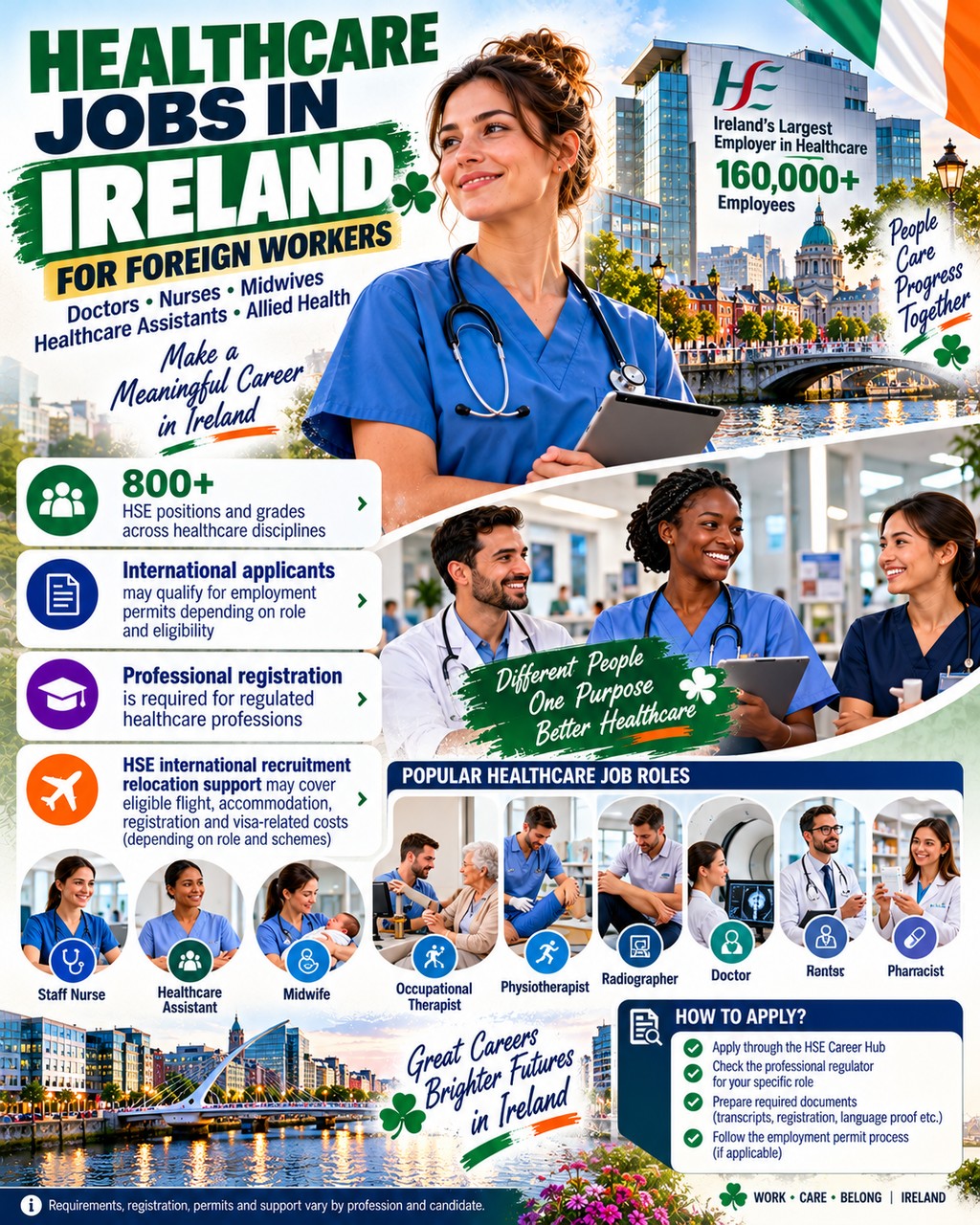
Ireland continues to offer significant opportunities for qualified healthcare professionals from overseas. The country’s health service employs professionals across hospitals, community services, nursing homes, mental-health services, disability services, primary care and other healthcare settings.
For foreign workers, Ireland is particularly attractive because several healthcare occupations are included on the country’s Critical Skills Occupations List, creating potential employment-permit pathways for qualified professionals.
However, getting a healthcare job in Ireland is not simply a matter of finding a vacancy and applying. Depending on the profession, an overseas applicant may first need professional registration, qualification recognition, English-language evidence, an employment permit and an Irish entry visa.
The good news is that Ireland has an established international-recruitment system. The HSE’s international recruitment service says it has more than 800 different positions and grade levels across healthcare disciplines, ranging from medical consultants to nurses, midwives and health and social care professionals.
This guide explains the best healthcare jobs for foreign workers in Ireland in 2026, which professions are in demand, registration requirements, salary and employment-permit rules, and how applicants from countries such as Pakistan, India, the Philippines and other non-EEA countries can approach the Irish job market.
Why Ireland Needs Foreign Healthcare Workers
Ireland’s healthcare system requires professionals across a wide range of disciplines.
The HSE currently recruits internationally for positions including:
- Doctors
- Nurses
- Midwives
- Health and Social Care Professionals
- Allied health professionals
- Healthcare assistants
- Medical scientists
- Physiotherapists
- Occupational therapists
- Radiographers
- Other specialist healthcare professionals
The HSE’s international recruitment service specifically encourages overseas applicants to register for job alerts and apply for suitable vacancies.
The demand is not restricted to Dublin.
Healthcare employment opportunities exist throughout Ireland, including:
- Dublin
- Cork
- Galway
- Limerick
- Waterford
- Kilkenny
- Mayo
- Sligo
- Donegal
- Kerry
- Tipperary
- Other regional locations
This can be particularly useful for foreign workers who are willing to consider locations outside Dublin.
Best Healthcare Jobs in Ireland for Foreign Workers
Not every healthcare occupation has the same immigration pathway.
Some professions are especially attractive because they appear on Ireland’s current Critical Skills Occupations List.
Here are some of the major opportunities.
1. Registered Nurses
Registered nursing is one of the most important healthcare careers for international applicants.
Nurses can work in:
- Public hospitals
- Private hospitals
- Nursing homes
- Community healthcare
- Mental-health services
- Disability services
- Older-person care
- Specialist clinical services
- Intensive care
- Emergency departments
- Operating theatres
Ireland’s current Critical Skills Occupations List includes Registered Nurses and Registered Midwives.
This makes nursing one of the more established professional routes for qualified foreign healthcare workers.
However, there is an important requirement:
You cannot simply arrive in Ireland and start working as a nurse using your overseas nursing qualification.
Nurses and midwives must be registered with the Nursing and Midwifery Board of Ireland (NMBI) before practising in Ireland. The HSE also states that healthcare professionals must be registered with their relevant professional regulatory body before working in the Irish health service.
2. Midwives
Qualified midwives can also find opportunities within Ireland’s healthcare system.
Midwives can work in:
- Maternity hospitals
- General hospitals
- Community maternity services
- Specialist maternity services
- Women’s health services
Registered midwives are included on Ireland’s current Critical Skills Occupations List.
Overseas-trained midwives must complete the appropriate NMBI qualification-recognition and registration processes.
3. Doctors and Medical Specialists
Ireland also recruits internationally trained doctors.
Potential positions include:
- General medical doctors
- Emergency physicians
- Surgeons
- Anaesthetists
- Psychiatrists
- Radiologists
- Paediatricians
- Cardiologists
- General practitioners
- Other specialist doctors
Medical practitioners and several specialist medical occupations are represented within Ireland’s Critical Skills framework.
However, doctors face professional-registration requirements that can be considerably more complex than simply submitting a CV.
Foreign-trained doctors should investigate:
- Medical Council of Ireland registration
- Recognition of qualifications
- Internship requirements
- Specialist registration
- English-language requirements
- Relevant examinations
- Employer requirements
A job offer does not replace professional registration.
4. Healthcare Assistants
Healthcare assistant positions are another major employment category.
Healthcare assistants can work in:
- Nursing homes
- Residential care
- Hospitals
- Community care
- Home support
- Disability services
- Older-person services
Current HSE vacancies demonstrate continuing recruitment in this area. For example, the HSE advertised a Healthcare Assistant – Home Support Galway campaign in September 2026, while another current HSE campaign was recruiting healthcare assistants in Kilkenny.
Healthcare assistants are particularly interesting for international workers because Ireland has a specific minimum annual remuneration threshold for this category.
For 2026, the minimum annual remuneration for healthcare assistants, home carers and care workers is €32,691.
However, applicants must still meet the relevant employment-permit and immigration requirements.
5. Physiotherapists
Physiotherapists can work across:
- Hospitals
- Rehabilitation centres
- Community healthcare
- Private clinics
- Sports medicine
- Older-person services
- Neurological rehabilitation
- Musculoskeletal services
Physiotherapists are included in the current Critical Skills Occupations List.
For overseas applicants, professional registration and qualification recognition are key steps.
6. Occupational Therapists
Occupational therapists are another healthcare profession with opportunities in Ireland.
They can work with:
- Children
- Older people
- People with disabilities
- Mental-health patients
- Rehabilitation patients
- Community healthcare users
The current Critical Skills list includes occupational therapists.
Current HSE recruitment also demonstrates demand for the profession. A recent HSE vacancy included a Senior Occupational Therapist position associated with Galway, Roscommon and Mayo services.
7. Speech and Language Therapists
Speech and language therapists work with patients experiencing:
- Speech difficulties
- Language difficulties
- Communication disorders
- Swallowing problems
- Developmental conditions
- Neurological conditions
Speech and language therapists are currently included in Ireland’s Critical Skills Occupations List.
This makes the profession particularly interesting for qualified overseas candidates who can meet Irish registration and employment requirements.
8. Radiographers
Radiographers can work in:
- Hospitals
- Diagnostic imaging
- X-ray services
- CT
- MRI
- Specialist imaging departments
Radiographers are included on the current Critical Skills Occupations List.
Applicants trained outside Ireland should check the Irish registration requirements applicable to their profession before accepting employment.
9. Radiation Therapists
Radiation therapists work primarily in cancer-care settings and are involved in delivering radiation treatment.
This is a specialist healthcare occupation requiring appropriate professional education and registration.
Radiation therapists are also listed among Ireland’s current Critical Skills occupations.
10. Medical Scientists
Medical scientists can work in areas such as:
- Clinical laboratories
- Pathology
- Microbiology
- Haematology
- Biochemistry
- Blood services
- Molecular diagnostics
The Critical Skills Occupations List includes Medical Scientists.
For overseas applicants, professional recognition and registration requirements should be checked before applying.
11. Cardiac Physiologists
Cardiac physiologists are specialist healthcare professionals working with cardiac diagnostic and monitoring procedures.
The current Critical Skills list includes:
- Cardiac physiologists
- Vascular technologists/physiologists
- Gastrointestinal technologists/physiologists
- Respiratory physiologists
These specialist roles can be attractive to overseas healthcare professionals with the correct qualifications and experience.
12. Dietitians
Dietitians work with patients on nutrition and dietary management.
They can be involved in:
- Clinical nutrition
- Diabetes management
- Obesity management
- Gastrointestinal conditions
- Hospital nutrition
- Community healthcare
- Specialist medical conditions
Dietitians are included in the current Critical Skills Occupations List.
13. Audiologists
Audiologists assess and manage hearing and related communication problems.
They may work in:
- Hospitals
- Community healthcare
- Specialist clinics
- Rehabilitation services
Audiologists are currently listed under Ireland’s Critical Skills healthcare occupations.
14. Podiatrists
Podiatrists specialise in foot and lower-limb health.
Potential employment settings include:
- Hospitals
- Community healthcare
- Specialist clinics
- Rehabilitation services
- Private healthcare
Podiatry/chiropody is represented on Ireland’s current Critical Skills list.
Healthcare Jobs in Ireland: Quick Comparison
| Healthcare profession | Foreign-worker potential | Professional registration |
|---|---|---|
| Registered Nurse | Very strong | NMBI |
| Midwife | Very strong | NMBI |
| Doctor | Strong | Medical Council |
| Physiotherapist | Strong | Relevant regulator |
| Occupational Therapist | Strong | Relevant regulator |
| Speech & Language Therapist | Strong | Relevant regulator |
| Radiographer | Strong | Relevant regulator |
| Medical Scientist | Strong | Relevant regulator |
| Pharmacist | Strong | PSI |
| Healthcare Assistant | Good | Role-dependent |
| Home Carer | Good | Role-dependent |
| Dietitian | Strong | Relevant regulator |
| Audiologist | Strong | Relevant regulator |
| Podiatrist | Strong | Relevant regulator |
The exact immigration route depends on the occupation, salary, qualifications, employer and current employment-permit rules.
Professional Registration Is Extremely Important
One of the biggest mistakes overseas healthcare applicants make is treating professional registration as an optional step.
It is not.
The HSE states that doctors, nurses, midwives and health and social care professionals need registration with their respective professional bodies before practising in the Irish health service.
This means your journey may look like:
Overseas qualification → Qualification recognition → Professional registration → Job application → Employment permit → Visa/immigration permission → Ireland
The exact order can vary depending on the profession.
How Overseas Nurses Can Register in Ireland
Nurses are one of the largest groups of internationally recruited healthcare professionals.
The NMBI process involves two major stages:
Stage 1 — Qualification Recognition
NMBI assesses whether your overseas nursing qualification meets the relevant Irish standards.
Stage 2 — Registration
Once qualification recognition is completed, the applicant proceeds with registration.
NMBI specifically explains that overseas applicants must complete qualification recognition before proceeding to registration.
Applicants should use their own MyNMBI credentials and upload their own documentation.
NMBI warns applicants not to give their MyNMBI credentials to recruitment agencies or other third parties.
This is extremely important for international applicants.
English Requirements for Overseas Nurses
English-language competence is an important part of the NMBI registration process for overseas-trained nurses and midwives.
NMBI requires applicants to demonstrate competence across:
- Speaking
- Reading
- Listening
- Writing
The evidence is submitted as part of the registration process, with the exact requirements depending on the applicable pathway.
Applicants should always check the current NMBI requirements before booking an English examination because requirements and accepted pathways can change.
What If an Overseas Nurse Needs Clinical Adaptation?
Some overseas nurses may be required to complete a clinical adaptation or assessment process.
The Department of Enterprise, Tourism and Employment explains that non-EEA nurses accepted for clinical adaptation placements are handled under the Atypical Working Scheme, rather than simply applying for an employment permit for the adaptation placement.
The relevant permission can cover a limited period for completing the adaptation process, NMBI registration and subsequent employment-permit steps.
Applicants should therefore understand exactly which stage they are at before travelling to Ireland.
Employment Permits for Foreign Healthcare Workers
If you are from outside the EEA, UK or Switzerland, you generally need an employment permit unless you fall under an exemption.
The Irish Department of Enterprise, Tourism and Employment states that non-EEA nationals generally must hold a valid employment permit to work in Ireland.
The HSE similarly explains that many healthcare jobs are in demand and that non-EEA applicants may qualify for a Critical Skills Employment Permit.
This is one reason Ireland is attractive to qualified foreign healthcare professionals.
Critical Skills Employment Permit
The Critical Skills Employment Permit is designed to attract highly skilled workers into occupations where Ireland has significant shortages.
Healthcare is strongly represented on the current Critical Skills Occupations List.
The current list, effective from 13 May 2026, includes professions such as:
- Registered nurses
- Registered midwives
- Physiotherapists
- Occupational therapists
- Speech and language therapists
- Radiographers
- Radiation therapists
- Medical scientists
- Dietitians
- Audiologists
- Podiatrists
- Various specialist healthcare professionals
2026 Salary Thresholds for Healthcare Workers
Salary is an important part of the employment-permit system.
The 2026 minimum annual remuneration thresholds include:
- Healthcare assistants, home carers and care workers: €32,691
- Critical Skills Employment Permit with relevant degree: €40,909
- Critical Skills Employment Permit without relevant degree: €68,911
- General Employment Permit: €36,605
These are minimum permit thresholds, not statements that every healthcare professional earns those amounts.
A registered nurse, doctor, physiotherapist or specialist healthcare professional may earn substantially more depending on grade, experience, employer and contract.
Public-sector healthcare roles may also be governed by applicable public-sector pay agreements.
HSE Jobs for Foreign Workers
The Health Service Executive is one of the most important employers for overseas healthcare professionals.
The HSE’s international recruitment service says it has more than 800 positions and grade levels across different disciplines.
Its recruitment platform includes vacancies across:
- Nursing
- Medicine
- Patient and client care
- Health and social care
- Administration
- Management
- Support services
Current HSE listings show that recruitment is occurring across multiple counties and healthcare categories.
For example, recent vacancies included:
- Healthcare Assistant — Galway
- Clinical Nurse Manager — Galway/Roscommon/Mayo
- Senior Occupational Therapist — Galway/Roscommon/Mayo
- Chief Clinical Perfusionist — Galway
- Healthcare Assistant — Kilkenny
This demonstrates that international applicants should look beyond Dublin when searching for opportunities.
HSE International Recruitment Support
The HSE has a dedicated international recruitment pathway.
International candidates can register with the HSE Career Hub to receive weekly job alerts based on their selected profession and geographical preferences.
This is useful because healthcare vacancies can open and close quickly.
Rather than checking websites randomly every few weeks, applicants can receive relevant vacancy notifications.
Relocation Support for Overseas HSE Employees
The HSE also provides a relocation package for eligible people moving to Ireland for relevant roles.
According to current HSE guidance, candidates outside Ireland can apply for the international recruitment relocation package when moving into a permanent or temporary role lasting at least two years.
The package can provide allowances for flights and accommodation, with the current maximum listed as:
- Up to €4,160 for candidates based in the EU or UK
- Up to €4,710 for candidates based outside the EU
The HSE states that the allowance is available for up to three months and requires appropriate receipts.
This can significantly reduce the initial financial burden for an overseas healthcare professional moving to Ireland.
What About Healthcare Assistants?
Healthcare assistant jobs can be an attractive option for people who do not have a professional nursing or medical qualification.
Typical duties can include:
- Supporting patients with daily activities
- Personal care
- Mobility assistance
- Monitoring patients
- Supporting nurses and healthcare professionals
- Maintaining patient comfort
- Communicating with families and healthcare teams
- Following care plans
However, applicants should carefully distinguish between:
Healthcare assistant
and
Registered nurse
They are completely different professional roles with different qualification and registration requirements.
A healthcare assistant should not present themselves as a nurse without the required Irish registration.
Healthcare Assistant Salary and Permit Route
For 2026, Ireland’s minimum annual remuneration threshold for healthcare assistants, home carers and care workers is €32,691.
This category can therefore be relevant to foreign workers, but applicants still need to satisfy the applicable employment-permit conditions.
They should also verify:
- Employer eligibility
- Job title
- Salary
- Working hours
- Contract duration
- Employment-permit eligibility
- Immigration requirements
Do not rely solely on a recruitment agent’s statement that “healthcare jobs are sponsored.”
Jobs in Nursing Homes
Ireland has a large care sector involving:
- Nursing homes
- Residential care
- Older-person care
- Disability services
- Community care
- Home support
Potential positions include:
- Healthcare assistant
- Nurse
- Care worker
- Home support worker
- Senior care worker
- Clinical nurse manager
Foreign workers should verify whether a specific position is eligible for an employment permit before accepting an offer.
Healthcare Jobs Outside Dublin
Foreign applicants often assume Dublin is the only place where they should search.
That can be a mistake.
Healthcare jobs exist throughout Ireland.
Galway
Strong opportunities in:
- Hospitals
- Nursing
- Mental health
- Medical devices
- Community healthcare
- Allied health
Current HSE listings have included healthcare assistants, clinical nurse management and specialist clinical roles in Galway and surrounding counties.
Cork
Important healthcare and life-sciences centre with opportunities in:
- Hospitals
- Nursing
- Pharmaceuticals
- Medical devices
- Research
Limerick
Opportunities include:
- Hospital healthcare
- Nursing
- Allied health
- Community services
- Medical technology
Dublin
The largest concentration of:
- Hospitals
- Private healthcare
- Corporate healthcare
- Specialist medical services
- Research
- Pharmaceutical companies
Mayo and Roscommon
Regional healthcare services also recruit nurses, allied health professionals and support workers.
The HSE’s recruitment system allows candidates to search by geographic preference.
Can Pakistani Healthcare Workers Get Jobs in Ireland?
Yes, Pakistani healthcare professionals can potentially work in Ireland, but the process depends heavily on their profession.
For example, a Pakistani:
- Nurse
- Doctor
- Physiotherapist
- Occupational therapist
- Medical scientist
- Healthcare assistant
may have different registration and employment-permit requirements.
For a Pakistani nurse, the process could broadly involve:
Nursing qualification → NMBI qualification recognition → English requirements → NMBI registration → Irish job → employment permit → visa → relocation
The precise route depends on the individual’s circumstances.
Pakistani applicants should be particularly careful with recruitment agencies because overseas healthcare recruitment attracts scams.
How to Apply for Healthcare Jobs in Ireland from Abroad
A practical strategy is:
Step 1: Identify your profession
Determine exactly what Irish occupation matches your current qualification.
For example:
BSN Nurse → Registered Nurse
rather than simply searching for “healthcare jobs.”
Step 2: Check professional registration
Find the Irish regulatory body for your profession.
Step 3: Begin qualification recognition
If your qualification was obtained outside Ireland, determine whether it must be formally assessed.
Step 4: Complete English requirements
Where required, complete the relevant English-language test.
Step 5: Search for vacancies
Use:
- HSE Career Hub
- JobsIreland
- EURES
- Hospital career pages
- Private healthcare employers
- Reputable recruitment companies
Step 6: Prepare your CV
Highlight:
- Qualification
- Registration
- Clinical experience
- Specialisation
- Years of experience
- Certifications
- English proficiency
- Relevant training
Step 7: Apply
Apply directly where possible.
Step 8: Verify employment-permit eligibility
Before paying an agent or making major relocation decisions, verify the official permit route.
Step 9: Obtain the appropriate immigration permission
If you are a non-EEA citizen, this may include an employment permit and an entry visa, depending on your nationality and circumstances.
How to Write a Healthcare CV for Ireland
Your CV should be easy for an Irish recruiter to understand.
For a nurse, for example:
Professional Summary
Registered Nurse with 6+ years of acute-care experience, specialising in medical-surgical nursing, patient assessment, medication administration, care planning and multidisciplinary teamwork. Experienced in high-volume hospital environments and committed to evidence-based patient care.
Key Skills
- Patient assessment
- Medication administration
- Care planning
- Infection prevention
- Clinical documentation
- Emergency response
- Patient education
- Multidisciplinary teamwork
- Electronic health records
- Infection control
Professional Experience
Include:
- Employer
- Country
- Hospital/department
- Job title
- Dates
- Responsibilities
- Major achievements
Qualifications
Clearly state:
- Degree
- University
- Graduation year
- Professional registration
- Relevant certifications
Do Not Pay for a “Guaranteed Irish Healthcare Job”
This deserves special attention.
Foreign healthcare workers are frequently targeted by fraudulent recruiters.
Be extremely cautious if someone says:
- “Pay €5,000 and we guarantee an Irish nursing job.”
- “We guarantee NMBI registration.”
- “We can get you a visa without registration.”
- “You don’t need IELTS.”
- “We can guarantee an HSE job.”
- “Send us your MyNMBI login.”
- “Pay us and we will upload your documents.”
NMBI explicitly warns overseas applicants not to share their MyNMBI credentials with third parties and says applicants should upload their own documentation.
NMBI also advises applicants not to leave their current employment or move to Ireland simply because they expect their registration application to succeed.
This is excellent advice for anyone applying from abroad.
Employment Permit Processing Times
Applicants should also account for processing time.
As of 6 October 2026, Ireland’s Department of Enterprise reported that it was processing:
- Critical Skills Employment Permit applications received on 29 September 2026
- New General Employment Permit applications received on 28 August 2026
The Department also states that employment-permit applications should generally be received at least 12 weeks before the proposed employment start date.
Processing dates change continuously, so applicants should check the official processing-date page rather than relying on old information from social media or recruitment agents.
Healthcare Jobs in Ireland Without a Degree
The healthcare sector contains opportunities that do not require a university degree.
Examples may include:
- Healthcare assistant
- Care worker
- Home support worker
- Certain support roles
- Administrative healthcare positions
- Facilities/support roles
However, regulated professional occupations such as:
- Nurse
- Doctor
- Physiotherapist
- Occupational therapist
- Pharmacist
require the appropriate qualifications and professional registration.
If your objective is immigration rather than simply employment, you should also check whether the specific non-degree occupation qualifies for an employment permit.
Best Healthcare Careers for Foreign Workers
If we consider a combination of demand, professional status and immigration potential, several careers stand out.
Strong options
1. Registered Nurse
Excellent international recruitment infrastructure and Critical Skills status.
2. Doctor/Specialist
Very strong professional demand but more complex registration.
3. Midwife
Critical Skills occupation with professional registration requirements.
4. Physiotherapist
Critical Skills occupation with opportunities across the health service.
5. Occupational Therapist
Strong demand and Critical Skills status.
6. Speech & Language Therapist
Specialist healthcare role included on the Critical Skills list.
7. Radiographer
Specialist occupation with Critical Skills eligibility.
8. Medical Scientist
Strong fit with Ireland’s healthcare and life-sciences ecosystem.
9. Healthcare Assistant
Lower qualification barrier than regulated professional roles, with a specific 2026 remuneration threshold.
Ireland vs Other Countries for Foreign Healthcare Workers
Ireland competes internationally for healthcare professionals.
Its advantages include:
- English-speaking environment
- Established international recruitment programmes
- Critical Skills employment-permit routes
- Large public health service
- International healthcare workforce
- Relocation support for eligible HSE recruits
- Career opportunities across multiple regions
The HSE states that many healthcare positions are in demand and that non-EEA healthcare applicants may qualify for skills-based employment permits.
However, Ireland also has challenges:
- Housing costs
- Cost of living
- Professional registration requirements
- Competition for some positions
- Immigration paperwork
- Qualification-recognition processes
Therefore, applicants should calculate the full cost and timeline before relocating.
Frequently Asked Questions
Can foreigners get healthcare jobs in Ireland?
Yes. Ireland actively recruits internationally for healthcare positions. The HSE has a dedicated international recruitment programme and advertises opportunities across more than 800 positions and grade levels.
Which healthcare jobs are best for foreigners?
Registered nurses, doctors, midwives, physiotherapists, occupational therapists, speech and language therapists, radiographers, medical scientists and other specialist healthcare professionals can be particularly attractive because several are included on Ireland’s Critical Skills Occupations List.
Can Pakistani nurses work in Ireland?
Yes, potentially. Pakistani nurses must meet the relevant NMBI qualification-recognition and registration requirements and then satisfy the applicable employment and immigration requirements.
Is IELTS required for nurses in Ireland?
Overseas-trained nurses and midwives must demonstrate the required English-language competence for NMBI registration through an accepted route. The exact evidence requirements should be checked directly with NMBI before applying.
How much does a healthcare assistant need to earn for a work permit?
For 2026, the minimum annual remuneration threshold for healthcare assistants, home carers and care workers is €32,691.
Do nurses need registration in Ireland?
Yes. Nurses and midwives must be registered with NMBI to practise in Ireland.
Can I apply for an HSE job from outside Ireland?
Yes. The HSE has a dedicated international recruitment service and provides information for overseas candidates.
Does the HSE help with relocation?
Eligible international recruits can receive relocation assistance. Current HSE guidance lists allowances of up to €4,710 for candidates moving from outside the EU, subject to the relevant conditions and receipts.
Do I need a work permit?
If you are a non-EEA national and do not have an exemption, you generally need a valid Irish employment permit to work.
Can I move to Ireland before my nursing registration is approved?
NMBI advises overseas applicants not to move to Ireland or leave their existing employment based merely on the expectation that registration will be successful.
Final Thoughts
Ireland remains a promising destination for foreign healthcare workers in 2026, particularly for professionals whose occupations appear on the Critical Skills Occupations List.
The strongest opportunities include registered nursing, medicine, midwifery, physiotherapy, occupational therapy, speech and language therapy, radiography, medical science and other specialist healthcare professions.
Healthcare assistants and care workers also represent an important employment category, with a specific 2026 minimum remuneration threshold of €32,691.
For foreign applicants, however, the most important lesson is:
Do not start with the visa. Start with your profession.
First determine whether your qualification is recognised in Ireland. Then complete the relevant professional-registration process. After that, find an eligible employer and determine the correct employment-permit route.
For nurses and midwives, NMBI registration is central to the process. For other healthcare professions, the relevant professional regulator must be identified.
The HSE’s international recruitment programme provides an important advantage because overseas candidates can search vacancies, receive job alerts and access information about relocation and recruitment.
For someone applying from Pakistan, India, the Philippines or another non-EEA country, the safest approach is to use official Irish government, HSE and professional-regulator information, verify every job offer independently and never give an agency control of your professional-registration account.
A genuine healthcare career in Ireland can offer strong long-term opportunities—but the successful route is based on recognised qualifications, professional registration, a legitimate job offer and the correct immigration permission, not on paying an agent for a promised “guaranteed visa.”
Leave a Reply