Category: Ireland

Ireland

  • Construction Jobs in Ireland: Salary & Requirements in 2026

    Construction Jobs in Ireland: Salary & Requirements in 2026

    Ireland’s construction industry remains one of the country’s important sources of employment in 2026, supported by continued investment in housing, infrastructure, commercial development, utilities and major capital projects.

    For job seekers, the sector offers opportunities ranging from entry-level labouring and skilled trades to engineering, quantity surveying, site management and construction project management.

    It is also an important sector for foreign workers. Several construction-related professional occupations are included on Ireland’s current Critical Skills Occupations List, including Site Manager, Construction Project Manager, Construction Planner/Scheduler and Commercial Manager.

    Current JobsIreland listings demonstrate the breadth of the market. Recent vacancies have included civil engineers, quantity surveyors, MEICA project managers, electrical engineers, commissioning engineers, plant fitters, construction-materials technicians, electricians and skilled construction workers.

    This guide explains the main construction jobs available in Ireland in 2026, expected salary levels, qualifications and experience employers look for, opportunities for foreign workers, employment-permit requirements and how to find legitimate construction jobs.


    Why Construction Jobs Are in Demand in Ireland

    Ireland continues to require substantial construction activity across several areas:

    • Residential housing
    • Apartment developments
    • Commercial buildings
    • Roads
    • Bridges
    • Water infrastructure
    • Renewable-energy projects
    • Data centres
    • Industrial facilities
    • Pharmaceutical facilities
    • Hospitals
    • Schools
    • Public infrastructure
    • Utilities
    • Manufacturing facilities

    Recruitment specialist Collins McNicholas reports that ongoing investment in residential development, infrastructure and capital projects continues to support demand for experienced construction professionals in Ireland. Its 2026 salary research is based on data from more than 6,000 candidates and over 400 successful placements made between January and March 2026.

    This creates opportunities at multiple levels.

    Someone without extensive professional qualifications may find work as a labourer or construction operative, while someone with an engineering degree and several years of experience can target civil engineering, project management or site-management positions.


    Types of Construction Jobs in Ireland

    The Irish construction industry is much larger than builders and general labourers.

    Some of the major categories include:

    • Construction labourers
    • General operatives
    • Carpenters
    • Bricklayers
    • Plasterers
    • Plumbers
    • Electricians
    • Steel fixers
    • Groundworkers
    • Plant operators
    • HGV drivers
    • Plant fitters
    • Site supervisors
    • Site managers
    • Construction managers
    • Civil engineers
    • Structural engineers
    • Mechanical engineers
    • Electrical engineers
    • Quantity surveyors
    • Commercial managers
    • Construction planners
    • Construction schedulers
    • BIM professionals
    • Project managers
    • Health and safety professionals
    • Building-services professionals

    The best occupation for you depends on your qualifications, experience, professional certification and right to work in Ireland.


    1. Construction Labourer

    Construction labouring is one of the more accessible ways to enter the sector.

    Typical responsibilities can include:

    • Moving materials
    • Preparing work areas
    • Cleaning construction sites
    • Assisting tradespeople
    • Loading and unloading materials
    • Basic site preparation
    • Following health and safety procedures
    • Supporting construction teams

    A labourer normally does not need a university degree.

    However, employers will expect:

    • Physical fitness
    • Reliability
    • Safety awareness
    • Ability to follow instructions
    • Ability to work outdoors
    • Basic communication skills

    For someone already legally entitled to work in Ireland, construction labouring can provide an entry point into the industry.

    For someone outside the EEA seeking an employment permit, however, the immigration situation is much more restrictive. You should never assume that an entry-level construction job automatically qualifies for sponsorship.


    2. General Construction Operative

    General construction operatives can work across different areas of a project.

    Duties may include:

    • Site preparation
    • Groundwork
    • Material handling
    • Concrete work
    • Assisting trades
    • Basic construction tasks
    • Site maintenance

    Experience can eventually lead to more specialised construction positions.

    A worker might progress from:

    General operative → skilled operative → trade specialist → supervisor → site manager

    This makes construction attractive for people who want to develop a career rather than simply find temporary work.


    3. Carpenter

    Carpenters are needed for:

    • Structural timber work
    • Doors
    • Frames
    • Roof structures
    • Interior fit-outs
    • Formwork
    • Renovation projects
    • Commercial construction

    Experienced carpenters can command significantly more than entry-level labourers, especially when they have specialist skills and can work independently.

    Useful qualifications include recognised trade training and apprenticeships.


    4. Electrician

    Electricians are required in both traditional construction and large industrial projects.

    They may work on:

    • Residential buildings
    • Commercial properties
    • Industrial facilities
    • Manufacturing plants
    • Data centres
    • Renewable-energy projects
    • Building-services installations

    Recent JobsIreland construction listings included industrial electrician positions in Kildare and Kilkenny.

    Industrial electrical experience can be particularly valuable because large manufacturing and infrastructure projects require specialised electrical skills.


    5. Plumber

    Construction plumbers work on:

    • Water systems
    • Heating systems
    • Drainage
    • Sanitary systems
    • Commercial plumbing
    • Industrial systems
    • Building services

    Experienced plumbers may work for construction contractors, mechanical contractors, facilities companies or specialist subcontractors.

    International plumbers should investigate whether their qualifications and experience are recognised for the specific job they are targeting.


    6. Bricklayer

    Bricklayers remain important for residential and commercial construction.

    Typical work includes:

    • Brick walls
    • Blockwork
    • Structural masonry
    • Extensions
    • Housing developments
    • Commercial buildings

    A recognised trade qualification and demonstrable experience can improve employment prospects.


    7. Groundworker

    Groundworkers are involved in the early stages of construction.

    Typical responsibilities include:

    • Excavation
    • Drainage
    • Foundations
    • Concrete preparation
    • Pipe installation
    • Road preparation
    • Site preparation
    • Kerbing

    Current JobsIreland construction listings have included pipe layers and groundworkers in civil-engineering projects.

    Groundworkers with experience operating machinery or working on major civil projects can become particularly valuable.


    8. Plant Operator

    Construction projects use heavy machinery for excavation, lifting and material handling.

    Potential roles include:

    • Excavator operator
    • Telehandler operator
    • Crane operator
    • Forklift operator
    • Dumper operator
    • Roller operator
    • Plant operator

    Employers generally expect appropriate training, certification and experience for the equipment being operated.

    Safety is extremely important because heavy machinery creates significant workplace risks.


    9. Construction Plant Fitter

    Plant fitters maintain and repair construction machinery.

    Responsibilities may include:

    • Diagnosing mechanical faults
    • Servicing machinery
    • Repairing hydraulic systems
    • Maintaining engines
    • Electrical troubleshooting
    • Preventive maintenance
    • Emergency repairs

    Current JobsIreland listings have included construction plant fitter positions.

    This can be a strong option for people with mechanical or heavy-equipment experience.


    10. Civil Engineer

    Civil engineering is one of the more professional routes into Ireland’s construction sector.

    Civil engineers may work on:

    • Roads
    • Bridges
    • Drainage
    • Water infrastructure
    • Buildings
    • Rail projects
    • Utilities
    • Earthworks
    • Infrastructure development

    Current JobsIreland listings include civil engineering opportunities, including a Civil Engineer internship/placement in County Galway and a Civils Design Engineer position in Loughrea, County Galway.

    A relevant engineering degree is normally required for professional civil-engineering positions.


    11. Structural Engineer

    Structural engineers design and assess structures to ensure they are safe and fit for purpose.

    They can work on:

    • Buildings
    • Bridges
    • Industrial structures
    • Residential developments
    • Commercial properties
    • Infrastructure

    Structural engineering is a specialist professional field and can offer strong salaries to experienced engineers.


    12. Mechanical Engineer

    Mechanical engineers are particularly important on:

    • Industrial projects
    • Pharmaceutical facilities
    • Manufacturing plants
    • Data centres
    • Building services
    • Energy projects
    • Mechanical installations

    Current JobsIreland construction listings include mechanical and MEICA-related roles.


    13. Electrical Engineer

    Electrical engineers work on the design, installation and commissioning of electrical systems.

    Potential projects include:

    • Industrial plants
    • Data centres
    • Pharmaceutical facilities
    • Commercial buildings
    • Renewable energy
    • Utilities
    • Manufacturing

    Recent JobsIreland listings included an Electrical Engineer position in the industrial/Leinster construction sector.


    14. Quantity Surveyor

    Quantity surveyors are responsible for the commercial and financial side of construction projects.

    Their responsibilities can include:

    • Cost estimation
    • Tendering
    • Procurement
    • Budget management
    • Contract administration
    • Valuations
    • Variations
    • Subcontractor payments
    • Cost forecasting
    • Final accounts

    Quantity surveying is an important professional career in Ireland.

    Recent JobsIreland listings have included quantity-surveyor positions and placements.

    A previous Irish vacancy for a Quantity Surveyor advertised a salary range of €36,000–€44,000 for a 39-hour week, illustrating how compensation can vary substantially according to experience and employer.


    15. Construction Planner / Scheduler

    Planning is increasingly important on large construction projects.

    Construction planners and schedulers may be responsible for:

    • Project schedules
    • Resource planning
    • Programme development
    • Progress tracking
    • Critical-path analysis
    • Contractor coordination
    • Reporting
    • Project forecasting

    This is especially important on major infrastructure and industrial projects.

    Importantly for foreign workers, Construction Project Managers / Construction Planner / Construction Scheduler are included on Ireland’s current Critical Skills Occupations List.


    16. Site Manager

    Site managers oversee day-to-day construction operations.

    Their responsibilities may include:

    • Managing workers
    • Coordinating subcontractors
    • Monitoring progress
    • Health and safety
    • Quality control
    • Materials
    • Site documentation
    • Programme management
    • Client communication
    • Ensuring work meets specifications

    Site Manager is currently included on Ireland’s Critical Skills Occupations List.

    This is particularly significant for experienced overseas construction professionals.


    17. Construction Project Manager

    Project managers have responsibility for the overall delivery of construction projects.

    They may manage:

    • Budget
    • Programme
    • Contractors
    • Consultants
    • Procurement
    • Risk
    • Quality
    • Health and safety
    • Client relationships

    Construction project management is currently included on Ireland’s Critical Skills Occupations List.

    For an experienced international construction professional, this can be one of the more attractive Irish employment-permit pathways.


    18. Commercial Manager

    Commercial managers oversee the financial and contractual aspects of large construction projects.

    Their work may include:

    • Contract management
    • Cost control
    • Commercial negotiations
    • Procurement
    • Claims
    • Variations
    • Subcontractor management
    • Financial reporting

    Commercial Manager is currently listed under the construction-related Critical Skills occupations.


    Construction Salary Expectations in Ireland

    Construction salaries vary enormously.

    The biggest factors include:

    • Profession
    • Experience
    • Location
    • Project size
    • Employer
    • Qualifications
    • Management responsibility
    • Specialist skills
    • Overtime
    • Contract type

    The 2026 Collins McNicholas construction salary guide reports continued demand for experienced quantity surveyors, project managers, site managers and engineers across Ireland.

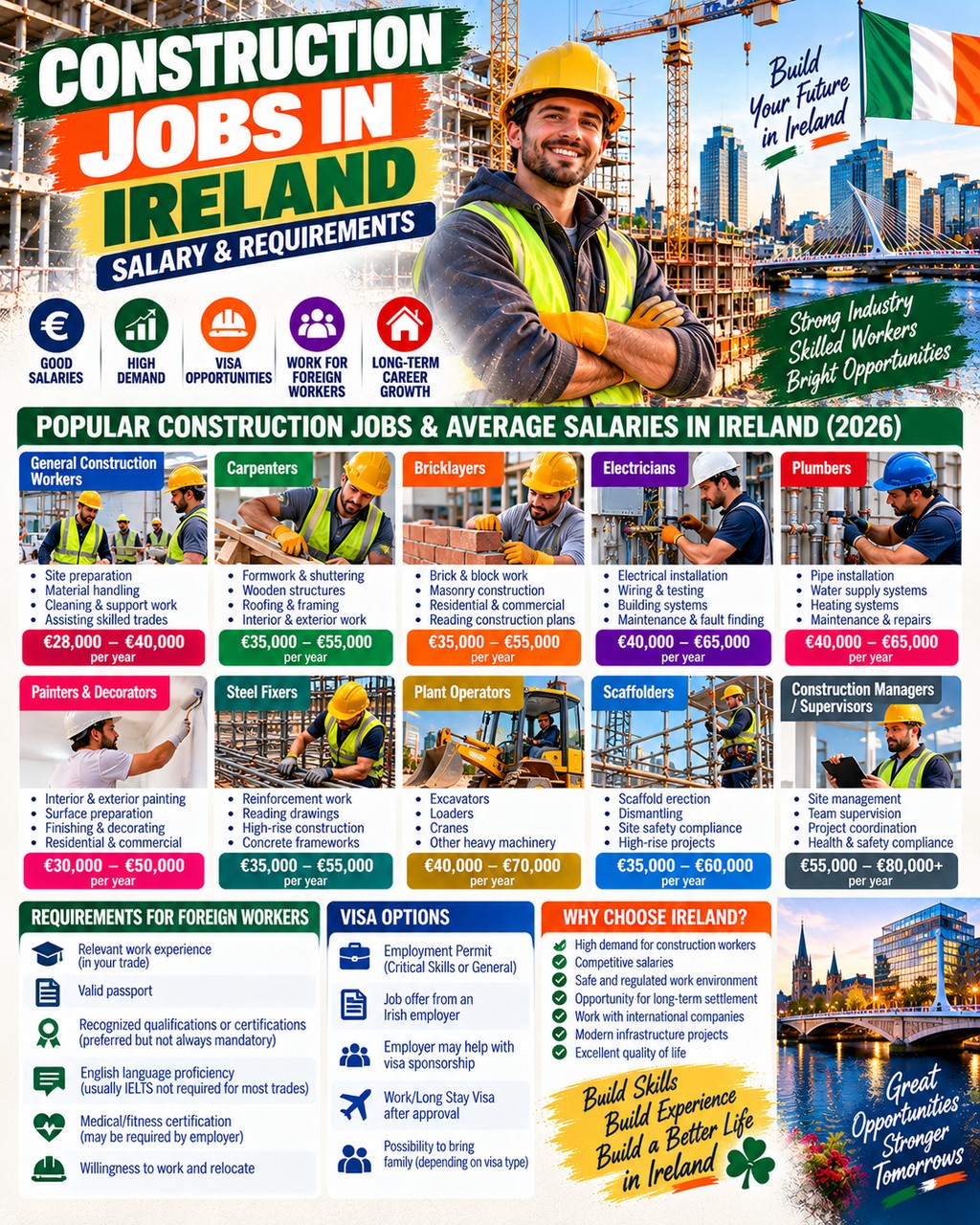
    Indicative market ranges can look approximately like this:

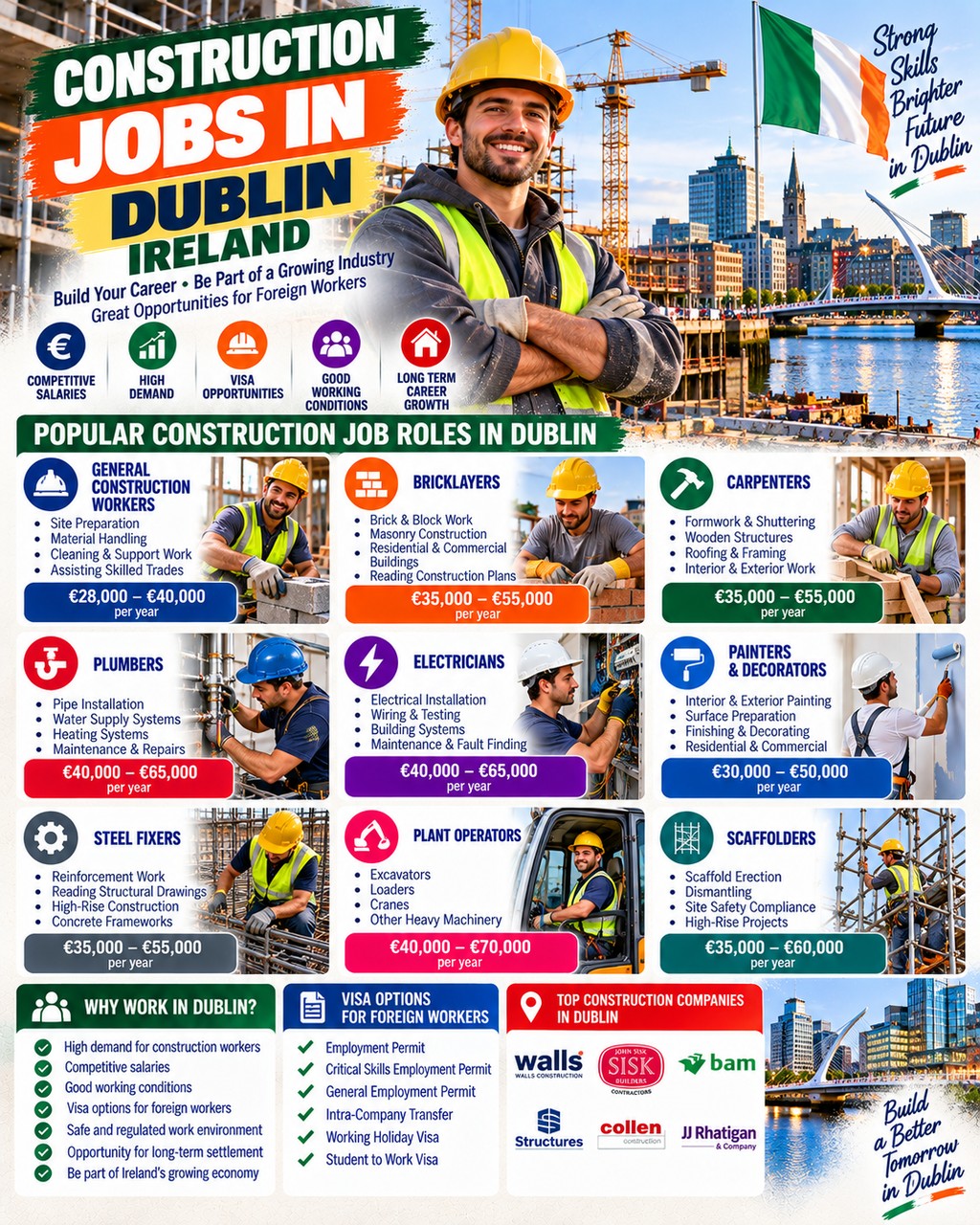
    Construction Job Indicative Annual Salary
    Construction Labourer €30,000–€40,000
    Skilled Construction Worker €35,000–€50,000+
    Carpenter €35,000–€55,000+
    Electrician €40,000–€65,000+
    Plumber €40,000–€60,000+
    Groundworker €35,000–€50,000+
    Plant Operator €35,000–€55,000+
    Civil Engineer €45,000–€75,000+
    Quantity Surveyor €45,000–€85,000+
    Site Manager €60,000–€100,000+
    Project Manager €70,000–€110,000+
    Commercial Manager €75,000–€120,000+
    Senior Construction Manager €80,000–€130,000+

    These are indicative market ranges, not guaranteed salaries. Actual offers can be lower or higher depending on experience, employer, region, project type and benefits.

    For international workers, the salary must also satisfy the relevant employment-permit requirements where a permit is required.


    Construction Salaries: Dublin vs Regional Ireland

    Dublin generally offers some of the country’s strongest salary opportunities, particularly for:

    • Project managers
    • Site managers
    • Quantity surveyors
    • Engineers
    • Commercial managers
    • Construction planners

    However, regional Ireland should not be ignored.

    Major construction employment markets include:

    Dublin

    • Housing
    • Commercial buildings
    • Infrastructure
    • Data centres
    • Public projects

    Cork

    • Pharmaceuticals
    • Industrial projects
    • Manufacturing
    • Infrastructure
    • Housing

    Galway

    • Medical devices
    • Industrial construction
    • Housing
    • Infrastructure

    Limerick

    • Manufacturing
    • Pharmaceuticals
    • Technology
    • Infrastructure

    Kildare

    • Industrial
    • Logistics
    • Housing
    • Infrastructure

    Meath

    • Housing
    • Infrastructure
    • Industrial projects

    Current JobsIreland listings show construction vacancies across counties including Galway, Kildare, Meath, Kilkenny, Cork, Louth and Dublin.


    Requirements for Construction Jobs in Ireland

    Requirements depend heavily on the position.

    Entry-Level Labourer

    May require:

    • Basic construction experience
    • Safety awareness
    • Physical fitness
    • Reliability
    • Ability to follow instructions

    Skilled Trades

    Usually require:

    • Trade qualification
    • Relevant experience
    • Safety training
    • Appropriate certification

    Engineer

    Usually requires:

    • Engineering degree
    • Relevant experience
    • Technical skills
    • Knowledge of Irish/EU standards where applicable

    Quantity Surveyor

    Usually requires:

    • Quantity surveying degree or equivalent
    • Commercial construction experience
    • Contract knowledge
    • Cost-management experience

    Site Manager

    Usually requires:

    • Significant construction experience
    • Supervisory experience
    • Health and safety knowledge
    • Project-management skills
    • Leadership ability

    Project Manager

    Usually requires:

    • Relevant degree or professional qualification
    • Several years of construction experience
    • Project-management experience
    • Budget and programme-management skills

    Safe Pass and Construction Site Requirements

    People working on Irish construction sites should understand the country’s construction-safety requirements.

    Safe Pass is an important safety-awareness requirement for people working on construction sites in Ireland.

    Depending on the occupation, additional training may be required, such as:

    • Manual handling
    • Working at heights
    • Abrasive wheels
    • MEWP training
    • Plant-operation certification
    • First aid
    • Other occupation-specific safety training

    Employers may specify particular certificates in their job advertisements.

    Foreign workers should not assume that a safety certificate from another country is automatically equivalent to an Irish requirement.


    Construction Jobs for Foreign Workers

    Ireland can be attractive for international construction professionals because several construction occupations are currently included on the Critical Skills Occupations List.

    The current list includes:

    • Site Manager
    • Construction Project Manager
    • Construction Planner
    • Construction Scheduler
    • Commercial Manager
    • Civil engineering-related occupations
    • Structural engineering roles
    • Mechanical engineering roles
    • Electrical engineering roles
    • Certain specialist engineering positions

    This is particularly important for experienced professionals.

    A foreign worker with ten years of experience as a construction project manager has a very different immigration profile from someone applying for a general labourer position.


    Ireland Employment Permit Salary Requirements

    For 2026, the standard minimum annual remuneration for a General Employment Permit is:

    €36,605

    The minimum for a Critical Skills Employment Permit with a relevant degree is:

    €40,909

    For eligible Critical Skills occupations without a relevant degree, the threshold is:

    €68,911

    There is also a Critical Skills graduate threshold of:

    €36,849

    These figures are employment-permit thresholds, not average construction salaries.

    A job paying €40,000 does not automatically qualify for a Critical Skills permit just because it is close to the salary threshold. The occupation itself must also meet the relevant criteria.


    How the Critical Skills Employment Permit Works

    The Critical Skills Employment Permit is designed for highly skilled occupations where Ireland has identified shortages.

    One major advantage is that a Labour Market Needs Test is not required for Critical Skills occupations.

    For eligible construction professionals, this can make the immigration route more attractive.

    The permit generally requires:

    • Eligible occupation
    • Relevant qualifications, skills and experience
    • Eligible salary
    • Bona-fide Irish employer
    • Employment offer of at least two years

    The Department states that an application should generally be received at least 12 weeks before the proposed employment start date.


    Can a Construction Labourer Get an Irish Work Permit?

    This is where applicants need to be careful.

    Ireland’s employment-permit system does not mean that every construction job can be sponsored.

    Some lower-skilled construction occupations may be ineligible for employment permits, while specific occupations or skills have exceptions or different rules.

    Therefore, someone outside the EEA should not simply search for:

    “Construction jobs with visa sponsorship Ireland.”

    Instead, search for the exact occupation:

    “Site Manager Ireland employment permit”

    or:

    “Construction Planner Ireland Critical Skills”

    or:

    “Civil Engineer Ireland Critical Skills”

    Then verify the occupation against the current official Irish employment-permit lists.


    Can Pakistani Construction Workers Get Jobs in Ireland?

    Yes, potentially—but the route depends on the occupation.

    A Pakistani:

    • Civil engineer
    • Structural engineer
    • Electrical engineer
    • Mechanical engineer
    • Site manager
    • Construction project manager
    • Quantity surveyor
    • Construction planner

    may have more relevant opportunities than someone applying for an ordinary labouring position.

    The first group contains occupations that can potentially fit Ireland’s skills-based employment-permit system, depending on the exact job and requirements.

    For Pakistani tradespeople, the situation needs to be checked individually because having extensive construction experience does not automatically make an occupation eligible for an employment permit.


    What Qualifications Are Valuable?

    For professional construction jobs, the following can be particularly valuable:

    Engineering

    • Civil engineering degree
    • Structural engineering degree
    • Mechanical engineering degree
    • Electrical engineering degree

    Commercial

    • Quantity surveying qualification
    • Commercial management experience
    • Contract-management experience

    Project Management

    • Construction project-management experience
    • Project-management certification
    • Planning/scheduling experience

    Technical

    • BIM
    • AutoCAD
    • Revit
    • Primavera P6
    • MS Project
    • Civil 3D
    • Quantity surveying software

    Safety

    • Health and safety qualifications
    • Construction safety training
    • Risk assessment experience

    Skills That Can Increase Your Salary

    If you want to move from a basic construction salary into higher-paying positions, specialist skills can make a major difference.

    BIM

    Building Information Modelling is increasingly important in large construction projects.

    Useful software includes:

    • Revit
    • Navisworks
    • Civil 3D

    Planning

    Learn:

    • Primavera P6
    • MS Project
    • Programme management
    • Critical-path analysis

    Quantity Surveying

    Develop:

    • Cost planning
    • Procurement
    • Contract administration
    • Valuations
    • Variations
    • Final accounts

    Commercial Management

    Learn:

    • NEC contracts
    • FIDIC
    • Claims
    • Variations
    • Procurement
    • Cost control

    Digital Construction

    Experience with construction technology can help professionals move into specialist roles.


    How to Find Construction Jobs in Ireland

    One of the best starting points is JobsIreland, Ireland’s national employment service.

    Recent JobsIreland construction searches have shown dozens of vacancies across different occupations and regions, including engineering, quantity surveying, project management, electrical, mechanical and skilled construction roles.

    Other useful sources include:

    • JobsIreland
    • EURES
    • LinkedIn
    • IrishJobs
    • Indeed Ireland
    • Construction recruitment agencies
    • Direct company career pages

    For foreign workers, always check whether the employer is genuinely offering an eligible position and whether the job can support an employment permit.


    How to Prepare a Construction CV

    A construction CV should be specific.

    Don’t simply write:

    “Worked on construction projects.”

    Instead, provide measurable information.

    For example:

    Site Manager — 2019–2026

    • Managed residential development projects with 120+ units
    • Supervised 60+ workers and subcontractors
    • Managed daily site activities and programme
    • Coordinated material deliveries
    • Conducted safety inspections
    • Worked with engineers, architects and quantity surveyors
    • Delivered projects within agreed programme requirements

    This immediately tells an employer what level of responsibility you have handled.


    What Foreign Construction Workers Should Put on Their CV

    Include:

    • Total years of experience
    • Countries worked in
    • Project types
    • Project values where appropriate
    • Number of workers supervised
    • Qualifications
    • Software skills
    • Safety certifications
    • Professional memberships
    • Major projects
    • Management experience

    For engineers, include:

    • Engineering discipline
    • Design software
    • Codes/standards used
    • Site experience
    • Project type
    • Professional registration where applicable

    For tradespeople, include:

    • Trade
    • Years of experience
    • Equipment used
    • Certifications
    • Project types
    • Specialist skills

    Construction Job Scams to Avoid

    International workers are particularly vulnerable to fake overseas recruitment.

    Be cautious if someone promises:

    • Guaranteed Irish construction visa
    • Guaranteed job without an interview
    • Guaranteed employment permit
    • Job without qualifications
    • Immediate work on a tourist visa
    • Construction job in exchange for a large upfront payment

    A genuine employer should provide a legitimate employment offer.

    The employment-permit system also has specific eligibility requirements.

    For example, JobsIreland advertisements commonly remind non-EEA applicants that they must hold a valid employment permit unless exempt.

    Never pay thousands of euros to an unknown person simply because they claim to have an Irish construction job.

    Verify the company independently.


    Best Construction Jobs for Foreign Workers

    If your main objective is an Irish employment-permit route, some professional construction careers stand out.

    1. Construction Project Manager

    Strong option for experienced professionals.

    2. Site Manager

    Currently included on the Critical Skills Occupations List.

    3. Construction Planner/Scheduler

    A particularly interesting occupation because it is specifically included in the current Critical Skills list.

    4. Commercial Manager

    Another construction-related Critical Skills occupation.

    5. Civil Engineer

    Strong professional pathway.

    6. Structural Engineer

    Strong specialist engineering pathway.

    7. Electrical Engineer

    Particularly relevant to industrial and infrastructure projects.

    8. Mechanical Engineer

    Strong opportunities in industrial and building-services projects.

    9. Quantity Surveyor

    An important commercial construction profession with opportunities across Ireland.


    Frequently Asked Questions

    Are construction jobs in demand in Ireland in 2026?

    Yes. Ireland continues to have significant construction activity in housing, infrastructure, industrial development and capital projects. Recruitment data indicates continuing demand for experienced engineers, quantity surveyors, project managers and site managers.

    What is the salary for construction workers in Ireland?

    It varies considerably. Entry-level construction workers may earn around €30,000–€40,000, while experienced tradespeople and professional construction managers can earn considerably more. Senior project managers and commercial managers can potentially earn €70,000–€120,000+ depending on experience and employer.

    Which construction jobs pay the most?

    Senior construction management, project management, commercial management, quantity surveying and specialist engineering roles tend to have the highest earning potential.

    Can foreigners get construction jobs in Ireland?

    Yes, particularly in skilled and professional occupations that meet employment-permit requirements. Several construction-related professional occupations are currently on the Critical Skills Occupations List.

    Can Pakistani construction workers work in Ireland?

    Potentially. Engineers, site managers, construction project managers, planners and other eligible professionals may have employment-permit routes, depending on their exact occupation, qualifications, salary and employer.

    What is the minimum salary for a General Employment Permit in Ireland in 2026?

    The 2026 minimum annual remuneration for a General Employment Permit is €36,605.

    What is the minimum salary for a Critical Skills Employment Permit?

    For eligible occupations requiring a relevant degree, the 2026 threshold is €40,909. A higher threshold of €68,911 applies to eligible Critical Skills occupations where the applicant does not have a relevant degree.

    Is construction on Ireland’s Critical Skills list?

    Yes, but not every construction job. The current list includes occupations such as Site Manager, Construction Project Manager, Construction Planner/Scheduler and Commercial Manager, alongside certain engineering professions.

    Can a construction labourer get a work permit?

    It depends on the exact occupation and current employment-permit rules. Applicants should not assume that any construction vacancy qualifies for sponsorship.

    Do construction workers need Safe Pass?

    People working on Irish construction sites generally need to comply with applicable construction safety requirements, including Safe Pass where required. Additional training may apply depending on the role and equipment involved.

    Is Dublin the best place for construction jobs?

    Dublin has a very large construction market, but it is not the only option. Cork, Galway, Limerick, Kildare, Meath and other regions also have construction activity and vacancies. Current JobsIreland listings demonstrate opportunities across several counties.


    Final Thoughts

    Construction remains an important employment sector in Ireland in 2026, with opportunities ranging from labouring and skilled trades to engineering, quantity surveying, site management and project management.

    For people already entitled to work in Ireland, the sector offers a broad range of career paths.

    For foreign workers, the most important distinction is between finding a construction job and finding a construction job that can legally support your employment in Ireland.

    That distinction matters.

    Ireland’s current Critical Skills framework creates particularly interesting opportunities for experienced professionals such as:

    • Site Managers
    • Construction Project Managers
    • Construction Planners
    • Construction Schedulers
    • Commercial Managers
    • Civil Engineers
    • Structural Engineers
    • Mechanical Engineers
    • Electrical Engineers

    The 2026 salary thresholds also mean that international applicants should carefully compare the advertised salary with the applicable employment-permit requirements. The standard General Employment Permit threshold is €36,605, while the relevant Critical Skills threshold is €40,909 for qualifying degree-level occupations.

    The best strategy for an overseas construction professional is therefore:

    Choose the right occupation → verify qualification requirements → check Critical Skills/permit eligibility → prepare an Ireland-focused CV → target legitimate employers → secure the job offer → apply for the appropriate employment permit and immigration permission.

    For someone with strong construction experience, the Irish market can offer significantly better long-term opportunities than simply searching for generic labouring jobs. The greatest potential is generally found by combining specialist skills, recognised qualifications, project experience and management responsibility.
  • Healthcare Jobs in Ireland for Foreign Workers in 2026

    Healthcare Jobs in Ireland for Foreign Workers in 2026

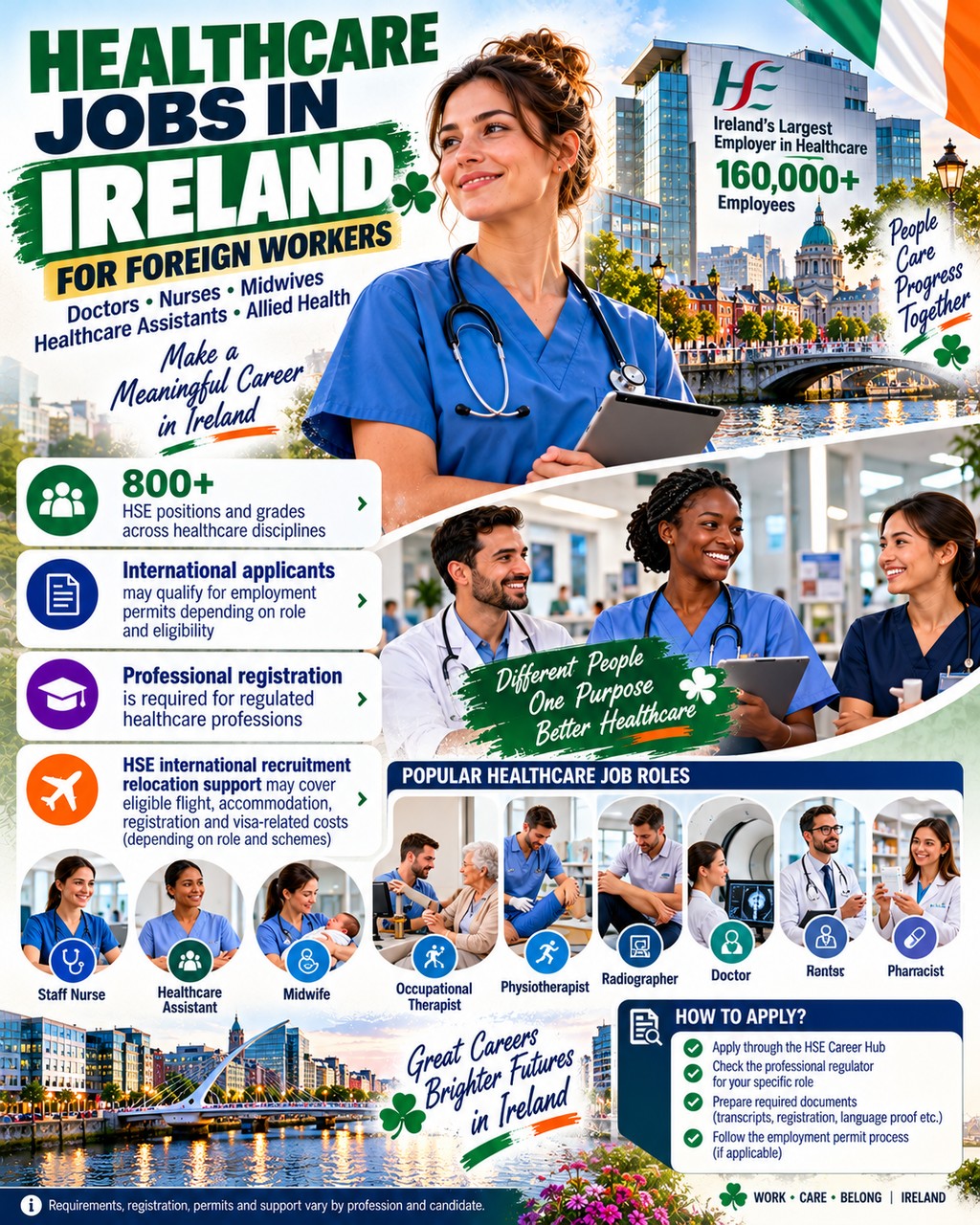
    Ireland continues to offer significant opportunities for qualified healthcare professionals from overseas. The country’s health service employs professionals across hospitals, community services, nursing homes, mental-health services, disability services, primary care and other healthcare settings.

    For foreign workers, Ireland is particularly attractive because several healthcare occupations are included on the country’s Critical Skills Occupations List, creating potential employment-permit pathways for qualified professionals.

    However, getting a healthcare job in Ireland is not simply a matter of finding a vacancy and applying. Depending on the profession, an overseas applicant may first need professional registration, qualification recognition, English-language evidence, an employment permit and an Irish entry visa.

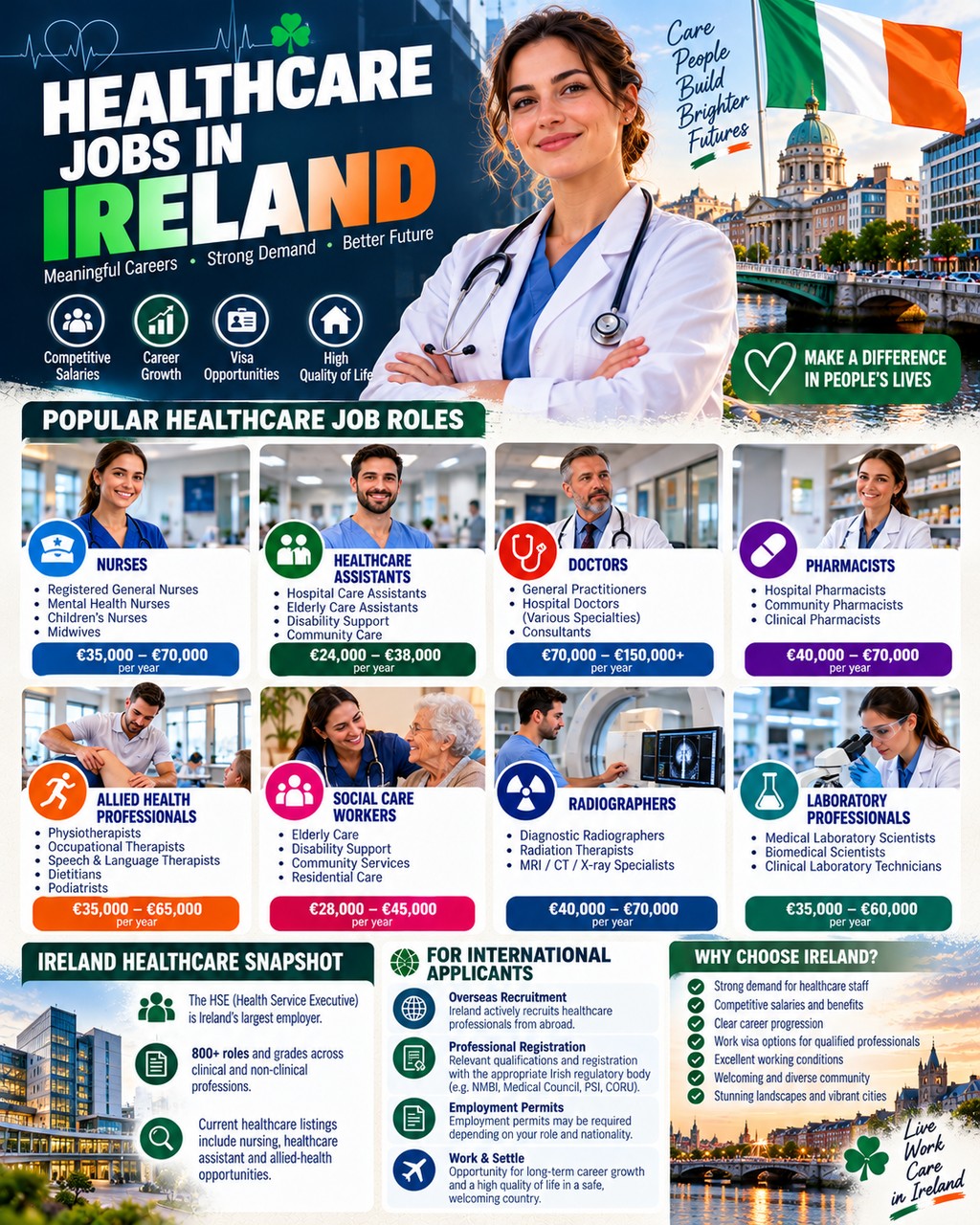
    The good news is that Ireland has an established international-recruitment system. The HSE’s international recruitment service says it has more than 800 different positions and grade levels across healthcare disciplines, ranging from medical consultants to nurses, midwives and health and social care professionals.

    This guide explains the best healthcare jobs for foreign workers in Ireland in 2026, which professions are in demand, registration requirements, salary and employment-permit rules, and how applicants from countries such as Pakistan, India, the Philippines and other non-EEA countries can approach the Irish job market.


    Why Ireland Needs Foreign Healthcare Workers

    Ireland’s healthcare system requires professionals across a wide range of disciplines.

    The HSE currently recruits internationally for positions including:

    • Doctors
    • Nurses
    • Midwives
    • Health and Social Care Professionals
    • Allied health professionals
    • Healthcare assistants
    • Medical scientists
    • Physiotherapists
    • Occupational therapists
    • Radiographers
    • Other specialist healthcare professionals

    The HSE’s international recruitment service specifically encourages overseas applicants to register for job alerts and apply for suitable vacancies.

    The demand is not restricted to Dublin.

    Healthcare employment opportunities exist throughout Ireland, including:

    • Dublin
    • Cork
    • Galway
    • Limerick
    • Waterford
    • Kilkenny
    • Mayo
    • Sligo
    • Donegal
    • Kerry
    • Tipperary
    • Other regional locations

    This can be particularly useful for foreign workers who are willing to consider locations outside Dublin.


    Best Healthcare Jobs in Ireland for Foreign Workers

    Not every healthcare occupation has the same immigration pathway.

    Some professions are especially attractive because they appear on Ireland’s current Critical Skills Occupations List.

    Here are some of the major opportunities.


    1. Registered Nurses

    Registered nursing is one of the most important healthcare careers for international applicants.

    Nurses can work in:

    • Public hospitals
    • Private hospitals
    • Nursing homes
    • Community healthcare
    • Mental-health services
    • Disability services
    • Older-person care
    • Specialist clinical services
    • Intensive care
    • Emergency departments
    • Operating theatres

    Ireland’s current Critical Skills Occupations List includes Registered Nurses and Registered Midwives.

    This makes nursing one of the more established professional routes for qualified foreign healthcare workers.

    However, there is an important requirement:

    You cannot simply arrive in Ireland and start working as a nurse using your overseas nursing qualification.

    Nurses and midwives must be registered with the Nursing and Midwifery Board of Ireland (NMBI) before practising in Ireland. The HSE also states that healthcare professionals must be registered with their relevant professional regulatory body before working in the Irish health service.


    2. Midwives

    Qualified midwives can also find opportunities within Ireland’s healthcare system.

    Midwives can work in:

    • Maternity hospitals
    • General hospitals
    • Community maternity services
    • Specialist maternity services
    • Women’s health services

    Registered midwives are included on Ireland’s current Critical Skills Occupations List.

    Overseas-trained midwives must complete the appropriate NMBI qualification-recognition and registration processes.


    3. Doctors and Medical Specialists

    Ireland also recruits internationally trained doctors.

    Potential positions include:

    • General medical doctors
    • Emergency physicians
    • Surgeons
    • Anaesthetists
    • Psychiatrists
    • Radiologists
    • Paediatricians
    • Cardiologists
    • General practitioners
    • Other specialist doctors

    Medical practitioners and several specialist medical occupations are represented within Ireland’s Critical Skills framework.

    However, doctors face professional-registration requirements that can be considerably more complex than simply submitting a CV.

    Foreign-trained doctors should investigate:

    • Medical Council of Ireland registration
    • Recognition of qualifications
    • Internship requirements
    • Specialist registration
    • English-language requirements
    • Relevant examinations
    • Employer requirements

    A job offer does not replace professional registration.


    4. Healthcare Assistants

    Healthcare assistant positions are another major employment category.

    Healthcare assistants can work in:

    • Nursing homes
    • Residential care
    • Hospitals
    • Community care
    • Home support
    • Disability services
    • Older-person services

    Current HSE vacancies demonstrate continuing recruitment in this area. For example, the HSE advertised a Healthcare Assistant – Home Support Galway campaign in September 2026, while another current HSE campaign was recruiting healthcare assistants in Kilkenny.

    Healthcare assistants are particularly interesting for international workers because Ireland has a specific minimum annual remuneration threshold for this category.

    For 2026, the minimum annual remuneration for healthcare assistants, home carers and care workers is €32,691.

    However, applicants must still meet the relevant employment-permit and immigration requirements.


    5. Physiotherapists

    Physiotherapists can work across:

    • Hospitals
    • Rehabilitation centres
    • Community healthcare
    • Private clinics
    • Sports medicine
    • Older-person services
    • Neurological rehabilitation
    • Musculoskeletal services

    Physiotherapists are included in the current Critical Skills Occupations List.

    For overseas applicants, professional registration and qualification recognition are key steps.


    6. Occupational Therapists

    Occupational therapists are another healthcare profession with opportunities in Ireland.

    They can work with:

    • Children
    • Older people
    • People with disabilities
    • Mental-health patients
    • Rehabilitation patients
    • Community healthcare users

    The current Critical Skills list includes occupational therapists.

    Current HSE recruitment also demonstrates demand for the profession. A recent HSE vacancy included a Senior Occupational Therapist position associated with Galway, Roscommon and Mayo services.


    7. Speech and Language Therapists

    Speech and language therapists work with patients experiencing:

    • Speech difficulties
    • Language difficulties
    • Communication disorders
    • Swallowing problems
    • Developmental conditions
    • Neurological conditions

    Speech and language therapists are currently included in Ireland’s Critical Skills Occupations List.

    This makes the profession particularly interesting for qualified overseas candidates who can meet Irish registration and employment requirements.


    8. Radiographers

    Radiographers can work in:

    • Hospitals
    • Diagnostic imaging
    • X-ray services
    • CT
    • MRI
    • Specialist imaging departments

    Radiographers are included on the current Critical Skills Occupations List.

    Applicants trained outside Ireland should check the Irish registration requirements applicable to their profession before accepting employment.


    9. Radiation Therapists

    Radiation therapists work primarily in cancer-care settings and are involved in delivering radiation treatment.

    This is a specialist healthcare occupation requiring appropriate professional education and registration.

    Radiation therapists are also listed among Ireland’s current Critical Skills occupations.


    10. Medical Scientists

    Medical scientists can work in areas such as:

    • Clinical laboratories
    • Pathology
    • Microbiology
    • Haematology
    • Biochemistry
    • Blood services
    • Molecular diagnostics

    The Critical Skills Occupations List includes Medical Scientists.

    For overseas applicants, professional recognition and registration requirements should be checked before applying.


    11. Cardiac Physiologists

    Cardiac physiologists are specialist healthcare professionals working with cardiac diagnostic and monitoring procedures.

    The current Critical Skills list includes:

    • Cardiac physiologists
    • Vascular technologists/physiologists
    • Gastrointestinal technologists/physiologists
    • Respiratory physiologists

    These specialist roles can be attractive to overseas healthcare professionals with the correct qualifications and experience.


    12. Dietitians

    Dietitians work with patients on nutrition and dietary management.

    They can be involved in:

    • Clinical nutrition
    • Diabetes management
    • Obesity management
    • Gastrointestinal conditions
    • Hospital nutrition
    • Community healthcare
    • Specialist medical conditions

    Dietitians are included in the current Critical Skills Occupations List.


    13. Audiologists

    Audiologists assess and manage hearing and related communication problems.

    They may work in:

    • Hospitals
    • Community healthcare
    • Specialist clinics
    • Rehabilitation services

    Audiologists are currently listed under Ireland’s Critical Skills healthcare occupations.


    14. Podiatrists

    Podiatrists specialise in foot and lower-limb health.

    Potential employment settings include:

    • Hospitals
    • Community healthcare
    • Specialist clinics
    • Rehabilitation services
    • Private healthcare

    Podiatry/chiropody is represented on Ireland’s current Critical Skills list.


    Healthcare Jobs in Ireland: Quick Comparison

    Healthcare profession Foreign-worker potential Professional registration
    Registered Nurse Very strong NMBI
    Midwife Very strong NMBI
    Doctor Strong Medical Council
    Physiotherapist Strong Relevant regulator
    Occupational Therapist Strong Relevant regulator
    Speech & Language Therapist Strong Relevant regulator
    Radiographer Strong Relevant regulator
    Medical Scientist Strong Relevant regulator
    Pharmacist Strong PSI
    Healthcare Assistant Good Role-dependent
    Home Carer Good Role-dependent
    Dietitian Strong Relevant regulator
    Audiologist Strong Relevant regulator
    Podiatrist Strong Relevant regulator

    The exact immigration route depends on the occupation, salary, qualifications, employer and current employment-permit rules.


    Professional Registration Is Extremely Important

    One of the biggest mistakes overseas healthcare applicants make is treating professional registration as an optional step.

    It is not.

    The HSE states that doctors, nurses, midwives and health and social care professionals need registration with their respective professional bodies before practising in the Irish health service.

    This means your journey may look like:

    Overseas qualification → Qualification recognition → Professional registration → Job application → Employment permit → Visa/immigration permission → Ireland

    The exact order can vary depending on the profession.


    How Overseas Nurses Can Register in Ireland

    Nurses are one of the largest groups of internationally recruited healthcare professionals.

    The NMBI process involves two major stages:

    Stage 1 — Qualification Recognition

    NMBI assesses whether your overseas nursing qualification meets the relevant Irish standards.

    Stage 2 — Registration

    Once qualification recognition is completed, the applicant proceeds with registration.

    NMBI specifically explains that overseas applicants must complete qualification recognition before proceeding to registration.

    Applicants should use their own MyNMBI credentials and upload their own documentation.

    NMBI warns applicants not to give their MyNMBI credentials to recruitment agencies or other third parties.

    This is extremely important for international applicants.


    English Requirements for Overseas Nurses

    English-language competence is an important part of the NMBI registration process for overseas-trained nurses and midwives.

    NMBI requires applicants to demonstrate competence across:

    • Speaking
    • Reading
    • Listening
    • Writing

    The evidence is submitted as part of the registration process, with the exact requirements depending on the applicable pathway.

    Applicants should always check the current NMBI requirements before booking an English examination because requirements and accepted pathways can change.


    What If an Overseas Nurse Needs Clinical Adaptation?

    Some overseas nurses may be required to complete a clinical adaptation or assessment process.

    The Department of Enterprise, Tourism and Employment explains that non-EEA nurses accepted for clinical adaptation placements are handled under the Atypical Working Scheme, rather than simply applying for an employment permit for the adaptation placement.

    The relevant permission can cover a limited period for completing the adaptation process, NMBI registration and subsequent employment-permit steps.

    Applicants should therefore understand exactly which stage they are at before travelling to Ireland.


    Employment Permits for Foreign Healthcare Workers

    If you are from outside the EEA, UK or Switzerland, you generally need an employment permit unless you fall under an exemption.

    The Irish Department of Enterprise, Tourism and Employment states that non-EEA nationals generally must hold a valid employment permit to work in Ireland.

    The HSE similarly explains that many healthcare jobs are in demand and that non-EEA applicants may qualify for a Critical Skills Employment Permit.

    This is one reason Ireland is attractive to qualified foreign healthcare professionals.


    Critical Skills Employment Permit

    The Critical Skills Employment Permit is designed to attract highly skilled workers into occupations where Ireland has significant shortages.

    Healthcare is strongly represented on the current Critical Skills Occupations List.

    The current list, effective from 13 May 2026, includes professions such as:

    • Registered nurses
    • Registered midwives
    • Physiotherapists
    • Occupational therapists
    • Speech and language therapists
    • Radiographers
    • Radiation therapists
    • Medical scientists
    • Dietitians
    • Audiologists
    • Podiatrists
    • Various specialist healthcare professionals

    2026 Salary Thresholds for Healthcare Workers

    Salary is an important part of the employment-permit system.

    The 2026 minimum annual remuneration thresholds include:

    • Healthcare assistants, home carers and care workers: €32,691
    • Critical Skills Employment Permit with relevant degree: €40,909
    • Critical Skills Employment Permit without relevant degree: €68,911
    • General Employment Permit: €36,605

    These are minimum permit thresholds, not statements that every healthcare professional earns those amounts.

    A registered nurse, doctor, physiotherapist or specialist healthcare professional may earn substantially more depending on grade, experience, employer and contract.

    Public-sector healthcare roles may also be governed by applicable public-sector pay agreements.


    HSE Jobs for Foreign Workers

    The Health Service Executive is one of the most important employers for overseas healthcare professionals.

    The HSE’s international recruitment service says it has more than 800 positions and grade levels across different disciplines.

    Its recruitment platform includes vacancies across:

    • Nursing
    • Medicine
    • Patient and client care
    • Health and social care
    • Administration
    • Management
    • Support services

    Current HSE listings show that recruitment is occurring across multiple counties and healthcare categories.

    For example, recent vacancies included:

    • Healthcare Assistant — Galway
    • Clinical Nurse Manager — Galway/Roscommon/Mayo
    • Senior Occupational Therapist — Galway/Roscommon/Mayo
    • Chief Clinical Perfusionist — Galway
    • Healthcare Assistant — Kilkenny

    This demonstrates that international applicants should look beyond Dublin when searching for opportunities.


    HSE International Recruitment Support

    The HSE has a dedicated international recruitment pathway.

    International candidates can register with the HSE Career Hub to receive weekly job alerts based on their selected profession and geographical preferences.

    This is useful because healthcare vacancies can open and close quickly.

    Rather than checking websites randomly every few weeks, applicants can receive relevant vacancy notifications.


    Relocation Support for Overseas HSE Employees

    The HSE also provides a relocation package for eligible people moving to Ireland for relevant roles.

    According to current HSE guidance, candidates outside Ireland can apply for the international recruitment relocation package when moving into a permanent or temporary role lasting at least two years.

    The package can provide allowances for flights and accommodation, with the current maximum listed as:

    • Up to €4,160 for candidates based in the EU or UK
    • Up to €4,710 for candidates based outside the EU

    The HSE states that the allowance is available for up to three months and requires appropriate receipts.

    This can significantly reduce the initial financial burden for an overseas healthcare professional moving to Ireland.


    What About Healthcare Assistants?

    Healthcare assistant jobs can be an attractive option for people who do not have a professional nursing or medical qualification.

    Typical duties can include:

    • Supporting patients with daily activities
    • Personal care
    • Mobility assistance
    • Monitoring patients
    • Supporting nurses and healthcare professionals
    • Maintaining patient comfort
    • Communicating with families and healthcare teams
    • Following care plans

    However, applicants should carefully distinguish between:

    Healthcare assistant

    and

    Registered nurse

    They are completely different professional roles with different qualification and registration requirements.

    A healthcare assistant should not present themselves as a nurse without the required Irish registration.


    Healthcare Assistant Salary and Permit Route

    For 2026, Ireland’s minimum annual remuneration threshold for healthcare assistants, home carers and care workers is €32,691.

    This category can therefore be relevant to foreign workers, but applicants still need to satisfy the applicable employment-permit conditions.

    They should also verify:

    • Employer eligibility
    • Job title
    • Salary
    • Working hours
    • Contract duration
    • Employment-permit eligibility
    • Immigration requirements

    Do not rely solely on a recruitment agent’s statement that “healthcare jobs are sponsored.”


    Jobs in Nursing Homes

    Ireland has a large care sector involving:

    • Nursing homes
    • Residential care
    • Older-person care
    • Disability services
    • Community care
    • Home support

    Potential positions include:

    • Healthcare assistant
    • Nurse
    • Care worker
    • Home support worker
    • Senior care worker
    • Clinical nurse manager

    Foreign workers should verify whether a specific position is eligible for an employment permit before accepting an offer.


    Healthcare Jobs Outside Dublin

    Foreign applicants often assume Dublin is the only place where they should search.

    That can be a mistake.

    Healthcare jobs exist throughout Ireland.

    Galway

    Strong opportunities in:

    • Hospitals
    • Nursing
    • Mental health
    • Medical devices
    • Community healthcare
    • Allied health

    Current HSE listings have included healthcare assistants, clinical nurse management and specialist clinical roles in Galway and surrounding counties.

    Cork

    Important healthcare and life-sciences centre with opportunities in:

    • Hospitals
    • Nursing
    • Pharmaceuticals
    • Medical devices
    • Research

    Limerick

    Opportunities include:

    • Hospital healthcare
    • Nursing
    • Allied health
    • Community services
    • Medical technology

    Dublin

    The largest concentration of:

    • Hospitals
    • Private healthcare
    • Corporate healthcare
    • Specialist medical services
    • Research
    • Pharmaceutical companies

    Mayo and Roscommon

    Regional healthcare services also recruit nurses, allied health professionals and support workers.

    The HSE’s recruitment system allows candidates to search by geographic preference.


    Can Pakistani Healthcare Workers Get Jobs in Ireland?

    Yes, Pakistani healthcare professionals can potentially work in Ireland, but the process depends heavily on their profession.

    For example, a Pakistani:

    • Nurse
    • Doctor
    • Physiotherapist
    • Occupational therapist
    • Medical scientist
    • Healthcare assistant

    may have different registration and employment-permit requirements.

    For a Pakistani nurse, the process could broadly involve:

    Nursing qualification → NMBI qualification recognition → English requirements → NMBI registration → Irish job → employment permit → visa → relocation

    The precise route depends on the individual’s circumstances.

    Pakistani applicants should be particularly careful with recruitment agencies because overseas healthcare recruitment attracts scams.


    How to Apply for Healthcare Jobs in Ireland from Abroad

    A practical strategy is:

    Step 1: Identify your profession

    Determine exactly what Irish occupation matches your current qualification.

    For example:

    BSN Nurse → Registered Nurse

    rather than simply searching for “healthcare jobs.”

    Step 2: Check professional registration

    Find the Irish regulatory body for your profession.

    Step 3: Begin qualification recognition

    If your qualification was obtained outside Ireland, determine whether it must be formally assessed.

    Step 4: Complete English requirements

    Where required, complete the relevant English-language test.

    Step 5: Search for vacancies

    Use:

    • HSE Career Hub
    • JobsIreland
    • EURES
    • Hospital career pages
    • Private healthcare employers
    • Reputable recruitment companies

    Step 6: Prepare your CV

    Highlight:

    • Qualification
    • Registration
    • Clinical experience
    • Specialisation
    • Years of experience
    • Certifications
    • English proficiency
    • Relevant training

    Step 7: Apply

    Apply directly where possible.

    Step 8: Verify employment-permit eligibility

    Before paying an agent or making major relocation decisions, verify the official permit route.

    Step 9: Obtain the appropriate immigration permission

    If you are a non-EEA citizen, this may include an employment permit and an entry visa, depending on your nationality and circumstances.


    How to Write a Healthcare CV for Ireland

    Your CV should be easy for an Irish recruiter to understand.

    For a nurse, for example:

    Professional Summary

    Registered Nurse with 6+ years of acute-care experience, specialising in medical-surgical nursing, patient assessment, medication administration, care planning and multidisciplinary teamwork. Experienced in high-volume hospital environments and committed to evidence-based patient care.

    Key Skills

    • Patient assessment
    • Medication administration
    • Care planning
    • Infection prevention
    • Clinical documentation
    • Emergency response
    • Patient education
    • Multidisciplinary teamwork
    • Electronic health records
    • Infection control

    Professional Experience

    Include:

    • Employer
    • Country
    • Hospital/department
    • Job title
    • Dates
    • Responsibilities
    • Major achievements

    Qualifications

    Clearly state:

    • Degree
    • University
    • Graduation year
    • Professional registration
    • Relevant certifications

    Do Not Pay for a “Guaranteed Irish Healthcare Job”

    This deserves special attention.

    Foreign healthcare workers are frequently targeted by fraudulent recruiters.

    Be extremely cautious if someone says:

    • “Pay €5,000 and we guarantee an Irish nursing job.”
    • “We guarantee NMBI registration.”
    • “We can get you a visa without registration.”
    • “You don’t need IELTS.”
    • “We can guarantee an HSE job.”
    • “Send us your MyNMBI login.”
    • “Pay us and we will upload your documents.”

    NMBI explicitly warns overseas applicants not to share their MyNMBI credentials with third parties and says applicants should upload their own documentation.

    NMBI also advises applicants not to leave their current employment or move to Ireland simply because they expect their registration application to succeed.

    This is excellent advice for anyone applying from abroad.


    Employment Permit Processing Times

    Applicants should also account for processing time.

    As of 6 October 2026, Ireland’s Department of Enterprise reported that it was processing:

    • Critical Skills Employment Permit applications received on 29 September 2026
    • New General Employment Permit applications received on 28 August 2026

    The Department also states that employment-permit applications should generally be received at least 12 weeks before the proposed employment start date.

    Processing dates change continuously, so applicants should check the official processing-date page rather than relying on old information from social media or recruitment agents.


    Healthcare Jobs in Ireland Without a Degree

    The healthcare sector contains opportunities that do not require a university degree.

    Examples may include:

    • Healthcare assistant
    • Care worker
    • Home support worker
    • Certain support roles
    • Administrative healthcare positions
    • Facilities/support roles

    However, regulated professional occupations such as:

    • Nurse
    • Doctor
    • Physiotherapist
    • Occupational therapist
    • Pharmacist

    require the appropriate qualifications and professional registration.

    If your objective is immigration rather than simply employment, you should also check whether the specific non-degree occupation qualifies for an employment permit.


    Best Healthcare Careers for Foreign Workers

    If we consider a combination of demand, professional status and immigration potential, several careers stand out.

    Strong options

    1. Registered Nurse

    Excellent international recruitment infrastructure and Critical Skills status.

    2. Doctor/Specialist

    Very strong professional demand but more complex registration.

    3. Midwife

    Critical Skills occupation with professional registration requirements.

    4. Physiotherapist

    Critical Skills occupation with opportunities across the health service.

    5. Occupational Therapist

    Strong demand and Critical Skills status.

    6. Speech & Language Therapist

    Specialist healthcare role included on the Critical Skills list.

    7. Radiographer

    Specialist occupation with Critical Skills eligibility.

    8. Medical Scientist

    Strong fit with Ireland’s healthcare and life-sciences ecosystem.

    9. Healthcare Assistant

    Lower qualification barrier than regulated professional roles, with a specific 2026 remuneration threshold.


    Ireland vs Other Countries for Foreign Healthcare Workers

    Ireland competes internationally for healthcare professionals.

    Its advantages include:

    • English-speaking environment
    • Established international recruitment programmes
    • Critical Skills employment-permit routes
    • Large public health service
    • International healthcare workforce
    • Relocation support for eligible HSE recruits
    • Career opportunities across multiple regions

    The HSE states that many healthcare positions are in demand and that non-EEA healthcare applicants may qualify for skills-based employment permits.

    However, Ireland also has challenges:

    • Housing costs
    • Cost of living
    • Professional registration requirements
    • Competition for some positions
    • Immigration paperwork
    • Qualification-recognition processes

    Therefore, applicants should calculate the full cost and timeline before relocating.


    Frequently Asked Questions

    Can foreigners get healthcare jobs in Ireland?

    Yes. Ireland actively recruits internationally for healthcare positions. The HSE has a dedicated international recruitment programme and advertises opportunities across more than 800 positions and grade levels.

    Which healthcare jobs are best for foreigners?

    Registered nurses, doctors, midwives, physiotherapists, occupational therapists, speech and language therapists, radiographers, medical scientists and other specialist healthcare professionals can be particularly attractive because several are included on Ireland’s Critical Skills Occupations List.

    Can Pakistani nurses work in Ireland?

    Yes, potentially. Pakistani nurses must meet the relevant NMBI qualification-recognition and registration requirements and then satisfy the applicable employment and immigration requirements.

    Is IELTS required for nurses in Ireland?

    Overseas-trained nurses and midwives must demonstrate the required English-language competence for NMBI registration through an accepted route. The exact evidence requirements should be checked directly with NMBI before applying.

    How much does a healthcare assistant need to earn for a work permit?

    For 2026, the minimum annual remuneration threshold for healthcare assistants, home carers and care workers is €32,691.

    Do nurses need registration in Ireland?

    Yes. Nurses and midwives must be registered with NMBI to practise in Ireland.

    Can I apply for an HSE job from outside Ireland?

    Yes. The HSE has a dedicated international recruitment service and provides information for overseas candidates.

    Does the HSE help with relocation?

    Eligible international recruits can receive relocation assistance. Current HSE guidance lists allowances of up to €4,710 for candidates moving from outside the EU, subject to the relevant conditions and receipts.

    Do I need a work permit?

    If you are a non-EEA national and do not have an exemption, you generally need a valid Irish employment permit to work.

    Can I move to Ireland before my nursing registration is approved?

    NMBI advises overseas applicants not to move to Ireland or leave their existing employment based merely on the expectation that registration will be successful.


    Final Thoughts

    Ireland remains a promising destination for foreign healthcare workers in 2026, particularly for professionals whose occupations appear on the Critical Skills Occupations List.

    The strongest opportunities include registered nursing, medicine, midwifery, physiotherapy, occupational therapy, speech and language therapy, radiography, medical science and other specialist healthcare professions.

    Healthcare assistants and care workers also represent an important employment category, with a specific 2026 minimum remuneration threshold of €32,691.

    For foreign applicants, however, the most important lesson is:

    Do not start with the visa. Start with your profession.

    First determine whether your qualification is recognised in Ireland. Then complete the relevant professional-registration process. After that, find an eligible employer and determine the correct employment-permit route.

    For nurses and midwives, NMBI registration is central to the process. For other healthcare professions, the relevant professional regulator must be identified.

    The HSE’s international recruitment programme provides an important advantage because overseas candidates can search vacancies, receive job alerts and access information about relocation and recruitment.

    For someone applying from Pakistan, India, the Philippines or another non-EEA country, the safest approach is to use official Irish government, HSE and professional-regulator information, verify every job offer independently and never give an agency control of your professional-registration account.

    A genuine healthcare career in Ireland can offer strong long-term opportunities—but the successful route is based on recognised qualifications, professional registration, a legitimate job offer and the correct immigration permission, not on paying an agent for a promised “guaranteed visa.”

  • Highest-Paying Jobs in Ireland in 2026

    Highest-Paying Jobs in Ireland in 2026

    Ireland has become one of Europe’s most attractive employment markets for highly skilled professionals, particularly in technology, pharmaceuticals, financial services, healthcare, engineering and professional services.

    But which jobs actually pay the most in Ireland in 2026?

    The answer depends heavily on experience, qualifications, location, industry and seniority. A newly qualified professional may earn considerably less than a senior manager or specialist in the same occupation. Dublin also tends to offer higher pay than many other parts of the country.

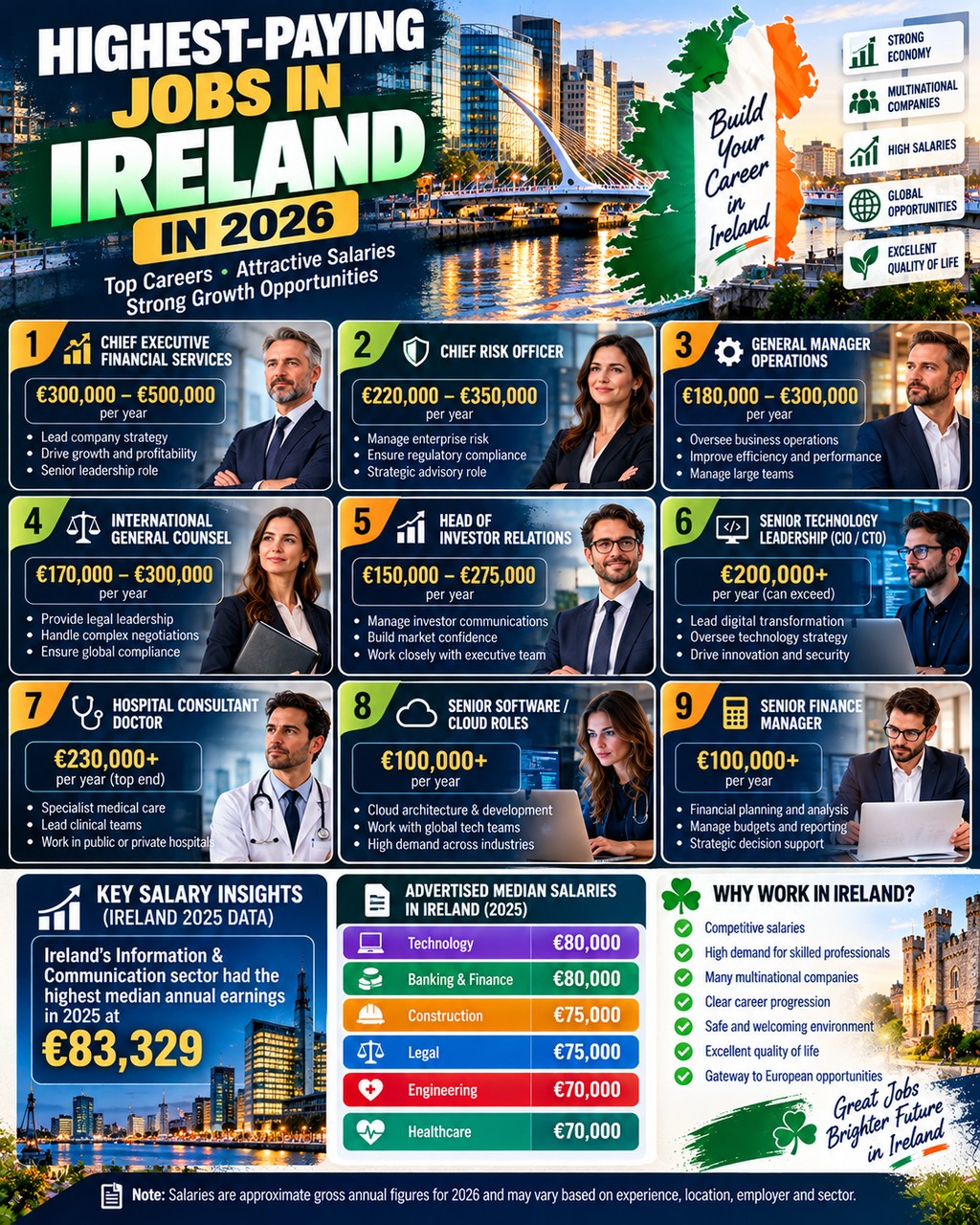
    The latest Central Statistics Office (CSO) data provides an important picture of the Irish earnings market. Median annual earnings for employments active for at least 50 weeks were €46,305 in 2025, up 3.3% from €44,816 in 2024. Median weekly earnings were €759.21. The Information & Communication sector recorded the highest median weekly earnings at €1,515.67, followed by Financial, Insurance & Real Estate at €1,086.76.

    For professionals looking to build a career in Ireland, this means the highest earning potential is concentrated in sectors where specialist skills are difficult to find.

    This article looks at some of the highest-paying jobs in Ireland in 2026, what these professionals do, typical salary potential, qualifications required, locations where opportunities are concentrated and whether these careers may be suitable for foreign workers.


    Ireland’s Highest-Paying Job Market in 2026

    Ireland’s highest-paying positions are concentrated in several major sectors:

    • Technology and software
    • Financial services
    • Pharmaceuticals
    • Life sciences
    • Healthcare and medicine
    • Engineering
    • Data and artificial intelligence
    • Legal services
    • Senior management
    • Professional services
    • Construction and property
    • Cybersecurity

    Recruitment specialist Morgan McKinley describes the 2026 Irish market as increasingly focused on specialist professionals who can solve complex business problems, with employers concentrating hiring budgets on critical skills rather than broad recruitment.

    Ireland’s employment-permit system also reflects this demand. The current Critical Skills Occupations List includes occupations across ICT, engineering, medicine, science, nursing, finance and other specialist areas. The current list took effect on 13 May 2026.


    1. Medical Doctors and Specialists

    Potential salary: €70,000–€250,000+ depending on speciality and seniority

    Medicine remains one of Ireland’s strongest high-income career paths.

    Doctors can work in:

    • Public hospitals
    • Private hospitals
    • Specialist clinics
    • General practice
    • Medical research
    • Universities
    • Pharmaceutical companies

    Specialist doctors and consultants can command substantially higher salaries than junior doctors.

    Medical specialties that can have particularly strong earning potential include:

    • Surgery
    • Anaesthetics
    • Radiology
    • Cardiology
    • Psychiatry
    • Oncology
    • Emergency medicine
    • General practice
    • Dermatology

    Salary should not be interpreted as a guaranteed figure because Irish medical compensation varies significantly by grade, employer, contracts, overtime, allowances and private practice.

    Medical practitioners are included on Ireland’s current Critical Skills Occupations List.

    Qualifications

    Typically required:

    • Medical degree
    • Medical Council registration
    • Internship/training
    • Specialist training for consultant positions
    • Relevant professional experience

    Foreign doctors must complete the appropriate recognition and registration process before practising medicine in Ireland.


    2. Chief Executive Officers

    Potential salary: €100,000–€300,000+ at larger organisations

    CEOs are among the highest-paid professionals in virtually every developed economy, and Ireland is no exception.

    A CEO may be responsible for:

    • Corporate strategy
    • Revenue growth
    • Business expansion
    • Financial performance
    • Recruitment
    • Investor relationships
    • Risk management
    • Corporate governance
    • Major business decisions

    The highest compensation packages are generally found in:

    • Multinational corporations
    • Financial services
    • Pharmaceutical companies
    • Technology companies
    • Large Irish businesses
    • High-growth companies

    CEO compensation can include much more than basic salary, including bonuses, equity and other benefits.

    Therefore, comparing a CEO’s basic salary with an ordinary employee’s salary can be misleading.


    3. Chief Financial Officers

    Potential salary: €100,000–€200,000+

    Chief Financial Officers, or CFOs, are responsible for the financial management of organisations.

    Typical responsibilities include:

    • Financial strategy
    • Budgeting
    • Forecasting
    • Corporate reporting
    • Risk management
    • Cash-flow management
    • Tax strategy
    • Investment decisions
    • Investor reporting
    • Financial controls

    The role generally requires extensive experience rather than simply an accounting qualification.

    A current Hays Ireland listing, for example, showed a Group Financial Controller position in Dublin advertised at €150,000–€165,000 plus benefits, illustrating the level of compensation available in senior finance roles.


    4. Senior Software Engineers

    Potential salary: €70,000–€120,000+

    Software engineering remains one of Ireland’s most attractive career paths.

    Ireland has a significant technology ecosystem involving:

    • Software companies
    • Cloud companies
    • Fintech
    • Cybersecurity
    • Artificial intelligence
    • SaaS
    • Telecommunications
    • E-commerce
    • Multinational technology companies

    Experienced software engineers can specialise in:

    • Backend development
    • Frontend development
    • Full-stack development
    • Cloud engineering
    • DevOps
    • Distributed systems
    • Mobile development
    • Machine learning
    • AI engineering

    Ireland’s current Critical Skills list includes programmers and software development professionals, IT project managers, IT business analysts, architects and systems designers, web development professionals and other ICT professionals.


    5. AI and Machine Learning Professionals

    Potential salary: €70,000–€150,000+

    Artificial intelligence has created a new premium within the technology sector.

    Professionals working in areas such as:

    • Machine learning
    • AI engineering
    • Data science
    • Natural-language processing
    • Computer vision
    • Generative AI
    • MLOps
    • AI research

    can command strong compensation when they have specialised technical skills and commercial experience.

    The highest salaries tend to go to people who combine technical knowledge with the ability to deploy AI systems at scale.

    Useful skills include:

    • Python
    • Machine learning
    • Deep learning
    • Cloud platforms
    • SQL
    • Data engineering
    • Statistics
    • MLOps
    • Generative AI
    • Large language models

    6. Cybersecurity Professionals

    Potential salary: €65,000–€130,000+

    Cybersecurity has become increasingly important as companies move more operations online.

    Common positions include:

    • Security engineer
    • Cybersecurity analyst
    • Security architect
    • Penetration tester
    • Cloud security engineer
    • Security consultant
    • Security manager
    • Chief Information Security Officer

    Senior cybersecurity professionals can earn considerably more than entry-level analysts.

    Ireland’s technology-heavy economy creates demand for professionals capable of protecting financial information, customer data, cloud infrastructure and corporate systems.


    7. Financial Services Professionals

    Potential salary: €60,000–€150,000+

    Financial services is one of Ireland’s highest-paying broad sectors.

    The CSO recorded median weekly earnings of €1,086.76 in the Financial, Insurance & Real Estate sector in 2025, second only to Information & Communication among the major economic sectors.

    High-paying financial positions can include:

    • Investment manager
    • Financial controller
    • Risk manager
    • Corporate finance manager
    • Investment analyst
    • Financial analyst
    • Actuary
    • Treasury manager
    • Compliance director
    • Finance director
    • CFO

    Dublin is particularly important because it is Ireland’s main financial-services centre.


    8. Actuaries

    Potential salary: €70,000–€150,000+

    Actuaries use mathematics, statistics and financial modelling to evaluate risk.

    They can work in:

    • Insurance
    • Banking
    • Investment
    • Pensions
    • Consulting
    • Risk management

    An actuarial career can be financially attractive because qualification requires significant mathematical ability and professional examinations.

    Useful skills include:

    • Mathematics
    • Statistics
    • Probability
    • Financial modelling
    • Data analysis
    • Risk assessment
    • Programming

    9. Pharmacists

    Potential salary: €50,000–€90,000+

    Pharmacists are another established professional career in Ireland.

    They can work in:

    • Community pharmacies
    • Hospitals
    • Pharmaceutical companies
    • Manufacturing
    • Research
    • Regulatory affairs

    Ireland’s pharmaceutical and life-sciences industries are particularly important to the country’s economy.

    The current Critical Skills Occupations List includes pharmacists and industrial pharmacists.

    Foreign-qualified pharmacists need to meet the relevant Irish professional-registration requirements before practising.


    10. Engineering Managers

    Potential salary: €80,000–€140,000+

    Ireland has strong demand for engineering talent because of its pharmaceutical, medical-device, technology, manufacturing and construction industries.

    Engineering management positions can include:

    • Engineering manager
    • Manufacturing engineering manager
    • Process engineering manager
    • Automation manager
    • Electrical engineering manager
    • Mechanical engineering manager
    • Validation manager
    • Quality engineering manager

    Senior engineers with management responsibility can command substantially higher salaries than entry-level engineers.


    11. Chemical Engineers

    Potential salary: €60,000–€120,000+

    Chemical engineering is particularly valuable in Ireland’s pharmaceutical and manufacturing industries.

    Chemical engineers may work on:

    • Production systems
    • Manufacturing processes
    • Pharmaceutical production
    • Process optimisation
    • Quality
    • Automation
    • Validation
    • Environmental systems

    The current Critical Skills list specifically includes chemical engineers and specialist production/process engineering occupations.


    12. Pharmaceutical and Life-Sciences Professionals

    Potential salary: €60,000–€130,000+

    Ireland is a major international location for pharmaceutical and life-sciences companies.

    High-paying positions include:

    • Regulatory affairs manager
    • Quality assurance manager
    • Validation engineer
    • Manufacturing manager
    • Process engineer
    • R&D scientist
    • Clinical research professional
    • Quality control manager
    • Pharmaceutical scientist
    • Biotechnology specialist

    Hays’ 2026 Ireland salary research identified life-sciences quality assurance specialists and R&D scientists among roles experiencing notable salary increases.


    13. Data Scientists

    Potential salary: €60,000–€120,000+

    Data scientists analyse large amounts of information to help organisations make decisions.

    They can work in:

    • Technology
    • Banking
    • Insurance
    • Healthcare
    • Pharmaceuticals
    • Retail
    • Telecommunications
    • Government
    • Consulting

    Typical skills include:

    • Python
    • SQL
    • Statistics
    • Machine learning
    • Data visualisation
    • Cloud computing
    • Data modelling

    Data professionals with strong business understanding can be particularly valuable because they can translate technical analysis into commercial decisions.


    14. IT Managers and Technology Directors

    Potential salary: €90,000–€160,000+

    Technology leadership can be extremely well paid.

    Examples include:

    • IT Director
    • Technology Director
    • Head of Engineering
    • Head of IT
    • Infrastructure Director
    • Head of Cybersecurity
    • Head of Data
    • Head of Cloud

    Ireland’s Critical Skills Occupations List includes IT specialist managers and ICT director-level occupations.

    At the highest levels, compensation may also include:

    • Annual bonuses
    • Stock
    • Long-term incentives
    • Company pension
    • Private healthcare
    • Other executive benefits

    15. Senior Construction and Project Managers

    Potential salary: €70,000–€130,000+

    Construction is not usually the first industry people associate with Ireland’s highest salaries, but experienced professionals can earn very strong incomes.

    Potential high-paying positions include:

    • Construction project manager
    • Senior project manager
    • Construction manager
    • Site manager
    • Commercial manager
    • Quantity surveyor
    • Construction planner
    • Construction scheduler

    Ireland’s Critical Skills list currently includes several construction-related professional occupations, including Site Manager and certain engineering and construction-planning roles.

    In 2026, the government also added Construction Planner/Scheduler to the Critical Skills Occupations List.


    16. Quantity Surveyors

    Potential salary: €60,000–€110,000+

    Quantity surveyors are responsible for the financial and contractual side of construction projects.

    They may manage:

    • Project costs
    • Budgets
    • Contracts
    • Procurement
    • Cost forecasting
    • Tendering
    • Payment assessments
    • Commercial negotiations

    Experienced quantity surveyors can move into senior commercial management positions.

    Construction and property salaries have also been supported by continuing demand for skilled professionals. Hays reported salary increases across construction and property in its 2026 Irish salary research.


    17. Solicitors and Senior Legal Professionals

    Potential salary: €65,000–€150,000+

    Legal professionals can earn strong salaries, especially at senior levels and within major commercial law firms.

    Specialisations can include:

    • Corporate law
    • Banking law
    • Finance
    • M&A
    • Technology law
    • Intellectual property
    • Employment law
    • Tax
    • Litigation

    Large Dublin law firms generally provide the strongest opportunities for high-level commercial legal careers.


    18. University Professors and Senior Academics

    Potential salary: €70,000–€130,000+

    Academic careers can also provide high salaries at senior levels.

    University professionals can progress through roles such as:

    • Lecturer
    • Senior lecturer
    • Associate professor
    • Professor
    • Department head
    • Research director

    A senior academic career usually requires:

    • Relevant bachelor’s degree
    • Master’s degree
    • PhD
    • Research experience
    • Publications
    • Teaching experience

    Indeed’s current Ireland salary information identifies professors among the country’s highest-paid occupations.


    19. Senior Healthcare Managers

    Potential salary: €70,000–€130,000+

    Healthcare does not only provide opportunities for doctors and nurses.

    Other senior positions include:

    • Hospital managers
    • Health service managers
    • Public-health managers
    • Clinical managers
    • Healthcare programme managers
    • Health operations managers

    Ireland’s current Critical Skills list includes senior health services and public-health managers and directors.


    20. Specialist Scientists

    Potential salary: €60,000–€120,000+

    Ireland’s pharmaceutical, biotechnology, medical-device and manufacturing industries employ scientists in specialist areas.

    Examples include:

    • Biochemists
    • Biological scientists
    • Chemical scientists
    • Medical scientists
    • Microbiologists
    • Research scientists
    • Pharmaceutical scientists

    The current Critical Skills list includes several specialist scientific occupations connected with manufacturing, medical devices, biotechnology and related industries.


    Top 10 Highest-Paying Careers at a Glance

    Career Potential Senior Salary
    Medical Specialist/Consultant €150,000–€250,000+
    CEO €100,000–€300,000+
    CFO/Finance Director €100,000–€200,000+
    Technology Director €100,000–€160,000+
    Senior Software Engineer €70,000–€120,000+
    AI/ML Specialist €70,000–€150,000+
    Senior Financial Professional €80,000–€150,000+
    Senior Legal Professional €80,000–€150,000+
    Engineering Manager €80,000–€140,000+
    Pharmaceutical/Life-Sciences Manager €80,000–€140,000+

    Important: These are broad indicative ranges, not guaranteed salaries. Actual compensation depends on experience, employer, location, qualifications, bonuses and seniority. The CSO’s latest data puts median annual earnings across the Irish economy at €46,305 for 2025, showing how different senior specialist salaries can be from the overall workforce.


    Which Industries Pay the Most in Ireland?

    The latest CSO data provides perhaps the clearest answer.

    1. Information & Communication

    Median weekly earnings in 2025:

    €1,515.67

    This was the highest among the broad economic sectors measured by the CSO.

    This sector includes areas such as:

    • Software
    • IT
    • Telecommunications
    • Digital services
    • Data
    • Technology

    2. Financial, Insurance & Real Estate

    Median weekly earnings:

    €1,086.76

    This sector includes:

    • Banking
    • Insurance
    • Investment
    • Financial services
    • Real estate
    • Professional financial services

    3. Professional, Scientific & Technical Activities

    This broad category includes many highly skilled professions, such as:

    • Engineering
    • Legal services
    • Consulting
    • Scientific services
    • Accounting
    • Architecture

    It can therefore contain substantial differences between entry-level and senior salaries.


    Dublin Has a Major Salary Advantage

    Location matters.

    The latest CSO figures show median weekly earnings among employments of people usually resident in Dublin were €848.06 in 2025, compared with €759.21 nationally.

    That does not mean every Dublin job pays more.

    However, Dublin has a particularly large concentration of:

    • Technology companies
    • Banks
    • Pharmaceutical companies
    • Professional-services firms
    • International headquarters
    • Law firms
    • Consulting firms

    Other cities can also provide strong opportunities.

    Cork

    Strong in:

    • Pharmaceuticals
    • Life sciences
    • Technology
    • Manufacturing
    • Engineering

    Galway

    Strong in:

    • Medical devices
    • Healthcare
    • Technology
    • Engineering
    • Manufacturing

    Limerick

    Strong in:

    • Technology
    • Engineering
    • Manufacturing
    • Healthcare
    • Pharmaceuticals

    For people prioritising maximum salary, Dublin may provide the widest selection of high-paying corporate positions, but Cork, Galway and Limerick can offer excellent specialist opportunities.


    Highest-Paying Jobs Without a University Degree

    Not every high-income career requires a traditional four-year university degree.

    Some careers can reach strong earnings through apprenticeships, licences, professional qualifications and experience.

    Examples include:

    • Experienced electrician
    • Specialist plumber
    • HGV driver
    • Construction supervisor
    • Site manager
    • Skilled technician
    • Industrial maintenance technician
    • Certain manufacturing specialists
    • Senior sales professionals
    • Specialist tradespeople

    However, there is an important difference between high earning potential and high starting salary.

    Someone may start at a modest salary and reach a significantly higher income after several years of experience, certification and progression.


    Highest-Paying Jobs for Foreign Workers

    Ireland can be particularly attractive to international professionals because several highly skilled occupations are included on the Critical Skills Occupations List.

    The current list includes occupations in:

    • ICT
    • Engineering
    • Medicine
    • Pharmacy
    • Science
    • Nursing
    • Midwifery
    • Certain construction professions
    • Specialist business and financial occupations

    However, being qualified for a high-paying job does not automatically mean that a person receives an Irish work permit.

    The exact:

    • Occupation
    • Salary
    • Qualification
    • Employer
    • Contract
    • Employment status
    • Immigration circumstances

    must be considered.


    Ireland’s 2026 Critical Skills Salary Thresholds

    The employment-permit salary threshold is particularly important for international job seekers.

    For 2026, the Department of Enterprise, Tourism and Employment lists:

    • General Employment Permit: €36,605
    • Critical Skills Employment Permit with relevant degree: €40,909
    • Critical Skills Employment Permit without relevant degree: €68,911
    • Critical Skills graduate: €36,849

    There are separate thresholds for healthcare assistants, home carers and other categories.

    These figures are permit thresholds, not typical salaries for the occupations listed in this article.

    For example, a software engineer may earn considerably more than the minimum salary required for a Critical Skills permit.


    How to Get a High-Paying Job in Ireland

    If your objective is not simply to find a job but to build a high-income career, follow a long-term strategy.

    1. Choose a high-value skill

    Focus on areas where employers have difficulty finding qualified people.

    Examples:

    • Software development
    • Cybersecurity
    • Data
    • AI
    • Engineering
    • Medicine
    • Pharmaceuticals
    • Finance
    • Construction management

    2. Obtain recognised qualifications

    Qualifications matter particularly in regulated professions.

    3. Build experience

    Experience can have a major effect on earning potential.

    A person with five to ten years of specialist experience will generally compete differently from someone entering the profession.

    4. Target the right employers

    Large multinational companies often provide strong compensation packages, but smaller specialist businesses can also pay competitively when talent is scarce.

    5. Consider Dublin

    If maximum earning potential is the priority, Dublin deserves consideration because of its concentration of high-paying industries.

    6. Develop specialist expertise

    Being “good at IT” is less valuable than being an expert in a specific area such as:

    • Cloud architecture
    • Cybersecurity
    • AI engineering
    • DevOps
    • Data engineering

    Specialisation can make you more valuable to employers.


    How Foreign Workers Can Apply

    International candidates should begin with their occupation rather than their visa.

    First identify:

    What job can I realistically do?

    Then determine:

    Is that occupation eligible for an Irish employment permit?

    Then:

    Does my qualification meet the Irish requirements?

    And finally:

    What immigration permission do I need?

    This order is important because finding a job advertisement does not automatically give a foreign applicant permission to work in Ireland.

    The Irish Government’s 2026 employment-permit changes continue to focus on shortages in areas such as construction, healthcare and transport, while the Critical Skills list covers many professional occupations.


    Best Websites for High-Paying Jobs in Ireland

    Job seekers should consider:

    • JobsIreland
    • EURES
    • LinkedIn
    • IrishJobs
    • Indeed Ireland
    • Direct company career pages
    • Professional recruitment firms

    For specialist professions, applying directly to companies can sometimes be more effective than relying exclusively on general job boards.


    How to Make Your CV Stand Out

    For a high-paying position, your CV should demonstrate value rather than simply list responsibilities.

    Instead of:

    “Managed software development team.”

    Use something more specific:

    “Led a 12-person engineering team delivering cloud-based applications used by 200,000+ customers.”

    Where possible, include:

    • Revenue impact
    • Cost savings
    • Team size
    • Projects completed
    • Certifications
    • Technology used
    • Productivity improvements
    • Sales growth
    • Compliance achievements
    • Major clients

    Senior employers want evidence of results.


    Is Ireland a Good Country for High-Paying Jobs?

    For qualified professionals, Ireland can be very attractive.

    The latest CSO data shows that median annual earnings reached €46,305 in 2025, while the highest-paying sectors were Information & Communication and Financial, Insurance & Real Estate.

    The country also has a significant multinational presence, particularly in:

    • Technology
    • Pharmaceuticals
    • Medical devices
    • Financial services
    • Professional services

    However, high salaries should always be considered alongside the cost of living.

    Housing, particularly in Dublin, can significantly reduce disposable income.

    Therefore, someone earning €80,000 in Dublin should not automatically assume they will have more disposable income than someone earning €65,000 in a lower-cost location.


    Frequently Asked Questions

    What is the highest-paying job in Ireland in 2026?

    There is no single highest-paying job because compensation varies by seniority and employer. Medical specialists, CEOs, CFOs and senior technology and financial professionals can all command very high salaries.

    What sector pays the most in Ireland?

    According to the latest CSO earnings data, Information & Communication had the highest median weekly earnings among the broad sectors in 2025 at €1,515.67.

    What is the average salary in Ireland in 2026?

    The latest CSO annual earnings release reports median annual earnings of €46,305 for 2025, which is the latest full-year figure available in the October 2026 release.

    What jobs pay over €100,000 in Ireland?

    Senior doctors, CEOs, CFOs, technology directors, senior financial professionals, senior lawyers, experienced engineering managers and certain specialist technology professionals can reach or exceed €100,000.

    What is the best high-paying career in Ireland for foreigners?

    Technology, engineering, medicine, pharmaceuticals, science, finance and certain specialist construction occupations can be attractive because several relevant occupations appear on Ireland’s Critical Skills Occupations List.

    Can I get an Irish work permit for a high-paying job?

    Possibly. A high salary alone does not guarantee a permit. The occupation, salary, qualifications, employer and applicable employment-permit rules must all meet the relevant requirements.

    Is Dublin the best city for high-paying jobs?

    Dublin generally offers the widest concentration of high-paying corporate and professional jobs. CSO data also shows that median weekly earnings among people usually resident in Dublin were higher than the national median in 2025.

    Can I earn a high salary in Ireland without a degree?

    Yes, some careers can eventually provide strong incomes without a traditional university degree, particularly specialist trades, construction, transport and certain sales or technical careers. However, many of Ireland’s highest-paid professional occupations require advanced qualifications.


    Final Thoughts

    Ireland’s highest-paying jobs in 2026 are concentrated around technology, finance, healthcare, pharmaceuticals, engineering, professional services and senior management.

    The latest CSO figures reinforce the importance of technology and finance: Information & Communication had median weekly earnings of €1,515.67, while Financial, Insurance & Real Estate recorded €1,086.76 in 2025.

    For someone planning a career in Ireland, the biggest lesson is simple:

    Do not chase salary alone. Chase valuable skills.

    A person who develops expertise in software engineering, AI, cybersecurity, engineering, medicine, pharmaceuticals, finance or another shortage occupation can potentially build a much stronger long-term career than someone simply looking for the highest advertised salary.

    For international applicants, there is another important consideration: choose a career that is both well paid and compatible with Ireland’s employment-permit system.

    Ireland’s current Critical Skills framework provides opportunities across many professional fields, but eligibility depends on the exact occupation and circumstances.

    The strongest strategy for 2026 is therefore to combine three things:

    High-demand skill + recognised qualification + relevant experience.

    That combination can significantly improve your chances of finding a well-paid career in Ireland.

  • Driver Jobs in Galway: Opportunities, Requirements, Salaries and How to Apply in 2026

    Driver Jobs in Galway: Opportunities, Requirements, Salaries and How to Apply in 2026

    Galway is one of Ireland’s most attractive regional employment centres, and driving is an important part of its local economy. From HGV and articulated-truck drivers to bus drivers, delivery drivers, van drivers and specialist transport roles, there are opportunities for people with different levels of driving experience.

    For job seekers already living in Ireland, driver jobs can provide a practical route into employment. For international applicants, however, the situation is more complicated because the type of driving licence you hold, your professional qualifications and Ireland’s employment-permit rules can determine whether an employer can legally hire you.

    Current JobsIreland listings show driver demand in and around Galway. For example, a recent HGV Driver vacancy with Roche Transport in Claregalway was advertised in October 2026, while Bus Éireann has advertised a D-licence bus-driver position in Galway.

    This guide explains the main driver jobs available in Galway, the qualifications employers look for, salary expectations, opportunities for foreign workers, licensing requirements and how to find legitimate vacancies.

    Why Driver Jobs Are Important in Galway

    Galway has a large economy covering manufacturing, healthcare, tourism, retail, construction, hospitality, logistics and services. All of these sectors depend on transportation.

    Goods need to move from warehouses to shops. Construction companies need materials delivered to sites. Manufacturers need products transported to customers. Supermarkets need regular deliveries, and hotels and businesses need transportation services.

    This creates demand for different categories of professional drivers.

    Current JobsIreland searches show HGV vacancies connected to Galway and the surrounding county, including positions in Claregalway and Tuam. A recent JobsIreland search also showed more than 50 HGV-driver vacancies nationally, demonstrating that heavy-goods transport remains an active employment category.

    For people searching specifically around Galway, it is important not to limit the search to Galway city. Many transport companies operate from industrial and rural areas around the city, including Claregalway, Tuam, Athenry, Oranmore and other parts of County Galway.


    Types of Driver Jobs in Galway

    There is no single type of “driver job.” Your licence, experience and qualifications will determine which positions you can apply for.

    1. HGV Driver Jobs

    HGV driving is one of the most important professional driving categories in Galway.

    HGV drivers may transport:

    • Food and beverages
    • Construction materials
    • Retail goods
    • Containers
    • Manufacturing products
    • Agricultural products
    • Refrigerated goods
    • General freight
    • Machinery
    • Building supplies

    A recent Roche Transport vacancy in Claregalway is an example of the type of HGV opportunity available around Galway.

    HGV drivers generally need an appropriate heavy-vehicle licence and professional driving qualifications.

    For international applicants, HGV driving is particularly interesting because Ireland has specific employment-permit arrangements for certain qualified HGV drivers.


    2. Articulated Truck Driver Jobs

    Artic drivers operate large tractor-and-trailer combinations.

    These jobs are generally aimed at experienced professional drivers and may involve:

    • Long-distance transportation
    • Regional deliveries
    • Distribution-centre deliveries
    • Container transportation
    • Retail distribution
    • Manufacturing logistics
    • Overnight or early-morning routes

    JobsIreland has recently listed an HGV articulated-truck driving vacancy with Roche Transport in Claregalway.

    Articulated driving can offer better earning potential than some entry-level driving positions, but it also requires more advanced licensing and professional experience.


    3. Bus Driver Jobs in Galway

    Bus driving is another important opportunity.

    Bus drivers can work for:

    • Public transport companies
    • Private bus operators
    • Tour companies
    • School transport providers
    • Airport-transfer companies
    • Private passenger transport businesses
    • Community transport organisations

    Bus Éireann recently advertised a Bus Driver – D Licence Galway position based at Galway Harbour Enterprise Park.

    The advertised position was for 39 hours per week, with weekly pay listed at €829.09–€959.87.

    Bus Éireann’s current nationwide D-licence recruitment information includes Galway among its locations and advertises annual earnings of approximately €43,250.71 to €50,073.42, depending on the position and circumstances.

    This demonstrates that professional bus driving can be a relatively well-paid occupation compared with many entry-level jobs.


    4. Delivery Driver Jobs

    Delivery driving is another common category.

    A delivery driver may work for:

    • Supermarkets
    • Restaurants
    • Logistics companies
    • E-commerce businesses
    • Pharmaceutical companies
    • Food distributors
    • Local wholesalers
    • Retail businesses

    Typical responsibilities include:

    • Collecting goods
    • Loading the vehicle
    • Planning delivery routes
    • Delivering products
    • Obtaining signatures
    • Maintaining delivery records
    • Checking vehicle condition
    • Providing customer service

    However, international applicants should understand an important distinction.

    Ireland’s employment-permit rules currently list van drivers as ineligible for employment permits. Therefore, a person outside the EEA should not assume that a standard van-delivery job can be used as a route to an Irish employment permit.

    This makes ordinary delivery-driver jobs much more suitable for people who already have the right to work in Ireland.


    5. Taxi and Private-Hire Driving

    There can also be opportunities involving passenger transport, taxis and private-hire services.

    However, these positions have different licensing and regulatory requirements from ordinary car driving.

    Applicants should check the relevant Irish requirements before starting work because having a standard Category B driving licence does not automatically mean someone can operate professionally as a taxi or other regulated passenger-service driver.

    For people coming from overseas, this category is generally more complicated than simply obtaining a driving job with an employer.


    6. School and Community Transport Drivers

    Some organisations require drivers to transport:

    • Students
    • Elderly people
    • People with disabilities
    • Community-service users
    • Patients or clients

    These roles may require additional checks and qualifications depending on the type of service.

    Employers may also place significant emphasis on:

    • Safe driving
    • Reliability
    • Patience
    • Communication
    • Garda vetting where applicable
    • Passenger safety

    These positions can be particularly suitable for experienced drivers who enjoy working with people rather than transporting goods.


    7. Construction-Related Driver Jobs

    Galway’s construction sector also creates demand for drivers.

    Potential roles include:

    • HGV drivers
    • Tipper drivers
    • Concrete truck drivers
    • Plant transport drivers
    • Delivery drivers
    • Heavy machinery transport drivers
    • Building-material delivery drivers

    These jobs can combine driving with experience in construction or logistics.

    For example, an HGV driver transporting concrete, aggregates or construction materials may be expected to understand loading procedures, vehicle safety and site requirements.


    8. Agricultural and Rural Transport Jobs

    County Galway has a large rural area outside Galway city, which creates additional transportation requirements.

    Drivers may be involved in:

    • Agricultural deliveries
    • Livestock-related transport
    • Feed deliveries
    • Farm machinery transportation
    • Food distribution
    • Agricultural supply distribution

    These positions may be located outside the city, so applicants who have their own transport or are willing to commute can have a wider choice of vacancies.


    Driver Jobs Around Galway City

    Job seekers should search the entire Galway employment area rather than only searching for “Galway city.”

    Important locations include:

    Galway City

    Major employment sectors include:

    • Public transport
    • Hospitality
    • Healthcare
    • Retail
    • Logistics
    • Manufacturing
    • Services

    Claregalway

    Claregalway is particularly relevant to professional drivers because transport companies operate in the area.

    A current HGV vacancy from Roche Transport is based in Knockdoemore, Claregalway.

    Tuam

    Tuam is another important transport and employment location in County Galway.

    Recent JobsIreland listings have included HGV driver vacancies around Tuam.

    Oranmore

    Oranmore’s proximity to Galway city, industrial areas and major transport routes makes it useful for logistics and delivery-related employment.

    Athenry

    Athenry is strategically located east of Galway and provides access to major road connections, making it relevant to transport and distribution.

    Gort

    Gort and southern County Galway can also provide opportunities for drivers serving Galway, Clare and surrounding areas.


    What Licence Do You Need?

    The licence depends on the type of vehicle you want to drive.

    Category B

    Generally associated with ordinary cars and smaller vehicles.

    This can be useful for:

    • Car-based jobs
    • Some support roles
    • Certain company-vehicle positions

    However, Category B alone does not qualify someone to operate an HGV or bus professionally.

    Category C

    Used for certain heavy goods vehicles.

    Category CE

    Particularly important for articulated HGV driving.

    Category D

    Used for buses.

    Bus Éireann’s current professional-driver recruitment specifically requires a full D licence for its bus-driver position.

    Applicants should always check the exact licence requirement in the vacancy rather than assuming that their existing licence is equivalent.


    HGV Driver Jobs and Employment Permits for Foreign Workers

    This is one of the most important sections for international job seekers.

    Ireland’s employment-permit rules make a specific exception for certain HGV drivers.

    The current Ineligible Occupations List states that large goods vehicle drivers are generally ineligible, except for heavy goods vehicle drivers who hold a Category CE or C1E licence or an accepted equivalent under a mutual-recognition arrangement.

    The Department of Enterprise, Tourism and Employment also states that employment permits may be granted to qualifying HGV drivers holding valid CE or C1E licences, subject to the other permit requirements.

    This is particularly important because many international drivers assume that any HGV licence from their home country will automatically qualify them.

    It does not.

    Ireland currently identifies five countries with mutual recognition arrangements for CE/C1E licences in the specific HGV employment-permit context:

    • South Africa
    • Australia
    • Japan
    • Georgia
    • South Korea

    The Irish authorities state that HGV permit holders must also comply with other regulatory requirements, including Driver Certificate of Professional Competence requirements.

    Therefore, applicants from countries outside these arrangements need to carefully investigate licence recognition and the process for obtaining the appropriate Irish licence.


    What About Bus Driver Jobs for Foreign Workers?

    Bus and coach drivers also have an exception under Ireland’s current employment-permit rules.

    The Ineligible Occupations List provides an exception for bus and coach drivers who have:

    • Category D
    • Category DE
    • Category D1
    • Category D1E

    or an equivalent licence recognised through an applicable mutual-recognition arrangement.

    This means that a qualified overseas bus driver may potentially have a route to employment, but eligibility depends on the exact licence, employer, employment conditions and immigration requirements.

    A job advertisement itself does not automatically grant the right to work in Ireland.


    Salary Expectations for Driver Jobs in Galway

    Driver salaries can vary considerably.

    Factors include:

    • Type of licence
    • HGV versus bus versus van driving
    • Years of experience
    • Number of hours
    • Overtime
    • Night work
    • Weekend work
    • Long-distance routes
    • Employer
    • Professional qualifications

    A useful current example is the Bus Éireann Galway D-licence vacancy, which advertised €829.09–€959.87 per week for a 39-hour working week.

    Bus Éireann’s current nationwide recruitment information gives an annual range of approximately €43,250.71–€50,073.42 for its professional bus-driver opportunity.

    For employment permits, however, salary requirements are important.

    Ireland’s 2026 minimum annual remuneration for a standard General Employment Permit is €36,605 based on a 39-hour week, equivalent to €18.05 per hour. For a 40-hour week, the minimum is €37,544.

    The actual salary offered by a transport company may be higher than the permit threshold.

    Also remember that overtime, bonuses and allowances may be treated differently when calculating permit remuneration. The official General Employment Permit checklist states that salary for this purpose refers to basic pay and does not include bonuses, shift allowances or overtime.


    Requirements Employers May Look For

    Depending on the position, employers may ask for:

    • Appropriate Irish driving licence
    • CE/C1E licence for HGV work
    • D licence for bus driving
    • Driver CPC
    • Tachograph card
    • Previous professional driving experience
    • Clean or acceptable driving record
    • Knowledge of road-safety requirements
    • Good communication skills
    • Basic English
    • Ability to complete delivery paperwork
    • Physical fitness where required
    • Reliability
    • Good customer-service skills

    A previous Galway HGV vacancy advertised through JobsIreland required a CE licence, Driver CPC, tachograph card, English communication ability and driving experience.


    Can You Get a Driver Job in Galway Without Experience?

    It depends on the type of driving job.

    Entry-level opportunities may be available in areas such as:

    • Driving-related support
    • Company vehicle roles
    • Warehouse and logistics positions
    • Assistant delivery roles
    • Training pathways

    However, professional HGV and bus driving are not normally true entry-level occupations because they involve specialist licences and safety responsibilities.

    If your long-term goal is to become an HGV driver, you should consider the career as a progression:

    Ordinary driving experience → appropriate licence → professional qualifications → commercial driving experience → HGV/Bus position

    This can make you a much stronger candidate.


    How Foreign Workers Can Apply for Driver Jobs in Galway

    If you are outside Ireland, the process should be approached carefully.

    Step 1: Identify your driving category

    Determine whether you are targeting:

    • HGV
    • Articulated truck
    • Bus
    • Delivery
    • Construction transport
    • Passenger transport

    Do not apply randomly.

    Step 2: Check your licence

    Find out whether your current licence is recognised in Ireland or whether you need to obtain an Irish licence.

    For HGV employment-permit purposes, licence recognition is particularly important.

    Step 3: Obtain professional qualifications

    For HGV positions, Driver CPC and other professional requirements can be essential.

    Step 4: Search legitimate employers

    Use:

    • JobsIreland
    • EURES
    • Bus Éireann careers
    • Company career pages
    • Established recruitment companies
    • LinkedIn

    JobsIreland currently shows driver vacancies connected to Galway, including HGV and bus-driver positions.

    Step 5: Apply with an Irish-style CV

    Your CV should clearly show:

    • Licence categories
    • Years of driving experience
    • Vehicle types
    • Countries where you drove professionally
    • HGV/bus experience
    • CPC qualification
    • Tachograph experience
    • Accident/claims record where appropriate
    • Safety record
    • Employment history

    CV Example for a Galway Driver Job

    A driver CV should be straightforward.

    Professional Summary

    Experienced professional driver with X years of commercial driving experience, holding a [licence category] licence. Experienced in [HGV/bus/delivery/logistics], vehicle safety checks, route planning, delivery documentation and compliance with road-safety regulations.

    Key Skills

    • Commercial driving
    • Route planning
    • Vehicle inspections
    • Delivery documentation
    • Customer service
    • Road safety
    • Tachograph operation
    • Driver CPC
    • Loading/unloading
    • Long-distance driving

    Driving Experience

    Include:

    • Employer
    • Country
    • Position
    • Vehicle type
    • Licence category
    • Dates
    • Main responsibilities

    For international applications, make your licence and professional qualifications extremely easy for the recruiter to find.


    Best Places to Search for Driver Jobs in Galway

    JobsIreland

    JobsIreland is one of the most useful sources because it is Ireland’s national employment service and regularly carries transport vacancies.

    Recent searches have shown HGV opportunities in Claregalway and other locations around County Galway.

    Bus Éireann

    For bus-driver jobs, check Bus Éireann’s official careers platform.

    Its current professional-driver recruitment specifically includes Galway among its locations.

    Recruitment Agencies

    Transport and logistics recruitment agencies can also be useful, particularly for HGV positions.

    However, applicants should verify that the agency and vacancy are legitimate before providing personal documents or paying any money.


    Beware of Driver Job Scams

    International drivers should be particularly careful with overseas recruitment.

    Be suspicious if someone promises:

    • “Guaranteed Irish visa”
    • “Guaranteed work permit”
    • “Guaranteed driver job”
    • “No licence required”
    • “Pay us first and we will arrange everything”
    • “Send money for your job offer”
    • “Buy our employment package”
    • “Tourist visa and start driving immediately”

    A genuine job offer does not automatically mean you have permission to work in Ireland.

    For non-EEA nationals, the appropriate employment-permit and immigration requirements must be satisfied. Current JobsIreland advertisements explicitly warn non-EEA applicants that they generally need a valid employment permit unless exempt.

    Never assume that a WhatsApp message or Facebook advertisement is legitimate simply because it uses the name of an Irish transport company.

    Verify the employer independently.


    Driver Jobs in Galway for Pakistani Workers

    Pakistani drivers interested in Galway should pay particular attention to licence recognition.

    A Pakistani heavy-vehicle licence does not automatically mean that the holder meets Ireland’s requirements for an employment permit as an HGV driver.

    The Irish Department of Enterprise specifically identifies the countries currently covered by the relevant CE/C1E mutual-recognition arrangements, and Pakistan is not included in that list.

    That does not mean a Pakistani driver should automatically give up on an Irish driving career.

    Instead, investigate:

    1. Whether your licence can be exchanged or recognised.
    2. Whether you need to obtain an Irish licence.
    3. Whether you meet Driver CPC requirements.
    4. Whether the job qualifies for an employment permit.
    5. Whether the employer is willing and eligible to support the required permit process.
    6. Whether the salary meets the relevant permit requirements.

    This is much safer than paying an overseas agent who promises a “guaranteed driver visa.”


    Is Galway a Good Place for Drivers?

    Galway can be attractive because it combines a sizeable city with a large surrounding county.

    Drivers can potentially find work across:

    • Galway city
    • Claregalway
    • Tuam
    • Athenry
    • Oranmore
    • Gort
    • County Galway’s rural areas
    • Nearby counties

    The key advantage is that you are not limited to one employer or one transport category.

    An experienced HGV driver, for example, can potentially target freight, construction, distribution, food logistics and other sectors.

    Bus drivers have another route through public and private passenger transport.


    How to Improve Your Chances of Getting Hired

    If you are serious about getting a driver job in Galway, focus on qualifications rather than simply sending hundreds of applications.

    Improve your licence

    The correct professional licence can dramatically expand your options.

    Obtain CPC qualifications

    Professional competence is important for commercial driving.

    Build documented experience

    Employers want evidence that you can safely operate commercial vehicles.

    Improve English

    Drivers need to communicate with:

    • Dispatchers
    • Customers
    • Warehouse staff
    • Site managers
    • Police and emergency services
    • Other road users

    Learn Irish road rules

    Even experienced international drivers need to become familiar with Irish regulations and road conditions.

    Apply directly

    Where possible, apply through official employer websites or JobsIreland rather than unknown agents.

    Be flexible about location

    Searching only “Galway city” can exclude jobs in Claregalway, Tuam, Athenry and other nearby areas.


    Frequently Asked Questions

    Are there driver jobs in Galway?

    Yes. Current JobsIreland listings include HGV and bus-driver vacancies connected with Galway and County Galway. Recent examples include an HGV Driver position in Claregalway and a Bus Driver – D Licence position in Galway.

    What is the best driver job in Galway?

    For experienced professional drivers, HGV and bus driving can be attractive options. The best choice depends on your licence, experience, salary expectations and whether you already have the right to work in Ireland.

    Can foreigners get driver jobs in Galway?

    Yes, but immigration eligibility depends on the occupation, licence, employer and employment-permit rules. Certain qualified HGV and bus drivers have specific exceptions under Ireland’s employment-permit rules.

    Can a Pakistani HGV driver work in Galway?

    Potentially, but a Pakistani HGV licence is not automatically covered by the CE/C1E mutual-recognition arrangements identified by the Irish authorities. The driver should investigate Irish licensing, professional qualifications and employment-permit eligibility before accepting a job offer.

    How much can a bus driver earn in Galway?

    A current Bus Éireann recruitment advertisement lists approximately €43,250.71–€50,073.42 annually, with weekly pay of €829.09–€959.87, depending on the position.

    Can I get a van-driver job with an Irish work permit?

    Ordinary van drivers are currently listed as ineligible for employment permits. Therefore, overseas applicants should not assume that a standard delivery-van position can provide an employment-permit route.

    What licence is needed for bus driving?

    Professional bus roles generally require an appropriate Category D licence or another recognised equivalent. Current Bus Éireann recruitment specifically requires a full D licence.

    What licence is important for HGV permit applications?

    For the HGV employment-permit exception, the Irish authorities refer specifically to Category CE or C1E licences, or qualifying equivalents under mutual-recognition arrangements.


    Final Thoughts

    Driver jobs in Galway can provide good opportunities for people with the right licence, professional qualifications and experience. The strongest opportunities are generally found in specialist areas such as HGV, articulated-truck and professional bus driving rather than ordinary van delivery.

    Current vacancies demonstrate that Galway has active demand for professional drivers. Recent examples include HGV recruitment in Claregalway and D-licence bus-driver recruitment with Bus Éireann in Galway.

    For Irish residents, the process can be relatively straightforward: obtain the correct licence and qualifications, prepare a strong CV and apply directly to employers.

    For foreign workers, the process requires considerably more planning. The most important issues are licence recognition, professional driving qualifications, employment-permit eligibility and immigration status.

    The best strategy is therefore not simply to search for “driver jobs in Galway.” Instead, identify the exact category of driving you qualify for, check whether that occupation can support an employment permit, verify the licence requirements and then target legitimate employers.

    For international drivers, especially those applying from outside Ireland, this approach can save significant time and help avoid expensive recruitment scams.

  • Construction Jobs in Dublin: Opportunities, Salaries, Skills and How to Find Work in 2026

    Construction Jobs in Dublin: Opportunities, Salaries, Skills and How to Find Work in 2026

    Dublin is one of Ireland’s most important construction markets, with ongoing demand connected to housing, commercial development, infrastructure, utilities, renovation and major public investment.

    For people searching for construction jobs in Dublin, opportunities range from general construction and skilled trades to highly qualified positions such as civil engineers, quantity surveyors, site managers, construction project managers, BIM specialists and construction planners.

    Construction is also one of the sectors Ireland has specifically identified as experiencing labour and skills shortages. In May 2026, the Irish Government announced changes to the employment-permit system aimed at addressing shortages in construction and infrastructure. Construction Planner/Scheduler and Geospatial Surveyor were added to the Critical Skills Occupations List, while five additional construction occupations became eligible for General Employment Permits: Plastic Lining Technicians, Steel Fixers, Fencing Operators/Erectors, Curtain Wallers and Concrete Pump Operators. (enterprise.gov.ie)

    This makes Dublin particularly interesting for experienced construction professionals and certain skilled tradespeople from Ireland, the EU/EEA and eligible international workers.

    Current JobsIreland listings demonstrate the range of opportunities in the Dublin market. Recent vacancies have included construction supervisors, construction site supervisors, experienced plumbers, civil-engineering site managers and other construction-related positions. (jobsireland.ie


    Why Work in Construction in Dublin?

    Dublin has several factors supporting continued construction activity.

    Key reasons include:

    • Housing demand
    • Residential construction
    • Commercial development
    • Infrastructure projects
    • Road and transport improvements
    • Utilities projects
    • Industrial and pharmaceutical facilities
    • Data-centre and technology infrastructure
    • Renovation and refurbishment
    • Public-sector construction
    • Large-scale engineering projects

    Ireland’s Government has identified construction labour shortages as an important issue while pursuing its housing and infrastructure objectives. The 2026 employment-permit changes were explicitly linked to the country’s multi-billion-euro National Development Plan and home-building programme. (enterprise.gov.ie)

    For someone with construction experience, this means Dublin deserves serious consideration as an employment destination.


    Types of Construction Jobs in Dublin

    Construction is a very broad industry.

    Some of the most common job categories include:

    1. Construction labourers
    2. Skilled construction workers
    3. Carpenters
    4. Plumbers
    5. Electricians
    6. Bricklayers
    7. Welders and steel workers
    8. Groundworkers
    9. Plant operators
    10. Site supervisors
    11. Site managers
    12. Civil engineers
    13. Quantity surveyors
    14. Construction project managers
    15. Construction planners
    16. BIM professionals
    17. Surveyors
    18. Health and safety professionals
    19. Estimators
    20. Construction commercial managers

    The qualifications and immigration rules can be very different between these occupations.


    1. Construction Labourer Jobs in Dublin

    Construction labourers support skilled tradespeople, contractors and site-management teams.

    Typical duties can include:

    • Moving materials
    • Preparing work areas
    • Loading and unloading
    • Site cleaning
    • Assisting tradespeople
    • Basic construction work
    • Supporting deliveries
    • Maintaining site safety
    • Using basic hand tools

    These positions can be suitable for people entering the construction industry or workers with previous general construction experience.

    However, overseas applicants should be careful: a job being available does not automatically mean it qualifies for an Irish employment permit.

    Ireland’s employment-permit system has specific rules around construction occupations, and some general construction and building occupations remain ineligible. (enterprise.gov.ie)


    2. Carpenter Jobs in Dublin

    Carpenters can work on:

    • Residential buildings
    • Commercial buildings
    • Renovations
    • Modular construction
    • Interior fit-outs
    • Roofing
    • Doors and windows
    • Structural timber
    • Joinery

    Recent JobsIreland listings have included an experienced carpenter position involving residential construction and modular homes in the Dublin area. (jobsireland.ie

    Experienced carpenters should highlight:

    • Years of experience
    • Types of projects
    • Tools and equipment
    • Reading technical drawings
    • Health and safety
    • Finishing skills
    • Timber-frame experience

    3. Plumber Jobs in Dublin

    Plumbing is another important construction trade.

    Plumbers may work on:

    • Residential developments
    • Commercial buildings
    • Heating systems
    • Water systems
    • Drainage
    • Sanitary systems
    • Renovation projects
    • Industrial installations

    A recent JobsIreland listing advertised an Experienced Plumber – Residential Construction & Drainage position in the Dublin area. (jobsireland.ie

    For overseas plumbers, relevant trade qualifications and documented experience can be important when applying to Irish employers.


    4. Electrician Jobs in Dublin

    Electricians can work across:

    • Residential construction
    • Commercial buildings
    • Industrial projects
    • Data centres
    • Infrastructure
    • Maintenance
    • Renewable-energy projects

    Potential specialisations include:

    • Electrical installation
    • Industrial electrical systems
    • Maintenance
    • Automation
    • Building services
    • Testing and inspection

    Applicants should make sure their qualifications and experience are appropriate for the Irish job and any applicable regulatory requirements.


    5. Steel Fixer Jobs in Dublin

    Steel fixing is an important part of reinforced-concrete construction.

    Steel fixers may work on:

    • Foundations
    • Concrete structures
    • High-rise buildings
    • Bridges
    • Infrastructure
    • Commercial developments

    This occupation is particularly relevant to foreign workers because Ireland changed its employment-permit rules in 2026.

    Steel Fixers were removed from the Ineligible Occupations List and made eligible for a General Employment Permit, subject to the applicable requirements. (enterprise.gov.ie)

    This does not mean every steel-fixer job automatically qualifies for a permit. The specific job, employer, salary and application conditions still matter.


    6. Construction Site Supervisor Jobs

    Site supervisors help coordinate day-to-day construction activity.

    Responsibilities can include:

    • Supervising workers
    • Coordinating subcontractors
    • Monitoring progress
    • Checking materials
    • Maintaining safety standards
    • Reading construction drawings
    • Coordinating deliveries
    • Reporting project issues
    • Supporting site managers

    Current JobsIreland listings have included Construction Supervisor and Construction Site Supervisor positions in Dublin. (jobsireland.ie)

    For experienced supervisors, a CV should clearly show:

    • Number of workers supervised
    • Project size
    • Project type
    • Health-and-safety responsibilities
    • Subcontractor coordination
    • Construction methods
    • Reporting responsibilities

    7. Construction Site Manager Jobs

    Site managers are responsible for managing construction projects at site level.

    Their duties may include:

    • Managing subcontractors
    • Scheduling work
    • Managing workers
    • Monitoring budgets
    • Health and safety
    • Quality control
    • Materials
    • Project timelines
    • Client coordination
    • Progress reporting

    A current JobsIreland search has included a Site Manager (Civil Engineering) vacancy in County Dublin. (jobsireland.ie

    Site managers are also included within Ireland’s Critical Skills Occupations List under the relevant production-manager/site-manager category. (enterprise.gov.ie


    8. Civil Engineering Jobs in Dublin

    Civil engineering is one of the strongest professional career paths within construction.

    Potential roles include:

    • Civil engineer
    • Structural engineer
    • Site engineer
    • Project engineer
    • Design engineer
    • Infrastructure engineer
    • Geotechnical engineer
    • Transportation engineer
    • Water engineer

    Ireland’s current Critical Skills Occupations List specifically includes Civil Engineers and Structural Engineers and Site Engineers. (enterprise.gov.ie

    This makes qualified civil and structural engineers particularly interesting for international applicants seeking an Irish employment-permit pathway.


    9. Quantity Surveyor Jobs in Dublin

    Quantity surveyors are important in controlling construction costs.

    Typical responsibilities include:

    • Cost estimation
    • Tender preparation
    • Contract administration
    • Cost control
    • Procurement
    • Valuation
    • Project budgeting
    • Financial reporting
    • Subcontractor management

    Candidates should highlight experience with:

    • Construction contracts
    • Cost planning
    • Procurement
    • Measurement
    • Estimating software
    • Commercial management

    Quantity surveying can provide a strong career path for candidates with relevant academic and professional qualifications.


    10. Construction Planner Jobs

    Construction planning is becoming particularly important in Ireland.

    A construction planner or scheduler may be responsible for:

    • Project schedules
    • Resource planning
    • Construction sequencing
    • Progress tracking
    • Programme updates
    • Contractor coordination
    • Risk identification
    • Project reporting

    Ireland added Construction Planner/Scheduler to the Critical Skills Occupations List in 2026. (enterprise.gov.ie)

    This is one of the more interesting developments for experienced international construction professionals.

    People with experience in:

    • Primavera P6
    • Microsoft Project
    • Construction planning
    • Scheduling
    • Project controls
    • Cost planning

    should pay particular attention to Dublin vacancies in this area.


    11. Geospatial Surveyor and Land Surveyor Jobs

    Surveying plays a critical role in construction.

    Potential responsibilities include:

    • Land surveying
    • Setting out
    • Topographical surveys
    • Construction surveying
    • GPS/GNSS
    • Total stations
    • CAD
    • GIS
    • Site measurements

    Ireland added Geospatial Surveyor, including Land Surveyor and Geomatics Surveyor roles, to the Critical Skills Occupations List in 2026. (enterprise.gov.ie)

    This can be a particularly attractive option for internationally qualified surveyors.


    12. BIM Jobs in Dublin

    Building Information Modelling has become increasingly important in modern construction.

    Potential positions include:

    • BIM Manager
    • BIM Coordinator
    • BIM Technician
    • BIM Engineer
    • Revit Technician
    • Digital Construction Specialist

    Ireland’s Critical Skills list includes BIM Manager and also lists BIM Coordinator/Technician within the relevant eligible occupations. (enterprise.gov.ie

    Useful software and skills include:

    • Revit
    • Navisworks
    • AutoCAD
    • BIM 360
    • Civil 3D
    • Clash detection
    • Model coordination
    • Digital construction

    13. Construction Project Manager Jobs

    Project managers coordinate the overall delivery of construction projects.

    They may manage:

    • Budget
    • Schedule
    • Contractors
    • Consultants
    • Procurement
    • Quality
    • Health and safety
    • Client relationships
    • Risk
    • Project reporting

    Construction project-management experience can be particularly valuable for large residential, commercial, infrastructure and industrial projects.


    14. Health and Safety Jobs

    Construction health and safety is a major responsibility in Ireland.

    Potential roles include:

    • Health and safety officer
    • Safety advisor
    • Construction safety manager
    • Site safety professional
    • Environmental health and safety specialist

    Useful qualifications can include:

    • IOSH
    • NEBOSH
    • Construction safety training
    • Relevant Irish qualifications
    • Site safety experience

    International applicants should check which qualifications Irish employers recognise and whether additional Irish certification is required.


    Construction Jobs in Different Parts of Dublin

    Do not limit your search to Dublin city centre.

    Construction employment is spread across the wider Dublin area.

    Dublin City Centre

    Projects include:

    • Commercial buildings
    • Apartments
    • Hotels
    • Offices
    • Renovations
    • Infrastructure

    Dublin 2 and Dublin 4

    These areas are particularly associated with:

    • Commercial construction
    • Office developments
    • Hotels
    • High-value residential projects

    Dublin 12

    Opportunities can include:

    • Residential construction
    • Renovation
    • Commercial projects
    • Industrial work

    Dublin 15

    Construction activity includes:

    • Residential development
    • Commercial projects
    • Infrastructure
    • Community facilities

    South Dublin

    Areas such as:

    • Tallaght
    • Sandyford
    • Stillorgan
    • Dundrum
    • Clondalkin

    can provide construction and building-services opportunities.

    A recent JobsIreland listing, for example, advertised a construction site supervisor position in Stillorgan, while another construction vacancy was located in Dublin 16. (jobsireland.ie


    Construction Jobs for Foreign Workers in Dublin

    Ireland can be an attractive destination for overseas construction professionals because the Government has explicitly identified construction skills shortages.

    However, foreign workers should understand the employment-permit system before applying.

    There are three broad situations:

    1. Critical Skills occupations

    These are highly skilled occupations where Ireland has identified shortages.

    Construction-related examples now include:

    • Construction Planner/Scheduler
    • Geospatial Surveyor
    • Certain engineering roles
    • Site Manager
    • BIM-related roles
    • Construction project-management roles

    The exact occupation and specialisation matter. (enterprise.gov.ie)

    2. General Employment Permit occupations

    A number of construction occupations can qualify for General Employment Permits.

    The 2026 changes specifically added:

    • Steel Fixers
    • Plastic Lining Technicians
    • Fencing Operators/Erectors
    • Curtain Wallers
    • Concrete Pump Operators

    to the eligible categories. (enterprise.gov.ie)

    3. Ineligible occupations

    Some construction occupations remain ineligible.

    The official list includes categories such as certain road construction, rail construction, other construction operatives and some general construction/building trades, subject to the specific exceptions listed by the Government. (enterprise.gov.ie

    This is why overseas applicants should check the exact occupation, rather than assuming “construction jobs” as a whole are eligible.


    Construction Jobs in Dublin for Pakistani Workers

    Pakistani construction professionals can apply for eligible Dublin positions.

    Potentially relevant backgrounds include:

    • Civil engineering
    • Structural engineering
    • Site management
    • Construction planning
    • Surveying
    • BIM
    • Quantity surveying
    • Skilled trades
    • Steel fixing
    • Specialist construction

    A sensible process is:

    1. Identify your exact occupation.
    2. Check Ireland’s employment-permit list.
    3. Check whether your salary meets the applicable threshold.
    4. Prepare an Irish-style CV.
    5. Search genuine Dublin employers.
    6. Apply directly.
    7. Obtain a genuine job offer.
    8. Determine the appropriate employment permit.
    9. Complete immigration requirements.
    10. Relocate only after the necessary authorisation is secured.

    Salary Requirements for Foreign Construction Workers

    Salary is especially important for non-EEA applicants.

    Ireland’s employment-permit system has minimum remuneration requirements.

    For 2026, the standard minimum annual remuneration for a General Employment Permit is €36,605, subject to the applicable rules and exceptions. (enterprise.gov.ie

    Critical Skills occupations have their own remuneration requirements.

    For example, the Critical Skills system has a standard threshold for eligible occupations requiring a relevant degree, while certain other categories have different thresholds. (enterprise.gov.ie

    Therefore, an overseas construction worker should check:

    Occupation + salary + employer + permit category

    rather than simply looking at whether a job advertisement says “construction.”


    Qualifications Useful for Dublin Construction Jobs

    The appropriate qualification depends on the position.

    For labourers

    Experience and site skills may be more important than academic qualifications.

    For skilled trades

    Employers may look for:

    • Trade certification
    • Apprenticeship
    • Relevant technical qualification
    • Documented experience

    For engineers

    Typically:

    • Engineering degree
    • Relevant professional experience
    • Technical knowledge

    For quantity surveyors

    Typically:

    • Quantity surveying qualification
    • Construction experience
    • Cost-management knowledge

    For site managers

    Employers often value:

    • Construction experience
    • Management experience
    • Safety knowledge
    • Project-management skills

    For BIM professionals

    Useful skills include:

    • Revit
    • AutoCAD
    • Navisworks
    • BIM coordination
    • 3D modelling

    How to Find Construction Jobs in Dublin

    1. JobsIreland

    JobsIreland is an important starting point.

    Current listings have included construction supervisors, site supervisors, plumbers and other construction positions in the Dublin area. (jobsireland.ie)

    Search terms include:

    • Construction jobs Dublin
    • Site manager Dublin
    • Civil engineer Dublin
    • Quantity surveyor Dublin
    • Construction planner Dublin
    • BIM jobs Dublin
    • Plumber Dublin
    • Carpenter Dublin
    • Electrician Dublin
    • Steel fixer Dublin
    • Groundworker Dublin
    • Construction supervisor Dublin

    2. EURES

    EURES can help international job seekers research employment opportunities and working conditions in Ireland.

    3. Direct Company Websites

    Search construction companies directly.

    Use searches such as:

    Construction companies Dublin careers

    Civil engineering companies Dublin jobs

    House builders Dublin careers

    Infrastructure contractors Dublin jobs

    4. Recruitment Agencies

    Recruitment agencies can be useful for construction professionals.

    However, verify the agency, employer and vacancy before providing money or sensitive documents.


    How to Make a Construction CV for Dublin

    A construction CV should be practical and achievement-focused.

    Include:

    Personal information

    • Name
    • Phone
    • Email
    • Current location

    Professional summary

    Example:

    Civil engineering professional with 8 years of experience in residential and infrastructure projects, including site supervision, subcontractor coordination and project scheduling.

    Work experience

    For each job, include:

    • Employer
    • Position
    • Dates
    • Project type
    • Responsibilities
    • Achievements

    Technical skills

    Examples:

    • AutoCAD
    • Revit
    • Civil 3D
    • Primavera P6
    • MS Project
    • Quantity surveying
    • Site management
    • Setting out
    • Surveying

    Certifications

    List:

    • Safety certificates
    • Trade qualifications
    • Engineering qualifications
    • Project-management certifications
    • BIM certifications

    Skills That Can Improve Your Chances

    The construction industry is increasingly technical.

    Useful skills include:

    • BIM
    • Revit
    • AutoCAD
    • Civil 3D
    • Primavera P6
    • MS Project
    • Quantity surveying
    • Project controls
    • Cost estimation
    • Construction planning
    • Surveying
    • Health and safety
    • Quality control
    • Environmental management

    For skilled trades, experience and recognised qualifications remain particularly important.


    Construction Jobs Without a University Degree

    There are construction opportunities that do not require a university degree.

    Potential examples include:

    • Carpenter
    • Plumber
    • Electrician
    • Steel fixer
    • Fencing operator
    • Curtain waller
    • Concrete pump operator
    • Skilled labourer
    • Plant operator
    • Construction worker

    Some of these occupations have become more relevant to international workers following Ireland’s 2026 employment-permit changes. (enterprise.gov.ie)

    However, no degree required does not mean no qualifications required.

    A skilled trade may still require:

    • Experience
    • Trade certification
    • Safety training
    • Employer-specific requirements
    • Relevant licences

    And for overseas applicants, employment-permit eligibility must be checked separately.


    Construction Job Scams to Avoid

    International construction workers should be particularly careful with overseas recruitment scams.

    Be suspicious of anyone offering:

    • Guaranteed Dublin construction job
    • Guaranteed work permit
    • Guaranteed visa
    • Job without an interview
    • Extremely high salary with no experience
    • Fake construction-company contracts
    • Employment in exchange for a large upfront payment

    Verify:

    • Employer website
    • Company registration
    • Job advertisement
    • Employment contract
    • Job location
    • Salary
    • Occupation classification
    • Employment-permit eligibility

    Do not hand over your passport or personal documents to an unknown agent unnecessarily.


    Dublin Construction Jobs: Practical Strategy for 2026

    If you are serious about finding construction work in Dublin, use this approach.

    Step 1 — Identify your exact trade

    Don’t simply say:

    I work in construction.

    Instead identify yourself as:

    Civil Engineer

    or:

    Steel Fixer

    or:

    Quantity Surveyor

    or:

    Construction Planner

    or:

    Plumber

    Step 2 — Check the Irish occupation list

    This is especially important if you are outside the EEA.

    Step 3 — Build a targeted CV

    Highlight projects, skills and qualifications.

    Step 4 — Search across Dublin

    Don’t restrict yourself to the city centre.

    Include the wider Dublin region.

    Step 5 — Apply directly

    Use JobsIreland, EURES and company websites.

    Step 6 — Verify the employer

    Before accepting an offer, research the company.

    Step 7 — Check the salary

    Make sure the salary meets the relevant employment-permit requirement if you need a permit.

    Step 8 — Understand the permit

    Determine whether the position falls under:

    • Critical Skills Employment Permit
    • General Employment Permit
    • Another permit category
    • No permit route

    Step 9 — Only then plan relocation

    Do not purchase expensive flights or pay an agent based solely on a verbal promise.


    Frequently Asked Questions

    What construction jobs are in demand in Dublin?

    Opportunities can be found in site management, civil engineering, construction planning, surveying, BIM, skilled trades, plumbing, electrical work, steel fixing and specialist construction.

    Can foreigners get construction jobs in Dublin?

    Yes, depending on their occupation, qualifications, employer, salary and employment-permit eligibility.

    Can Pakistani construction workers work in Dublin?

    Yes, eligible Pakistani workers can apply for Dublin construction jobs. The specific occupation must qualify under Ireland’s employment-permit rules.

    Are construction workers in demand in Ireland?

    Yes. The Irish Government specifically cited construction and infrastructure labour shortages when announcing its 2026 employment-permit changes. (enterprise.gov.ie)

    Which construction jobs are on Ireland’s Critical Skills list?

    The current list includes roles such as Construction Planner/Scheduler, Geospatial Surveyor, Civil Engineer, Structural Engineer, Site Engineer, BIM Manager and certain other specialised construction-related roles. (enterprise.gov.ie

    Can a steel fixer get an Irish work permit?

    Steel fixers were made eligible for General Employment Permits under Ireland’s 2026 employment-permit changes, subject to the applicable requirements. (enterprise.gov.ie)

    Can plumbers get construction jobs in Dublin?

    Yes. Plumbing vacancies are advertised in the Dublin area, including recent residential construction and drainage positions. (jobsireland.ie

    Can I get a construction job in Dublin without a degree?

    Yes. Many trade and site roles do not require university degrees. However, relevant experience, trade qualifications and safety training may be required.

    What is the minimum salary for a General Employment Permit?

    The standard minimum annual remuneration is €36,605 in 2026, subject to the applicable rules and exceptions. (enterprise.gov.ie

    Where should I search for construction jobs in Dublin?

    Start with JobsIreland, EURES, construction-company career pages and reputable recruitment agencies.


    Final Thoughts

    Dublin remains one of Ireland’s most important construction markets, with opportunities across residential construction, commercial development, infrastructure, utilities, industrial projects and renovation.

    For experienced professionals, some of the most attractive career paths include civil engineering, site management, construction planning, surveying, BIM, quantity surveying and project management.

    For skilled tradespeople, opportunities can include plumbing, electrical work, carpentry, steel fixing, curtain walling, fencing, concrete-pump operation and other specialist construction work.

    Ireland’s 2026 employment-permit changes are particularly significant for international construction workers. The Government added Construction Planner/Scheduler and Geospatial Surveyor to the Critical Skills list and opened General Employment Permit routes for several additional specialist construction occupations. (enterprise.gov.ie

    Current JobsIreland vacancies also demonstrate that Dublin’s market includes roles ranging from construction supervisors and site supervisors to plumbers and civil-engineering site managers. (jobsireland.ie

    For someone applying from Pakistan or another non-EEA country, the most important step is to identify the exact occupation before starting the immigration process.

    The ideal pathway is:

    Construction skill → Relevant qualification/experience → Genuine Dublin employer → Suitable salary → Employment permit eligibility → Work authorisation → Relocation

    Do not rely on an agent promising a “guaranteed construction visa.”

    With the right skills and a legitimate employer, Dublin can offer strong opportunities for construction professionals and selected skilled tradespeople in 2026.

  • Healthcare Jobs in Ireland: Opportunities, Salaries, Requirements and Jobs for Foreign Workers in 2026

    Healthcare Jobs in Ireland: Opportunities, Salaries, Requirements and Jobs for Foreign Workers in 2026

    Ireland has a large and continuously evolving healthcare sector, creating opportunities for nurses, doctors, healthcare assistants, social care workers, physiotherapists, pharmacists, medical scientists, radiographers, therapists and other healthcare professionals.

    For people searching for healthcare jobs in Ireland, the country’s public health service, private hospitals, nursing homes, disability services, home-care providers and specialist healthcare organisations all contribute to employment opportunities.

    The Health Service Executive (HSE) is Ireland’s largest employer, with more than 160,000 employees, and its recruitment platform covers more than 800 different positions and grade levels, ranging from medical consultants and nurses to health and social care professionals and various support and administrative roles.

    Healthcare is also one of the sectors where Ireland has specifically adjusted its employment-permit system to address labour shortages. In 2026, the Irish Government announced further employment-permit changes targeting shortages in healthcare and social care, including measures concerning healthcare assistants and care workers.

    For international applicants, Ireland can therefore be an attractive destination. But healthcare is a regulated sector, so having a healthcare qualification from another country does not necessarily mean you can immediately work in the same profession in Ireland.

    This guide explains the major healthcare careers available in Ireland, qualifications and registration requirements, opportunities for foreign workers, employment permits, English-language requirements, job-search methods, salaries and common mistakes to avoid.


    Why Work in Healthcare in Ireland?

    Healthcare can be an attractive career sector for several reasons.

    Key advantages include:

    • Large public healthcare system
    • Private healthcare opportunities
    • Demand for healthcare professionals
    • Opportunities throughout Ireland
    • International recruitment
    • Career progression
    • Specialist healthcare roles
    • Opportunities in hospitals and community care
    • Nursing-home employment
    • Disability and social-care services
    • Home-care opportunities
    • Potential employment-permit pathways for eligible non-EEA workers

    The HSE currently advertises healthcare positions throughout Ireland, rather than concentrating employment only in Dublin. Current listings include nursing positions in Galway, Limerick, Waterford, Sligo and other locations, as well as healthcare-assistant vacancies.

    This means job seekers should consider the entire country rather than limiting their search to Dublin.


    Major Healthcare Jobs in Ireland

    The healthcare sector includes much more than doctors and nurses.

    Major employment categories include:

    1. Registered nurses
    2. Doctors and medical consultants
    3. Healthcare assistants
    4. Home-care workers
    5. Social care workers
    6. Physiotherapists
    7. Occupational therapists
    8. Speech and language therapists
    9. Radiographers
    10. Pharmacists
    11. Medical scientists
    12. Psychologists
    13. Midwives
    14. Medical laboratory professionals
    15. Healthcare administrators
    16. Disability-service professionals
    17. Mental-health professionals
    18. Healthcare support workers

    The qualification, registration and immigration requirements vary significantly between these occupations.


    1. Nursing Jobs in Ireland

    Nursing is one of the most important healthcare career paths in Ireland.

    Potential nursing positions include:

    • Staff nurse
    • Registered general nurse
    • Mental-health nurse
    • Children’s nurse
    • Intellectual-disability nurse
    • Emergency-department nurse
    • Theatre nurse
    • Community nurse
    • Public-health nurse
    • Clinical nurse manager
    • Nurse specialist
    • Advanced nurse practitioner

    The HSE’s current recruitment listings show numerous nursing and midwifery vacancies, including staff nurses, clinical nurse managers, emergency-department nurses and specialist positions.

    Nursing is also included on Ireland’s Critical Skills Occupations List, which includes registered nurses and registered midwives.

    This makes nursing one of the most significant healthcare careers for qualified international workers.


    2. Healthcare Assistant Jobs

    Healthcare assistants provide essential support to patients and service users.

    Their responsibilities may include:

    • Personal care
    • Supporting daily activities
    • Mobility assistance
    • Patient comfort
    • Meal assistance
    • Basic observations
    • Supporting nurses and other healthcare professionals
    • Maintaining a safe environment
    • Supporting people with disabilities
    • Elderly care

    Healthcare assistants may work in:

    • Hospitals
    • Nursing homes
    • Disability services
    • Residential care
    • Home support
    • Community services

    The HSE currently advertises healthcare-assistant positions, including home-support campaigns and disability-service roles.

    Healthcare assistants are particularly relevant to international job seekers because Ireland has identified shortages in healthcare and social care.

    The Government’s 2026 employment-permit review specifically discussed flexibility around the 50:50 rule for healthcare assistants working in nursing homes, disability care and homecare because of ongoing workforce shortages.


    3. Doctor and Medical Consultant Jobs

    Ireland also employs doctors across numerous specialisations.

    Potential positions include:

    • General practitioners
    • Emergency physicians
    • Surgeons
    • Anaesthetists
    • Psychiatrists
    • Paediatricians
    • Cardiologists
    • Radiologists
    • Oncologists
    • Medical consultants
    • Hospital doctors

    Doctors trained outside Ireland will generally need to address professional registration and recognition requirements before practising.

    The HSE’s international recruitment platform explicitly includes medical consultants among the healthcare positions available through its recruitment system.

    Doctors should therefore investigate:

    • Medical Council registration
    • Recognition of qualifications
    • Internship requirements
    • Specialist registration
    • English-language requirements
    • Employment opportunities
    • Employment permits
    • Immigration requirements

    4. Midwifery Jobs

    Midwives play an important role in Ireland’s maternity services.

    Potential jobs include:

    • Staff midwife
    • Clinical midwife manager
    • Community midwife
    • Specialist midwife
    • Maternity-care positions

    Registered midwives are included on Ireland’s Critical Skills Occupations List.

    International midwives must obtain the necessary Irish professional registration before practising.


    5. Physiotherapy Jobs

    Physiotherapists can work in:

    • Hospitals
    • Rehabilitation centres
    • Private clinics
    • Community healthcare
    • Sports medicine
    • Elderly care
    • Disability services

    Typical responsibilities can include:

    • Rehabilitation
    • Mobility assessment
    • Exercise programmes
    • Injury recovery
    • Neurological rehabilitation
    • Musculoskeletal treatment
    • Patient education

    Physiotherapists are included among the therapy professions on Ireland’s Critical Skills Occupations List.


    6. Occupational Therapy Jobs

    Occupational therapists help patients develop or regain the skills required for daily living.

    They may work with:

    • Elderly people
    • People with disabilities
    • Children
    • Neurological patients
    • Mental-health patients
    • Rehabilitation patients

    Occupational therapists are also listed among Ireland’s Critical Skills therapy professions.

    International applicants should investigate the relevant Irish professional-registration requirements before applying.


    7. Speech and Language Therapist Jobs

    Speech and language therapists work with people experiencing communication and swallowing difficulties.

    Potential work environments include:

    • Hospitals
    • Schools
    • Rehabilitation centres
    • Community healthcare
    • Disability services
    • Child-development services

    Speech and language therapists are included within Ireland’s Critical Skills therapy-profession categories.


    8. Radiographer Jobs

    Radiography provides opportunities for qualified healthcare professionals specialising in medical imaging.

    Possible areas include:

    • Diagnostic radiography
    • Medical imaging
    • CT
    • MRI
    • X-ray
    • Other specialist imaging services

    Radiographers are specifically included on Ireland’s Critical Skills Occupations List.

    This can make radiography particularly interesting for appropriately qualified international applicants.


    9. Medical Scientist Jobs

    Medical scientists and laboratory professionals can work in:

    • Hospital laboratories
    • Pathology
    • Microbiology
    • Biochemistry
    • Haematology
    • Immunology
    • Research
    • Diagnostic services

    Medical Scientist is included on Ireland’s Critical Skills Occupations List.

    Applicants should check the relevant professional-registration requirements and ensure their qualifications are recognised for the role they intend to perform.


    10. Pharmacist Jobs

    Pharmacists can work in:

    • Hospitals
    • Community pharmacies
    • Pharmaceutical organisations
    • Clinical services
    • Healthcare organisations
    • Research

    International pharmacists should investigate the relevant Irish registration and qualification-recognition requirements before seeking employment.

    Pharmacy-related work can also overlap with Ireland’s strong pharmaceutical industry, although a pharmacist role and a pharmaceutical-industry role have different professional requirements.


    11. Social Care and Disability-Service Jobs

    Ireland’s healthcare system includes extensive social-care and disability services.

    Potential roles include:

    • Social care worker
    • Support worker
    • Disability support worker
    • Residential-care worker
    • Community support worker
    • Family-support worker

    These roles can involve supporting people with:

    • Disabilities
    • Mental-health needs
    • Intellectual disabilities
    • Elderly-care requirements
    • Community-care needs

    Current HSE recruitment includes disability-service and patient/client-care positions.


    12. Home-Care Jobs in Ireland

    Home support is another important area.

    Home-care workers may assist people in their own homes with:

    • Personal care
    • Mobility
    • Meals
    • Household-related support
    • Medication-related routines under appropriate supervision
    • Daily activities
    • Companionship
    • Community participation

    Ireland’s 2026 employment-permit review renewed a quota for Home Support Services, reflecting continued demand in this area.

    For overseas applicants, however, the exact occupation, salary and permit conditions should be checked before assuming a home-care position will provide a work-permit pathway.


    Healthcare Jobs in Dublin

    Dublin is Ireland’s largest healthcare employment centre.

    Potential opportunities include:

    • Hospitals
    • Private hospitals
    • Nursing homes
    • Home-care organisations
    • Disability services
    • Specialist clinics
    • Research organisations
    • Pharmaceutical and medical-device companies

    Dublin is particularly suitable for professionals looking for a large labour market and a wide variety of healthcare employers.

    However, competition can also be higher, and accommodation costs can be significant.


    Healthcare Jobs in Cork

    Cork is another major healthcare employment centre.

    Healthcare opportunities can be found in:

    • Hospitals
    • Nursing homes
    • Community services
    • Disability services
    • Private healthcare
    • Pharmaceutical and medical-device companies

    Cork is particularly attractive for healthcare professionals who also have an interest in life sciences, medical technology or pharmaceuticals.


    Healthcare Jobs in Galway

    Galway is especially important for:

    • Medical technology
    • Hospitals
    • Nursing
    • Community healthcare
    • Disability services
    • Research
    • Rehabilitation

    Current HSE recruitment includes nursing and home-support vacancies in Galway.


    Healthcare Jobs in Limerick

    Limerick provides opportunities in:

    • Hospitals
    • Nursing
    • Healthcare support
    • Community healthcare
    • Disability services
    • Mental-health services

    Current HSE listings include nursing positions in Limerick, including staff-nurse vacancies.


    Healthcare Jobs in Smaller Irish Cities and Towns

    International applicants should not limit themselves to Dublin, Cork and Galway.

    Healthcare employers operate throughout:

    • Kerry
    • Mayo
    • Sligo
    • Donegal
    • Waterford
    • Kilkenny
    • Clare
    • Tipperary
    • Wexford
    • Louth
    • Meath
    • Kildare
    • Westmeath
    • Laois
    • Offaly

    Current HSE listings demonstrate healthcare recruitment across multiple counties, including Galway, Limerick, Waterford, Sligo, Mayo and Roscommon.

    Being willing to work outside Dublin can therefore significantly increase the number of opportunities you consider.


    Healthcare Jobs in Ireland for Foreign Workers

    Ireland actively recruits international healthcare professionals.

    The HSE has a dedicated International Recruitment programme and specifically states that many healthcare jobs are in demand within the Irish health service. It also notes that non-EEA healthcare applicants may qualify for a Critical Skills Employment Permit depending on their role and circumstances.

    For a foreign healthcare professional, the process normally involves several separate stages:

    1. Qualification recognition
    2. Professional registration
    3. English-language requirements where applicable
    4. Job search
    5. Employment offer
    6. Employment-permit application where required
    7. Visa/immigration process where required
    8. Travel and arrival
    9. Final employment and registration requirements

    The order and details depend on the profession.


    Nursing in Ireland for Pakistani Nurses

    Ireland can be an important destination for internationally trained nurses, including nurses from Pakistan.

    However, a Pakistani nursing qualification does not automatically allow you to practise as a nurse in Ireland.

    Nurses and midwives who qualified outside Ireland must go through the Nursing and Midwifery Board of Ireland (NMBI) process.

    NMBI states that overseas-qualified nurses and midwives must complete a two-stage process:

    1. Recognition of qualifications
    2. Registration

    Applicants must provide their own documentation through the NMBI process. NMBI specifically warns applicants not to share their MyNMBI credentials with third parties.

    This is an important warning for international applicants who use recruitment agencies.


    English Requirements for Nurses

    English-language competence is an important part of the NMBI registration process for many overseas-trained nurses and midwives.

    NMBI accepts certain pathways, including approved English-language evidence through IELTS Academic or OET.

    For IELTS Academic, NMBI currently specifies:

    • Listening: 7.0
    • Reading: 7.0
    • Speaking: 7.0
    • Writing: 6.5
    • Overall: 7.0

    For OET, NMBI specifies:

    • Listening: B
    • Reading: B
    • Speaking: B
    • Writing: C+

    NMBI also has alternative pathways for applicants trained and/or practising in recognised English-speaking countries under specific conditions.

    Applicants should always check NMBI’s current requirements before booking an English examination because requirements and procedures can change.


    Important Warning for Overseas Nurses

    NMBI specifically advises overseas applicants not to leave their current employment or move to Ireland based only on an expectation that their registration will be successful.

    It also advises applicants not to apply for nursing or midwifery positions until they have received their registration decision.

    This is extremely important.

    A safer approach is:

    Qualification recognition → NMBI registration → job application → employment permit/immigration → relocation

    rather than:

    Pay agent → travel to Ireland → hope registration works out


    Employment Permits for Healthcare Workers

    If you are a non-EEA national, you generally need a valid Irish employment permit unless an exemption applies.

    Healthcare has several occupations that may qualify for the Critical Skills Employment Permit.

    Ireland’s current Critical Skills list includes:

    • Registered nurses
    • Registered midwives
    • Radiographers
    • Radiation therapists
    • Cardiac physiologists
    • Vascular technologists/physiologists
    • Gastrointestinal technologists/physiologists
    • Respiratory physiologists
    • Audiologists
    • Perfusionists
    • Dieticians
    • Medical scientists
    • Physiotherapists
    • Occupational therapists
    • Speech and language therapists
    • Orthoptists

    The precise occupation and requirements must be checked against the current official list.


    Healthcare Assistants and Employment Permits

    Healthcare assistants occupy a different position from regulated professionals such as nurses.

    Ireland’s 2026 employment-permit changes specifically addressed shortages in healthcare and social care and renewed the relevant employment-permit quota for Support Worker and Home Support Services categories.

    The Government also highlighted particular workforce shortages involving healthcare assistants in:

    • Nursing homes
    • Disability care
    • Homecare

    Applicants should therefore check the current permit category, salary threshold and quota conditions for the specific healthcare-assistant or care-worker vacancy.


    Salary Requirements for Healthcare Employment Permits

    Salary is an important consideration for foreign workers.

    Ireland’s employment-permit system has minimum remuneration requirements that vary according to permit and occupation.

    The Government’s 2026 framework includes a standard General Employment Permit threshold of €36,605, while certain healthcare and care-related occupations have special thresholds.

    For example, the Government’s 2026 employment-permit information identifies a €32,691 threshold for healthcare assistants, home carers and care workers under the relevant arrangements.

    Do not rely on an old salary figure from a recruitment website. Check the official threshold applicable to your specific application.


    How to Find Healthcare Jobs in Ireland

    1. HSE Career Hub

    The HSE Career Hub should be one of the first places healthcare professionals investigate.

    The HSE provides:

    • Current vacancies
    • Career information
    • International recruitment information
    • Job alerts
    • Career pathways
    • Health-region information

    The HSE allows applicants to register for customised weekly job alerts based on profession and geographic preference.

    2. HSE Jobs

    The HSE’s job-search system allows applicants to search by category.

    Categories include:

    • Nursing and midwifery
    • Patient and client care
    • Health and social care professionals
    • Medical and dental
    • Management
    • Administrative
    • Other support services

    Current listings demonstrate active recruitment across multiple healthcare categories.

    3. Private Hospitals

    Private healthcare organisations can also recruit:

    • Nurses
    • Healthcare assistants
    • Doctors
    • Therapists
    • Technicians
    • Administrators

    4. Nursing Homes

    Nursing homes employ:

    • Nurses
    • Healthcare assistants
    • Care workers
    • Activity staff
    • Support staff
    • Administrators

    5. Home-Care Organisations

    Home-care providers recruit workers to support elderly and vulnerable people in their homes.

    6. Recruitment Agencies

    The HSE states that many international nurses and Health and Social Care Professionals are recruited through a small number of employment agencies that manage recruitment processes on behalf of the HSE.

    However, applicants should verify that an agency is legitimate before sharing sensitive documents or paying fees.


    How to Prepare a Healthcare CV for Ireland

    Your healthcare CV should be specific to your profession.

    Include:

    • Professional title
    • Professional registration
    • Qualifications
    • Clinical experience
    • Specialisations
    • Hospital/clinic experience
    • Certifications
    • Training
    • Languages
    • Relevant skills
    • Employment history

    For nurses

    Highlight:

    • Ward experience
    • Patient numbers
    • Speciality
    • Medication administration
    • Clinical procedures
    • Emergency experience
    • Infection control
    • Documentation
    • Team leadership

    For healthcare assistants

    Highlight:

    • Elderly care
    • Disability care
    • Personal care
    • Mobility support
    • Dementia care
    • Homecare experience
    • Patient communication

    For doctors

    Highlight:

    • Specialty
    • Clinical experience
    • Procedures
    • Hospital departments
    • Qualifications
    • Research
    • Publications
    • Professional registration

    Best Healthcare Specialisations for International Applicants

    Some healthcare professions are particularly relevant to Ireland’s skills-shortage framework.

    These include:

    Nursing

    One of the strongest international recruitment categories.

    Midwifery

    Included within Critical Skills occupations.

    Radiography

    Included on the Critical Skills list.

    Physiotherapy

    Included among eligible therapy professions.

    Occupational Therapy

    Also included within Critical Skills therapy professions.

    Speech and Language Therapy

    Another eligible therapy profession.

    Medical Science

    Medical scientists are included on the Critical Skills list.

    These occupations should still be checked against the precise current eligibility requirements before applying.


    Is Ireland Good for Healthcare Professionals?

    For appropriately qualified healthcare professionals, Ireland can be an attractive career destination.

    Advantages can include:

    • Large healthcare system
    • Public-sector opportunities
    • Private-sector opportunities
    • International recruitment
    • Career progression
    • Multiple regions
    • English-speaking workplace
    • Employment-permit routes for eligible occupations

    However, there are also challenges.

    Challenges include:

    • Professional registration
    • Qualification recognition
    • English-language requirements
    • Immigration paperwork
    • Competition for some positions
    • Housing costs
    • Relocation expenses
    • Waiting for registration decisions
    • Adapting to Irish healthcare systems

    The process is therefore much easier when applicants prepare their documentation before starting the job search.


    Healthcare Jobs in Ireland Without a Degree

    Not every healthcare-related job requires a university degree.

    Potential opportunities can include:

    • Healthcare assistants
    • Home-care workers
    • Support workers
    • Care workers
    • Certain patient-support roles
    • Administrative healthcare positions
    • Catering and support services within healthcare organisations

    The HSE itself advertises many non-clinical and support roles alongside professional healthcare positions.

    However, applicants from outside the EEA must separately check whether the specific occupation qualifies for an employment permit.


    Common Mistakes Foreign Healthcare Applicants Make

    Mistake 1: Applying before registration

    For regulated professions, registration can be essential.

    Nurses and midwives, for example, must be registered with NMBI to practise in Ireland.

    Mistake 2: Paying an agent to create your registration account

    NMBI specifically states that applicants should upload their own documents and protect their MyNMBI credentials.

    Mistake 3: Leaving your current job too early

    Do not resign simply because an agent tells you that registration is “almost guaranteed.”

    Mistake 4: Assuming every healthcare job qualifies for a work permit

    Different healthcare occupations have different rules.

    Mistake 5: Using outdated salary information

    Employment-permit thresholds change.

    Always check the current official figures.

    Mistake 6: Looking only at Dublin

    Healthcare jobs exist across Ireland.

    Current HSE recruitment demonstrates opportunities in multiple counties.


    Healthcare Job Scams in Ireland

    International healthcare recruitment attracts scammers.

    Be careful if someone promises:

    • Guaranteed Irish nursing job
    • Guaranteed HSE job
    • Guaranteed visa
    • Guaranteed NMBI registration
    • Guaranteed employment permit
    • Job without interview
    • Registration without documents
    • Very high salary with no experience

    Before paying anyone, verify:

    • Employer
    • Agency
    • Job advertisement
    • Employment contract
    • Registration requirements
    • Salary
    • Employment-permit category
    • Official government requirements

    Most importantly, never give an agency control of your professional-registration account credentials.

    NMBI explicitly warns applicants not to share MyNMBI credentials with third parties.


    Current Employment Permit Processing Times

    For non-EEA healthcare professionals who require an employment permit, processing time should be considered when planning relocation.

    As of 8 October 2026, Ireland’s Department of Enterprise reported that it was processing:

    • Critical Skills Employment Permit applications received on 1 October 2026
    • New General Employment Permit applications received on 2 September 2026
    • Other new permit applications received on 19 August 2026

    Processing dates change regularly, so applicants should check the official government page before making travel plans.


    Step-by-Step Guide for Foreign Healthcare Workers

    If you are applying from Pakistan or another non-EEA country, a practical approach is:

    Step 1: Identify your profession

    For example:

    • Nurse
    • Healthcare assistant
    • Physiotherapist
    • Medical scientist
    • Radiographer
    • Doctor
    • Pharmacist

    Step 2: Check professional registration

    Determine which Irish regulatory organisation regulates your profession.

    Step 3: Check qualification recognition

    Find out whether your qualification meets Irish requirements.

    Step 4: Check English requirements

    Determine whether IELTS, OET or another accepted form of evidence is required.

    Step 5: Prepare documents

    Common documents may include:

    • Passport
    • Degree
    • Diploma
    • Transcripts
    • Registration certificate
    • Employment references
    • Experience letters
    • English-language results
    • Professional certificates

    Step 6: Apply for registration

    Complete the relevant professional-registration process.

    Step 7: Search for jobs

    Use:

    • HSE Career Hub
    • HSE Jobs
    • Private hospitals
    • Nursing homes
    • Healthcare organisations
    • Reputable recruitment agencies

    Step 8: Obtain an employment offer

    Make sure the job and salary are genuine.

    Step 9: Check employment-permit eligibility

    Confirm the correct permit category.

    Step 10: Complete immigration requirements

    If you require an Irish visa, complete the relevant visa process after securing the necessary employment authorisation.


    Frequently Asked Questions

    What are the most in-demand healthcare jobs in Ireland?

    Major opportunities include nursing, healthcare assistants, midwifery, physiotherapy, occupational therapy, medical science, radiography, social care and home support.

    Can Pakistani nurses work in Ireland?

    Yes, Pakistani nurses can pursue employment in Ireland, but they must meet NMBI qualification-recognition and registration requirements before practising as nurses.

    Is nursing on Ireland’s Critical Skills list?

    Yes. Registered nurses and registered midwives are included on the current Critical Skills Occupations List.

    Can healthcare assistants get jobs in Ireland?

    Yes. Healthcare-assistant vacancies are advertised by the HSE and other healthcare providers.

    Do healthcare assistants need a university degree?

    Not necessarily. Requirements depend on the specific vacancy and employer.

    Can healthcare assistants from outside the EU get work permits?

    Potentially, depending on the occupation, salary, employer, quota and other employment-permit requirements. Ireland made specific 2026 changes concerning healthcare and social-care shortages.

    Do nurses need IELTS for Ireland?

    Many overseas-trained nurses need to demonstrate English-language competence. NMBI accepts IELTS Academic and OET under specified score requirements, while alternative pathways exist for applicants meeting certain conditions.

    Can I work as a nurse in Ireland before NMBI registration?

    Nurses and midwives who practise in Ireland must be registered with NMBI. Overseas applicants should therefore complete the required registration process before practising as nurses or midwives.

    Where can I find healthcare jobs in Ireland?

    The HSE Career Hub and HSE Jobs are among the best starting points. The HSE also provides international-recruitment information and weekly job alerts.

    Is Ireland good for foreign healthcare workers?

    Ireland can be an attractive option, particularly for qualified nurses, midwives, therapists, medical scientists, radiographers and other professionals whose occupations are eligible under the relevant employment-permit rules.


    Final Thoughts

    Ireland’s healthcare sector offers opportunities for both Irish residents and qualified international workers.

    The country’s largest healthcare employer, the HSE, employs more than 160,000 people and advertises hundreds of different healthcare and support positions across Ireland.

    The strongest opportunities for internationally trained professionals include nursing, midwifery, radiography, physiotherapy, occupational therapy, speech and language therapy and medical science, several of which are included on Ireland’s Critical Skills Occupations List.

    There are also opportunities for healthcare assistants, home-care workers and support workers, with the Irish Government specifically addressing ongoing workforce shortages in these areas through 2026 employment-permit changes.

    For Pakistani and other non-EEA applicants, however, the most important lesson is simple:

    Do not start with the visa. Start with the profession.

    First determine whether your qualification is recognised, whether you need professional registration, whether you meet the English-language requirements and whether your intended occupation can qualify for an employment permit.

    For nurses, this means taking the NMBI process seriously. NMBI requires overseas applicants to complete qualification recognition and registration, and it specifically warns applicants not to make major relocation or employment decisions based simply on an expectation that registration will be approved.

    A sensible pathway is:

    Qualification → Registration → Job → Employment Permit → Visa/Immigration → Ireland

    rather than paying an agent for a supposed guaranteed job or visa.

    With the right qualification, registration, experience and documentation, Ireland can offer a realistic and potentially rewarding healthcare career pathway for international professionals in 2026.

  • Galway Jobs: Best Employment Opportunities, Salaries, High-Demand Careers and How to Find Work in 2026

    Galway Jobs: Best Employment Opportunities, Salaries, High-Demand Careers and How to Find Work in 2026

    Galway is one of Ireland’s most interesting regional employment markets and has built a strong reputation in medical technology, healthcare, technology, engineering, manufacturing, pharmaceuticals, tourism, hospitality, education and professional services.

    For people searching for Galway jobs, the city and wider County Galway offer opportunities ranging from highly skilled engineering and technology careers to healthcare, construction, hospitality, manufacturing and skilled-trade positions.

    Galway is particularly important for Ireland’s MedTech industry. The region has a substantial cluster of international medical-device companies, research organisations and technology businesses. This makes Galway especially attractive for engineers, scientists, technicians, healthcare professionals and manufacturing specialists.

    Current JobsIreland listings show a broad range of vacancies in Galway and County Galway. Recent listings include civil design engineers, HGV drivers, CNC operators and welders, healthcare assistants, university positions, construction workers and other professional and technical roles.

    For international applicants, Galway can be an excellent city to investigate, particularly if your background is in technology, engineering, science, healthcare or manufacturing. However, finding a job and obtaining legal permission to work in Ireland are separate processes.

    This guide explains the best jobs in Galway in 2026, major industries, locations to consider, opportunities without a university degree, foreign-worker requirements, employment permits, job-search strategies and common scams.


    Why Work in Galway?

    Galway offers several advantages for job seekers.

    Major reasons to consider Galway include:

    • Strong medical-device industry
    • Growing technology sector
    • Engineering opportunities
    • Pharmaceutical and life-sciences employment
    • Healthcare jobs
    • Manufacturing opportunities
    • Construction employment
    • Hospitality and tourism
    • Education and research
    • Skilled-trade positions
    • International employers
    • University and research opportunities
    • Opportunities outside Dublin

    Galway’s economy is particularly notable because it combines technology, science, manufacturing and healthcare with a major tourism industry.

    This gives job seekers a wider range of career options than the city’s relatively small population might initially suggest.


    Most In-Demand Jobs in Galway

    Some of the strongest employment categories include:

    1. Medical-device jobs
    2. Engineering jobs
    3. Technology and IT
    4. Healthcare jobs
    5. Pharmaceutical jobs
    6. Manufacturing jobs
    7. Construction jobs
    8. Skilled trades
    9. Hospitality and tourism
    10. Logistics and transportation
    11. Education and research
    12. Finance and accounting
    13. Food production
    14. Retail
    15. Administrative and professional services

    The best sector depends on your qualifications, experience and, if you are applying from outside the EEA, employment-permit eligibility.


    1. Medical Device Jobs in Galway

    Medical technology is one of the biggest reasons professionals consider Galway.

    The city and surrounding region have developed a strong medical-device ecosystem involving:

    • Medical-device manufacturing
    • Engineering
    • Research and development
    • Quality assurance
    • Quality control
    • Product development
    • Regulatory affairs
    • Manufacturing technology
    • Automation
    • Supply chain

    Potential jobs include:

    • Medical-device engineer
    • Manufacturing engineer
    • Process engineer
    • Quality engineer
    • Validation engineer
    • R&D engineer
    • Product development engineer
    • Quality-control technician
    • Production technician
    • Regulatory affairs specialist
    • Manufacturing operator
    • Maintenance technician

    Galway is therefore particularly attractive for people with backgrounds in mechanical engineering, biomedical engineering, electrical engineering, manufacturing, biotechnology, science and quality systems.

    For international workers, specialised engineering and science positions can also be worth checking against Ireland’s Critical Skills Occupations List. The current list took effect on 13 May 2026.


    2. Engineering Jobs in Galway

    Engineering is another major employment area.

    Current Galway-area listings include a Civils Design Engineer position in Loughrea, County Galway, demonstrating the demand for engineering skills beyond Galway city itself.

    Potential engineering careers include:

    • Civil engineer
    • Mechanical engineer
    • Electrical engineer
    • Biomedical engineer
    • Manufacturing engineer
    • Process engineer
    • Quality engineer
    • Automation engineer
    • Design engineer
    • Project engineer
    • Maintenance engineer
    • Environmental engineer

    Galway’s combination of medical devices, manufacturing, construction and technology creates demand for engineers across several industries.

    Engineering skills that can improve your chances include:

    • CAD
    • Automation
    • PLC programming
    • Process engineering
    • Quality systems
    • Lean manufacturing
    • Project management
    • Data analysis
    • Manufacturing systems
    • Regulatory compliance

    3. Technology and IT Jobs in Galway

    Galway is also developing as a technology centre.

    Potential technology jobs include:

    • Software developers
    • Software engineers
    • Cloud engineers
    • Cybersecurity specialists
    • Data analysts
    • Data engineers
    • DevOps engineers
    • Systems administrators
    • Network engineers
    • Database administrators
    • IT support specialists
    • Business analysts
    • Technical project managers
    • Product managers

    Technology professionals should search beyond the simple phrase “IT jobs Galway.”

    Try searches such as:

    • Software engineer Galway
    • Cloud engineer Galway
    • Cybersecurity Galway
    • Data analyst Galway
    • DevOps Galway
    • Software developer Galway
    • Technical support Galway
    • IT project manager Galway

    For foreign workers, highly specialised technology occupations should be checked against the current Critical Skills Occupations List. Eligibility depends on the precise occupation and, in some cases, the specialisation rather than simply the general job title.


    4. Healthcare Jobs in Galway

    Healthcare provides another important source of employment.

    Potential jobs include:

    • Registered nurses
    • Healthcare assistants
    • Care workers
    • Social care workers
    • Physiotherapists
    • Occupational therapists
    • Radiographers
    • Pharmacists
    • Medical laboratory professionals
    • Healthcare administrators
    • Support workers

    Current JobsIreland listings show healthcare assistant vacancies in Galway, including positions with nursing and healthcare organisations.

    Healthcare can therefore be an important area for both Irish residents and qualified international workers.

    However, regulated healthcare professions may require:

    • Qualification recognition
    • Professional registration
    • English-language requirements
    • Relevant Irish certification
    • Appropriate employment authorisation

    A foreign nursing or medical qualification, for example, does not automatically allow someone to practise in Ireland.


    5. Pharmaceutical Jobs in Galway

    Galway’s life-sciences ecosystem also creates pharmaceutical and biotechnology-related opportunities.

    Potential jobs include:

    • Pharmaceutical technicians
    • Laboratory technicians
    • Quality-control specialists
    • Quality-assurance specialists
    • Process technicians
    • Validation specialists
    • Manufacturing technicians
    • Production operators
    • Regulatory professionals
    • Biochemists
    • Microbiologists
    • Chemical engineers

    Candidates with GMP experience can be particularly attractive for pharmaceutical and medical-device employers.

    Useful skills include:

    • GMP
    • Quality assurance
    • Quality control
    • Validation
    • Documentation
    • Manufacturing processes
    • Laboratory procedures
    • Regulatory compliance

    Ireland changed its employment-permit system in 2026 and made pharmaceutical technicians eligible for General Employment Permits under specified conditions.


    6. Manufacturing Jobs in Galway

    Manufacturing is an important part of Galway’s economy, particularly because of its medical-device and technology industries.

    Potential jobs include:

    Entry-level and intermediate

    • Production operators
    • Assembly workers
    • Packaging operators
    • Machine operators
    • Warehouse workers
    • Production assistants

    Skilled

    • CNC operators
    • Manufacturing technicians
    • Maintenance technicians
    • Quality technicians
    • Process technicians
    • Automation technicians

    Professional

    • Manufacturing engineers
    • Quality engineers
    • Production supervisors
    • Operations managers
    • Supply-chain managers

    Manufacturing experience can be particularly valuable when combined with technical training or certifications.


    7. Skilled Trade Jobs in Galway

    Galway also has opportunities for people who do not have university degrees.

    Potential positions include:

    • Welders
    • CNC operators
    • Electricians
    • Plumbers
    • Mechanical technicians
    • Maintenance technicians
    • Construction workers
    • Fabricators
    • Vehicle technicians
    • Machine operators

    Current JobsIreland listings include CNC Operators and Welders in Athenry, County Galway.

    This demonstrates that the Galway employment market is not limited to office and professional jobs.

    For skilled workers, practical experience, trade certification and documented qualifications can be very important.


    8. Construction Jobs in Galway

    Construction offers opportunities throughout Galway city and the wider county.

    Potential careers include:

    • Civil engineers
    • Construction managers
    • Site managers
    • Quantity surveyors
    • Construction planners
    • Surveyors
    • Electricians
    • Plumbers
    • Carpenters
    • Steel workers
    • Machine operators
    • General construction workers

    Galway-area listings currently include civil engineering and construction-related positions.

    Ireland also expanded employment-permit eligibility in 2026 for several construction-related occupations, including Construction Planner/Scheduler and Geospatial Surveyor, while additional construction occupations became eligible for General Employment Permits.

    This makes the construction sector worth investigating for appropriately qualified international workers.


    9. Hospitality and Hotel Jobs in Galway

    Galway is a major tourism destination and therefore has a substantial hospitality industry.

    Potential jobs include:

    • Hotel receptionists
    • Housekeeping staff
    • Chefs
    • Chef de Partie
    • Kitchen assistants
    • Waiters
    • Restaurant supervisors
    • Baristas
    • Hotel managers
    • Restaurant managers
    • Catering assistants
    • Maintenance workers

    Hospitality opportunities can be particularly useful for people without university degrees.

    However, international workers should not assume that every hotel or restaurant position qualifies for an employment permit.

    Ireland’s 2026 permit changes renewed quotas for certain hotel and accommodation managers and restaurant/catering establishment managers and proprietors, subject to the applicable requirements.


    10. Logistics and Driving Jobs

    Galway and the surrounding county also have transportation and logistics employment.

    Potential positions include:

    • HGV drivers
    • Delivery drivers
    • Warehouse operatives
    • Forklift operators
    • Logistics coordinators
    • Inventory controllers
    • Transport planners
    • Dispatch coordinators
    • Supply-chain specialists

    A current JobsIreland listing shows an HGV Driver vacancy in Claregalway, County Galway.

    For international drivers, however, licensing requirements are particularly important. A foreign driving licence may not automatically give you the right to drive every category of vehicle for employment in Ireland.


    11. Education and Research Jobs

    Galway is home to a significant university and research community.

    Potential careers include:

    • University lecturers
    • Researchers
    • Research assistants
    • Laboratory technicians
    • Professors
    • Administrative staff
    • IT specialists
    • Student-support professionals
    • Academic services staff

    Current JobsIreland listings include university positions such as an Established Professor of Tumour Immunology at the University of Galway.

    For academic positions, applicants should expect specific requirements relating to:

    • Degrees
    • Research publications
    • Teaching experience
    • Research funding
    • Professional experience
    • Academic specialisation

    12. Food and Food-Production Jobs

    County Galway also provides employment in food and agriculture.

    Potential jobs include:

    • Food-production workers
    • Food-processing operators
    • Chefs
    • Butchers
    • Bakers
    • Quality-control workers
    • Production supervisors
    • Packaging workers
    • Food technicians

    These opportunities can be found both within Galway city and in smaller towns and rural communities.

    However, foreign workers should check employment-permit eligibility before relying on these positions as an immigration pathway.


    Best Areas Around Galway for Jobs

    One of the biggest mistakes job seekers make is searching only for “Galway city jobs.”

    The wider county can significantly increase your opportunities.

    Galway City

    Strong in:

    • Technology
    • Healthcare
    • Medical devices
    • Education
    • Hospitality
    • Retail
    • Professional services

    Parkmore

    Parkmore is particularly important for:

    • Medical devices
    • Technology
    • Manufacturing
    • Engineering
    • Industrial businesses

    Ballybrit

    Ballybrit is an important commercial and industrial area with:

    • Manufacturing
    • Healthcare-related businesses
    • Technology
    • Business services
    • Industrial employment

    Oranmore

    Opportunities can include:

    • Logistics
    • Manufacturing
    • Retail
    • Hospitality
    • Food
    • Business services

    Athenry

    Athenry provides opportunities in:

    • Engineering
    • Manufacturing
    • Construction
    • Agriculture
    • Skilled trades

    Current listings include CNC operator and welding positions in Athenry.

    Loughrea

    Loughrea and the surrounding area offer:

    • Construction
    • Engineering
    • Healthcare
    • Retail
    • Manufacturing

    A current JobsIreland listing includes a civil design engineering position in Loughrea.

    Tuam

    Tuam is another location worth including in job searches, particularly for:

    • Manufacturing
    • Engineering
    • Construction
    • Automotive
    • Skilled trades

    Recent Galway listings include industrial positions around Tuam.


    Galway Jobs for Foreign Workers

    Galway can be especially attractive for international workers because several of its strongest industries rely on specialised technical skills.

    The most promising categories for foreign professionals can include:

    • Medical technology
    • Engineering
    • IT
    • Science
    • Pharmaceuticals
    • Healthcare
    • Manufacturing
    • Construction

    However, non-EEA applicants generally need the appropriate employment permit unless they qualify for an exemption.

    Ireland’s employment-permit system currently distinguishes between:

    • Critical Skills occupations
    • General Employment Permit occupations
    • Ineligible occupations
    • Certain quota-based occupations
    • Other specialised permit categories

    The Critical Skills list is particularly important for highly skilled international applicants. It identifies occupations where Ireland has shortages of relevant qualifications, experience or skills.


    Galway Jobs and the Critical Skills Employment Permit

    If you are a highly qualified professional, check the Critical Skills Occupations List before applying.

    Potentially relevant fields include:

    • ICT
    • Engineering
    • Science
    • Healthcare
    • Certain financial occupations
    • Specialist business roles

    However, applicants should examine the exact occupation and specialisation.

    Ireland explicitly states that simply falling within a broad occupational category does not necessarily make a person eligible. Specific skills listed under the occupation can determine eligibility.

    The 2026 Critical Skills remuneration threshold for occupations requiring a relevant degree is €40,909, while a lower threshold of €36,849 applies in specified circumstances to recent graduates. Other Critical Skills categories have higher thresholds.


    General Employment Permit Jobs in Galway

    The General Employment Permit is broader than the Critical Skills route.

    Ireland’s system generally allows permits for occupations that are not on the ineligible list, provided the other requirements are met. In many cases, the employer must conduct a Labour Market Needs Test.

    The standard General Employment Permit minimum annual remuneration in 2026 is €36,605. Special thresholds apply to certain occupations, including healthcare assistants, home carers and care workers, where the 2026 threshold is €32,691.

    This is extremely important for international job seekers.

    A vacancy might look attractive, but if the salary or occupation does not meet the relevant permit requirements, it may not provide a viable route to working legally in Ireland.


    Can Pakistani Citizens Get Jobs in Galway?

    Yes.

    Pakistani citizens can apply for suitable Galway jobs, provided they meet the relevant Irish employment and immigration requirements.

    A realistic pathway is:

    1. Identify your exact occupation.
    2. Check the occupation against Ireland’s permit lists.
    3. Search for genuine Galway employers.
    4. Apply for suitable vacancies.
    5. Receive a legitimate employment offer.
    6. Confirm the salary and contract.
    7. Determine the correct employment-permit category.
    8. Submit the required application.
    9. Complete immigration requirements.
    10. Travel after receiving the necessary authorisation.

    Do not assume that an agent’s promise of a job automatically means you will receive a work permit.


    Galway Jobs Without a Degree

    A university degree is not required for every job in Galway.

    Potential opportunities include:

    • Welders
    • CNC operators
    • Carpenters
    • Construction workers
    • Chefs
    • Kitchen assistants
    • Production operators
    • Warehouse workers
    • Maintenance technicians
    • Vehicle technicians
    • Skilled tradespeople
    • Certain care-related roles

    Current Galway listings include CNC operators, welders, HGV drivers, healthcare assistants and construction-related positions.

    However:

    A job that does not require a university degree is not automatically eligible for an employment permit.

    International applicants must check immigration eligibility separately.


    How to Find Galway Jobs

    1. JobsIreland

    JobsIreland should be one of your first resources.

    The public employment service currently shows hundreds of Galway-area vacancies, depending on the filters and vacancy type selected.

    Search using specific keywords such as:

    • Galway software engineer
    • Galway medical device jobs
    • Galway pharmaceutical jobs
    • Galway healthcare jobs
    • Galway construction jobs
    • Galway welding jobs
    • Galway CNC jobs
    • Galway hotel jobs
    • Galway chef jobs
    • Galway manufacturing jobs
    • Galway engineering jobs

    2. EURES

    EURES is useful for researching jobs and working conditions across Europe.

    It can help applicants understand:

    • Job opportunities
    • Employment conditions
    • Living and working in Ireland
    • Recruitment
    • European labour mobility

    3. Direct Company Applications

    For Galway, direct applications can be particularly valuable.

    Search company career pages using terms such as:

    Careers Galway

    Jobs Galway

    Medical devices Galway careers

    Pharmaceutical jobs Galway

    Engineering jobs Galway

    This is particularly useful for international applicants targeting:

    • Medical-device companies
    • Pharmaceutical companies
    • Technology companies
    • Engineering companies
    • Hospitals
    • Manufacturing companies
    • Universities
    • Hotels

    4. Recruitment Agencies

    Recruitment agencies can connect candidates with Galway employers.

    However, verify the vacancy and employer before sending documents or paying any money.

    Be particularly cautious if someone promises:

    • Guaranteed employment
    • Guaranteed work permit
    • Guaranteed visa
    • Guaranteed accommodation

    How to Prepare a CV for Galway Jobs

    Your CV should be targeted to the job.

    Include:

    • Name
    • Contact details
    • Professional summary
    • Employment history
    • Education
    • Certifications
    • Technical skills
    • Languages
    • Relevant achievements

    For medical-device jobs

    Highlight:

    • GMP
    • Quality systems
    • Validation
    • Manufacturing
    • Regulatory experience
    • ISO experience

    For engineering

    Highlight:

    • CAD
    • PLC
    • Automation
    • Project management
    • Process engineering
    • Manufacturing systems

    For IT

    Highlight:

    • Programming languages
    • Cloud platforms
    • Databases
    • Cybersecurity
    • DevOps
    • Software frameworks

    For construction

    Highlight:

    • Site experience
    • Equipment
    • Certifications
    • Health and safety
    • Project experience

    Skills That Can Improve Your Chances in Galway

    Medical Technology

    • Quality assurance
    • Validation
    • Manufacturing
    • Regulatory affairs
    • Process engineering

    Engineering

    • Automation
    • CAD
    • Mechanical design
    • Electrical systems
    • Process engineering

    Technology

    • Software development
    • Cloud computing
    • Cybersecurity
    • Data analysis
    • AI and machine learning

    Manufacturing

    • CNC
    • Lean manufacturing
    • Quality control
    • Maintenance
    • Production systems

    Healthcare

    • Nursing
    • Patient care
    • Clinical experience
    • Healthcare administration
    • Social care

    Galway vs Dublin vs Cork for Jobs

    Each city has its own strengths.

    Dublin

    Best known for:

    • Technology
    • Finance
    • Professional services
    • Corporate headquarters
    • International business

    Cork

    Particularly strong in:

    • Pharmaceuticals
    • Medical devices
    • Technology
    • Engineering
    • Manufacturing

    Galway

    Particularly strong in:

    • Medical devices
    • Healthcare
    • Technology
    • Engineering
    • Research
    • Manufacturing
    • Tourism

    For someone working in medical technology, biomedical engineering or advanced manufacturing, Galway can therefore be a particularly interesting alternative to Dublin.


    Cost of Living in Galway

    Before accepting a Galway job, calculate your complete monthly budget.

    Consider:

    • Rent
    • Utilities
    • Food
    • Transport
    • Mobile phone
    • Insurance
    • Taxes
    • Personal expenses

    Do not compare job offers based only on gross annual salary.

    Accommodation costs can have a major impact on your disposable income.

    If you are relocating from abroad, investigate accommodation availability before accepting an offer and avoid sending deposits to unknown people without independently verifying the property and landlord.


    Current Ireland Employment Permit Processing

    Employment-permit processing times change regularly.

    As of 8 October 2026, Ireland’s Department of Enterprise reported that it was processing:

    • Critical Skills applications received on 1 October 2026
    • New General Employment Permit applications received on 2 September 2026
    • Other new permit applications received on 19 August 2026

    These dates are updated regularly, so applicants should check the official government processing page rather than relying on old social-media posts or information supplied by agents.


    Galway Job Scams to Avoid

    International applicants should be particularly careful with overseas recruitment scams.

    Be suspicious if someone promises:

    • A guaranteed Galway job
    • A guaranteed Irish work visa
    • A guaranteed employment permit
    • A job without an interview
    • An unusually high salary for an entry-level position
    • A permit in exchange for a large cash payment

    Always verify:

    • Employer name
    • Company website
    • Physical business presence
    • Job advertisement
    • Employment contract
    • Salary
    • Job responsibilities
    • Permit eligibility

    Ireland also maintains an official Ineligible List of Occupations. Applicants should check the official list rather than relying entirely on a recruitment agent’s claims.


    Frequently Asked Questions

    What are the best jobs in Galway?

    Medical technology, engineering, IT, healthcare, pharmaceuticals, manufacturing, construction, skilled trades and hospitality are among the most important employment categories.

    Is Galway good for foreign workers?

    Yes, especially for workers with skills in medical devices, engineering, technology, healthcare, science and manufacturing.

    Can Pakistani citizens work in Galway?

    Yes. Pakistani citizens can apply for suitable jobs, but they must meet Ireland’s employment-permit and immigration requirements.

    Can I get a Galway job without a degree?

    Yes. Opportunities exist in skilled trades, construction, hospitality, manufacturing, logistics and other areas that may not require university qualifications.

    Is Galway better than Dublin for jobs?

    It depends on your profession. Dublin has the largest overall employment market, while Galway is particularly strong in medical devices, engineering, healthcare, technology and research.

    Are there IT jobs in Galway?

    Yes. Galway has a significant technology ecosystem, with opportunities in software, cloud, cybersecurity, data and technical services.

    Are there medical-device jobs in Galway?

    Yes. Medical technology is one of Galway’s most important employment sectors and provides opportunities for engineers, technicians, scientists, quality professionals and manufacturing workers.

    What salary is needed for a General Employment Permit in Ireland?

    The standard General Employment Permit minimum annual remuneration for 2026 is €36,605, while special thresholds apply to certain occupations.

    What salary is required for Critical Skills jobs?

    For specified Critical Skills occupations requiring a relevant degree, the 2026 minimum annual remuneration is €40,909, with different thresholds for certain categories.

    Where can I search for Galway jobs?

    Start with JobsIreland, EURES, direct company career pages and reputable recruitment agencies.


    Final Thoughts

    Galway is one of Ireland’s most attractive regional employment markets, particularly for people working in medical technology, engineering, healthcare, technology, pharmaceuticals, manufacturing and research.

    The city’s medical-device ecosystem makes it especially interesting for engineers, technicians, scientists and manufacturing professionals. At the same time, the wider Galway employment market provides opportunities in construction, hospitality, logistics, skilled trades and healthcare.

    Current JobsIreland vacancies demonstrate the diversity of opportunities, with listings covering everything from civil engineering and CNC/welding to healthcare, HGV driving and university research.

    For international workers, Galway can potentially be an excellent alternative to Dublin or Cork. But immigration eligibility should be considered from the beginning rather than after receiving a job offer.

    The smartest approach is to:

    • Identify your exact occupation.
    • Check the Critical Skills and General Employment Permit rules.
    • Search Galway city and the wider county.
    • Target industries that match your experience.
    • Prepare a professional CV.
    • Apply directly to genuine employers.
    • Check salary requirements.
    • Verify every job offer.
    • Never pay for a supposed guaranteed visa or work permit.

    Whether you are an engineer, software developer, nurse, pharmaceutical technician, welder, CNC operator, construction worker, chef or manufacturing professional, Galway offers a diverse range of employment opportunities worth exploring in 2026.

  • Cork Jobs: Best Employment Opportunities, Salaries, High-Demand Careers and How to Find Work in 2026

    Cork Jobs: Best Employment Opportunities, Salaries, High-Demand Careers and How to Find Work in 2026

    Cork is one of Ireland’s most important employment centres outside Dublin and has developed a particularly strong reputation in technology, pharmaceuticals, biotechnology, medical devices, engineering, manufacturing, healthcare, hospitality and professional services.

    For people searching for Cork jobs, the city and surrounding county offer opportunities for university graduates, experienced professionals, skilled tradespeople and workers looking for jobs in manufacturing, hospitality, healthcare and other sectors.

    Cork is also becoming increasingly attractive to international workers. The South-West region, covering Cork and Kerry, has the largest concentration of foreign direct investment outside Dublin, with 235 IDA Ireland client companies employing close to 52,000 people directly. The region benefits from University College Cork, Munster Technological University and the Tyndall National Institute, providing a substantial talent and research ecosystem.

    Current JobsIreland listings show around 300 vacancies in County Cork, with current examples including electrical technicians, cleaners, event managers, forestry technicians, structural steel painters, food-service assistants, chefs, production technicians and healthcare assistants.

    For international applicants, Cork can be particularly interesting because several of its strongest industries employ people in highly skilled occupations. However, finding a job and obtaining permission to work in Ireland are separate matters. Non-EEA workers generally need an appropriate employment permit unless an exemption applies.


    Why Work in Cork?

    Cork has several advantages for job seekers.

    Major reasons people consider Cork include:

    • Strong technology industry
    • Major pharmaceutical and biopharmaceutical presence
    • Large medical-device sector
    • Engineering and manufacturing opportunities
    • Growing semiconductor and electronics sector
    • Healthcare jobs
    • Hospitality and tourism
    • Logistics and transportation
    • Skilled-trade opportunities
    • International companies
    • Strong university and research ecosystem
    • Employment opportunities outside Dublin

    Cork is also attracting significant new investment.

    In January 2026, Qualcomm announced a €125 million investment in Cork, with the company’s Cork operations expected to grow to more than 1,000 employees and the investment creating hundreds of highly skilled R&D opportunities.

    Infineon Technologies also opened a new R&D centre in Cork in March 2026. The centre focuses on automotive and consumer microelectronics and is expected to support both experienced engineers and graduate-level positions.

    These developments demonstrate why Cork is increasingly important for technology and engineering professionals.


    Most In-Demand Jobs in Cork

    Some of the strongest employment categories include:

    1. Pharmaceutical jobs
    2. Medical-device jobs
    3. Technology and IT
    4. Engineering
    5. Manufacturing
    6. Healthcare
    7. Construction
    8. Hospitality
    9. Logistics and warehouse jobs
    10. Finance and accounting
    11. Skilled trades
    12. Research and science
    13. Retail
    14. Food production
    15. Administrative and business services

    The best sector for you will depend on your education, experience, professional qualifications and, for foreign workers, employment-permit eligibility.


    1. Pharmaceutical Jobs in Cork

    Pharmaceuticals are one of Cork’s biggest employment strengths.

    Potential jobs include:

    • Pharmaceutical technicians
    • Process technicians
    • Manufacturing operators
    • Quality-control specialists
    • Quality-assurance professionals
    • Laboratory technicians
    • Validation specialists
    • Bioprocess engineers
    • Chemical engineers
    • Production supervisors
    • Maintenance technicians
    • Regulatory professionals
    • Supply-chain specialists

    Ireland has a major pharmaceutical and biopharmaceutical ecosystem, with more than 90 pharmaceutical companies and approximately 45,000 people employed in IDA client companies in the sector.

    Cork is an important part of this ecosystem.

    One major example is Merck’s investment in Cork. The company opened a €150 million filtration manufacturing facility at Blarney Business Park, while its wider Cork investment programme totals €440 million and is expected to support more than 200 additional jobs in Cork by 2028.

    This creates opportunities not only for scientists but also for:

    • Engineers
    • Technicians
    • Production workers
    • Maintenance specialists
    • Quality professionals
    • Supply-chain workers
    • Project managers

    2. Medical Device Jobs in Cork

    Cork is also connected to Ireland’s large medical-technology industry.

    Ireland’s MedTech sector includes more than 300 companies and over 50,000 employees, with Ireland hosting 14 of the world’s top 15 medical-technology companies.

    Potential Cork jobs include:

    • Medical-device engineers
    • Quality engineers
    • Manufacturing engineers
    • Process engineers
    • Validation engineers
    • Quality-control technicians
    • Production operators
    • R&D engineers
    • Regulatory specialists
    • Automation engineers
    • Mechanical engineers
    • Electrical engineers

    This sector can be particularly attractive for people with engineering, science, manufacturing and quality-management backgrounds.


    3. Technology and IT Jobs in Cork

    Cork is increasingly becoming a major technology hub.

    IDA Ireland describes Cork as a location for international technology headquarters and notes that the city is home to more than 100 technology companies. The city’s two universities also provide a talent pool of more than 40,000 students.

    Technology jobs include:

    • Software developers
    • Software engineers
    • Cloud engineers
    • Cybersecurity specialists
    • Data analysts
    • Data scientists
    • AI engineers
    • DevOps engineers
    • Network engineers
    • Systems administrators
    • Technical support specialists
    • Business analysts
    • Product managers
    • IT project managers

    The technology sector received another major boost in 2026 when Qualcomm announced its €125 million Cork expansion.

    OpenText also announced a €105 million investment in Ireland in 2026, creating 400 jobs across its Irish sites, including high-skilled positions associated with AI, cybersecurity, sovereign cloud and digital operations in Cork and Galway.


    4. Engineering Jobs in Cork

    Engineering is another strong employment category.

    Potential positions include:

    • Mechanical engineers
    • Electrical engineers
    • Electronic engineers
    • Chemical engineers
    • Process engineers
    • Manufacturing engineers
    • Quality engineers
    • Automation engineers
    • Civil engineers
    • Project engineers
    • Design engineers
    • Maintenance engineers

    Cork’s combination of technology, pharmaceuticals, manufacturing and medical devices creates demand for engineers across multiple industries.

    For example, Qualcomm’s Cork expansion is focused heavily on advanced R&D and semiconductor technologies, while Infineon’s new Cork facility focuses on automotive and consumer microelectronics.

    This means engineers should search not only for vacancies containing the word “engineer”, but also terms such as:

    • R&D
    • Semiconductor
    • Manufacturing
    • Process
    • Automation
    • Validation
    • Quality
    • Product development
    • Embedded systems

    5. Manufacturing Jobs in Cork

    Manufacturing provides employment at several levels.

    Entry and intermediate positions

    • Production operators
    • Packaging operators
    • Machine operators
    • Warehouse operators
    • Manufacturing technicians
    • Assembly workers
    • Quality inspectors

    Skilled positions

    • Maintenance technicians
    • CNC operators
    • Process technicians
    • Automation technicians
    • Quality technicians
    • Production supervisors

    Professional positions

    • Manufacturing engineers
    • Quality engineers
    • Production managers
    • Operations managers
    • Supply-chain managers

    Cork’s manufacturing opportunities are strongly connected with pharmaceuticals, medical devices, electronics, engineering and food production.


    6. Healthcare Jobs in Cork

    Healthcare is another major source of employment.

    Potential jobs include:

    • Nurses
    • Healthcare assistants
    • Care workers
    • Physiotherapists
    • Occupational therapists
    • Pharmacists
    • Radiographers
    • Medical laboratory professionals
    • Social-care professionals
    • Healthcare administrators

    Current JobsIreland listings in County Cork include healthcare assistant positions, including vacancies in Macroom and nursing-home roles in the Cork area.

    International healthcare professionals should check professional registration and qualification-recognition requirements before applying.

    A nursing qualification from another country, for example, does not automatically mean that an applicant can immediately practise as a nurse in Ireland.


    7. Construction Jobs in Cork

    Construction offers opportunities for both professionals and skilled tradespeople.

    Potential positions include:

    • Construction managers
    • Site managers
    • Quantity surveyors
    • Civil engineers
    • Construction planners
    • Surveyors
    • Electricians
    • Plumbers
    • Welders
    • Steel workers
    • Machine operators
    • Maintenance workers
    • General construction workers

    Construction can be particularly attractive for experienced workers who do not have university degrees.

    However, international applicants should always check whether their specific occupation qualifies for an Irish employment permit.


    8. Hospitality and Hotel Jobs in Cork

    Cork has an active tourism and hospitality industry.

    Potential jobs include:

    • Hotel receptionists
    • Housekeeping staff
    • Chefs
    • Chef de Partie
    • Kitchen assistants
    • Waiters
    • Restaurant supervisors
    • Baristas
    • Hotel managers
    • Restaurant managers
    • Catering assistants
    • Maintenance workers

    Current JobsIreland listings include Chef de Partie positions in County Cork, as well as evening chef and food-service assistant vacancies.

    Hospitality may be suitable for applicants without university degrees, but foreign workers need to check employment-permit eligibility because not every hospitality occupation qualifies.


    9. Logistics and Warehouse Jobs

    Cork’s manufacturing and industrial base creates demand for logistics and supply-chain workers.

    Potential jobs include:

    • Warehouse operatives
    • Forklift operators
    • Logistics coordinators
    • Inventory controllers
    • Supply-chain assistants
    • Transport planners
    • Dispatch coordinators
    • Procurement assistants
    • Distribution managers

    For international applicants, however, warehouse and logistics jobs must be checked individually against Ireland’s employment-permit rules.


    10. Skilled Trade Jobs in Cork

    Cork can also be attractive for people with practical technical skills.

    Potential jobs include:

    • Electricians
    • Welders
    • Plumbers
    • Mechanical technicians
    • Electrical technicians
    • Vehicle technicians
    • Maintenance technicians
    • Construction workers
    • Fabricators
    • Machine operators

    Current Cork vacancies include an Electrical Technician and Structural Steel Painter, demonstrating the range of practical and technical positions being advertised.

    For skilled tradespeople, relevant certifications and documented work experience can be very important.


    11. Food and Food-Production Jobs

    County Cork has a significant food and agriculture economy.

    Potential jobs include:

    • Food-production operators
    • Butchers
    • Bakers
    • Chefs
    • Food-processing workers
    • Quality-control workers
    • Production supervisors
    • Packaging workers
    • Food technicians
    • Supply-chain workers

    These jobs may be available both inside Cork city and in surrounding towns and rural areas.

    Applicants should distinguish between jobs that are readily accessible to local workers and those for which a non-EEA worker can legally obtain an employment permit.


    Best Areas Around Cork for Jobs

    Do not search only for “Cork City jobs.”

    County Cork contains several important employment areas.

    Cork City

    Strong in:

    • Technology
    • Healthcare
    • Finance
    • Education
    • Professional services
    • Hospitality
    • Retail

    Little Island

    Important for:

    • Manufacturing
    • Pharmaceuticals
    • Logistics
    • Industrial operations

    Carrigtwohill

    Strong in:

    • Manufacturing
    • Medical technology
    • Pharmaceuticals
    • Food production

    Current JobsIreland listings include food-service and other positions in Carrigtwohill.

    Ringaskiddy

    Important for:

    • Pharmaceuticals
    • Manufacturing
    • Port-related activity
    • Logistics

    Current listings include an evening chef position in Ringaskiddy, illustrating the variety of employment around the area.

    Blarney

    Blarney has become particularly important for life-sciences manufacturing.

    Merck’s €150 million filtration facility is located at Blarney Business Park.

    Ballincollig

    Opportunities can include:

    • Manufacturing
    • Food services
    • Retail
    • Healthcare
    • Logistics

    Macroom

    Macroom and surrounding areas offer opportunities in:

    • Healthcare
    • Manufacturing
    • Food
    • Agriculture
    • Hospitality

    Current JobsIreland listings include production technician and healthcare assistant positions in Macroom.


    Cork Jobs for Foreign Workers

    Cork can be an attractive location for international workers because many of its major industries operate internationally.

    The strongest opportunities for foreign professionals are often found in:

    • IT
    • Engineering
    • Pharmaceuticals
    • Biotechnology
    • Medical devices
    • Science
    • Healthcare
    • Advanced manufacturing

    However, there is an important difference between finding a job and being legally authorised to work.

    If you are a non-EEA national, you will generally need the appropriate employment permit unless you qualify for an exemption.

    The Irish employment-permit system includes routes such as:

    • Critical Skills Employment Permit
    • General Employment Permit
    • Other specialised employment permits

    The exact occupation, salary and employer circumstances determine which route may apply.


    Cork Jobs and the Critical Skills Route

    Highly qualified professionals should investigate whether their occupation appears on Ireland’s Critical Skills Occupations List.

    Potential areas relevant to Cork include:

    • Software development
    • Engineering
    • Science
    • Technology
    • Healthcare
    • Certain specialised manufacturing roles
    • Research and development

    Cork’s strong technology, pharmaceutical, medical-device and engineering industries make it particularly relevant for people with specialised qualifications.

    For example, the 2026 expansion of Qualcomm’s Cork operations is creating highly skilled R&D opportunities, while Infineon’s new centre supports advanced microelectronics R&D.


    Can Pakistani Citizens Get Jobs in Cork?

    Yes.

    Pakistani citizens can apply for suitable Cork jobs, but they must meet the applicable Irish immigration and employment-permit requirements.

    A realistic process is:

    1. Identify your occupation.
    2. Check whether your occupation is eligible.
    3. Search for genuine Cork employers.
    4. Apply for relevant positions.
    5. Receive a legitimate employment offer.
    6. Check the salary and contract.
    7. Determine the appropriate employment-permit route.
    8. Submit the necessary application.
    9. Complete immigration requirements.
    10. Travel only after receiving the necessary authorisation.

    Do not confuse an employer’s willingness to interview you with a guarantee that you will receive an employment permit.


    Cork Jobs Without a Degree

    A university degree is not required for every job in Cork.

    Potential opportunities can include:

    • Chefs
    • Food-service workers
    • Skilled trades
    • Construction workers
    • Maintenance technicians
    • Production operators
    • Warehouse workers
    • Machine operators
    • Vehicle technicians
    • Some care-related roles

    Current JobsIreland listings demonstrate that County Cork has vacancies ranging from cleaners and food-service assistants to electrical technicians, structural steel painters, production technicians and healthcare assistants.

    But there is an important warning for international applicants:

    A job not requiring a degree does not automatically qualify for an employment permit.

    Always check the immigration rules separately.


    How to Find Jobs in Cork

    1. JobsIreland

    JobsIreland should be one of your first sources.

    The platform currently lists hundreds of vacancies in County Cork.

    Search using specific terms rather than simply:

    Cork jobs

    For example:

    • Software engineer Cork
    • Pharmaceutical jobs Cork
    • Production technician Cork
    • Healthcare assistant Cork
    • Electrician Cork
    • Manufacturing jobs Cork
    • Hotel jobs Cork
    • Chef jobs Cork
    • Engineering jobs Cork
    • Warehouse jobs Cork

    2. EURES

    EURES is another useful source for people researching employment opportunities across Europe.

    It can provide information about:

    • Jobs
    • Working conditions
    • Recruitment
    • Living and working in Ireland
    • Employment rights

    3. Company Career Pages

    For Cork, direct applications can be particularly useful.

    Search company websites for:

    Careers + Cork

    or:

    Jobs + Cork + Ireland

    This is especially useful for:

    • Pharmaceutical companies
    • Technology companies
    • Medical-device manufacturers
    • Engineering companies
    • Hospitals
    • Hotels
    • Manufacturing companies

    4. Recruitment Agencies

    Recruitment agencies can help candidates identify suitable vacancies.

    However, be careful with agencies that promise:

    • Guaranteed employment
    • Guaranteed visa
    • Guaranteed employment permit
    • Guaranteed accommodation

    A legitimate recruitment process should involve a genuine vacancy and identifiable employer.


    How to Prepare a CV for Cork Jobs

    Your CV should be professional and targeted.

    Include:

    • Name
    • Contact details
    • Professional summary
    • Employment history
    • Education
    • Certifications
    • Technical skills
    • Languages
    • Relevant achievements

    For technical jobs, list specific technologies, machinery, software, certifications or equipment you have experience with.

    For manufacturing jobs, mention:

    • GMP
    • Quality systems
    • Production equipment
    • Safety procedures
    • Lean manufacturing
    • Validation
    • Maintenance

    For IT jobs, list:

    • Programming languages
    • Cloud platforms
    • Databases
    • Cybersecurity tools
    • Development frameworks
    • Certifications

    What Skills Are Valuable in Cork?

    Technology

    • Software development
    • Cloud
    • Cybersecurity
    • AI
    • Data analytics
    • Embedded systems

    Pharmaceuticals

    • GMP
    • Quality assurance
    • Quality control
    • Validation
    • Bioprocessing
    • Manufacturing

    Engineering

    • Automation
    • Electrical engineering
    • Mechanical engineering
    • Process engineering
    • Semiconductor technology

    Manufacturing

    • CNC
    • Maintenance
    • Production
    • Quality control
    • Automation

    Healthcare

    • Nursing
    • Care
    • Clinical experience
    • Healthcare administration
    • Specialist qualifications

    Cork vs Dublin for Jobs

    Dublin remains Ireland’s largest employment centre, but Cork has an important advantage for people interested in pharmaceuticals, medical devices, engineering, advanced manufacturing and technology.

    Cork also offers a major regional FDI ecosystem.

    IDA Ireland describes the South-West as having the largest concentration of FDI outside Dublin, with approximately 52,000 direct employees across 235 IDA client companies.

    Cork is therefore worth considering rather than automatically choosing Dublin.

    A technology professional might find a strong opportunity in Cork’s growing technology ecosystem, while a pharmaceutical or medical-device professional may find Cork particularly attractive.


    Cost of Living in Cork

    Before accepting a job, calculate your expected monthly expenses.

    Consider:

    • Rent
    • Utilities
    • Food
    • Transport
    • Mobile phone
    • Insurance
    • Tax
    • Other personal expenses

    Do not compare jobs using gross salary alone.

    For example, a job offering a higher salary may not necessarily leave you with more disposable income if accommodation and commuting costs are substantially higher.

    It is also important to investigate where you will live before relocating.


    Common Cork Job-Search Mistakes

    Mistake 1: Searching only Cork City

    Search the wider county.

    Look at:

    • Cork City
    • Little Island
    • Carrigtwohill
    • Ringaskiddy
    • Blarney
    • Ballincollig
    • Macroom
    • Mallow
    • Cobh
    • Midleton

    Mistake 2: Applying without checking permit eligibility

    If you are outside the EEA, check the occupation and permit requirements before relying on a vacancy as a route to Ireland.


    Mistake 3: Using a generic CV

    A pharmaceutical employer and a hotel employer do not want the same CV.

    Create a different version for each career area.


    Mistake 4: Paying an agent for a guaranteed job

    Be extremely cautious about anyone promising a guaranteed Cork job or Irish work visa in exchange for money.


    Mistake 5: Ignoring smaller employers

    Large multinational companies attract huge numbers of applicants.

    Also investigate:

    • Local manufacturers
    • Engineering firms
    • Hospitals
    • Nursing homes
    • Hotels
    • Restaurants
    • Logistics companies
    • Technology startups
    • Local businesses

    Frequently Asked Questions

    What are the best jobs in Cork?

    Some of the strongest sectors include pharmaceuticals, medical devices, technology, engineering, manufacturing, healthcare, construction, hospitality and logistics.

    Is Cork good for foreign workers?

    Yes. Cork has a significant international business presence, particularly in technology, pharmaceuticals, medical devices and engineering. The South-West has the largest concentration of FDI outside Dublin.

    Can Pakistani citizens work in Cork?

    Yes, provided they meet the relevant Irish employment-permit and immigration requirements.

    Can I get a Cork job without a degree?

    Yes. Some jobs in construction, hospitality, manufacturing, food production, maintenance and skilled trades do not require university degrees.

    Is Cork better than Dublin for jobs?

    It depends on your occupation. Dublin has the largest overall employment market, while Cork is particularly strong in pharmaceuticals, medical devices, engineering, manufacturing and technology.

    Are there technology jobs in Cork?

    Yes. Cork has more than 100 technology companies according to IDA Ireland, and major technology investments by companies such as Qualcomm and Infineon are strengthening the city’s technology ecosystem.

    Are there pharmaceutical jobs in Cork?

    Yes. Pharmaceuticals and life sciences are major parts of the Cork economy. Merck’s Cork operations, for example, are expanding significantly, with more than 200 additional jobs expected to be supported by 2028.

    Where should I search for Cork jobs?

    Start with JobsIreland, EURES, company career pages and reputable recruitment agencies.

    Can a recruitment agent guarantee my Ireland work permit?

    No. A legitimate recruiter cannot guarantee an immigration outcome simply because you pay a fee.


    Final Thoughts

    Cork has developed into one of Ireland’s most important employment markets outside Dublin.

    Its strongest advantages are its concentration of pharmaceutical, medical-device, technology, engineering and manufacturing companies, combined with growing opportunities in healthcare, construction, hospitality and logistics.

    The city’s technology ecosystem is receiving substantial investment. Qualcomm’s €125 million expansion is expected to create hundreds of highly skilled R&D opportunities, while Infineon’s new Cork R&D centre is strengthening the semiconductor and microelectronics sector.

    Life sciences are equally important. Merck’s €440 million Cork investment programme and expected additional employment demonstrate the continuing strength of the region’s pharmaceutical and manufacturing base.

    For job seekers without university degrees, opportunities also exist in areas such as construction, hospitality, food production, manufacturing, maintenance and skilled trades. Current JobsIreland listings demonstrate that Cork vacancies cover a broad range of skill levels.

    For international applicants, however, the most important step is to check employment-permit eligibility before making relocation plans.

    A strong Cork job-search strategy is therefore:

    • Identify your exact occupation.
    • Search the wider Cork employment area.
    • Check employment-permit eligibility.
    • Target industries that match your skills.
    • Build a professional, targeted CV.
    • Apply directly to genuine employers.
    • Verify salary and contract details.
    • Never pay for a supposed guaranteed visa or job.

    Whether you are a software engineer, pharmaceutical technician, nurse, construction worker, electrician, chef, production operator or experienced manager, Cork is a city worth considering when searching for employment opportunities in Ireland in 2026.

  • Dublin Jobs: Best Employment Opportunities, High-Demand Careers and How to Find Work in 2026

    Dublin Jobs: Best Employment Opportunities, High-Demand Careers and How to Find Work in 2026

    Dublin is the largest employment centre in Ireland and remains one of the country’s most important destinations for professionals, skilled workers, graduates, international workers and people looking to build a career in Europe.

    The city has a diverse economy covering technology, financial services, pharmaceuticals, healthcare, construction, hospitality, retail, logistics, professional services and education. Dublin is also home to a large concentration of international companies, making it particularly attractive to workers with technology, business, finance, engineering and professional qualifications.

    For people searching for Dublin jobs, there are opportunities at many different career levels. Current listings on Ireland’s public JobsIreland service show more than 1,000 vacancies in Dublin, including roles in healthcare, construction, hospitality, maintenance, motor vehicle technology, catering and professional services.

    Dublin is particularly interesting for foreign workers because some of the occupations in demand in the city can qualify for Ireland’s employment-permit system. However, simply finding a vacancy does not automatically give a non-EEA worker the right to work in Ireland. The occupation, salary, employer and permit category all need to meet the relevant requirements.

    This guide explains the best jobs in Dublin in 2026, the sectors hiring, opportunities for people without degrees, jobs for foreign workers, employment permits, how to apply and how to avoid common scams.


    Why Work in Dublin?

    Dublin has several characteristics that make it one of Ireland’s strongest employment markets.

    Major advantages include:

    • Ireland’s largest concentration of employment
    • Large technology sector
    • Strong financial-services industry
    • Pharmaceutical and life-sciences opportunities
    • International companies and multinational employers
    • Healthcare employment
    • Construction and infrastructure work
    • Hospitality and tourism jobs
    • Professional and business services
    • English-speaking working environment
    • Opportunities for skilled international workers

    Government employment data shows that Dublin has experienced particularly strong long-term employment growth. Between 2016 and 2025, employment in companies supported by Enterprise Ireland, IDA Ireland and Údarás na Gaeltachta increased by 56.2% in the Dublin region, equivalent to approximately 78,981 additional jobs.

    The wider Irish labour market also remained strong in 2026. Total employment reached approximately 2.84 million in Q2 2026, with 21,200 jobs created over the previous year.


    Most In-Demand Jobs in Dublin

    Dublin’s economy is broad, so job opportunities exist across many industries.

    Some of the major categories include:

    1. IT and technology
    2. Finance and accounting
    3. Healthcare
    4. Engineering
    5. Construction
    6. Pharmaceuticals
    7. Financial technology
    8. Professional services
    9. Hospitality and hotels
    10. Retail
    11. Logistics and transportation
    12. Manufacturing
    13. Education
    14. Administration
    15. Sales and marketing
    16. Skilled trades

    Let’s look at these opportunities in more detail.


    1. IT and Technology Jobs in Dublin

    Technology is one of Dublin’s most important employment sectors.

    Potential positions include:

    • Software developers
    • Software engineers
    • Cloud engineers
    • Cybersecurity specialists
    • Data analysts
    • Data engineers
    • DevOps engineers
    • Systems administrators
    • Network engineers
    • Database administrators
    • IT support specialists
    • Business analysts
    • Technical project managers
    • AI and machine-learning specialists
    • Product managers

    Dublin is particularly attractive to technology professionals because of its large multinational business presence.

    The Irish employment-permit system also identifies specific technology and other specialised occupations under the Critical Skills Occupations List. The current list took effect on 13 May 2026. Importantly, eligibility can depend on the exact specialisation within a broad occupational category.

    For international technology professionals, this makes Dublin one of the most interesting Irish markets to investigate.


    2. Finance and Accounting Jobs

    Dublin is one of Ireland’s major financial-services centres.

    Jobs include:

    • Accountants
    • Financial analysts
    • Auditors
    • Risk analysts
    • Compliance officers
    • Tax specialists
    • Banking professionals
    • Insurance specialists
    • Investment operations professionals
    • Financial controllers
    • Payroll specialists
    • Corporate finance professionals
    • FinTech professionals

    Ireland’s financial-services sector continued to expand in 2025. Employment in financial services increased by 2.7% to 43,282 jobs, with significant employment expansion in Dublin.

    Professionals with qualifications such as ACCA, ACA, CIMA or relevant university degrees may find opportunities in accounting and finance, although the exact requirements vary by employer and occupation.


    3. Healthcare Jobs in Dublin

    Healthcare is another major source of employment.

    Potential Dublin jobs include:

    • Registered nurses
    • Healthcare assistants
    • Care workers
    • Physiotherapists
    • Occupational therapists
    • Radiographers
    • Pharmacists
    • Medical laboratory professionals
    • Social care workers
    • Home-care workers
    • Healthcare administrators
    • Medical receptionists

    Current JobsIreland listings include healthcare assistant vacancies in Dublin, demonstrating that healthcare opportunities are available in the city’s current employment market.

    International healthcare professionals should remember that some occupations are regulated. Professional registration, qualification recognition and other requirements may apply.

    Ireland also made changes to employment-permit eligibility in 2026 to address shortages in healthcare and other sectors.


    4. Construction Jobs in Dublin

    Construction is an important source of employment as Dublin continues to develop housing, commercial buildings and infrastructure.

    Potential jobs include:

    • Construction managers
    • Site managers
    • Quantity surveyors
    • Civil engineers
    • Construction planners
    • Surveyors
    • Electricians
    • Plumbers
    • Welders
    • Steel workers
    • Plant operators
    • Maintenance workers
    • General construction workers

    Ireland’s 2026 employment-permit review specifically targeted skills shortages in construction and infrastructure.

    Several construction-related occupations were added or adjusted within the employment-permit system during 2026.

    For foreign workers with construction experience, it is therefore worth checking the exact occupation against the current permit lists.


    5. Pharmaceutical and Life-Science Jobs

    Dublin and the wider Irish market offer opportunities connected with pharmaceuticals, chemicals and medical products.

    Potential positions include:

    • Pharmaceutical technicians
    • Laboratory technicians
    • Quality-control technicians
    • Quality-assurance specialists
    • Manufacturing technicians
    • Process technicians
    • Validation specialists
    • Production operators
    • Regulatory specialists
    • Chemical engineers
    • Microbiologists
    • Biochemists

    Ireland’s chemicals sector recorded 4.4% employment growth in 2025, reaching 47,771 jobs across the relevant enterprise-supported companies.

    The medical-device sector also grew by 3.3% in 2025 to 47,112 jobs nationally.

    These sectors can be especially attractive to candidates with backgrounds in chemistry, biology, engineering, laboratory science and manufacturing.


    6. Hospitality and Hotel Jobs in Dublin

    Dublin is one of Ireland’s biggest tourism and hospitality markets.

    Potential positions include:

    • Hotel receptionists
    • Front-office staff
    • Housekeeping staff
    • Chefs
    • Sous chefs
    • Chef de partie
    • Kitchen assistants
    • Waiters
    • Restaurant supervisors
    • Baristas
    • Hotel managers
    • Restaurant managers
    • Maintenance staff
    • Catering assistants

    Current JobsIreland listings include positions such as Chef de Partie and catering-related roles in Dublin.

    Hospitality can be particularly attractive for people who do not have university degrees.

    However, foreign workers should check immigration eligibility carefully. Not every hospitality position is eligible for an employment permit.


    7. Skilled Trade Jobs in Dublin

    A university degree is not necessarily required for every good career in Dublin.

    Skilled workers may find opportunities in:

    • Electrical work
    • Plumbing
    • Welding
    • Mechanical maintenance
    • Vehicle repair
    • Construction
    • Industrial maintenance
    • Machine operation
    • Engineering technician roles
    • Building maintenance

    Current Dublin listings include roles such as Motor Vehicle Technician, Construction Plant Fitter and maintenance positions.

    Ireland’s 2026 employment-permit review also expanded eligibility for a number of occupations connected with construction, transport, healthcare and agri-food.


    8. Manufacturing Jobs

    Although Dublin is better known internationally for technology and finance, manufacturing is also an important employment sector.

    Potential jobs include:

    • Production operators
    • Machine operators
    • Manufacturing technicians
    • Maintenance technicians
    • Quality inspectors
    • Packaging operators
    • Production supervisors
    • Process technicians
    • Warehouse operators
    • Engineering technicians

    Manufacturing-related employment is particularly relevant to pharmaceutical, medical-device, food and industrial companies.


    9. Logistics and Warehouse Jobs

    Dublin is an important distribution and transportation centre.

    Potential positions include:

    • Warehouse operatives
    • Forklift operators
    • Logistics coordinators
    • Inventory controllers
    • Transport planners
    • Delivery drivers
    • Supply-chain specialists
    • Procurement assistants
    • Distribution managers
    • Freight coordinators

    The wider Irish economy recorded employment growth in transportation and storage during 2026.

    For international applicants, however, a logistics vacancy should not automatically be assumed to qualify for a work permit. The specific occupation must be checked.


    10. Retail Jobs in Dublin

    Dublin has a large retail sector covering shopping centres, supermarkets, department stores, specialist shops and online retail.

    Common roles include:

    • Sales assistants
    • Retail supervisors
    • Store managers
    • Cashiers
    • Customer-service representatives
    • Stockroom assistants
    • Visual-merchandising staff
    • E-commerce assistants

    Retail can be accessible to people without university qualifications, although competition can be strong.

    For non-EEA applicants, immigration rules are especially important because some lower-skilled retail occupations may be on Ireland’s ineligible occupations list.


    Best Areas of Dublin for Employment

    Job seekers should consider the wider Dublin metropolitan employment area rather than focusing only on Dublin city centre.

    Important employment locations include:

    Dublin City Centre

    Strong in:

    • Finance
    • Technology
    • Hospitality
    • Retail
    • Professional services
    • Education
    • Healthcare

    Dublin 2

    Known for:

    • Financial services
    • Professional services
    • Technology
    • Restaurants
    • Hotels
    • Corporate offices

    Dublin 4

    Important for:

    • Technology
    • Finance
    • Professional services
    • International organisations
    • Healthcare
    • Business services

    Dublin 8

    Opportunities can include:

    • Healthcare
    • Hospitality
    • Retail
    • Construction
    • Public services
    • Education

    Dublin 12

    Employment opportunities include:

    • Warehousing
    • Logistics
    • Maintenance
    • Healthcare
    • Manufacturing
    • Retail

    Dublin 15

    A growing suburban employment area with opportunities in:

    • Healthcare
    • Retail
    • Logistics
    • Business services
    • Construction

    Current JobsIreland vacancies demonstrate that jobs are distributed across many parts of Dublin, including Dublin 6, Dublin 7, Dublin 9, Dublin 12 and Dublin 15.


    Dublin Jobs for Foreign Workers

    Dublin is one of the most attractive Irish cities for international workers, but immigration status is critical.

    If you are a non-EEA national, you generally need an employment permit unless you fall within an exemption.

    Ireland’s employment-permit system includes different categories, including:

    • Critical Skills Employment Permit
    • General Employment Permit
    • Intra-Company Transfer Employment Permit
    • Other specialised permit categories

    The Critical Skills Occupations List identifies occupations where Ireland has shortages in qualifications, experience or skills.

    The General Employment Permit provides a broader route for eligible occupations, subject to the relevant requirements.


    Dublin Jobs With Work Permit Opportunities

    For international applicants, some of the most interesting categories are:

    Technology

    • Software development
    • Cybersecurity
    • Data
    • Cloud computing
    • Engineering-related IT

    Healthcare

    • Nursing
    • Certain healthcare occupations
    • Social care and care-related roles subject to applicable rules

    Engineering

    • Civil engineering
    • Mechanical engineering
    • Electrical engineering
    • Process engineering
    • Specialist technical roles

    Construction

    • Construction planning
    • Quantity surveying
    • Certain skilled construction occupations

    Science

    • Pharmaceutical
    • Laboratory
    • Chemical
    • Biotechnology-related positions

    Ireland reviewed its employment-permit occupation lists in 2026 and approved 32 changes, including new Critical Skills and General Employment Permit occupations and renewed quotas for certain occupations.


    Dublin Employment Permit Salary Requirements

    Salary is extremely important for international workers.

    From 1 March 2026, the standard minimum annual remuneration for a General Employment Permit increased to €36,605. The standard Critical Skills threshold for relevant qualifications increased to approximately €40,904/€40,909, depending on the applicable category and current official wording.

    There are separate thresholds and special rules for certain occupations, including some healthcare and agri-food roles.

    This means an overseas applicant should ask:

    Does this specific job meet the salary requirement for the employment permit I would need?

    before spending money on relocation or an agent.


    Can Pakistani Workers Get Jobs in Dublin?

    Yes, Pakistani citizens can apply for eligible jobs in Dublin.

    However, the process should be approached carefully.

    A realistic pathway can be:

    1. Identify your occupation.
    2. Check whether your occupation is eligible.
    3. Find genuine Dublin employers.
    4. Apply for suitable vacancies.
    5. Receive a legitimate employment offer.
    6. Confirm salary and contract conditions.
    7. Determine the correct employment-permit category.
    8. Complete the employment-permit process.
    9. Complete the relevant immigration requirements.
    10. Travel only after receiving the necessary authorisation.

    The most important point is that a job offer and permission to work are not the same thing.


    How to Find Dublin Jobs

    1. JobsIreland

    JobsIreland is one of the best places to start because it is Ireland’s public employment service.

    The Dublin section currently shows more than 1,000 vacancies across different sectors.

    2. EURES

    EURES provides European employment information and vacancy resources and can be useful for international job seekers researching opportunities in Ireland.

    3. Company Websites

    Large employers often publish vacancies directly.

    Search:

    Company Name + Careers + Dublin

    or:

    Company Name + Jobs Ireland

    4. Recruitment Agencies

    Recruitment agencies can help connect candidates with employers.

    However, applicants should verify that the agency and vacancy are genuine.

    Never assume that paying a large “processing fee” guarantees employment.


    How to Search for Dublin Jobs on Google

    Instead of searching only:

    Dublin jobs

    use more specific searches such as:

    • Dublin software developer jobs
    • Dublin nursing jobs
    • Dublin construction jobs
    • Dublin hotel jobs
    • Dublin chef jobs
    • Dublin warehouse jobs
    • Dublin electrician jobs
    • Dublin engineering jobs
    • Dublin pharmaceutical jobs
    • Dublin healthcare assistant jobs
    • Dublin finance jobs
    • Dublin accounting jobs
    • Dublin logistics jobs
    • Dublin manufacturing jobs

    If you are applying from outside Ireland, add:

    “employment permit”

    or:

    “visa sponsorship”

    to your research — but always verify the employer’s actual permit position directly.


    How to Prepare Your CV for Dublin Jobs

    A strong CV can make a major difference.

    Your CV should clearly show:

    • Name
    • Contact details
    • Professional summary
    • Employment history
    • Education
    • Certifications
    • Technical skills
    • Languages
    • Relevant achievements

    For skilled workers, put your most relevant experience near the top.

    For example, instead of:

    Worked in construction for several years.

    write:

    Construction professional with 7 years of experience in commercial building projects, site coordination and health-and-safety procedures.

    Quantify achievements whenever possible.


    Skills That Can Improve Your Chances in Dublin

    Depending on the industry, useful skills include:

    IT

    • Programming
    • Cloud computing
    • Cybersecurity
    • Data analytics
    • DevOps
    • Database management

    Construction

    • Quantity surveying
    • Site management
    • CAD
    • Project management
    • Surveying
    • Health and safety

    Manufacturing

    • CNC
    • Quality control
    • Automation
    • Lean manufacturing
    • Maintenance
    • Production systems

    Finance

    • Accounting
    • Financial modelling
    • Compliance
    • Audit
    • Risk management
    • Tax

    Healthcare

    • Professional registration
    • Clinical experience
    • Patient care
    • Communication
    • Specialist qualifications

    Jobs in Dublin Without a Degree

    There are many occupations where a university degree is not necessarily required.

    Examples can include:

    • Chefs
    • Skilled trades
    • Vehicle technicians
    • Construction workers
    • Maintenance workers
    • Warehouse workers
    • Catering workers
    • Hospitality workers
    • Production operators
    • Care-related workers

    Current JobsIreland vacancies include roles such as Chef de Partie, Motor Vehicle Technician, Construction Plant Fitter, Catering Assistant and maintenance positions.

    However, international workers need to make an important distinction:

    No degree required does not mean no immigration requirements.

    A job may be open to someone without a degree but still be unsuitable for a non-EEA applicant if the occupation is not eligible for an employment permit.


    Dublin Jobs and Cost of Living

    One of the biggest challenges of working in Dublin is the cost of accommodation.

    Before accepting a job, calculate:

    • Monthly salary
    • Income tax and deductions
    • Rent
    • Utilities
    • Food
    • Transportation
    • Health and insurance costs
    • Mobile phone
    • Other living expenses

    A high gross salary does not automatically mean a high amount of disposable income.

    Someone earning more in Dublin may still have significant housing expenses.

    For international workers, it is therefore important to research accommodation before moving.


    Current Employment Permit Processing

    Applicants should also consider processing times.

    As of 7 October 2026, Ireland’s Department of Enterprise reported that it was processing:

    • Critical Skills Employment Permit applications received on 30 September 2026
    • New General Employment Permit applications received on 31 August 2026
    • Other new applications received on 18 August 2026

    Processing dates change over time, so applicants should check the official government page before making travel or employment plans.


    Dublin Jobs: Common Scams to Avoid

    International job seekers are frequent targets for employment scams.

    Be cautious if someone promises:

    • Guaranteed Dublin employment
    • Guaranteed work visa
    • Guaranteed employment permit
    • Guaranteed accommodation
    • A job without an interview
    • A job with unusually high salary
    • A visa in exchange for a large cash payment

    Always verify:

    • Company name
    • Company website
    • Employer contact details
    • Job advertisement
    • Employment contract
    • Salary
    • Job location
    • Employment-permit eligibility

    Ireland maintains an official list of occupations that are ineligible for employment permits, so applicants should check their occupation rather than relying entirely on an agent’s claims.


    Frequently Asked Questions

    What are the best jobs in Dublin?

    Technology, healthcare, finance, engineering, pharmaceuticals, construction, professional services, hospitality, logistics and skilled trades are among the major employment areas.

    Is Dublin good for foreign workers?

    Yes, particularly for workers with skills in occupations that are eligible for Irish employment permits.

    Can Pakistani citizens work in Dublin?

    Yes, provided they meet the applicable immigration and employment-permit requirements.

    Can I get a Dublin job without a degree?

    Yes. Some hospitality, construction, maintenance, manufacturing, logistics and skilled-trade positions do not require university degrees.

    What is the minimum salary for a General Employment Permit in Ireland?

    The standard minimum annual remuneration for a General Employment Permit is €36,605 from 1 March 2026, subject to applicable exceptions and special categories.

    Are Dublin IT jobs good for foreign workers?

    Dublin’s technology sector can be particularly attractive because certain specialised technology occupations appear on Ireland’s Critical Skills Occupations List.

    Is Dublin the only good city for jobs in Ireland?

    No. Cork, Galway, Limerick, Waterford and other locations also offer employment opportunities. Dublin is simply the country’s largest concentration of many corporate and professional jobs.

    Where can I search for Dublin jobs?

    Start with JobsIreland, EURES, employer career pages and reputable recruitment agencies.

    Can an agent guarantee an Ireland work visa?

    No legitimate agent should promise a guaranteed immigration outcome simply because you pay a fee. The application must meet Ireland’s legal requirements.


    Final Thoughts

    Dublin remains one of the strongest job markets in Ireland and an important destination for international professionals.

    The city offers opportunities across technology, finance, healthcare, engineering, pharmaceuticals, construction, manufacturing, hospitality, logistics and professional services.

    Current public employment listings show that vacancies are available across a wide range of occupations, while government data demonstrates Dublin’s strong long-term employment growth.

    For international applicants, however, the best strategy is not simply to search for the highest-paying Dublin job.

    Instead:

    • Identify your occupation.
    • Check whether it is eligible for an employment permit.
    • Check the salary requirement.
    • Target genuine employers.
    • Prepare a strong CV.
    • Apply directly through reliable sources.
    • Verify every job offer.
    • Never pay someone for a supposed guaranteed visa.

    For skilled professionals, Dublin can provide a particularly strong combination of international employers, career opportunities and access to Ireland’s employment-permit system.

    For workers without degrees, opportunities also exist, particularly in skilled trades, construction, hospitality, manufacturing, maintenance and selected care-related occupations — but immigration eligibility must always be checked separately.

    The best Dublin job is the one that matches your skills, provides a genuine employment contract and gives you a legally realistic pathway to work in Ireland.

  • Jobs in Ireland: Opportunities, High-Demand Careers, Salaries and How to Find Work in 2026

    Jobs in Ireland: Opportunities, High-Demand Careers, Salaries and How to Find Work in 2026

    Ireland has become one of Europe’s most attractive employment markets for skilled professionals, international workers, graduates and people looking to build a long-term career abroad. The country has a relatively small population but a highly international economy, with major employers operating in technology, pharmaceuticals, healthcare, financial services, manufacturing, construction, hospitality and professional services.

    For people searching for jobs in Ireland, there are opportunities ranging from entry-level positions and hospitality jobs to highly skilled careers in IT, engineering, healthcare, finance and science.

    Ireland’s labour market remains relatively strong in 2026. Total employment reached approximately 2.84 million in Q2 2026, with employment increasing by 21,200 over the previous year. The seasonally adjusted unemployment rate was 5.0% in September 2026.

    For international applicants, however, finding a job is only one part of the process. If you are a non-EEA national, you generally need an appropriate Irish employment permit unless you qualify for an exemption. The type of job, salary, occupation and employer can significantly affect your eligibility.

    This guide explains the major job opportunities in Ireland, where the jobs are, which occupations are in demand, how foreign workers can apply, salary considerations, employment permits and practical tips for finding legitimate employment.


    Why Work in Ireland?

    Ireland offers several advantages for people looking for employment.

    Major advantages include:

    • Strong multinational business presence
    • English-speaking working environment
    • Opportunities in technology and pharmaceuticals
    • Growing healthcare sector
    • Demand for skilled construction workers
    • Financial and professional-services opportunities
    • Strong education and research sectors
    • Opportunities for international workers
    • Access to the wider European business environment
    • Multiple employment-permit routes for eligible non-EEA workers

    Ireland’s economy is also highly internationalised. Many multinational companies have European or international operations in Ireland, creating demand for employees with technical, business, financial, scientific and multilingual skills.

    The labour market is not limited to Dublin. Government data for Q2 2026 showed that employment outside Dublin increased by approximately 12,000 over the year, while growth was recorded in sectors including education, transportation and storage, and industry.


    Most In-Demand Jobs in Ireland

    The best opportunities depend on your qualifications, experience and immigration status.

    Some of the most important employment categories include:

    1. Healthcare
    2. Information technology
    3. Engineering
    4. Construction
    5. Pharmaceuticals
    6. Finance and accounting
    7. Manufacturing
    8. Logistics and transportation
    9. Hospitality and tourism
    10. Education
    11. Science and research
    12. Sales and marketing
    13. Skilled trades
    14. Agriculture and food processing
    15. Administrative and customer-service roles

    Let’s examine some of these areas in more detail.


    1. Healthcare Jobs in Ireland

    Healthcare is one of the most important employment sectors in Ireland.

    Potential jobs include:

    • Nurses
    • Doctors
    • Healthcare assistants
    • Physiotherapists
    • Occupational therapists
    • Radiographers
    • Pharmacists
    • Medical laboratory professionals
    • Social care workers
    • Home-care workers
    • Healthcare administrators

    Ireland has also adjusted its employment-permit system to respond to labour shortages in healthcare and social care. Certain healthcare assistant, home-care and care-worker positions have specific remuneration thresholds under the employment-permit system.

    For regulated professions such as nursing and medicine, obtaining a job is not necessarily enough. Applicants may need professional recognition or registration with the relevant Irish regulatory body.

    International healthcare applicants should therefore investigate:

    • Qualification recognition
    • Professional registration
    • English-language requirements
    • Employment permit eligibility
    • Employer sponsorship
    • Immigration registration

    2. IT and Technology Jobs

    Ireland has a particularly strong technology sector.

    Potential technology careers include:

    • Software developers
    • Software engineers
    • Cloud engineers
    • Cybersecurity specialists
    • Data engineers
    • Data scientists
    • Systems administrators
    • Network engineers
    • DevOps engineers
    • IT project managers
    • Business analysts
    • Database administrators
    • Technical support specialists
    • AI and machine-learning professionals

    Technology is also strongly represented within Ireland’s Critical Skills employment framework. The official Critical Skills Occupations List includes eligible specialised occupations where Ireland identifies shortages in qualifications, experience or skills. The current list took effect on 13 May 2026.

    For an international technology professional, a job that qualifies under the Critical Skills framework can potentially provide a much stronger immigration pathway than an occupation that does not qualify.


    3. Engineering Jobs

    Engineering is another major opportunity.

    Jobs may include:

    • Mechanical engineers
    • Electrical engineers
    • Civil engineers
    • Chemical engineers
    • Process engineers
    • Manufacturing engineers
    • Quality engineers
    • Automation engineers
    • Environmental engineers
    • Structural engineers
    • Project engineers
    • Construction engineers

    Ireland’s 2026 employment-permit changes specifically targeted shortages in areas such as construction and infrastructure. New occupations added to the Critical Skills list included Construction Planner/Scheduler and Geospatial Surveyor.

    Engineers with internationally recognised qualifications and relevant professional experience should carefully check whether their specific occupation and specialisation qualifies for a Critical Skills Employment Permit.


    4. Construction Jobs

    Ireland’s construction sector offers opportunities for both professionals and skilled tradespeople.

    Potential occupations include:

    • Construction managers
    • Site managers
    • Quantity surveyors
    • Civil engineers
    • Construction planners
    • Land surveyors
    • Geospatial surveyors
    • Electricians
    • Plumbers
    • Steel fixers
    • Curtain wall installers
    • Machine operators
    • General construction workers

    The Irish Government announced employment-permit changes in 2026 specifically addressing shortages in construction and related sectors. Several occupations were added to permit-eligible categories, including steel fixers, fencing operators, curtain wallers and concrete pump operators under the General Employment Permit framework, while some construction-related professional roles were added to Critical Skills.

    This makes construction an important sector for international job seekers, although applicants should always check the exact occupation and current permit conditions before accepting an offer.


    5. Pharmaceutical and Life-Sciences Jobs

    Ireland is an important European location for pharmaceutical and life-sciences companies.

    Possible careers include:

    • Pharmaceutical technicians
    • Laboratory technicians
    • Quality-control professionals
    • Quality-assurance specialists
    • Process technicians
    • Manufacturing operators
    • Validation specialists
    • Regulatory professionals
    • Biochemists
    • Microbiologists
    • Chemical engineers
    • Production managers

    The pharmaceutical sector can be particularly attractive for people with science, engineering, chemistry, biology or manufacturing backgrounds.

    In 2026, Ireland also made pharmaceutical technicians eligible for General Employment Permits under specified conditions.


    6. Finance and Accounting Jobs

    Ireland’s financial-services sector provides opportunities in:

    • Accountancy
    • Banking
    • Financial analysis
    • Risk management
    • Compliance
    • Audit
    • Tax
    • Investment operations
    • Insurance
    • Financial technology
    • Corporate finance
    • Payroll

    Dublin is particularly important for financial and professional services, but employment opportunities also exist elsewhere in the country.

    Candidates with qualifications such as ACCA, ACA, CIMA, CFA or relevant university degrees may have stronger opportunities depending on the occupation and employer.


    7. Manufacturing Jobs

    Manufacturing remains an important source of employment in Ireland.

    Potential jobs include:

    • Production operators
    • Machine operators
    • Manufacturing technicians
    • Maintenance technicians
    • Quality-control workers
    • Production supervisors
    • Process technicians
    • Packaging operators
    • Warehouse workers
    • Engineering technicians

    Manufacturing opportunities can be found in areas associated with:

    • Pharmaceuticals
    • Medical devices
    • Food production
    • Electronics
    • Chemicals
    • Engineering
    • Industrial equipment

    The Irish Government reported employment growth in industry in 2026, highlighting manufacturing and related activities as part of broader labour-market growth.


    8. Logistics and Warehouse Jobs

    Ireland’s transportation and logistics sector provides jobs throughout the country.

    Potential positions include:

    • Warehouse operatives
    • Forklift operators
    • Logistics coordinators
    • Transport planners
    • Delivery drivers
    • Supply-chain specialists
    • Inventory controllers
    • Distribution managers
    • Procurement specialists
    • Freight coordinators

    Transportation and storage were among the sectors showing strong employment growth in the year to Q2 2026.

    However, international applicants should not assume that every warehouse or driving vacancy is eligible for an employment permit. Permit eligibility depends on the exact occupation and applicable rules.


    9. Hospitality and Hotel Jobs

    Ireland’s tourism industry creates employment in hotels, restaurants, pubs and other hospitality businesses.

    Jobs can include:

    • Hotel receptionists
    • Housekeeping staff
    • Chefs
    • Kitchen assistants
    • Waiters
    • Restaurant supervisors
    • Baristas
    • Hotel managers
    • Restaurant managers
    • Maintenance workers
    • Catering staff

    Hospitality can be attractive for people without university degrees, but international workers need to pay particular attention to employment-permit rules.

    Ireland renewed quotas for certain hospitality management occupations in 2026, including hotel and accommodation managers and restaurant/catering establishment managers. Specific conditions, including labour-market testing, can apply.


    10. Education Jobs

    Education provides opportunities for:

    • Primary-school teachers
    • Secondary-school teachers
    • University lecturers
    • Researchers
    • Special-needs educators
    • Teaching assistants
    • Administrators
    • Early-years professionals

    Teaching positions can have additional qualification and registration requirements.

    International teachers should check whether their qualifications are recognised in Ireland before applying extensively.


    11. Skilled Trade Jobs

    People without university degrees should not assume that Ireland has opportunities only for graduates.

    Depending on current labour demand and permit eligibility, skilled trades can include:

    • Electricians
    • Plumbers
    • Welders
    • Mechanics
    • Construction workers
    • Machine operators
    • Maintenance technicians
    • Steel workers
    • Surveying-related occupations
    • Vehicle technicians

    Some occupations have become eligible for Irish employment permits following labour-market reviews in 2026.

    For international applicants, however, having a trade skill does not automatically mean that a work permit will be approved. Always check the current occupation list.


    Best Cities in Ireland for Jobs

    Although Dublin receives a large share of international attention, job opportunities exist across Ireland.

    Dublin

    Dublin is the country’s largest employment centre and is particularly important for:

    • Technology
    • Finance
    • Professional services
    • Pharmaceuticals
    • Healthcare
    • Hospitality
    • Retail
    • Construction

    It is often the first destination considered by international professionals.

    Cork

    Cork has strong activity in:

    • Pharmaceuticals
    • Technology
    • Manufacturing
    • Healthcare
    • Food
    • Professional services

    Galway

    Galway is known for opportunities connected with:

    • Medical devices
    • Technology
    • Healthcare
    • Tourism
    • Education
    • Manufacturing

    Limerick

    Limerick provides opportunities in:

    • Manufacturing
    • Engineering
    • Technology
    • Healthcare
    • Logistics
    • Education

    Waterford

    Waterford has employment opportunities in:

    • Manufacturing
    • Pharmaceuticals
    • Healthcare
    • Retail
    • Technology
    • Tourism

    Job seekers should not restrict themselves to Dublin. Government labour-market figures showed that employment growth outside Dublin was significant in 2026.


    Jobs in Ireland for Foreign Workers

    Ireland can be an attractive destination for international workers, but immigration rules are extremely important.

    If you are from outside the European Economic Area, you will generally need a valid employment permit unless you fall under an exemption.

    The main employment-permit routes relevant to many workers include:

    Critical Skills Employment Permit

    The Critical Skills Employment Permit is designed for highly skilled workers in occupations where Ireland has identified shortages.

    It covers eligible occupations in areas including:

    • ICT
    • Engineering
    • Science
    • Healthcare
    • Finance
    • Certain professional occupations

    The exact occupation and specialisation matter. Simply having a degree does not automatically qualify someone for a Critical Skills permit.

    General Employment Permit

    The General Employment Permit is broader.

    Ireland describes it as the primary route for many third-country nationals working in occupations experiencing labour or skills shortages. Occupations are generally eligible unless excluded by the relevant rules.

    Some General Employment Permit applications require a Labour Market Needs Test. In those cases, the employer must meet advertising requirements before a permit application can be submitted.


    Ireland Employment Permit Salary Requirements

    Salary is one of the most important issues for foreign workers.

    From 1 March 2026, Ireland increased several minimum annual remuneration thresholds.

    For example, the 2026 thresholds include:

    • General Employment Permit: €36,605
    • Critical Skills with relevant degree: €40,909
    • Critical Skills without relevant degree: €68,911
    • Healthcare assistants, home carers and care workers: €32,691
    • Meat and horticultural operatives: €32,691

    There are special rules and exceptions for certain categories, so applicants should check the current official threshold for their specific occupation.

    This is important because a job advertisement offering a salary below the applicable permit threshold may not be suitable for a non-EEA applicant seeking that particular permit.


    Can Someone From Pakistan Get a Job in Ireland?

    Yes, Pakistani citizens can apply for jobs in Ireland.

    However, being selected by an Irish employer and being legally authorised to work in Ireland are two separate things.

    A typical pathway can involve:

    1. Identify an occupation for which you are qualified.
    2. Find a legitimate Irish employer.
    3. Receive a suitable employment offer.
    4. Determine which employment permit applies.
    5. Submit the required employment-permit application.
    6. Complete the relevant immigration process.
    7. Travel to Ireland after receiving the necessary authorisation.
    8. Register as required after arrival.

    Do not pay an agent simply because they promise a “guaranteed Ireland work visa.”

    A genuine job offer should be connected to a real employer, genuine vacancy, appropriate salary and lawful employment-permit process.


    How to Find Jobs in Ireland

    There are several effective methods.

    1. JobsIreland

    JobsIreland is an important Irish public employment service resource.

    Search for jobs based on:

    • Occupation
    • Location
    • Experience
    • Keywords
    • Employer

    2. EURES

    EURES provides European employment information and vacancy resources.

    Its Ireland guidance recommends researching Irish opportunities before travelling and using employment-service resources and EURES advisers for information.

    3. Company Career Pages

    Large employers frequently advertise positions directly on their websites.

    Search for:

    Company Name + Careers

    or:

    Company Name + Jobs Ireland

    4. Recruitment Agencies

    Recruitment agencies can be useful for finding vacancies.

    However, be careful with agencies demanding large upfront payments for supposed job placement or guaranteed visas.

    EURES notes that private recruitment agencies cannot charge job seekers for the basic service of registering on their databases.


    How to Prepare an Irish CV

    Your CV should normally be:

    • Clear
    • Professional
    • Easy to read
    • Relevant to the vacancy
    • Focused on achievements
    • Accurate
    • Free of unnecessary information

    Include:

    • Full name
    • Contact details
    • Location
    • Professional summary
    • Employment history
    • Education
    • Certifications
    • Technical skills
    • Language skills
    • Relevant achievements

    For skilled jobs, highlight measurable achievements.

    Instead of writing:

    Responsible for managing employees.

    A stronger statement would be:

    Managed a team of 15 employees and improved production efficiency through revised workflow procedures.

    Tailor your CV to each vacancy instead of sending exactly the same document to every employer.


    Skills That Can Improve Your Chances

    Depending on the industry, useful skills include:

    Technology

    • Programming
    • Cloud computing
    • Cybersecurity
    • Data analysis
    • AI and automation
    • Database management

    Construction

    • Quantity surveying
    • Project management
    • CAD
    • Site management
    • Surveying
    • Health and safety

    Healthcare

    • Professional registration
    • Clinical experience
    • English communication
    • Specialist qualifications

    Manufacturing

    • CNC
    • Automation
    • Quality control
    • Lean manufacturing
    • Maintenance
    • Production systems

    Business

    • Accounting
    • Compliance
    • Financial analysis
    • Project management
    • Sales
    • Digital marketing

    Is It Easy to Get a Job in Ireland?

    Ireland has a healthy labour market, but that does not mean every applicant will easily find employment.

    The unemployment rate was 5.0% in September 2026, while employment remained at historically high levels.

    Your chances depend heavily on:

    • Your occupation
    • Qualifications
    • Work experience
    • English ability
    • Salary expectations
    • Location
    • Employer demand
    • Employment-permit eligibility
    • Professional registration requirements

    For a non-EEA applicant, permit eligibility should be checked before spending significant time applying for jobs that cannot legally support your immigration route.


    Ireland Jobs: Common Mistakes to Avoid

    Mistake 1: Applying for everything

    Do not send hundreds of generic applications.

    Target positions that match your qualifications and permit eligibility.

    Mistake 2: Ignoring the occupation list

    A job title may sound suitable but still fall into an ineligible category.

    Check the official occupation lists before relying on a vacancy for immigration purposes.

    Mistake 3: Believing “visa guaranteed” advertisements

    No legitimate recruiter should guarantee an immigration outcome simply because you pay money.

    Mistake 4: Ignoring salary requirements

    For employment permits, salary can be critical.

    A job paying less than the applicable minimum remuneration threshold may not qualify for the relevant permit.

    Mistake 5: Travelling before securing the correct authorisation

    Do not assume you can arrive in Ireland as a visitor and simply begin working.

    Non-EEA nationals generally need the appropriate employment authorisation unless exempt.


    Employment Permit Processing

    Processing times can change.

    As of 7 October 2026, Ireland’s Department of Enterprise reported that it was processing Critical Skills applications received on 30 September 2026 and new General Employment Permit applications received on 31 August 2026.

    Applicants should therefore check the official processing-date page rather than relying on old information from social media, agents or outdated websites.


    Are There Jobs in Ireland Without a Degree?

    Yes, there are jobs that do not necessarily require a university degree.

    Depending on the occupation and immigration rules, these can include:

    • Skilled trades
    • Construction
    • Manufacturing
    • Hospitality
    • Logistics
    • Food production
    • Maintenance
    • Certain care roles
    • Transport-related positions
    • Warehouse work

    But there is an important distinction:

    A job not requiring a degree does not automatically mean that the job qualifies for an employment permit.

    Foreign workers must consider both the employer’s hiring requirements and Ireland’s immigration/employment-permit rules.


    Ireland Job Search Strategy for 2026

    A practical strategy is to follow these steps.

    Step 1: Identify your occupation

    Write down your exact professional occupation rather than simply saying “I need a job.”

    For example:

    • Mechanical Engineer
    • Registered Nurse
    • Software Developer
    • Welder
    • Chef
    • Accountant
    • Construction Planner

    Step 2: Check permit eligibility

    Search the Irish employment-permit system for your occupation.

    Step 3: Check salary

    Make sure the expected salary can meet the relevant employment-permit threshold.

    Step 4: Target appropriate employers

    Focus on companies already hiring people with your skill set.

    Step 5: Create a targeted CV

    Adapt your CV for every major application.

    Step 6: Apply directly

    Use public employment services, EURES, company career pages and reputable recruitment agencies.

    Step 7: Prepare for interviews

    Research:

    • The employer
    • The position
    • Salary expectations
    • Responsibilities
    • Your relevant experience
    • Irish workplace culture

    Step 8: Verify the immigration process

    Before paying anyone or making travel arrangements, verify the requirements through official Irish government sources.


    Frequently Asked Questions

    What are the most in-demand jobs in Ireland?

    Major areas include healthcare, IT, engineering, construction, pharmaceuticals, manufacturing, finance, logistics, education and selected hospitality occupations.

    Can foreigners work in Ireland?

    Yes. Non-EEA nationals generally need a valid employment permit unless they qualify for an exemption.

    Can Pakistani citizens apply for jobs in Ireland?

    Yes. Pakistani citizens can apply, but successful applicants generally need to meet the applicable employment-permit and immigration requirements.

    Is Ireland good for IT professionals?

    Ireland can be an attractive market for technology professionals, particularly those whose occupation and specialisation fall within the Critical Skills framework.

    Can I get an Ireland job without a degree?

    Some occupations do not require a university degree. However, international workers must separately check employment-permit eligibility.

    What is the minimum salary for an Irish General Employment Permit in 2026?

    The standard General Employment Permit minimum annual remuneration is €36,605 from 1 March 2026, subject to applicable exceptions and special categories.

    Does an employer have to sponsor me?

    For many non-EEA workers, the employment-permit process requires a qualifying employment offer and employer involvement or information. The exact application structure depends on the permit type.

    Can I work in Ireland on a tourist visa?

    You should not assume that tourist permission allows you to work. Non-EEA nationals generally require appropriate employment authorisation before legally working in Ireland.

    Is Dublin the only place with good jobs?

    No. Cork, Galway, Limerick, Waterford and other areas also have significant employment opportunities. Recent employment growth has occurred outside Dublin as well.


    Final Thoughts

    Ireland remains an interesting destination for people looking for international employment in 2026. The country’s employment base reached approximately 2.84 million workers in Q2 2026, while unemployment remained around 5% in September.

    The strongest opportunities are concentrated in areas such as technology, healthcare, engineering, construction, pharmaceuticals, manufacturing, finance, logistics and selected hospitality occupations.

    For international applicants, however, the smartest approach is not simply to search for “jobs in Ireland.”

    Instead, identify your exact occupation, determine whether it is eligible for an employment permit, check the salary requirements, target genuine Irish employers and prepare a professional application.

    The Irish employment-permit system was updated significantly in 2026, including changes designed to address shortages in construction, healthcare, transport, agri-food and other sectors.

    For someone planning to move from abroad, this preparation can make the difference between applying randomly and following a realistic employment pathway.

    The best Ireland job opportunity is not necessarily the job with the highest advertised salary. It is the job that matches your skills, has a genuine employer, meets the legal employment requirements and provides a realistic route to working legally in Ireland.