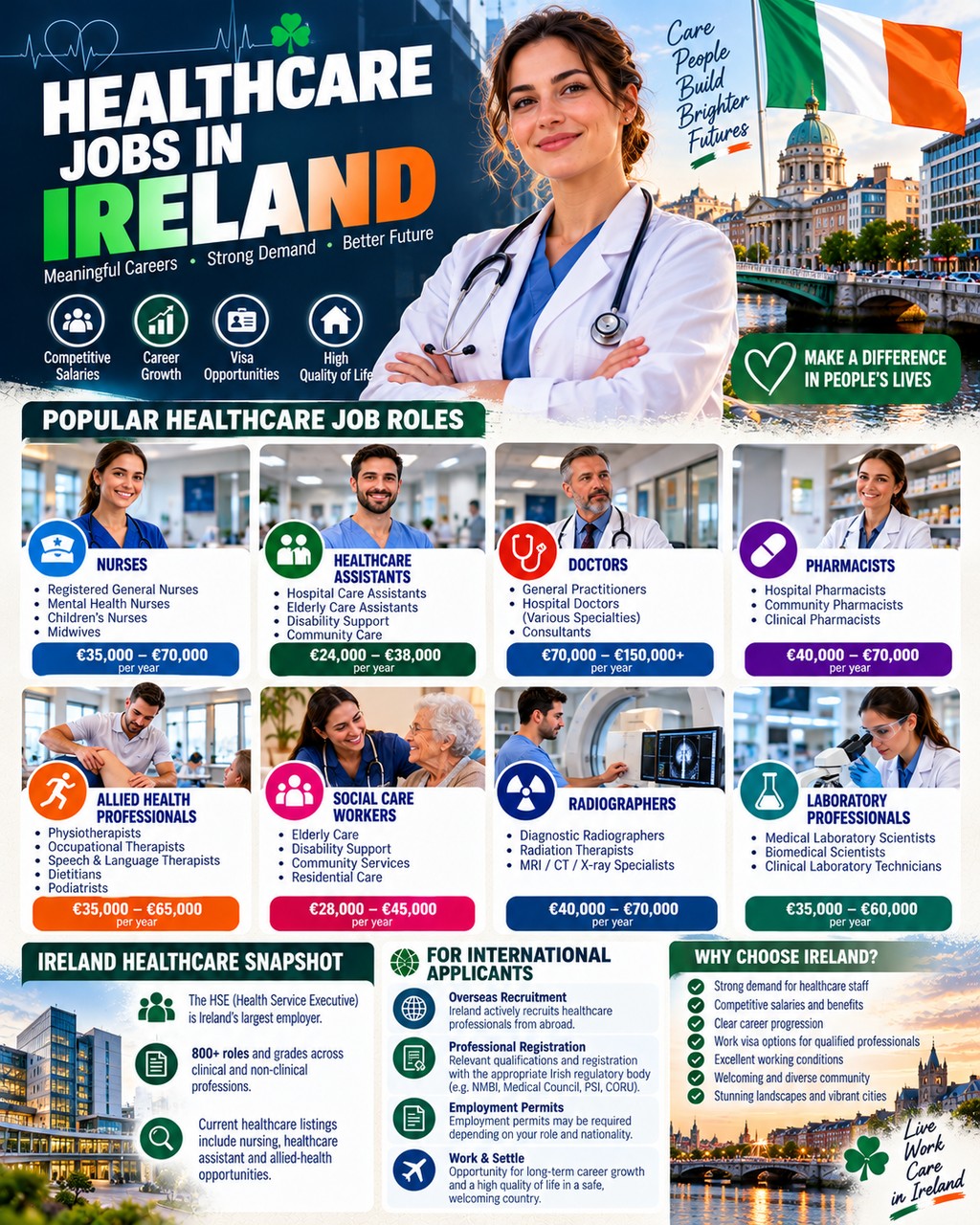
Ireland has a large and continuously evolving healthcare sector, creating opportunities for nurses, doctors, healthcare assistants, social care workers, physiotherapists, pharmacists, medical scientists, radiographers, therapists and other healthcare professionals.
For people searching for healthcare jobs in Ireland, the country’s public health service, private hospitals, nursing homes, disability services, home-care providers and specialist healthcare organisations all contribute to employment opportunities.
The Health Service Executive (HSE) is Ireland’s largest employer, with more than 160,000 employees, and its recruitment platform covers more than 800 different positions and grade levels, ranging from medical consultants and nurses to health and social care professionals and various support and administrative roles.
Healthcare is also one of the sectors where Ireland has specifically adjusted its employment-permit system to address labour shortages. In 2026, the Irish Government announced further employment-permit changes targeting shortages in healthcare and social care, including measures concerning healthcare assistants and care workers.
For international applicants, Ireland can therefore be an attractive destination. But healthcare is a regulated sector, so having a healthcare qualification from another country does not necessarily mean you can immediately work in the same profession in Ireland.
This guide explains the major healthcare careers available in Ireland, qualifications and registration requirements, opportunities for foreign workers, employment permits, English-language requirements, job-search methods, salaries and common mistakes to avoid.
Why Work in Healthcare in Ireland?
Healthcare can be an attractive career sector for several reasons.
Key advantages include:
- Large public healthcare system
- Private healthcare opportunities
- Demand for healthcare professionals
- Opportunities throughout Ireland
- International recruitment
- Career progression
- Specialist healthcare roles
- Opportunities in hospitals and community care
- Nursing-home employment
- Disability and social-care services
- Home-care opportunities
- Potential employment-permit pathways for eligible non-EEA workers
The HSE currently advertises healthcare positions throughout Ireland, rather than concentrating employment only in Dublin. Current listings include nursing positions in Galway, Limerick, Waterford, Sligo and other locations, as well as healthcare-assistant vacancies.
This means job seekers should consider the entire country rather than limiting their search to Dublin.
Major Healthcare Jobs in Ireland
The healthcare sector includes much more than doctors and nurses.
Major employment categories include:
- Registered nurses
- Doctors and medical consultants
- Healthcare assistants
- Home-care workers
- Social care workers
- Physiotherapists
- Occupational therapists
- Speech and language therapists
- Radiographers
- Pharmacists
- Medical scientists
- Psychologists
- Midwives
- Medical laboratory professionals
- Healthcare administrators
- Disability-service professionals
- Mental-health professionals
- Healthcare support workers
The qualification, registration and immigration requirements vary significantly between these occupations.
1. Nursing Jobs in Ireland
Nursing is one of the most important healthcare career paths in Ireland.
Potential nursing positions include:
- Staff nurse
- Registered general nurse
- Mental-health nurse
- Children’s nurse
- Intellectual-disability nurse
- Emergency-department nurse
- Theatre nurse
- Community nurse
- Public-health nurse
- Clinical nurse manager
- Nurse specialist
- Advanced nurse practitioner
The HSE’s current recruitment listings show numerous nursing and midwifery vacancies, including staff nurses, clinical nurse managers, emergency-department nurses and specialist positions.
Nursing is also included on Ireland’s Critical Skills Occupations List, which includes registered nurses and registered midwives.
This makes nursing one of the most significant healthcare careers for qualified international workers.
2. Healthcare Assistant Jobs
Healthcare assistants provide essential support to patients and service users.
Their responsibilities may include:
- Personal care
- Supporting daily activities
- Mobility assistance
- Patient comfort
- Meal assistance
- Basic observations
- Supporting nurses and other healthcare professionals
- Maintaining a safe environment
- Supporting people with disabilities
- Elderly care
Healthcare assistants may work in:
- Hospitals
- Nursing homes
- Disability services
- Residential care
- Home support
- Community services
The HSE currently advertises healthcare-assistant positions, including home-support campaigns and disability-service roles.
Healthcare assistants are particularly relevant to international job seekers because Ireland has identified shortages in healthcare and social care.
The Government’s 2026 employment-permit review specifically discussed flexibility around the 50:50 rule for healthcare assistants working in nursing homes, disability care and homecare because of ongoing workforce shortages.
3. Doctor and Medical Consultant Jobs
Ireland also employs doctors across numerous specialisations.
Potential positions include:
- General practitioners
- Emergency physicians
- Surgeons
- Anaesthetists
- Psychiatrists
- Paediatricians
- Cardiologists
- Radiologists
- Oncologists
- Medical consultants
- Hospital doctors
Doctors trained outside Ireland will generally need to address professional registration and recognition requirements before practising.
The HSE’s international recruitment platform explicitly includes medical consultants among the healthcare positions available through its recruitment system.
Doctors should therefore investigate:
- Medical Council registration
- Recognition of qualifications
- Internship requirements
- Specialist registration
- English-language requirements
- Employment opportunities
- Employment permits
- Immigration requirements
4. Midwifery Jobs
Midwives play an important role in Ireland’s maternity services.
Potential jobs include:
- Staff midwife
- Clinical midwife manager
- Community midwife
- Specialist midwife
- Maternity-care positions
Registered midwives are included on Ireland’s Critical Skills Occupations List.
International midwives must obtain the necessary Irish professional registration before practising.
5. Physiotherapy Jobs
Physiotherapists can work in:
- Hospitals
- Rehabilitation centres
- Private clinics
- Community healthcare
- Sports medicine
- Elderly care
- Disability services
Typical responsibilities can include:
- Rehabilitation
- Mobility assessment
- Exercise programmes
- Injury recovery
- Neurological rehabilitation
- Musculoskeletal treatment
- Patient education
Physiotherapists are included among the therapy professions on Ireland’s Critical Skills Occupations List.
6. Occupational Therapy Jobs
Occupational therapists help patients develop or regain the skills required for daily living.
They may work with:
- Elderly people
- People with disabilities
- Children
- Neurological patients
- Mental-health patients
- Rehabilitation patients
Occupational therapists are also listed among Ireland’s Critical Skills therapy professions.
International applicants should investigate the relevant Irish professional-registration requirements before applying.
7. Speech and Language Therapist Jobs
Speech and language therapists work with people experiencing communication and swallowing difficulties.
Potential work environments include:
- Hospitals
- Schools
- Rehabilitation centres
- Community healthcare
- Disability services
- Child-development services
Speech and language therapists are included within Ireland’s Critical Skills therapy-profession categories.
8. Radiographer Jobs
Radiography provides opportunities for qualified healthcare professionals specialising in medical imaging.
Possible areas include:
- Diagnostic radiography
- Medical imaging
- CT
- MRI
- X-ray
- Other specialist imaging services
Radiographers are specifically included on Ireland’s Critical Skills Occupations List.
This can make radiography particularly interesting for appropriately qualified international applicants.
9. Medical Scientist Jobs
Medical scientists and laboratory professionals can work in:
- Hospital laboratories
- Pathology
- Microbiology
- Biochemistry
- Haematology
- Immunology
- Research
- Diagnostic services
Medical Scientist is included on Ireland’s Critical Skills Occupations List.
Applicants should check the relevant professional-registration requirements and ensure their qualifications are recognised for the role they intend to perform.
10. Pharmacist Jobs
Pharmacists can work in:
- Hospitals
- Community pharmacies
- Pharmaceutical organisations
- Clinical services
- Healthcare organisations
- Research
International pharmacists should investigate the relevant Irish registration and qualification-recognition requirements before seeking employment.
Pharmacy-related work can also overlap with Ireland’s strong pharmaceutical industry, although a pharmacist role and a pharmaceutical-industry role have different professional requirements.
11. Social Care and Disability-Service Jobs
Ireland’s healthcare system includes extensive social-care and disability services.
Potential roles include:
- Social care worker
- Support worker
- Disability support worker
- Residential-care worker
- Community support worker
- Family-support worker
These roles can involve supporting people with:
- Disabilities
- Mental-health needs
- Intellectual disabilities
- Elderly-care requirements
- Community-care needs
Current HSE recruitment includes disability-service and patient/client-care positions.
12. Home-Care Jobs in Ireland
Home support is another important area.
Home-care workers may assist people in their own homes with:
- Personal care
- Mobility
- Meals
- Household-related support
- Medication-related routines under appropriate supervision
- Daily activities
- Companionship
- Community participation
Ireland’s 2026 employment-permit review renewed a quota for Home Support Services, reflecting continued demand in this area.
For overseas applicants, however, the exact occupation, salary and permit conditions should be checked before assuming a home-care position will provide a work-permit pathway.
Healthcare Jobs in Dublin
Dublin is Ireland’s largest healthcare employment centre.
Potential opportunities include:
- Hospitals
- Private hospitals
- Nursing homes
- Home-care organisations
- Disability services
- Specialist clinics
- Research organisations
- Pharmaceutical and medical-device companies
Dublin is particularly suitable for professionals looking for a large labour market and a wide variety of healthcare employers.
However, competition can also be higher, and accommodation costs can be significant.
Healthcare Jobs in Cork
Cork is another major healthcare employment centre.
Healthcare opportunities can be found in:
- Hospitals
- Nursing homes
- Community services
- Disability services
- Private healthcare
- Pharmaceutical and medical-device companies
Cork is particularly attractive for healthcare professionals who also have an interest in life sciences, medical technology or pharmaceuticals.
Healthcare Jobs in Galway
Galway is especially important for:
- Medical technology
- Hospitals
- Nursing
- Community healthcare
- Disability services
- Research
- Rehabilitation
Current HSE recruitment includes nursing and home-support vacancies in Galway.
Healthcare Jobs in Limerick
Limerick provides opportunities in:
- Hospitals
- Nursing
- Healthcare support
- Community healthcare
- Disability services
- Mental-health services
Current HSE listings include nursing positions in Limerick, including staff-nurse vacancies.
Healthcare Jobs in Smaller Irish Cities and Towns
International applicants should not limit themselves to Dublin, Cork and Galway.
Healthcare employers operate throughout:
- Kerry
- Mayo
- Sligo
- Donegal
- Waterford
- Kilkenny
- Clare
- Tipperary
- Wexford
- Louth
- Meath
- Kildare
- Westmeath
- Laois
- Offaly
Current HSE listings demonstrate healthcare recruitment across multiple counties, including Galway, Limerick, Waterford, Sligo, Mayo and Roscommon.
Being willing to work outside Dublin can therefore significantly increase the number of opportunities you consider.
Healthcare Jobs in Ireland for Foreign Workers
Ireland actively recruits international healthcare professionals.
The HSE has a dedicated International Recruitment programme and specifically states that many healthcare jobs are in demand within the Irish health service. It also notes that non-EEA healthcare applicants may qualify for a Critical Skills Employment Permit depending on their role and circumstances.
For a foreign healthcare professional, the process normally involves several separate stages:
- Qualification recognition
- Professional registration
- English-language requirements where applicable
- Job search
- Employment offer
- Employment-permit application where required
- Visa/immigration process where required
- Travel and arrival
- Final employment and registration requirements
The order and details depend on the profession.
Nursing in Ireland for Pakistani Nurses
Ireland can be an important destination for internationally trained nurses, including nurses from Pakistan.
However, a Pakistani nursing qualification does not automatically allow you to practise as a nurse in Ireland.
Nurses and midwives who qualified outside Ireland must go through the Nursing and Midwifery Board of Ireland (NMBI) process.
NMBI states that overseas-qualified nurses and midwives must complete a two-stage process:
- Recognition of qualifications
- Registration
Applicants must provide their own documentation through the NMBI process. NMBI specifically warns applicants not to share their MyNMBI credentials with third parties.
This is an important warning for international applicants who use recruitment agencies.
English Requirements for Nurses
English-language competence is an important part of the NMBI registration process for many overseas-trained nurses and midwives.
NMBI accepts certain pathways, including approved English-language evidence through IELTS Academic or OET.
For IELTS Academic, NMBI currently specifies:
- Listening: 7.0
- Reading: 7.0
- Speaking: 7.0
- Writing: 6.5
- Overall: 7.0
For OET, NMBI specifies:
- Listening: B
- Reading: B
- Speaking: B
- Writing: C+
NMBI also has alternative pathways for applicants trained and/or practising in recognised English-speaking countries under specific conditions.
Applicants should always check NMBI’s current requirements before booking an English examination because requirements and procedures can change.
Important Warning for Overseas Nurses
NMBI specifically advises overseas applicants not to leave their current employment or move to Ireland based only on an expectation that their registration will be successful.
It also advises applicants not to apply for nursing or midwifery positions until they have received their registration decision.
This is extremely important.
A safer approach is:
Qualification recognition → NMBI registration → job application → employment permit/immigration → relocation
rather than:
Pay agent → travel to Ireland → hope registration works out
Employment Permits for Healthcare Workers
If you are a non-EEA national, you generally need a valid Irish employment permit unless an exemption applies.
Healthcare has several occupations that may qualify for the Critical Skills Employment Permit.
Ireland’s current Critical Skills list includes:
- Registered nurses
- Registered midwives
- Radiographers
- Radiation therapists
- Cardiac physiologists
- Vascular technologists/physiologists
- Gastrointestinal technologists/physiologists
- Respiratory physiologists
- Audiologists
- Perfusionists
- Dieticians
- Medical scientists
- Physiotherapists
- Occupational therapists
- Speech and language therapists
- Orthoptists
The precise occupation and requirements must be checked against the current official list.
Healthcare Assistants and Employment Permits
Healthcare assistants occupy a different position from regulated professionals such as nurses.
Ireland’s 2026 employment-permit changes specifically addressed shortages in healthcare and social care and renewed the relevant employment-permit quota for Support Worker and Home Support Services categories.
The Government also highlighted particular workforce shortages involving healthcare assistants in:
- Nursing homes
- Disability care
- Homecare
Applicants should therefore check the current permit category, salary threshold and quota conditions for the specific healthcare-assistant or care-worker vacancy.
Salary Requirements for Healthcare Employment Permits
Salary is an important consideration for foreign workers.
Ireland’s employment-permit system has minimum remuneration requirements that vary according to permit and occupation.
The Government’s 2026 framework includes a standard General Employment Permit threshold of €36,605, while certain healthcare and care-related occupations have special thresholds.
For example, the Government’s 2026 employment-permit information identifies a €32,691 threshold for healthcare assistants, home carers and care workers under the relevant arrangements.
Do not rely on an old salary figure from a recruitment website. Check the official threshold applicable to your specific application.
How to Find Healthcare Jobs in Ireland
1. HSE Career Hub
The HSE Career Hub should be one of the first places healthcare professionals investigate.
The HSE provides:
- Current vacancies
- Career information
- International recruitment information
- Job alerts
- Career pathways
- Health-region information
The HSE allows applicants to register for customised weekly job alerts based on profession and geographic preference.
2. HSE Jobs
The HSE’s job-search system allows applicants to search by category.
Categories include:
- Nursing and midwifery
- Patient and client care
- Health and social care professionals
- Medical and dental
- Management
- Administrative
- Other support services
Current listings demonstrate active recruitment across multiple healthcare categories.
3. Private Hospitals
Private healthcare organisations can also recruit:
- Nurses
- Healthcare assistants
- Doctors
- Therapists
- Technicians
- Administrators
4. Nursing Homes
Nursing homes employ:
- Nurses
- Healthcare assistants
- Care workers
- Activity staff
- Support staff
- Administrators
5. Home-Care Organisations
Home-care providers recruit workers to support elderly and vulnerable people in their homes.
6. Recruitment Agencies
The HSE states that many international nurses and Health and Social Care Professionals are recruited through a small number of employment agencies that manage recruitment processes on behalf of the HSE.
However, applicants should verify that an agency is legitimate before sharing sensitive documents or paying fees.
How to Prepare a Healthcare CV for Ireland
Your healthcare CV should be specific to your profession.
Include:
- Professional title
- Professional registration
- Qualifications
- Clinical experience
- Specialisations
- Hospital/clinic experience
- Certifications
- Training
- Languages
- Relevant skills
- Employment history
For nurses
Highlight:
- Ward experience
- Patient numbers
- Speciality
- Medication administration
- Clinical procedures
- Emergency experience
- Infection control
- Documentation
- Team leadership
For healthcare assistants
Highlight:
- Elderly care
- Disability care
- Personal care
- Mobility support
- Dementia care
- Homecare experience
- Patient communication
For doctors
Highlight:
- Specialty
- Clinical experience
- Procedures
- Hospital departments
- Qualifications
- Research
- Publications
- Professional registration
Best Healthcare Specialisations for International Applicants
Some healthcare professions are particularly relevant to Ireland’s skills-shortage framework.
These include:
Nursing
One of the strongest international recruitment categories.
Midwifery
Included within Critical Skills occupations.
Radiography
Included on the Critical Skills list.
Physiotherapy
Included among eligible therapy professions.
Occupational Therapy
Also included within Critical Skills therapy professions.
Speech and Language Therapy
Another eligible therapy profession.
Medical Science
Medical scientists are included on the Critical Skills list.
These occupations should still be checked against the precise current eligibility requirements before applying.
Is Ireland Good for Healthcare Professionals?
For appropriately qualified healthcare professionals, Ireland can be an attractive career destination.
Advantages can include:
- Large healthcare system
- Public-sector opportunities
- Private-sector opportunities
- International recruitment
- Career progression
- Multiple regions
- English-speaking workplace
- Employment-permit routes for eligible occupations
However, there are also challenges.
Challenges include:
- Professional registration
- Qualification recognition
- English-language requirements
- Immigration paperwork
- Competition for some positions
- Housing costs
- Relocation expenses
- Waiting for registration decisions
- Adapting to Irish healthcare systems
The process is therefore much easier when applicants prepare their documentation before starting the job search.
Healthcare Jobs in Ireland Without a Degree
Not every healthcare-related job requires a university degree.
Potential opportunities can include:
- Healthcare assistants
- Home-care workers
- Support workers
- Care workers
- Certain patient-support roles
- Administrative healthcare positions
- Catering and support services within healthcare organisations
The HSE itself advertises many non-clinical and support roles alongside professional healthcare positions.
However, applicants from outside the EEA must separately check whether the specific occupation qualifies for an employment permit.
Common Mistakes Foreign Healthcare Applicants Make
Mistake 1: Applying before registration
For regulated professions, registration can be essential.
Nurses and midwives, for example, must be registered with NMBI to practise in Ireland.
Mistake 2: Paying an agent to create your registration account
NMBI specifically states that applicants should upload their own documents and protect their MyNMBI credentials.
Mistake 3: Leaving your current job too early
Do not resign simply because an agent tells you that registration is “almost guaranteed.”
Mistake 4: Assuming every healthcare job qualifies for a work permit
Different healthcare occupations have different rules.
Mistake 5: Using outdated salary information
Employment-permit thresholds change.
Always check the current official figures.
Mistake 6: Looking only at Dublin
Healthcare jobs exist across Ireland.
Current HSE recruitment demonstrates opportunities in multiple counties.
Healthcare Job Scams in Ireland
International healthcare recruitment attracts scammers.
Be careful if someone promises:
- Guaranteed Irish nursing job
- Guaranteed HSE job
- Guaranteed visa
- Guaranteed NMBI registration
- Guaranteed employment permit
- Job without interview
- Registration without documents
- Very high salary with no experience
Before paying anyone, verify:
- Employer
- Agency
- Job advertisement
- Employment contract
- Registration requirements
- Salary
- Employment-permit category
- Official government requirements
Most importantly, never give an agency control of your professional-registration account credentials.
NMBI explicitly warns applicants not to share MyNMBI credentials with third parties.
Current Employment Permit Processing Times
For non-EEA healthcare professionals who require an employment permit, processing time should be considered when planning relocation.
As of 8 October 2026, Ireland’s Department of Enterprise reported that it was processing:
- Critical Skills Employment Permit applications received on 1 October 2026
- New General Employment Permit applications received on 2 September 2026
- Other new permit applications received on 19 August 2026
Processing dates change regularly, so applicants should check the official government page before making travel plans.
Step-by-Step Guide for Foreign Healthcare Workers
If you are applying from Pakistan or another non-EEA country, a practical approach is:
Step 1: Identify your profession
For example:
- Nurse
- Healthcare assistant
- Physiotherapist
- Medical scientist
- Radiographer
- Doctor
- Pharmacist
Step 2: Check professional registration
Determine which Irish regulatory organisation regulates your profession.
Step 3: Check qualification recognition
Find out whether your qualification meets Irish requirements.
Step 4: Check English requirements
Determine whether IELTS, OET or another accepted form of evidence is required.
Step 5: Prepare documents
Common documents may include:
- Passport
- Degree
- Diploma
- Transcripts
- Registration certificate
- Employment references
- Experience letters
- English-language results
- Professional certificates
Step 6: Apply for registration
Complete the relevant professional-registration process.
Step 7: Search for jobs
Use:
- HSE Career Hub
- HSE Jobs
- Private hospitals
- Nursing homes
- Healthcare organisations
- Reputable recruitment agencies
Step 8: Obtain an employment offer
Make sure the job and salary are genuine.
Step 9: Check employment-permit eligibility
Confirm the correct permit category.
Step 10: Complete immigration requirements
If you require an Irish visa, complete the relevant visa process after securing the necessary employment authorisation.
Frequently Asked Questions
What are the most in-demand healthcare jobs in Ireland?
Major opportunities include nursing, healthcare assistants, midwifery, physiotherapy, occupational therapy, medical science, radiography, social care and home support.
Can Pakistani nurses work in Ireland?
Yes, Pakistani nurses can pursue employment in Ireland, but they must meet NMBI qualification-recognition and registration requirements before practising as nurses.
Is nursing on Ireland’s Critical Skills list?
Yes. Registered nurses and registered midwives are included on the current Critical Skills Occupations List.
Can healthcare assistants get jobs in Ireland?
Yes. Healthcare-assistant vacancies are advertised by the HSE and other healthcare providers.
Do healthcare assistants need a university degree?
Not necessarily. Requirements depend on the specific vacancy and employer.
Can healthcare assistants from outside the EU get work permits?
Potentially, depending on the occupation, salary, employer, quota and other employment-permit requirements. Ireland made specific 2026 changes concerning healthcare and social-care shortages.
Do nurses need IELTS for Ireland?
Many overseas-trained nurses need to demonstrate English-language competence. NMBI accepts IELTS Academic and OET under specified score requirements, while alternative pathways exist for applicants meeting certain conditions.
Can I work as a nurse in Ireland before NMBI registration?
Nurses and midwives who practise in Ireland must be registered with NMBI. Overseas applicants should therefore complete the required registration process before practising as nurses or midwives.
Where can I find healthcare jobs in Ireland?
The HSE Career Hub and HSE Jobs are among the best starting points. The HSE also provides international-recruitment information and weekly job alerts.
Is Ireland good for foreign healthcare workers?
Ireland can be an attractive option, particularly for qualified nurses, midwives, therapists, medical scientists, radiographers and other professionals whose occupations are eligible under the relevant employment-permit rules.
Final Thoughts
Ireland’s healthcare sector offers opportunities for both Irish residents and qualified international workers.
The country’s largest healthcare employer, the HSE, employs more than 160,000 people and advertises hundreds of different healthcare and support positions across Ireland.
The strongest opportunities for internationally trained professionals include nursing, midwifery, radiography, physiotherapy, occupational therapy, speech and language therapy and medical science, several of which are included on Ireland’s Critical Skills Occupations List.
There are also opportunities for healthcare assistants, home-care workers and support workers, with the Irish Government specifically addressing ongoing workforce shortages in these areas through 2026 employment-permit changes.
For Pakistani and other non-EEA applicants, however, the most important lesson is simple:
Do not start with the visa. Start with the profession.
First determine whether your qualification is recognised, whether you need professional registration, whether you meet the English-language requirements and whether your intended occupation can qualify for an employment permit.
For nurses, this means taking the NMBI process seriously. NMBI requires overseas applicants to complete qualification recognition and registration, and it specifically warns applicants not to make major relocation or employment decisions based simply on an expectation that registration will be approved.
A sensible pathway is:
Qualification → Registration → Job → Employment Permit → Visa/Immigration → Ireland
rather than paying an agent for a supposed guaranteed job or visa.
With the right qualification, registration, experience and documentation, Ireland can offer a realistic and potentially rewarding healthcare career pathway for international professionals in 2026.
Leave a Reply