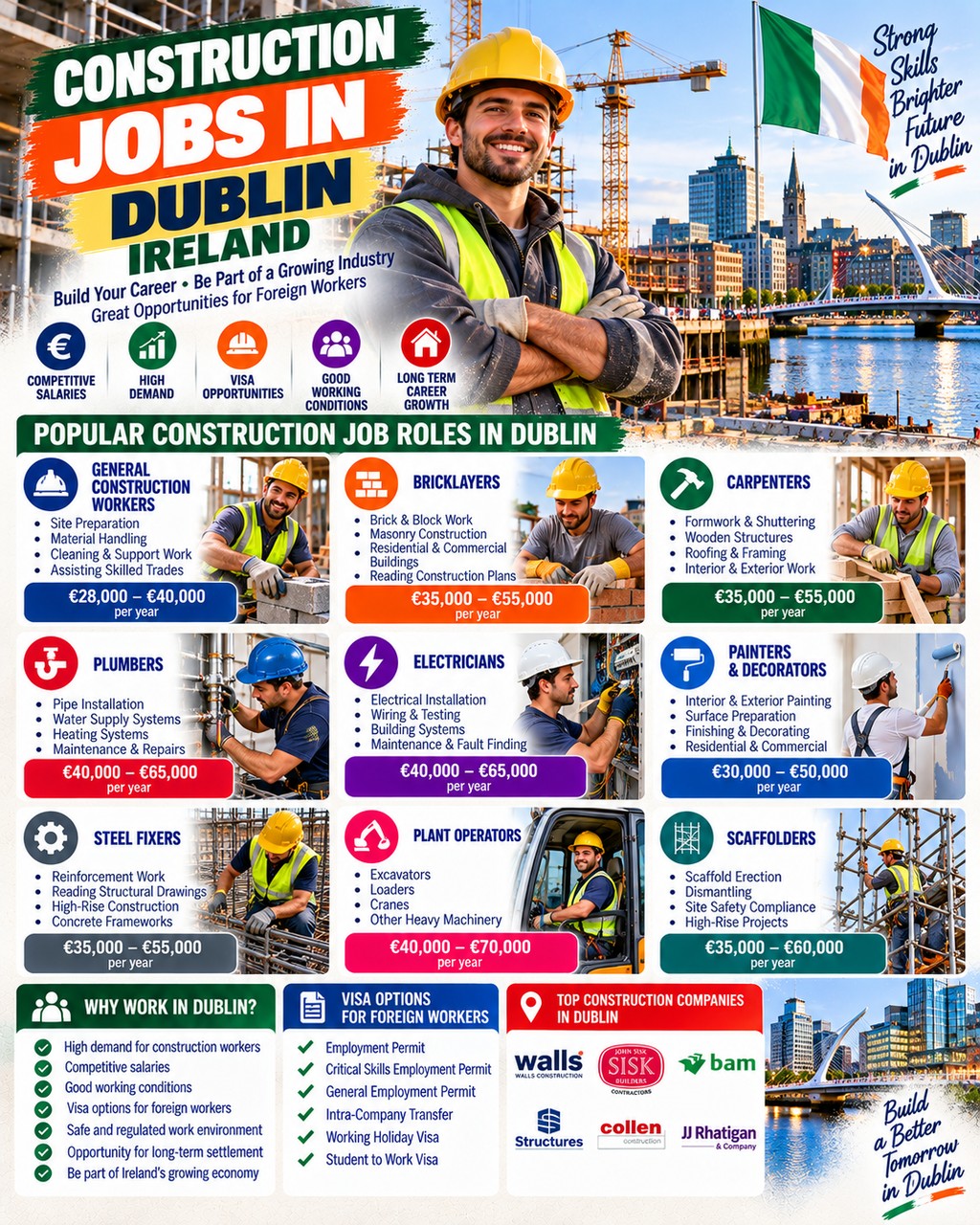
Dublin is one of Ireland’s most important construction markets, with ongoing demand connected to housing, commercial development, infrastructure, utilities, renovation and major public investment.
For people searching for construction jobs in Dublin, opportunities range from general construction and skilled trades to highly qualified positions such as civil engineers, quantity surveyors, site managers, construction project managers, BIM specialists and construction planners.
Construction is also one of the sectors Ireland has specifically identified as experiencing labour and skills shortages. In May 2026, the Irish Government announced changes to the employment-permit system aimed at addressing shortages in construction and infrastructure. Construction Planner/Scheduler and Geospatial Surveyor were added to the Critical Skills Occupations List, while five additional construction occupations became eligible for General Employment Permits: Plastic Lining Technicians, Steel Fixers, Fencing Operators/Erectors, Curtain Wallers and Concrete Pump Operators. (enterprise.gov.ie)
This makes Dublin particularly interesting for experienced construction professionals and certain skilled tradespeople from Ireland, the EU/EEA and eligible international workers.
Current JobsIreland listings demonstrate the range of opportunities in the Dublin market. Recent vacancies have included construction supervisors, construction site supervisors, experienced plumbers, civil-engineering site managers and other construction-related positions. (jobsireland.ie
Why Work in Construction in Dublin?
Dublin has several factors supporting continued construction activity.
Key reasons include:
- Housing demand
- Residential construction
- Commercial development
- Infrastructure projects
- Road and transport improvements
- Utilities projects
- Industrial and pharmaceutical facilities
- Data-centre and technology infrastructure
- Renovation and refurbishment
- Public-sector construction
- Large-scale engineering projects
Ireland’s Government has identified construction labour shortages as an important issue while pursuing its housing and infrastructure objectives. The 2026 employment-permit changes were explicitly linked to the country’s multi-billion-euro National Development Plan and home-building programme. (enterprise.gov.ie)
For someone with construction experience, this means Dublin deserves serious consideration as an employment destination.
Types of Construction Jobs in Dublin
Construction is a very broad industry.
Some of the most common job categories include:
- Construction labourers
- Skilled construction workers
- Carpenters
- Plumbers
- Electricians
- Bricklayers
- Welders and steel workers
- Groundworkers
- Plant operators
- Site supervisors
- Site managers
- Civil engineers
- Quantity surveyors
- Construction project managers
- Construction planners
- BIM professionals
- Surveyors
- Health and safety professionals
- Estimators
- Construction commercial managers
The qualifications and immigration rules can be very different between these occupations.
1. Construction Labourer Jobs in Dublin
Construction labourers support skilled tradespeople, contractors and site-management teams.
Typical duties can include:
- Moving materials
- Preparing work areas
- Loading and unloading
- Site cleaning
- Assisting tradespeople
- Basic construction work
- Supporting deliveries
- Maintaining site safety
- Using basic hand tools
These positions can be suitable for people entering the construction industry or workers with previous general construction experience.
However, overseas applicants should be careful: a job being available does not automatically mean it qualifies for an Irish employment permit.
Ireland’s employment-permit system has specific rules around construction occupations, and some general construction and building occupations remain ineligible. (enterprise.gov.ie)
2. Carpenter Jobs in Dublin
Carpenters can work on:
- Residential buildings
- Commercial buildings
- Renovations
- Modular construction
- Interior fit-outs
- Roofing
- Doors and windows
- Structural timber
- Joinery
Recent JobsIreland listings have included an experienced carpenter position involving residential construction and modular homes in the Dublin area. (jobsireland.ie
Experienced carpenters should highlight:
- Years of experience
- Types of projects
- Tools and equipment
- Reading technical drawings
- Health and safety
- Finishing skills
- Timber-frame experience
3. Plumber Jobs in Dublin
Plumbing is another important construction trade.
Plumbers may work on:
- Residential developments
- Commercial buildings
- Heating systems
- Water systems
- Drainage
- Sanitary systems
- Renovation projects
- Industrial installations
A recent JobsIreland listing advertised an Experienced Plumber – Residential Construction & Drainage position in the Dublin area. (jobsireland.ie
For overseas plumbers, relevant trade qualifications and documented experience can be important when applying to Irish employers.
4. Electrician Jobs in Dublin
Electricians can work across:
- Residential construction
- Commercial buildings
- Industrial projects
- Data centres
- Infrastructure
- Maintenance
- Renewable-energy projects
Potential specialisations include:
- Electrical installation
- Industrial electrical systems
- Maintenance
- Automation
- Building services
- Testing and inspection
Applicants should make sure their qualifications and experience are appropriate for the Irish job and any applicable regulatory requirements.
5. Steel Fixer Jobs in Dublin
Steel fixing is an important part of reinforced-concrete construction.
Steel fixers may work on:
- Foundations
- Concrete structures
- High-rise buildings
- Bridges
- Infrastructure
- Commercial developments
This occupation is particularly relevant to foreign workers because Ireland changed its employment-permit rules in 2026.
Steel Fixers were removed from the Ineligible Occupations List and made eligible for a General Employment Permit, subject to the applicable requirements. (enterprise.gov.ie)
This does not mean every steel-fixer job automatically qualifies for a permit. The specific job, employer, salary and application conditions still matter.
6. Construction Site Supervisor Jobs
Site supervisors help coordinate day-to-day construction activity.
Responsibilities can include:
- Supervising workers
- Coordinating subcontractors
- Monitoring progress
- Checking materials
- Maintaining safety standards
- Reading construction drawings
- Coordinating deliveries
- Reporting project issues
- Supporting site managers
Current JobsIreland listings have included Construction Supervisor and Construction Site Supervisor positions in Dublin. (jobsireland.ie)
For experienced supervisors, a CV should clearly show:
- Number of workers supervised
- Project size
- Project type
- Health-and-safety responsibilities
- Subcontractor coordination
- Construction methods
- Reporting responsibilities
7. Construction Site Manager Jobs
Site managers are responsible for managing construction projects at site level.
Their duties may include:
- Managing subcontractors
- Scheduling work
- Managing workers
- Monitoring budgets
- Health and safety
- Quality control
- Materials
- Project timelines
- Client coordination
- Progress reporting
A current JobsIreland search has included a Site Manager (Civil Engineering) vacancy in County Dublin. (jobsireland.ie
Site managers are also included within Ireland’s Critical Skills Occupations List under the relevant production-manager/site-manager category. (enterprise.gov.ie
8. Civil Engineering Jobs in Dublin
Civil engineering is one of the strongest professional career paths within construction.
Potential roles include:
- Civil engineer
- Structural engineer
- Site engineer
- Project engineer
- Design engineer
- Infrastructure engineer
- Geotechnical engineer
- Transportation engineer
- Water engineer
Ireland’s current Critical Skills Occupations List specifically includes Civil Engineers and Structural Engineers and Site Engineers. (enterprise.gov.ie
This makes qualified civil and structural engineers particularly interesting for international applicants seeking an Irish employment-permit pathway.
9. Quantity Surveyor Jobs in Dublin
Quantity surveyors are important in controlling construction costs.
Typical responsibilities include:
- Cost estimation
- Tender preparation
- Contract administration
- Cost control
- Procurement
- Valuation
- Project budgeting
- Financial reporting
- Subcontractor management
Candidates should highlight experience with:
- Construction contracts
- Cost planning
- Procurement
- Measurement
- Estimating software
- Commercial management
Quantity surveying can provide a strong career path for candidates with relevant academic and professional qualifications.
10. Construction Planner Jobs
Construction planning is becoming particularly important in Ireland.
A construction planner or scheduler may be responsible for:
- Project schedules
- Resource planning
- Construction sequencing
- Progress tracking
- Programme updates
- Contractor coordination
- Risk identification
- Project reporting
Ireland added Construction Planner/Scheduler to the Critical Skills Occupations List in 2026. (enterprise.gov.ie)
This is one of the more interesting developments for experienced international construction professionals.
People with experience in:
- Primavera P6
- Microsoft Project
- Construction planning
- Scheduling
- Project controls
- Cost planning
should pay particular attention to Dublin vacancies in this area.
11. Geospatial Surveyor and Land Surveyor Jobs
Surveying plays a critical role in construction.
Potential responsibilities include:
- Land surveying
- Setting out
- Topographical surveys
- Construction surveying
- GPS/GNSS
- Total stations
- CAD
- GIS
- Site measurements
Ireland added Geospatial Surveyor, including Land Surveyor and Geomatics Surveyor roles, to the Critical Skills Occupations List in 2026. (enterprise.gov.ie)
This can be a particularly attractive option for internationally qualified surveyors.
12. BIM Jobs in Dublin
Building Information Modelling has become increasingly important in modern construction.
Potential positions include:
- BIM Manager
- BIM Coordinator
- BIM Technician
- BIM Engineer
- Revit Technician
- Digital Construction Specialist
Ireland’s Critical Skills list includes BIM Manager and also lists BIM Coordinator/Technician within the relevant eligible occupations. (enterprise.gov.ie
Useful software and skills include:
- Revit
- Navisworks
- AutoCAD
- BIM 360
- Civil 3D
- Clash detection
- Model coordination
- Digital construction
13. Construction Project Manager Jobs
Project managers coordinate the overall delivery of construction projects.
They may manage:
- Budget
- Schedule
- Contractors
- Consultants
- Procurement
- Quality
- Health and safety
- Client relationships
- Risk
- Project reporting
Construction project-management experience can be particularly valuable for large residential, commercial, infrastructure and industrial projects.
14. Health and Safety Jobs
Construction health and safety is a major responsibility in Ireland.
Potential roles include:
- Health and safety officer
- Safety advisor
- Construction safety manager
- Site safety professional
- Environmental health and safety specialist
Useful qualifications can include:
- IOSH
- NEBOSH
- Construction safety training
- Relevant Irish qualifications
- Site safety experience
International applicants should check which qualifications Irish employers recognise and whether additional Irish certification is required.
Construction Jobs in Different Parts of Dublin
Do not limit your search to Dublin city centre.
Construction employment is spread across the wider Dublin area.
Dublin City Centre
Projects include:
- Commercial buildings
- Apartments
- Hotels
- Offices
- Renovations
- Infrastructure
Dublin 2 and Dublin 4
These areas are particularly associated with:
- Commercial construction
- Office developments
- Hotels
- High-value residential projects
Dublin 12
Opportunities can include:
- Residential construction
- Renovation
- Commercial projects
- Industrial work
Dublin 15
Construction activity includes:
- Residential development
- Commercial projects
- Infrastructure
- Community facilities
South Dublin
Areas such as:
- Tallaght
- Sandyford
- Stillorgan
- Dundrum
- Clondalkin
can provide construction and building-services opportunities.
A recent JobsIreland listing, for example, advertised a construction site supervisor position in Stillorgan, while another construction vacancy was located in Dublin 16. (jobsireland.ie
Construction Jobs for Foreign Workers in Dublin
Ireland can be an attractive destination for overseas construction professionals because the Government has explicitly identified construction skills shortages.
However, foreign workers should understand the employment-permit system before applying.
There are three broad situations:
1. Critical Skills occupations
These are highly skilled occupations where Ireland has identified shortages.
Construction-related examples now include:
- Construction Planner/Scheduler
- Geospatial Surveyor
- Certain engineering roles
- Site Manager
- BIM-related roles
- Construction project-management roles
The exact occupation and specialisation matter. (enterprise.gov.ie)
2. General Employment Permit occupations
A number of construction occupations can qualify for General Employment Permits.
The 2026 changes specifically added:
- Steel Fixers
- Plastic Lining Technicians
- Fencing Operators/Erectors
- Curtain Wallers
- Concrete Pump Operators
to the eligible categories. (enterprise.gov.ie)
3. Ineligible occupations
Some construction occupations remain ineligible.
The official list includes categories such as certain road construction, rail construction, other construction operatives and some general construction/building trades, subject to the specific exceptions listed by the Government. (enterprise.gov.ie
This is why overseas applicants should check the exact occupation, rather than assuming “construction jobs” as a whole are eligible.
Construction Jobs in Dublin for Pakistani Workers
Pakistani construction professionals can apply for eligible Dublin positions.
Potentially relevant backgrounds include:
- Civil engineering
- Structural engineering
- Site management
- Construction planning
- Surveying
- BIM
- Quantity surveying
- Skilled trades
- Steel fixing
- Specialist construction
A sensible process is:
- Identify your exact occupation.
- Check Ireland’s employment-permit list.
- Check whether your salary meets the applicable threshold.
- Prepare an Irish-style CV.
- Search genuine Dublin employers.
- Apply directly.
- Obtain a genuine job offer.
- Determine the appropriate employment permit.
- Complete immigration requirements.
- Relocate only after the necessary authorisation is secured.
Salary Requirements for Foreign Construction Workers
Salary is especially important for non-EEA applicants.
Ireland’s employment-permit system has minimum remuneration requirements.
For 2026, the standard minimum annual remuneration for a General Employment Permit is €36,605, subject to the applicable rules and exceptions. (enterprise.gov.ie
Critical Skills occupations have their own remuneration requirements.
For example, the Critical Skills system has a standard threshold for eligible occupations requiring a relevant degree, while certain other categories have different thresholds. (enterprise.gov.ie
Therefore, an overseas construction worker should check:
Occupation + salary + employer + permit category
rather than simply looking at whether a job advertisement says “construction.”
Qualifications Useful for Dublin Construction Jobs
The appropriate qualification depends on the position.
For labourers
Experience and site skills may be more important than academic qualifications.
For skilled trades
Employers may look for:
- Trade certification
- Apprenticeship
- Relevant technical qualification
- Documented experience
For engineers
Typically:
- Engineering degree
- Relevant professional experience
- Technical knowledge
For quantity surveyors
Typically:
- Quantity surveying qualification
- Construction experience
- Cost-management knowledge
For site managers
Employers often value:
- Construction experience
- Management experience
- Safety knowledge
- Project-management skills
For BIM professionals
Useful skills include:
- Revit
- AutoCAD
- Navisworks
- BIM coordination
- 3D modelling
How to Find Construction Jobs in Dublin
1. JobsIreland
JobsIreland is an important starting point.
Current listings have included construction supervisors, site supervisors, plumbers and other construction positions in the Dublin area. (jobsireland.ie)
Search terms include:
- Construction jobs Dublin
- Site manager Dublin
- Civil engineer Dublin
- Quantity surveyor Dublin
- Construction planner Dublin
- BIM jobs Dublin
- Plumber Dublin
- Carpenter Dublin
- Electrician Dublin
- Steel fixer Dublin
- Groundworker Dublin
- Construction supervisor Dublin
2. EURES
EURES can help international job seekers research employment opportunities and working conditions in Ireland.
3. Direct Company Websites
Search construction companies directly.
Use searches such as:
Construction companies Dublin careers
Civil engineering companies Dublin jobs
House builders Dublin careers
Infrastructure contractors Dublin jobs
4. Recruitment Agencies
Recruitment agencies can be useful for construction professionals.
However, verify the agency, employer and vacancy before providing money or sensitive documents.
How to Make a Construction CV for Dublin
A construction CV should be practical and achievement-focused.
Include:
Personal information
- Name
- Phone
- Current location
Professional summary
Example:
Civil engineering professional with 8 years of experience in residential and infrastructure projects, including site supervision, subcontractor coordination and project scheduling.
Work experience
For each job, include:
- Employer
- Position
- Dates
- Project type
- Responsibilities
- Achievements
Technical skills
Examples:
- AutoCAD
- Revit
- Civil 3D
- Primavera P6
- MS Project
- Quantity surveying
- Site management
- Setting out
- Surveying
Certifications
List:
- Safety certificates
- Trade qualifications
- Engineering qualifications
- Project-management certifications
- BIM certifications
Skills That Can Improve Your Chances
The construction industry is increasingly technical.
Useful skills include:
- BIM
- Revit
- AutoCAD
- Civil 3D
- Primavera P6
- MS Project
- Quantity surveying
- Project controls
- Cost estimation
- Construction planning
- Surveying
- Health and safety
- Quality control
- Environmental management
For skilled trades, experience and recognised qualifications remain particularly important.
Construction Jobs Without a University Degree
There are construction opportunities that do not require a university degree.
Potential examples include:
- Carpenter
- Plumber
- Electrician
- Steel fixer
- Fencing operator
- Curtain waller
- Concrete pump operator
- Skilled labourer
- Plant operator
- Construction worker
Some of these occupations have become more relevant to international workers following Ireland’s 2026 employment-permit changes. (enterprise.gov.ie)
However, no degree required does not mean no qualifications required.
A skilled trade may still require:
- Experience
- Trade certification
- Safety training
- Employer-specific requirements
- Relevant licences
And for overseas applicants, employment-permit eligibility must be checked separately.
Construction Job Scams to Avoid
International construction workers should be particularly careful with overseas recruitment scams.
Be suspicious of anyone offering:
- Guaranteed Dublin construction job
- Guaranteed work permit
- Guaranteed visa
- Job without an interview
- Extremely high salary with no experience
- Fake construction-company contracts
- Employment in exchange for a large upfront payment
Verify:
- Employer website
- Company registration
- Job advertisement
- Employment contract
- Job location
- Salary
- Occupation classification
- Employment-permit eligibility
Do not hand over your passport or personal documents to an unknown agent unnecessarily.
Dublin Construction Jobs: Practical Strategy for 2026
If you are serious about finding construction work in Dublin, use this approach.
Step 1 — Identify your exact trade
Don’t simply say:
I work in construction.
Instead identify yourself as:
Civil Engineer
or:
Steel Fixer
or:
Quantity Surveyor
or:
Construction Planner
or:
Plumber
Step 2 — Check the Irish occupation list
This is especially important if you are outside the EEA.
Step 3 — Build a targeted CV
Highlight projects, skills and qualifications.
Step 4 — Search across Dublin
Don’t restrict yourself to the city centre.
Include the wider Dublin region.
Step 5 — Apply directly
Use JobsIreland, EURES and company websites.
Step 6 — Verify the employer
Before accepting an offer, research the company.
Step 7 — Check the salary
Make sure the salary meets the relevant employment-permit requirement if you need a permit.
Step 8 — Understand the permit
Determine whether the position falls under:
- Critical Skills Employment Permit
- General Employment Permit
- Another permit category
- No permit route
Step 9 — Only then plan relocation
Do not purchase expensive flights or pay an agent based solely on a verbal promise.
Frequently Asked Questions
What construction jobs are in demand in Dublin?
Opportunities can be found in site management, civil engineering, construction planning, surveying, BIM, skilled trades, plumbing, electrical work, steel fixing and specialist construction.
Can foreigners get construction jobs in Dublin?
Yes, depending on their occupation, qualifications, employer, salary and employment-permit eligibility.
Can Pakistani construction workers work in Dublin?
Yes, eligible Pakistani workers can apply for Dublin construction jobs. The specific occupation must qualify under Ireland’s employment-permit rules.
Are construction workers in demand in Ireland?
Yes. The Irish Government specifically cited construction and infrastructure labour shortages when announcing its 2026 employment-permit changes. (enterprise.gov.ie)
Which construction jobs are on Ireland’s Critical Skills list?
The current list includes roles such as Construction Planner/Scheduler, Geospatial Surveyor, Civil Engineer, Structural Engineer, Site Engineer, BIM Manager and certain other specialised construction-related roles. (enterprise.gov.ie
Can a steel fixer get an Irish work permit?
Steel fixers were made eligible for General Employment Permits under Ireland’s 2026 employment-permit changes, subject to the applicable requirements. (enterprise.gov.ie)
Can plumbers get construction jobs in Dublin?
Yes. Plumbing vacancies are advertised in the Dublin area, including recent residential construction and drainage positions. (jobsireland.ie
Can I get a construction job in Dublin without a degree?
Yes. Many trade and site roles do not require university degrees. However, relevant experience, trade qualifications and safety training may be required.
What is the minimum salary for a General Employment Permit?
The standard minimum annual remuneration is €36,605 in 2026, subject to the applicable rules and exceptions. (enterprise.gov.ie
Where should I search for construction jobs in Dublin?
Start with JobsIreland, EURES, construction-company career pages and reputable recruitment agencies.
Final Thoughts
Dublin remains one of Ireland’s most important construction markets, with opportunities across residential construction, commercial development, infrastructure, utilities, industrial projects and renovation.
For experienced professionals, some of the most attractive career paths include civil engineering, site management, construction planning, surveying, BIM, quantity surveying and project management.
For skilled tradespeople, opportunities can include plumbing, electrical work, carpentry, steel fixing, curtain walling, fencing, concrete-pump operation and other specialist construction work.
Ireland’s 2026 employment-permit changes are particularly significant for international construction workers. The Government added Construction Planner/Scheduler and Geospatial Surveyor to the Critical Skills list and opened General Employment Permit routes for several additional specialist construction occupations. (enterprise.gov.ie
Current JobsIreland vacancies also demonstrate that Dublin’s market includes roles ranging from construction supervisors and site supervisors to plumbers and civil-engineering site managers. (jobsireland.ie
For someone applying from Pakistan or another non-EEA country, the most important step is to identify the exact occupation before starting the immigration process.
The ideal pathway is:
Construction skill → Relevant qualification/experience → Genuine Dublin employer → Suitable salary → Employment permit eligibility → Work authorisation → Relocation
Do not rely on an agent promising a “guaranteed construction visa.”
With the right skills and a legitimate employer, Dublin can offer strong opportunities for construction professionals and selected skilled tradespeople in 2026.
Leave a Reply