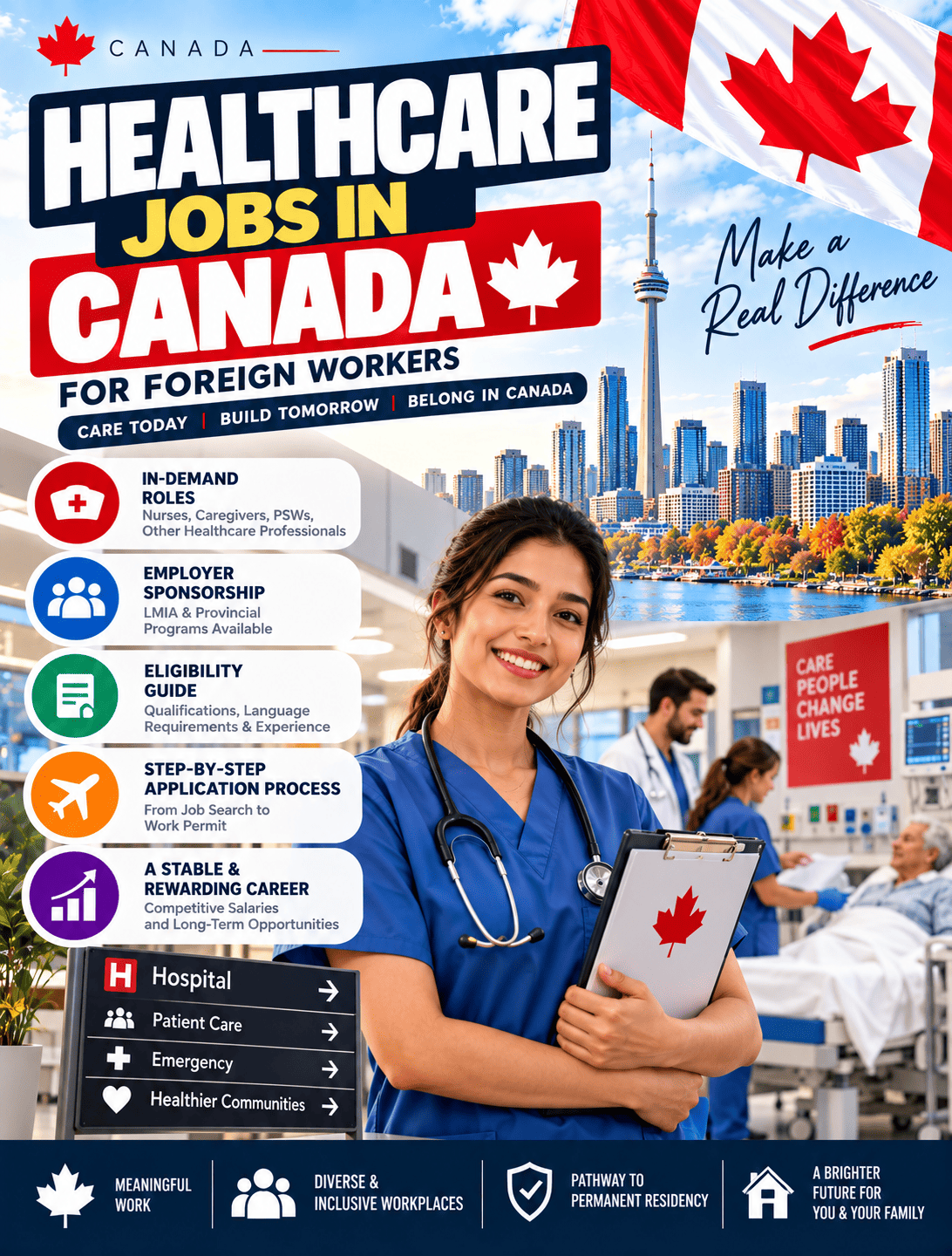
Canada’s healthcare sector offers career opportunities for qualified workers from around the world. Hospitals, long-term care facilities, retirement homes, home-care providers, clinics and other healthcare organizations employ thousands of professionals across the country.
For foreign workers, healthcare can be particularly attractive because Canada has a large and diverse healthcare system and continues to recruit workers in several healthcare occupations. However, getting a healthcare job in Canada from outside the country is not as simple as finding a vacancy and submitting a résumé.
Many healthcare occupations are regulated, meaning foreign-trained professionals may need to have their education, qualifications and professional credentials assessed before they can legally work in the same occupation in Canada.
This is especially important for nurses, physicians, pharmacists, physiotherapists and other regulated professionals.
At the same time, there are healthcare-related occupations that may have different entry requirements, including nurse aides, health care aides, personal support workers and other patient-support positions.
For example, Canada’s official Job Bank recently showed more than 500 jobs nationally under the nurse aides, orderlies and patient service associates occupational group, including hundreds of health care aide positions.
This guide explains the healthcare jobs available to foreign workers, the difference between regulated and non-regulated occupations, licensing requirements, potential employer-supported work opportunities and how international applicants can search for legitimate Canadian healthcare jobs.
Why Healthcare Jobs Are Attractive to Foreign Workers
Healthcare is one of the sectors that international job seekers frequently consider when looking at Canada.
There are several reasons.
First, healthcare services are required throughout the country. Hospitals and care facilities are not concentrated exclusively in Canada’s largest cities.
Second, healthcare includes a very wide range of occupations.
A foreign worker could potentially pursue a career as:
- Registered nurse
- Licensed practical nurse
- Nurse practitioner
- Physician
- Pharmacist
- Medical laboratory technologist
- Medical sonographer
- Physiotherapist
- Occupational therapist
- Respiratory therapist
- Dental professional
- Health care aide
- Nurse aide
- Personal support worker
- Medical orderly
- Home support worker
- Healthcare administrator
- Healthcare manager
- Medical office worker
The requirements are very different for each occupation.
Someone with a foreign nursing degree, for example, faces a very different process from someone applying for a health care aide position.
Understanding that difference is one of the most important parts of planning a Canadian healthcare career.
Healthcare Jobs in Canada for Foreign Workers
1. Registered Nurse Jobs
Registered nurses are among the most commonly discussed healthcare careers for international applicants.
Registered nurses can work in:
- Hospitals
- Long-term care facilities
- Community healthcare
- Clinics
- Home healthcare
- Mental health services
- Rehabilitation
- Public health
- Private healthcare organizations
Foreign-trained nurses may have significant professional experience but still need to complete Canada’s nursing registration process.
Nursing is regulated at the provincial and territorial level.
That means an applicant generally cannot simply arrive in Canada with a foreign nursing qualification and immediately begin working as a registered nurse.
The applicant may need to:
- Have their education assessed.
- Provide proof of nursing education.
- Demonstrate professional experience.
- Meet language requirements where applicable.
- Complete the required registration process.
- Meet examination requirements where applicable.
- Register with the appropriate provincial or territorial nursing regulator.
The exact process depends on the province or territory.
This makes choosing a province an important decision for internationally educated nurses.
Are Canadian employers hiring foreign nurses?
There are current examples of nursing vacancies in Canada’s temporary foreign worker job listings.
At the time of research, Canada’s official Job Bank showed a registered nurse position in Richmond Hill, Ontario paying $41.28 per hour, while another registered nurse position in Dundas, Ontario listed $45 per hour and indicated that an LMIA had been requested.
These postings demonstrate that foreign-worker recruitment can occur in nursing.
However, an LMIA-related job posting does not eliminate professional licensing requirements.
A nurse still needs to meet the applicable requirements to legally practise nursing.
2. Registered Practical Nurse and Licensed Practical Nurse Jobs
Canada uses different nursing designations depending on the province.
In Ontario, for example, the designation is generally Registered Practical Nurse (RPN).
In many other provinces, the comparable occupation is known as Licensed Practical Nurse (LPN).
Foreign-trained applicants with nursing education below the registered nurse level may explore these positions depending on their qualifications.
Job Bank’s temporary foreign worker search has recently included RPN positions.
For example, postings have included:
- Registered practical nurse positions in Powassan, Ontario
- Registered practical nurse positions in Barrie, Ontario
Both examples showed that an LMIA had been requested.
Again, foreign-trained applicants should distinguish between finding an employer and being professionally licensed.
The two processes are related but not identical.
3. Health Care Aide Jobs
Health care aide positions can be particularly interesting for international applicants who do not qualify to work as registered nurses.
Health care aides may assist patients with everyday care and support.
Depending on the workplace and position, duties can include:
- Assisting with personal hygiene
- Helping patients move
- Supporting meals
- Monitoring patients
- Assisting with daily activities
- Maintaining patient comfort
- Reporting observations to nursing staff
- Supporting elderly or disabled patients
Health care aides may work in:
- Long-term care homes
- Retirement facilities
- Hospitals
- Assisted living facilities
- Home care
- Community healthcare
Job Bank recently showed more than 500 health care aide jobs across Canada under the broader NOC 33102 occupational group.
The distribution was spread across several provinces, including Ontario, Saskatchewan, Quebec, Alberta, British Columbia and others.
This is important for foreign workers because it demonstrates that healthcare opportunities are not limited to Toronto or Vancouver.
4. Nurse Aide Jobs
Nurse aides, orderlies and patient service associates provide basic patient-care support to healthcare teams.
According to Job Bank, this occupational group includes workers who assist nurses, hospital staff and physicians in providing basic patient care.
They can work in:
- Hospitals
- Nursing homes
- Assisted-care facilities
- Long-term care
- Other healthcare establishments
Job Bank’s national data recently showed more than 500 vacancies in this occupational group.
The occupation generally requires post-secondary education, apprenticeship training of less than two years or more than six months of on-the-job training, depending on the specific position and requirements. Job Bank lists a national median wage of approximately $24 per hour for the broader occupational group.
Foreign applicants should still verify the requirements of the specific province and employer.
5. Personal Support Worker Jobs
Personal support workers, often referred to as PSWs in Ontario, provide assistance to people who require support with daily activities.
They may work with:
- Elderly people
- People with disabilities
- Patients recovering from illness
- People receiving home care
- Residents of long-term care facilities
Duties can include:
- Personal hygiene assistance
- Mobility assistance
- Meal assistance
- Household support
- Companionship
- Monitoring and reporting changes in condition
Job Bank’s temporary foreign worker listings have included personal support worker positions in Ontario.
For example, a recent listing in Markham showed a personal support aide position paying $23 per hour with an LMIA requested. Another position in Scarborough listed $21.28 per hour.
These examples show that healthcare-support occupations can sometimes provide opportunities for foreign workers.
6. Long-Term Care Jobs
Canada has a substantial long-term care sector because of its aging population.
Long-term care facilities employ many different workers, including:
- Registered nurses
- Practical nurses
- Nurse aides
- Personal support workers
- Care aides
- Healthcare supervisors
- Dietary workers
- Rehabilitation staff
- Administrative employees
- Maintenance staff
Long-term care can therefore provide opportunities across multiple skill levels.
Job Bank’s temporary foreign worker search recently included a long-term care aide position in Toronto paying $23 per hour with an LMIA requested.
Foreign workers should consider long-term care facilities outside Canada’s largest cities as well.
Some facilities in smaller communities may have recruitment needs that differ from those in major metropolitan areas.
7. Home Care Jobs
Home healthcare is another area worth investigating.
Home support workers can provide services to people who need assistance in their own homes.
Responsibilities may include:
- Personal care
- Meal preparation
- Light housekeeping
- Assistance with mobility
- Companionship
- Routine daily activities
The exact occupation and immigration classification can vary depending on the actual duties.
Foreign workers should never rely solely on the job title.
Read the duties carefully.
A job advertised as a “caregiver” could involve very different responsibilities from a regulated nursing position.
8. Medical Orderly Jobs
Medical orderlies support patients and healthcare teams.
Depending on the facility, duties may include:
- Transporting patients
- Moving equipment
- Supporting hospital staff
- Cleaning and preparing areas
- Assisting with basic patient movement
Medical orderly positions also appear in Canada’s temporary foreign worker job listings.
For example, a recent Job Bank listing showed a medical orderly position in Quebec paying approximately $20–$21 per hour with an LMIA requested.
This can be an option for applicants who have relevant healthcare support experience but are not licensed nurses or physicians.
9. Healthcare Management Jobs
Experienced healthcare professionals may also find management opportunities.
Potential roles include:
- Clinical services manager
- Healthcare administrator
- Long-term care administrator
- Nursing manager
- Healthcare operations manager
- Facility manager
These positions normally require significantly more experience and education.
Job Bank’s current temporary foreign worker listings included a clinical services manager position in Brampton, Ontario with a listed wage of $58.50 per hour. It also showed a long-term care administrator position in Stouffville, Ontario with a salary range of $108,000 to $138,000 annually.
These are examples rather than typical salaries.
Management positions have their own education and experience requirements, and applicants should never assume that an international management title automatically transfers to a Canadian equivalent.
Healthcare Jobs and Employer Sponsorship
Many foreign workers search for:
“Healthcare jobs in Canada with sponsorship.”
In Canada, the term “sponsorship” is often used informally.
The actual immigration mechanism may involve:
- Labour Market Impact Assessment (LMIA)
- International Mobility Program
- Provincial Nominee Program
- Express Entry
- Other work-permit or immigration pathways
A healthcare employer may be willing to recruit a foreign worker, but that does not automatically mean the employer can bypass professional licensing or immigration requirements.
For example, a Job Bank listing can indicate that an employer has requested an LMIA.
That is not the same thing as saying that an applicant automatically qualifies for a work permit.
Job Bank currently shows temporary foreign worker healthcare vacancies with both LMIA-requested positions and other recruitment classifications.
What Is an LMIA?
The Labour Market Impact Assessment is part of Canada’s Temporary Foreign Worker Program.
An employer may need an LMIA before hiring a foreign worker.
The assessment generally considers whether hiring a temporary foreign worker is appropriate for the Canadian labour market.
For foreign healthcare applicants, an LMIA-supported position can potentially be useful because it may provide an employer-specific basis for a work permit application.
But there is an important distinction:
LMIA approval does not equal professional licensing.
A foreign nurse could potentially have an employer interested in hiring them, but the applicant may still need to complete provincial nursing registration before practising as a nurse.
Licensing: The Biggest Issue for Foreign Healthcare Workers
This is probably the most important section of this entire article.
Healthcare is not one single profession.
Some healthcare occupations are regulated and some are not.
For regulated occupations, the province or territory controls who can practise.
Examples include:
- Registered nurses
- Practical nurses
- Physicians
- Pharmacists
- Dentists
- Physiotherapists
- Occupational therapists
- Many other healthcare professions
A foreign-trained healthcare worker should therefore investigate credential recognition before making an immigration decision.
Canada’s official Job Bank advises foreign candidates to check whether their occupation is regulated and determine the time and cost required to have credentials recognized.
This can prevent a major mistake.
Imagine spending money moving to Canada only to discover that you cannot legally work in your profession until you complete an assessment, examination or additional training.
Planning the credential process first is much safer.
How Foreign Nurses Can Prepare for Canada
If you are an internationally educated nurse, consider this sequence.
Step 1: Identify Your Nursing Designation
Determine whether your Canadian target occupation is:
- Registered Nurse
- Registered Practical Nurse
- Licensed Practical Nurse
- Nurse Practitioner
Your foreign education may not map directly to one Canadian designation.
Step 2: Select Potential Provinces
Research the provinces where you may want to live and work.
Do not automatically select Toronto.
Other provinces may have different recruitment conditions, living costs and registration processes.
Step 3: Check Credential Requirements
Determine which organization handles nursing registration in the province.
Step 4: Prepare Documentation
You may need documents such as:
- Degree or diploma
- Academic transcripts
- Nursing registration
- Employment history
- Professional references
- Identity documents
- Language test results
- Other supporting documentation
Step 5: Complete Required Assessments
Depending on your circumstances, your credentials may need to be assessed.
Step 6: Meet Language Requirements
English or French proficiency may be required.
Step 7: Complete Examination Requirements
Depending on your nursing designation and province, you may need to complete examinations.
Step 8: Apply for Registration
You need the appropriate provincial registration before legally practising the regulated profession.
What Qualifications Help Foreign Healthcare Workers?
Employers may look for:
- Relevant education
- Professional certification
- Work experience
- Language ability
- Patient-care experience
- Communication skills
- Computer skills
- Documentation skills
- Medical terminology
- Infection-control knowledge
- First-aid training
- CPR certification
- Professional references
For senior positions, leadership experience can also be important.
A foreign applicant should not simply list a job title.
Explain what you actually did.
For example:
Instead of:
“Nurse – 5 years.”
A stronger résumé might explain:
“Provided patient care in a 40-bed medical ward, monitored vital signs, administered medications according to physician orders, maintained patient records and collaborated with physicians and nursing staff.”
Specific information helps employers understand your experience.
English and French Skills Matter
Language is particularly important in healthcare.
Healthcare workers communicate with:
- Patients
- Families
- Doctors
- Nurses
- Pharmacists
- Therapists
- Administrators
- Emergency personnel
A misunderstanding in a healthcare environment can have serious consequences.
Depending on the profession and province, applicants may therefore need to demonstrate English or French proficiency.
Quebec has different language requirements and operates under a distinct immigration framework from Canada’s other provinces.
Applicants should research language requirements specific to their intended occupation and province.
Which Provinces Should Foreign Healthcare Workers Consider?
There is no single “best province” for every healthcare worker.
Your best option depends on:
- Occupation
- Licensing requirements
- Job availability
- Salary
- Cost of living
- Immigration pathway
- Language
- Family circumstances
- Rural or urban preferences
Current Job Bank data demonstrates that healthcare-support jobs are distributed across Canada.
For health care aides, recent listings included substantial numbers in Saskatchewan, Quebec, Ontario, Alberta and British Columbia.
This is useful because international applicants sometimes make the mistake of searching only for Toronto jobs.
A national search can produce more options.
Rural Healthcare Jobs Can Be Worth Considering
Smaller communities can sometimes offer opportunities that are overlooked by international applicants.
A foreign worker may immediately search:
Toronto healthcare jobs
or:
Vancouver nurse jobs
But those cities can attract large numbers of applicants.
Healthcare facilities in smaller communities may have different recruitment needs.
Potential locations can include:
- Smaller Ontario communities
- Northern communities
- Rural Alberta
- Saskatchewan
- Manitoba
- Atlantic Canada
- British Columbia’s smaller communities
This does not mean every rural healthcare job provides immigration support.
It simply means that international applicants should not artificially restrict their search to Canada’s largest cities.
How to Find Healthcare Jobs in Canada From Outside Canada
Canada’s official Job Bank provides a specific resource for foreign candidates.
It recommends that people outside Canada:
- Confirm their eligibility.
- Check whether their qualifications are recognized.
- Search and apply to employers recruiting international candidates.
This is a much better starting point than relying on random Facebook groups or recruitment advertisements.
Job Bank identifies jobs that are open to international candidates.
Its guidance explains that a specific symbol indicates jobs where international candidates can apply, while another indicates jobs limited to people already authorized to work in Canada.
Search Using Your Occupation
Instead of searching only:
“Healthcare jobs Canada sponsorship”
try specific searches such as:
- Registered nurse LMIA Canada
- RPN LMIA Ontario
- LPN LMIA Canada
- Nurse aide LMIA Canada
- Health care aide LMIA Canada
- Personal support worker LMIA Canada
- Medical orderly LMIA Canada
- Long-term care aide LMIA Canada
- Healthcare manager LMIA Canada
- Clinical services manager Canada
Specific searches are generally more useful because employers recruit for occupations, not vague categories.
How to Prepare a Healthcare Résumé
Your résumé should be easy for a Canadian employer to understand.
Include:
Professional Summary
Briefly explain your profession and experience.
Education
List:
- Degree
- Diploma
- Institution
- Country
- Graduation year
Professional Registration
Include your current professional registration where applicable.
Work Experience
Include:
- Employer
- Position
- Dates
- Department
- Main responsibilities
Certifications
Include relevant certifications such as:
- CPR
- First Aid
- Professional certificates
- Specialty training
Skills
Highlight skills relevant to the position.
Language
State your English and/or French ability accurately.
Do not claim a language level that you cannot demonstrate during an interview.
Common Mistakes Foreign Healthcare Applicants Make
Mistake 1: Assuming a Foreign Degree Automatically Transfers
It may not.
Healthcare licensing is regulated.
Mistake 2: Searching Only Toronto
There are healthcare jobs across Canada.
Mistake 3: Applying for Every Nursing Job
If you are not eligible for the required registration, an employer may not be able to hire you into that regulated position.
Mistake 4: Paying for a “Guaranteed Job”
This is a major red flag.
Mistake 5: Confusing an LMIA Request With an Approved LMIA
These are different statuses.
Current Job Bank listings demonstrate both requested and approved LMIA categories.
Mistake 6: Ignoring Credential Recognition
This can create expensive delays.
Mistake 7: Using an Unprofessional Résumé
A healthcare résumé should clearly demonstrate qualifications and professional experience.
How to Avoid Healthcare Job Scams
Healthcare recruitment can attract scammers because international workers may be willing to pay significant amounts for the opportunity to move to Canada.
Be cautious if someone promises:
- Guaranteed Canadian employment
- Guaranteed LMIA
- Guaranteed permanent residence
- Guaranteed nursing registration
- Guaranteed visa
- Guaranteed family immigration
You should independently verify the employer.
Check:
- Company name
- Physical location
- Official website
- Job posting
- Salary
- Job duties
- Employment contract
- Immigration requirements
Do not send large payments to individuals simply because they claim to represent a Canadian employer.
Canada’s official Job Bank is particularly useful because it allows foreign candidates to identify employers that are recruiting internationally.
Can Healthcare Workers Get Permanent Residence?
Potentially, yes.
A healthcare job can sometimes form part of a longer-term immigration strategy, but a job offer does not automatically guarantee permanent residence.
Potential immigration pathways can include:
- Express Entry
- Provincial Nominee Programs
- Other economic immigration programs
- Healthcare-specific immigration initiatives when available
- Employer-supported work permits followed by eligible permanent-residence pathways
Provincial Nominee Programs are particularly important because provinces can nominate eligible candidates under their own immigration streams.
Canada’s Express Entry-linked PNP process requires applicants to qualify for both the relevant provincial or territorial program and one of the eligible Express Entry programs.
Immigration rules and program priorities can change, so applicants should check current requirements before making plans.
Healthcare Job vs Healthcare Immigration
These are two different questions.
Question 1:
Can I get a healthcare job?
This depends on your qualifications, employer demand, licensing and work authorization.
Question 2:
Can this job help me immigrate permanently?
That depends on the specific immigration program and your personal circumstances.
A healthcare job can be useful without automatically creating a path to permanent residence.
Likewise, someone may qualify for an immigration program without having a specific employer-sponsored job.
Understanding this distinction can save applicants a lot of confusion.
Frequently Asked Questions
Can foreign nurses work in Canada?
Yes, foreign-trained nurses can pursue nursing careers in Canada, but they generally need to meet the registration requirements of the province or territory where they intend to practise.
Which healthcare jobs are easier for foreign workers?
Healthcare-support positions such as health care aide, nurse aide, personal support worker and medical orderly may have different entry requirements from regulated professions. Job availability and qualification requirements vary by province and employer.
Are Canadian hospitals hiring foreign workers?
Some Canadian healthcare employers recruit internationally, but not every hospital vacancy is open to foreign applicants. Job seekers should specifically look for employers recruiting international candidates.
Can I get a healthcare job with an LMIA?
Some healthcare positions appear in Canada’s temporary foreign worker listings with an LMIA requested or approved. However, an LMIA does not replace professional licensing where licensing is required.
How much does a health care aide earn in Canada?
Job Bank currently lists a national median wage of approximately $24 per hour for the broader nurse aides, orderlies and patient service associates occupational group. Actual pay varies by province, employer, experience and position.
Do I need Canadian experience?
Not always.
Some employers recruit workers based on international experience, particularly where the candidate has relevant education and skills.
However, regulated healthcare professions have additional registration requirements.
Can I apply from outside Canada?
Yes, but you should focus on employers specifically recruiting international candidates. Canada’s Job Bank provides a dedicated foreign-candidate resource for this purpose.
Can a healthcare job lead to permanent residence?
Potentially, but there is no automatic guarantee. Your eligibility depends on the immigration program, occupation, province, work experience, language ability and other factors.
Which healthcare occupation has the most opportunities?
There is no single answer for all of Canada.
Job Bank currently shows substantial numbers of vacancies in the broader nurse aide, orderly and patient service associate category, while nursing and other regulated professions also have vacancies. The best occupation for you depends on your existing qualifications and whether you can obtain Canadian recognition or registration.
Final Thoughts
Healthcare can be one of the more interesting employment sectors for foreign workers considering Canada, but international applicants need to approach the process realistically.
The biggest mistake is assuming that “Canada needs healthcare workers” means every foreign healthcare professional can immediately obtain a job.
The reality is more complicated.
Canada’s healthcare system includes both regulated and non-regulated occupations. Nurses, physicians, pharmacists and many other professionals may need Canadian credential recognition and provincial registration before they can practise.
At the same time, healthcare-support positions such as health care aides, nurse aides, personal support workers and medical orderlies can provide other potential opportunities, depending on qualifications and employer requirements.
Current Job Bank information demonstrates that healthcare positions are being advertised to temporary foreign workers. Recent listings included registered nurses, registered practical nurses, nurse aides, personal support workers, health care aides, medical orderlies, long-term care aides and healthcare management positions.
For someone outside Canada, the smartest approach is therefore:
1. Identify your exact healthcare occupation.
2. Determine whether it is regulated.
3. Check Canadian credential-recognition requirements.
4. Identify provinces where your occupation has opportunities.
5. Prepare a professional Canadian-style résumé.
6. Search Canada’s official Job Bank and employers recruiting international candidates.
7. Look specifically for LMIA or other legitimate work-permit pathways where appropriate.
8. Verify every employer before sending personal documents or money.
9. Treat immigration and employment as two connected but separate processes.
10. Check current Canadian government requirements before making financial or immigration decisions.
The strongest candidates are not necessarily those who simply want to move to Canada. They are the people who can demonstrate that their education, professional experience, language ability and qualifications match a genuine Canadian healthcare need.
For foreign healthcare workers, preparation matters. Research the occupation first, understand the licensing process, identify realistic provinces and then target legitimate employers.
That approach is far more effective than applying randomly to hundreds of “Canada healthcare sponsorship” advertisements.
Disclaimer: Canadian immigration rules, healthcare licensing requirements, labour-market conditions, wages and job vacancies can change. This article is intended for general information and should not be treated as legal, immigration or professional-licensing advice. Always verify current requirements with the relevant Canadian government authority, provincial regulator and employer before making decisions.
Leave a Reply