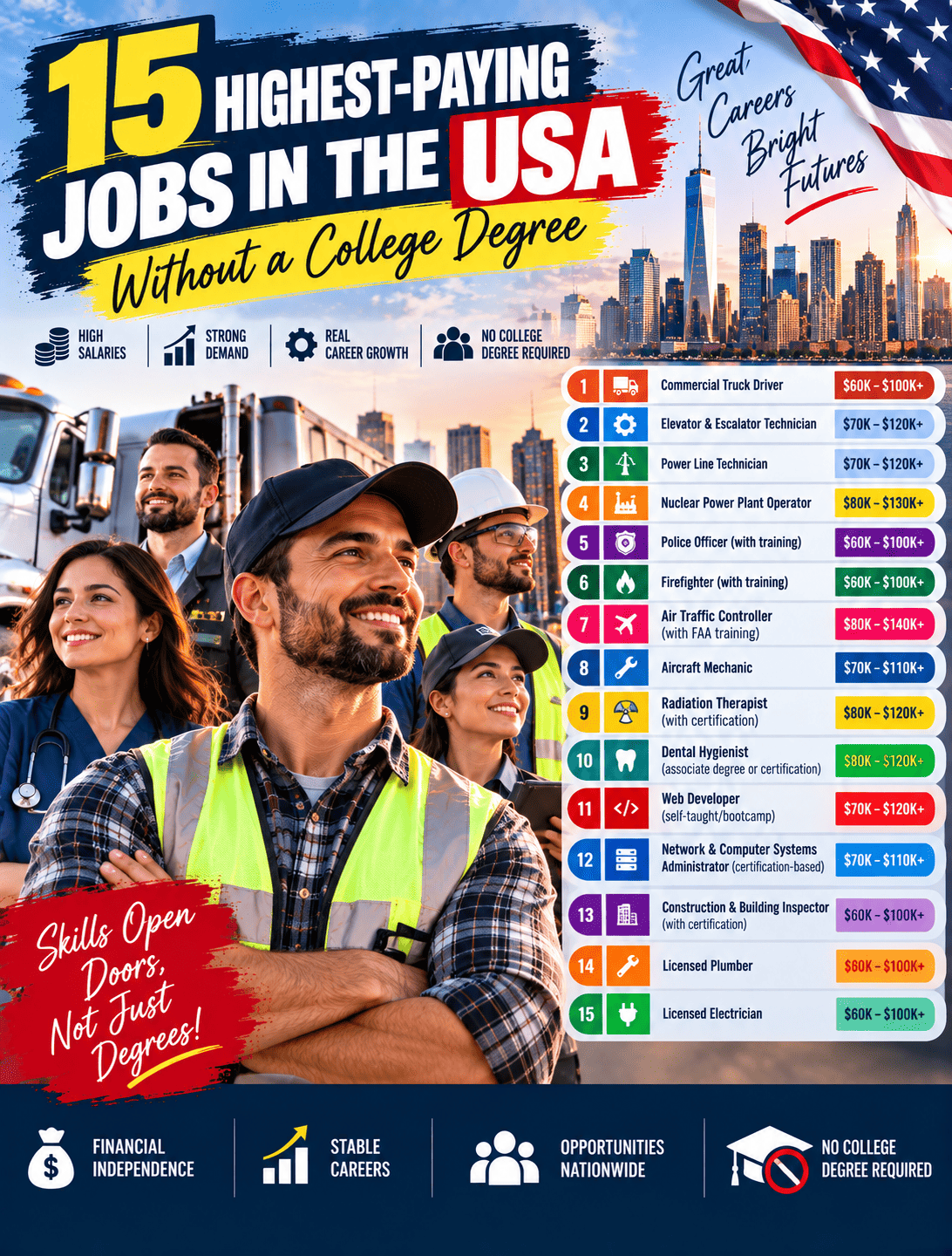
A four-year college degree is often presented as the standard route to a high-paying career in the United States. But it is not the only route.
Thousands of Americans build strong careers through apprenticeships, vocational schools, professional licenses, commercial driving programs, technical certifications, on-the-job training and industry-specific education.
Some of these careers can eventually pay well above the national median wage.
According to the U.S. Bureau of Labor Statistics (BLS), the median annual wage across all U.S. occupations was approximately $50,980 in May 2025. At the same time, several occupations that typically do not require a bachelor’s degree had median or average wages substantially above that figure.
For example, elevator and escalator installers and repairers had a 2025 median annual wage of $109,910, while electricians had a median of $63,190 and plumbers, pipefitters and steamfitters had a median of $63,800.
This means that someone without a traditional university degree can potentially build a six-figure career, although the highest salaries generally require experience, licensing, specialized training, overtime, difficult working conditions or significant responsibility.
Below are 15 of the strongest options to consider.
1. Elevator and Escalator Installer and Repairer
2025 median pay: $109,910 per year
Typical entry education: High school diploma or equivalent
Typical training: Apprenticeship
Elevator and escalator installation and repair is one of the highest-paying careers available without a four-year college degree.
These professionals install, maintain, troubleshoot and repair elevators, escalators, moving walkways and related lifting systems.
The job requires technical knowledge of:
- Electrical systems
- Mechanical systems
- Hydraulics
- Motors
- Control systems
- Safety equipment
- Computerized components
Most workers enter the profession through an apprenticeship rather than a traditional university program.
The BLS reports that the median annual wage reached $109,910 in May 2025, with the highest-paid 10% earning more than $158,890. Employment is projected to grow 6% between 2025 and 2035.
The career can be physically demanding. Workers may operate in confined spaces, elevator shafts and machine rooms and may need to work at heights.
For someone comfortable with mechanical and electrical work, however, it can be one of the strongest non-degree career options.
2. Airline Pilot
2025 median pay: $232,140 for airline pilots, copilots and flight engineers
Typical entry education: Bachelor’s degree for airline pilots
This career needs an important qualification: airline pilots generally do require a bachelor’s degree, so this is not a pure “no-degree” occupation.
However, commercial pilots are a different category.
The BLS reports a 2025 median annual wage of $123,220 for commercial pilots, and commercial pilots typically enter through flight training rather than a four-year college degree.
Commercial pilots can work in areas such as:
- Charter aviation
- Corporate aviation
- Flight instruction
- Aerial photography
- Agricultural aviation
- Emergency services
- Other specialized aviation
Becoming a commercial pilot requires significant flight training and FAA certification.
The cost of obtaining the necessary flight experience can be substantial, so this is not an inexpensive career path even though it may not require a traditional bachelor’s degree.
3. Electrical Power-Line Installer and Repairer
2025 median pay: $95,320 per year
Typical entry education: High school diploma or equivalent
Electrical power-line installers and repairers install, maintain and repair the electrical systems that transmit and distribute power.
Their work can involve:
- Electrical poles
- Transmission lines
- Distribution systems
- Transformers
- Underground systems
- Emergency repairs
The BLS reports a 2025 median annual wage of $95,320 for electrical power-line installers and repairers.
The work can be physically demanding and potentially dangerous.
Workers may have to:
- Work outdoors
- Climb poles
- Work at heights
- Work in bad weather
- Respond to emergencies
- Work irregular hours
Storms can create significant overtime opportunities because electrical infrastructure often needs immediate repair.
This career is particularly suitable for people who prefer hands-on technical work rather than office employment.
4. Construction and Extraction Supervisor
2025 average wage: $86,450 per year
Typical education: High school diploma or equivalent
Construction supervisors manage workers and coordinate construction and extraction activities.
Responsibilities can include:
- Managing crews
- Assigning tasks
- Monitoring safety
- Coordinating materials
- Inspecting work
- Managing schedules
- Working with contractors
- Communicating with project managers
BLS data shows that first-line supervisors of construction trades and extraction workers had an annual mean wage of $86,450 in May 2025.
The important point is that people usually do not enter this position immediately.
A typical pathway might look like:
Construction laborer → Skilled tradesperson → Lead worker → Supervisor
Therefore, experience can be more important than a university degree.
5. Aircraft and Avionics Equipment Mechanic
2025 median pay: $80,180 per year
Typical entry education: Postsecondary nondegree award
Aircraft and avionics technicians inspect, maintain, test and repair aircraft systems.
They may specialize in:
- Engines
- Electrical systems
- Navigation
- Communication equipment
- Flight-control systems
- Avionics
The BLS lists a 2025 median wage of $80,180 for aircraft and avionics equipment mechanics and technicians.
Many positions require specialized aviation training and certification rather than a bachelor’s degree.
This career is particularly attractive for people interested in aviation but who do not want to become pilots.
6. Air Traffic Controller
2025 median pay: $146,490 per year
Typical education: Varies
Air traffic controllers coordinate aircraft movement and help maintain safe distances between aircraft.
Their responsibilities include:
- Monitoring aircraft
- Giving instructions
- Coordinating takeoffs and landings
- Managing traffic
- Communicating with pilots
- Responding to changing conditions
BLS data reports a 2025 median annual wage of $146,490 for air traffic controllers.
This is a highly responsible career.
Candidates must satisfy specific FAA requirements, and hiring involves testing, training and medical requirements.
It is not a simple entry-level job, but it demonstrates that some high-paying careers rely heavily on specialized training rather than a conventional bachelor’s degree.
7. Dental Hygienist
2024 median pay: $94,260 per year
Typical entry education: Associate’s degree
Dental hygienists work with dentists to provide preventive oral healthcare.
Their responsibilities can include:
- Cleaning teeth
- Taking dental X-rays
- Examining patients
- Educating patients about oral hygiene
- Applying preventive treatments
The BLS reports a 2024 median annual wage of $94,260 for dental hygienists.
A dental hygienist generally needs an associate’s degree and professional licensing.
Therefore, this career does not require a four-year bachelor’s degree, but it does require formal postsecondary education and licensing.
This is an important distinction when researching “jobs without a college degree.”
8. Diagnostic Medical Sonographer
2024 median pay: $89,340 per year
Typical entry education: Associate’s degree
Diagnostic medical sonographers operate ultrasound equipment to produce images that healthcare professionals use to evaluate patients.
They may work in:
- Hospitals
- Medical centers
- Diagnostic laboratories
- Physician offices
- Outpatient facilities
The BLS reports a 2024 median annual wage of $89,340 and projected employment growth of 13% from 2024 to 2034.
The career generally requires specialized education, commonly an associate’s degree.
For people interested in healthcare but not interested in spending many years in medical school, sonography can be an attractive alternative.
9. Respiratory Therapist
2024 median pay: $80,450 per year
Typical entry education: Associate’s degree
Respiratory therapists provide care to patients experiencing breathing or respiratory problems.
They may work with:
- Hospital patients
- Emergency patients
- People with chronic respiratory conditions
- Intensive-care patients
- Patients requiring ventilator support
BLS data reports a 2024 median annual wage of $80,450 and projected employment growth of 12% from 2024 to 2034.
This profession normally requires an associate’s degree and appropriate licensing or credentialing.
It is a good example of a career where a four-year degree is not required, but specialized education definitely is.
10. Electrician
2025 median pay: $63,190 per year
Typical entry education: High school diploma or equivalent
Electricians install, maintain and repair electrical systems.
They can work on:
- Homes
- Commercial buildings
- Industrial facilities
- Electrical equipment
- Communication systems
- Control systems
- Construction projects
The BLS reports a 2025 median annual wage of $63,190. Employment is projected to grow 9% from 2024 to 2034, faster than the average for all occupations.
Electricians commonly enter through apprenticeships.
The career can become significantly more lucrative as workers gain experience, obtain advanced licenses and move into supervisory or independent contracting roles.
An experienced electrician who operates a successful contracting business can potentially earn substantially more than the employee median, although business ownership also brings additional expenses and risk.
11. Plumber, Pipefitter or Steamfitter
2025 median pay: $63,800 per year
Typical entry education: High school diploma or equivalent
Plumbers, pipefitters and steamfitters install and repair piping systems.
They work in:
- Residential buildings
- Commercial buildings
- Factories
- Industrial facilities
- Construction projects
- Infrastructure systems
The BLS reports a 2025 median annual wage of $63,800 and projects 7% employment growth from 2024 to 2034.
Many workers enter through apprenticeships.
Specialization and experience can lead to higher-paying positions.
Workers can also eventually establish their own plumbing businesses, although licensing requirements vary by state.
12. Industrial Machinery Mechanic and Millwright
2025 median pay: $64,100 per year
Typical entry education: High school diploma or equivalent
Industrial machinery mechanics and millwrights maintain and repair machinery used in factories and industrial operations.
Their work can involve:
- Motors
- Conveyor systems
- Pumps
- Industrial machinery
- Hydraulic systems
- Mechanical systems
- Production equipment
The BLS reports a 2025 median annual wage of $64,100 for industrial machinery mechanics, machinery maintenance workers and millwrights.
Manufacturing companies depend on these workers because equipment failures can stop production.
Experienced industrial maintenance workers can therefore become extremely valuable to employers.
13. Telecommunications Technician
2025 median pay: $66,200 per year
Telecommunications technicians install and maintain communications infrastructure.
Their work can involve:
- Internet infrastructure
- Fiber-optic systems
- Communication equipment
- Wireless infrastructure
- Network systems
- Cable systems
BLS data places the 2025 median wage at approximately $66,200 for telecommunications technicians.
The occupation can be a good option for people who enjoy technical work but do not want a traditional university education.
As communications networks evolve, technicians may need to continuously update their skills.
14. Wind Turbine Technician
2025 median pay: $64,120 per year
Wind turbine technicians maintain and repair wind-energy systems.
Their work can include:
- Mechanical maintenance
- Electrical systems
- Hydraulic components
- Turbine inspections
- Troubleshooting
- Equipment replacement
The BLS lists a 2025 median annual wage of $64,120.
This occupation generally requires postsecondary nondegree training rather than a bachelor’s degree.
The job can be physically demanding and often involves working at significant heights.
For people interested in renewable energy and technical careers, it can be an interesting alternative to traditional office jobs.
15. Commercial Truck Driver
Typical entry education: High school diploma or equivalent
Commercial truck driving is one of the most accessible routes into a potentially solid-paying career without a four-year degree.
Heavy and tractor-trailer drivers transport goods across the country.
They can work in:
- Local delivery
- Regional transportation
- Long-haul trucking
- Refrigerated freight
- Flatbed trucking
- Tanker transportation
- Specialized freight
- Dedicated routes
Requirements vary, but many heavy-truck driving jobs require a Commercial Driver’s License (CDL).
Drivers can potentially increase their earnings through:
- Experience
- Specialized freight
- Additional endorsements
- Long-haul routes
- Team driving
- Dedicated contracts
- Overtime
- Performance bonuses
However, trucking should not be viewed simply as an easy way to make a high salary. Long hours, time away from home, traffic, safety responsibilities and irregular schedules can make the occupation challenging.
What Makes These Careers Different?
The phrase “without a college degree” can be misleading.
There are at least four different pathways.
Path 1: High School + Apprenticeship
Examples:
- Electrician
- Plumber
- Elevator installer
- Construction trades
Path 2: High School + Specialized Training
Examples:
- CDL truck driver
- Commercial pilot
- Telecommunications technician
- Some aviation careers
Path 3: Associate’s Degree
Examples:
- Dental hygienist
- Diagnostic medical sonographer
- Respiratory therapist
Path 4: Experience + Career Progression
Examples:
- Construction supervisor
- Maintenance supervisor
- Restaurant manager
- Transportation manager
So “no college degree” does not mean “no training.”
In many cases, the highest-paying alternatives to university require significant technical training, licensing, certification or experience.
Can You Make $100,000 Without a Degree?
Yes, but it is important to understand how.
Some occupations have six-figure median or average wages.
For example, BLS data shows:
- Elevator installers and repairers: $109,910 median
- Air traffic controllers: $146,490 median
- Commercial pilots: $123,220 median
- Airline pilots: $232,140 median, although airline pilots typically require a bachelor’s degree.
Other occupations can reach $100,000 through:
- Overtime
- Seniority
- Specialized skills
- Management
- Union employment
- Geographic location
- Self-employment
- Business ownership
But applicants should distinguish between median wage, average wage, top-end earnings and advertised salary.
A job advertisement promising “$100,000+” does not mean every worker in that occupation will earn $100,000.
Best No-Degree Jobs for People Who Like Hands-On Work
If you dislike sitting behind a desk, consider:
- Elevator installer
- Electrician
- Plumber
- Power-line installer
- Industrial machinery mechanic
- Aircraft mechanic
- Construction supervisor
- Commercial truck driver
- Wind turbine technician
- Telecommunications technician
These careers involve practical, technical or physical work.
Best No-Four-Year-Degree Jobs in Healthcare
Healthcare provides several strong alternatives to careers requiring lengthy university education.
Options include:
- Dental hygienist
- Diagnostic medical sonographer
- Respiratory therapist
- MRI technologist
- Medical equipment technician
- Licensed practical nurse
- Surgical technologist
- Radiologic technologist
The BLS specifically highlights several healthcare careers that can be entered with an associate’s degree or postsecondary nondegree award rather than a bachelor’s degree.
Healthcare can be attractive because many occupations have structured training and licensing pathways.
How to Get One of These Jobs
The best pathway depends on the occupation.
Step 1: Choose the career
Don’t start by searching for “high-paying jobs.”
Start with:
What type of work do I actually want to do?
Someone who hates heights probably should not become an elevator installer.
Someone who dislikes driving should not become a truck driver.
Someone uncomfortable with healthcare environments may not enjoy respiratory therapy.
Step 2: Check the education requirement
Look at the exact BLS occupation rather than relying on a social-media list.
Some jobs require:
- High school diploma
- Apprenticeship
- Certificate
- Associate’s degree
- License
- CDL
- FAA certification
- Specialized training
Step 3: Calculate training costs
A “no-degree career” can still require thousands of dollars in training.
Compare:
- Tuition
- Tools
- Equipment
- Licensing fees
- Testing fees
- Transportation
- Lost income during training
Step 4: Look for apprenticeships
Apprenticeships can be particularly attractive because workers learn while gaining practical experience.
Many skilled trades use apprenticeship models.
Step 5: Get experience
Experience can dramatically change earning potential.
A new electrician and a highly experienced electrician are not necessarily earning the same amount.
What About Starting Your Own Business?
Some no-degree careers can eventually become business opportunities.
For example:
Electrician → Electrical contractor
Plumber → Plumbing company
HVAC technician → HVAC business
Truck driver → Owner-operator
Construction worker → General contractor
Elevator technician → Specialized maintenance business
Business ownership can create significantly higher income potential, but it also introduces:
- Equipment costs
- Insurance
- Payroll
- Taxes
- Marketing
- Licensing
- Customer acquisition
- Liability
- Cash-flow risk
Therefore, becoming self-employed should be considered a business decision rather than an automatic route to higher income.
Jobs Without a College Degree for Immigrants
International workers often search for high-paying U.S. jobs that do not require a bachelor’s degree.
Some occupations may be easier to understand from a skills perspective, but immigration creates a separate issue.
A person cannot legally work in the United States simply because they qualify for the occupation.
Foreign workers need an appropriate immigration status or employment authorization.
Depending on the occupation and circumstances, immigration options can be limited or highly specific.
A foreign electrician, truck driver, plumber or mechanic should therefore investigate:
- U.S. work authorization
- State licensing
- Credential recognition
- Employer requirements
- Occupational training
- Immigration eligibility
A foreign qualification does not automatically equal a U.S. professional license.
Beware of “No Degree, $100K Guaranteed” Job Ads
There are legitimate high-paying jobs without bachelor’s degrees, but job seekers should be skeptical of exaggerated claims.
Be careful with advertisements saying:
“No experience needed — $150,000 salary.”
“Guaranteed $100K job.”
“Work in USA — visa guaranteed.”
“Pay us $5,000 and we’ll get you a job.”
“No qualifications required.”
Real high-paying careers generally require something valuable in return:
- Technical skill
- Experience
- Licensing
- Difficult working conditions
- Responsibility
- Specialized training
- Long hours
- Geographic mobility
If an offer sounds dramatically better than normal industry wages and requires little skill or effort, investigate it carefully.
Frequently Asked Questions
What is the highest-paying job in the USA without a bachelor’s degree?
There is no single answer because “without a bachelor’s degree” includes different education and training pathways. Among occupations that typically do not require a bachelor’s degree, elevator and escalator installers and repairers had a 2025 median wage of $109,910, while air traffic controllers and commercial pilots can have substantially higher pay but have specialized eligibility and training requirements.
Can I make $100,000 without going to college?
Yes. Some careers can reach or exceed $100,000, particularly elevator installation, specialized transportation, commercial aviation, air traffic control and certain skilled-trade or management positions.
However, $100,000 is not guaranteed simply because you enter one of these occupations.
What is the best trade to learn?
That depends on your interests and location. Electrical work, plumbing, elevator installation, industrial maintenance and power-line work can all provide strong career opportunities.
Is trade school better than college?
Neither is universally better. A trade program can be a faster route into certain technical careers, while university education is necessary or advantageous for many professional occupations.
The better choice depends on the career you want.
What jobs pay $70,000 without a degree?
Examples can include experienced electricians, aircraft and avionics technicians, construction supervisors, specialized technicians, commercial pilots and certain healthcare occupations requiring an associate’s degree.
What jobs pay $100,000 without a four-year degree?
Elevator installers and repairers are one clear example. Commercial pilots can also exceed $100,000 in median pay, although becoming a commercial pilot requires substantial flight training.
Do no-degree jobs have career growth?
Absolutely. Many skilled careers have clear progression:
Apprentice → Technician → Senior Technician → Supervisor → Manager
or:
Driver → Experienced Driver → Specialized Driver → Owner-Operator
Experience can be a major component of earning potential.
Are these jobs physically demanding?
Several are.
Elevator installation, power-line work, construction, plumbing, electrical work, trucking and industrial maintenance can involve physical work, heights, outdoor conditions, heavy equipment or irregular schedules.
Can foreigners get these jobs?
Foreign workers must have appropriate U.S. employment authorization and must meet any state or federal licensing requirements. Having experience in another country does not automatically provide permission to work in the United States.
Final Thoughts
A four-year college degree is not the only route to a successful career in America.
The U.S. labor market contains thousands of jobs where employers value technical ability, practical experience, licensing, certification and reliability more than a traditional bachelor’s degree.
The strongest examples include elevator installation, electrical power-line work, aviation maintenance, construction supervision, skilled trades, industrial maintenance, healthcare technician careers and commercial driving.
The key is to understand that “no college degree” does not mean “no education.”
The highest-paying careers usually require something else.
That might be:
- A paid apprenticeship
- A technical certificate
- An associate’s degree
- A professional license
- A CDL
- FAA certification
- Several years of experience
- Specialized technical skills
For example, elevator and escalator installers and repairers had a 2025 median annual wage of $109,910, while electricians had a median of $63,190 and plumbers, pipefitters and steamfitters had a median of $63,800.
The best strategy is therefore not simply to ask:
“What job pays the most without college?”
Instead, ask:
“What valuable skill can I learn that employers are willing to pay well for?”
That question leads to a much more sustainable career decision.
For anyone considering an alternative to a four-year degree, research the occupation carefully, check the current BLS wage and employment outlook, investigate training costs, understand licensing requirements and speak with people already working in the field.
A degree is one path to a career.
It is not the only path.
Leave a Reply