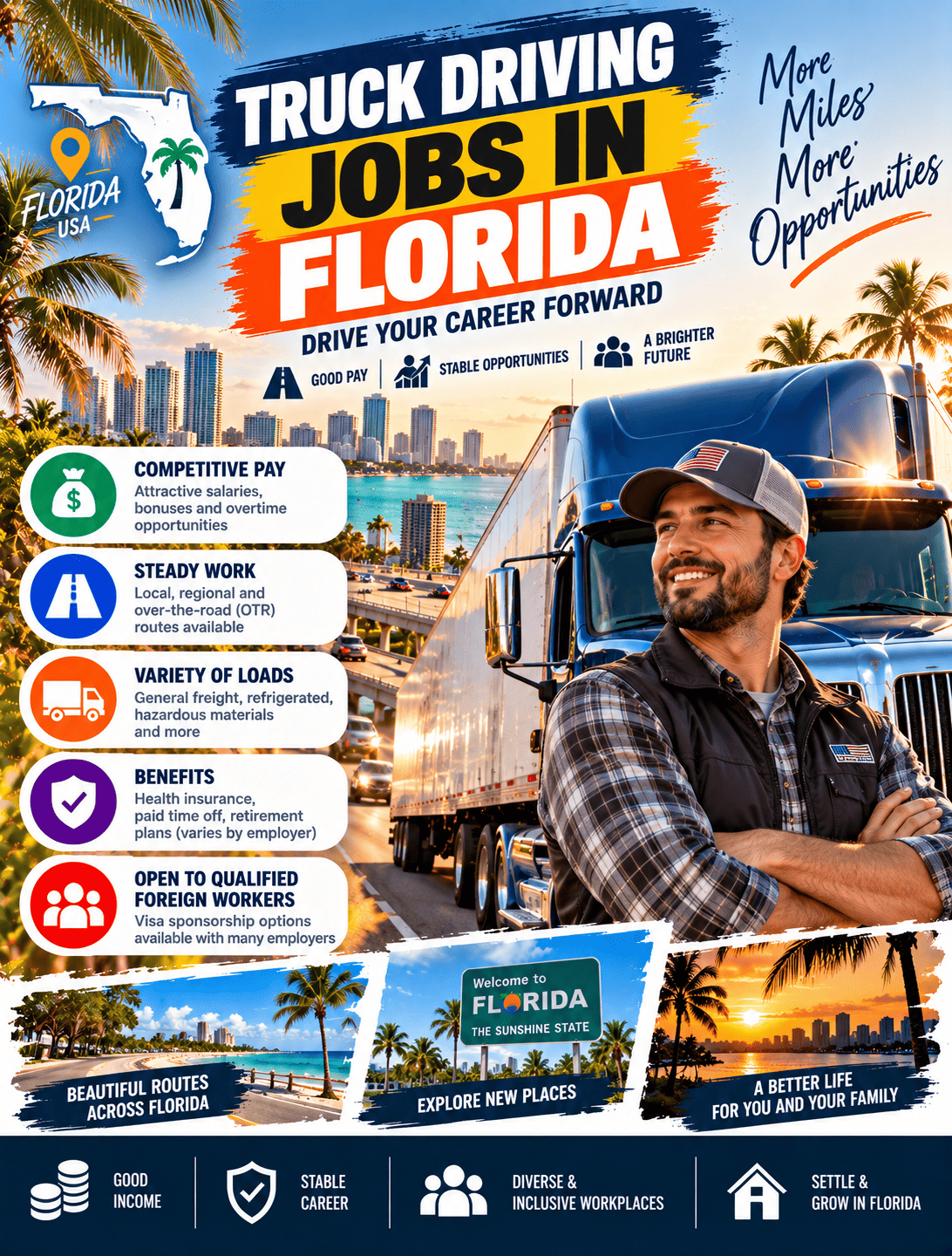
Truck driving is an important part of Florida’s economy. Every day, commercial drivers transport food, construction materials, consumer products, packages, fuel, vehicles and other goods between warehouses, distribution centers, businesses, ports and customers.
Florida is particularly important for transportation because of its large population, tourism industry, extensive highway network, ports, distribution centers and connections to other parts of the United States.
For people considering a career in transportation, truck driving jobs in Florida can offer several different career paths. Drivers can choose from local routes, regional routes, dedicated routes and over-the-road (OTR) positions. Some jobs allow drivers to return home every day, while others involve spending several days or weeks on the road.
The occupation also has a relatively straightforward career structure. A person can obtain the appropriate Commercial Driver License (CDL), gain experience and then move into better-paying or more specialized driving positions.
According to the U.S. Bureau of Labor Statistics, Florida had approximately 101,920 heavy and tractor-trailer truck drivers in the 2023 occupational employment data, with a mean annual wage of approximately $52,760 at that time.
More recent national truck-transportation wage data from 2025 puts the median annual wage for heavy and tractor-trailer truck drivers at approximately $60,320, with a mean of approximately $61,540. Actual Florida pay varies considerably depending on experience, route, employer, freight type, bonuses and compensation structure.
Current Florida job advertisements also show positions paying considerably more than the statewide historical averages, particularly for experienced CDL-A drivers and specialized or OTR work.
Why Truck Driving Is Important in Florida
Florida’s economy depends heavily on moving goods.
Trucks connect:
- Ports with warehouses
- Warehouses with stores
- Farms with distributors
- Manufacturers with customers
- Distribution centers with retailers
- Construction suppliers with job sites
- Businesses with customers
Florida’s major population centers create substantial demand for freight transportation.
The state also has major transportation hubs around:
- Jacksonville
- Miami
- Orlando
- Tampa
- Fort Lauderdale
- Fort Myers
- Lakeland
- Port St. Lucie
- Gainesville
- Ocala
- Tallahassee
A driver does not necessarily need to live in Miami or Orlando to find trucking work. Distribution and freight activity is spread throughout the state.
Types of Truck Driving Jobs in Florida
One of the most important decisions for a new driver is choosing the type of route.
1. Local Truck Driving Jobs
Local drivers generally operate within a relatively limited geographic area and may return home every day.
Examples include:
- Grocery delivery
- Construction materials
- Beverage distribution
- Waste transportation
- Retail delivery
- Local freight
- Port transportation
- Equipment delivery
Local jobs can be attractive to drivers who want a more predictable home life.
The trade-off is that local work may involve more loading, unloading, traffic and frequent stops than long-haul trucking.
2. Regional Truck Driving Jobs
Regional drivers operate within a defined area, often covering several states.
For example, a Florida-based regional driver may regularly travel between Florida and neighboring southeastern states.
Regional jobs can provide a balance between income and home time.
They are often attractive to drivers who want more miles than local work but do not want to stay away from home for several weeks.
3. OTR Truck Driving Jobs
OTR means Over the Road.
OTR drivers can travel across large portions of the United States.
A Florida-based OTR driver may transport freight to states throughout the:
- Southeast
- Midwest
- Northeast
- Southwest
- Mountain states
- West Coast
OTR positions can provide substantial mileage, but drivers generally spend more time away from home.
Current Florida job advertisements include OTR positions offering compensation of roughly $1,700–$3,200 per week depending on the employer, route, experience and compensation arrangement. These advertised figures should not be treated as guaranteed earnings because actual income depends on miles, freight, bonuses, deductions and other conditions.
4. Dedicated Truck Driving Jobs
Dedicated drivers normally operate a specific route or serve a particular customer.
For example, a driver might repeatedly transport freight between:
Distribution Center A → Retail Stores → Distribution Center A
The major advantage is predictability.
Dedicated jobs may offer:
- Regular routes
- Predictable schedules
- Consistent customers
- Familiar roads
- More predictable home time
For drivers who do not want the unpredictability of general OTR trucking, dedicated routes can be attractive.
5. Team Truck Driving
Team drivers operate with another driver.
While one driver rests, the other can continue driving, allowing the truck to cover long distances more efficiently.
Team driving can be useful for long-distance freight but requires strong communication and compatibility between drivers.
Current Florida listings include CDL-A team-driver opportunities, including trainee positions. One Palm City listing advertised approximately $75,000 or more for drivers under its particular compensation structure, illustrating how earnings can vary by employer and route.
6. Refrigerated Trucking
Refrigerated, or “reefer,” trucking involves temperature-controlled freight.
Typical cargo includes:
- Food
- Produce
- Frozen products
- Dairy
- Pharmaceuticals
- Temperature-sensitive goods
Reefer drivers can travel long distances and may earn more depending on experience and employer.
However, refrigerated trucking can involve stricter delivery schedules and temperature-management requirements.
7. Flatbed Truck Driving
Flatbed trucks transport cargo that cannot easily be enclosed in a standard trailer.
Examples include:
- Steel
- Lumber
- Construction equipment
- Machinery
- Building materials
Flatbed driving can be physically more demanding because drivers may have additional responsibilities related to securing cargo.
Specialized experience can also make flatbed driving a useful career path for experienced CDL drivers.
8. Tanker Truck Driving
Tanker drivers transport liquids or gases.
Depending on the cargo, additional endorsements and qualifications may be required.
Tankers may carry:
- Fuel
- Chemicals
- Food-grade liquids
- Industrial materials
Hazardous-material transportation requires additional qualifications and comes with greater responsibility.
9. Auto Transport Truck Driving
Florida’s large population and automotive market create opportunities for vehicle transportation.
Auto transport drivers move cars between:
- Dealerships
- Auctions
- Distribution centers
- Customers
- Ports
- Rental fleets
These positions can require specialized equipment and experience.
CDL Requirements for Truck Drivers in Florida
The most important qualification for most commercial truck driving jobs is a Commercial Driver License.
Florida’s commercial licensing rules distinguish between different CDL classes.
A Class A CDL is generally the primary license required for operating large combination vehicles such as tractor-trailers.
Florida’s commercial-driver guidance states that a CDL is required for certain vehicles, including combinations with a gross vehicle weight rating of 26,001 pounds or more when the towed unit exceeds 10,000 pounds, as well as certain heavy vehicles and vehicles carrying placardable hazardous materials.
Depending on the job, drivers may also need endorsements.
Common endorsements include:
- Hazmat (H)
- Tanker (N)
- Passenger (P)
- School Bus (S)
- Combination tanker/hazmat (X)
The specific license and endorsements required depend on the vehicle and freight.
CDL-A Is Usually the Key License for Tractor-Trailer Jobs
People searching for long-haul truck driving jobs will generally encounter CDL-A positions.
A CDL-A can open opportunities such as:
- OTR driver
- Regional driver
- Dedicated driver
- Dry-van driver
- Reefer driver
- Flatbed driver
- Specialized freight driver
- Some tanker positions
A new driver should carefully check the employer’s requirements before assuming that a CDL alone is sufficient.
Some employers also require:
- Minimum driving experience
- Clean driving record
- Medical certification
- Drug and alcohol testing
- Background checks
- Specific endorsements
- Minimum age
- Training completion
How to Get a CDL in Florida
The process generally involves several stages.
Step 1: Determine the CDL class
For tractor-trailer driving, Class A is typically the relevant category.
Step 2: Obtain a Commercial Learner’s Permit
A person seeking a CDL generally needs to complete the applicable knowledge requirements and obtain the appropriate learner’s permit.
Step 3: Complete required training
Prospective commercial drivers may need entry-level driver training through a registered provider, depending on the type of CDL or endorsement being pursued.
Florida also has approved third-party CDL testing providers and training schools. FLHSMV has highlighted the expansion of approved CDL truck-driving training facilities in the state.
Step 4: Pass the skills test
The CDL skills process generally involves demonstrating safe operation of the commercial vehicle.
Step 5: Obtain the CDL
After meeting the applicable requirements, the driver can receive the appropriate commercial license.
The exact process can change, so applicants should confirm current requirements directly with the Florida Highway Safety and Motor Vehicles department before paying for training.
How Much Do Truck Drivers Make in Florida?
Truck-driver earnings vary significantly.
Factors include:
- CDL class
- Driving experience
- Miles driven
- Type of freight
- Local vs. OTR
- Company driver vs. owner-operator
- Endorsements
- Bonuses
- Home-time requirements
- Route
- Employer
Historical BLS data reported a Florida mean annual wage of approximately $52,760 for heavy and tractor-trailer truck drivers in 2023.
More recent national 2025 data for the occupation reported a median wage of approximately $60,320 and mean wage of approximately $61,540.
Florida’s official Occupational Employment and Wage Statistics program publishes wage estimates for more than 800 occupations and provides both statewide and metropolitan-area information.
Current job advertisements can show significantly higher advertised compensation for experienced drivers.
For example, current listings include:
- $75,000+ advertised compensation for some OTR team-driver roles
- Approximately $70,000–$93,000 advertised annual compensation in selected Florida CDL positions
- Some OTR positions advertising $1,700–$3,200 per week
These figures are job-advertised amounts, not guaranteed salaries, and should be evaluated against experience requirements, mileage, deductions, benefits and home-time arrangements.
Entry-Level Truck Driving Jobs in Florida
One of the most attractive aspects of trucking is that some companies recruit new CDL holders.
Search for terms such as:
- Entry-level CDL-A driver
- CDL-A trainee
- Recent CDL graduate
- New CDL driver
- Company-sponsored CDL training
- Driver trainee
- Regional CDL-A trainee
Some current Florida listings specifically state that recent CDL school graduates and new CDL holders are welcome.
However, entry-level drivers should carefully examine the training arrangement.
Ask:
- Is the training paid?
- How long is the training?
- Is there a training contract?
- What happens if I leave the company?
- Is the job local, regional or OTR?
- How much home time is provided?
- Is pay hourly, per mile or percentage-based?
- Are bonuses guaranteed or conditional?
- Who pays for lodging during training?
- What deductions will appear on my paycheck?
Truck Driving Jobs in Miami
Miami is an important transportation market because of its population, commercial activity, distribution infrastructure and international trade.
Potential opportunities include:
- Local delivery
- Regional trucking
- Port-related transportation
- Refrigerated freight
- Retail distribution
- Construction-material hauling
- Waste transportation
- OTR trucking
Miami drivers should expect significant traffic and should carefully consider commute times when evaluating local positions.
Truck Driving Jobs in Jacksonville
Jacksonville is particularly important for trucking and logistics.
Its location, transportation infrastructure and access to major freight corridors make it a significant location for:
- OTR trucking
- Regional trucking
- Distribution
- Warehousing
- Port-related freight
- Dedicated routes
Current Florida job listings show numerous CDL opportunities in the Jacksonville area, including company-driver, OTR and specialized positions.
Truck Driving Jobs in Orlando
Orlando’s huge tourism economy creates demand for transportation and distribution.
Drivers may transport:
- Food
- Beverages
- Retail products
- Hotel supplies
- Construction materials
- General freight
Local and regional opportunities can be found around Orlando’s distribution and commercial areas.
Truck Driving Jobs in Tampa
Tampa is another major Florida transportation center.
Potential opportunities include:
- Local CDL driving
- Regional freight
- Construction hauling
- Food distribution
- Warehouse-to-store transportation
- OTR trucking
Tampa can be attractive for drivers who want access to a major metropolitan area without necessarily working in Miami.
Truck Driving Jobs in Lakeland and Central Florida
Central Florida is strategically important because of its position between major population centers.
Lakeland and surrounding areas have substantial distribution and logistics activity.
This can create opportunities for:
- Warehouse drivers
- Distribution drivers
- Regional drivers
- Dedicated drivers
- Refrigerated freight drivers
- OTR drivers
Drivers should also consider nearby cities when searching because trucking employers frequently recruit across a wider geographic area.
Company Driver vs. Owner-Operator
A major career decision is whether to become a company driver or operate your own truck.
Company Driver
The trucking company owns or leases the truck and employs the driver.
Advantages may include:
- More predictable income
- Company-provided equipment
- Benefits
- Less financial risk
- No direct responsibility for truck ownership
This is generally easier for new drivers.
Owner-Operator
An owner-operator owns or leases a truck and operates it independently or under a carrier.
Potential advantages include:
- Greater control
- Higher gross revenue potential
- Ability to choose certain freight
- Business ownership
But expenses can be substantial.
These may include:
- Truck payments
- Fuel
- Maintenance
- Tires
- Insurance
- Permits
- Tolls
- Accounting
- Downtime
- Repairs
A large gross revenue figure does not necessarily mean large take-home income.
New drivers should usually understand the industry thoroughly before taking on significant truck debt.
How to Find Truck Driving Jobs in Florida
Job seekers can use several sources.
Start with:
- Employ Florida
- FloridaCommerce
- Company career websites
- Indeed
- Trucking-specific job boards
- Local staffing companies
- CDL schools
- Driver recruiting departments
FloridaCommerce provides official employment projections and occupational wage information that can help applicants research occupations and regional labor markets.
When searching online, use specific keywords such as:
“CDL A driver Florida”
“Entry level CDL A driver Florida”
“Local truck driver Miami”
“CDL driver Jacksonville FL”
“OTR truck driver Orlando”
“Regional CDL driver Tampa”
Specific searches usually produce better results than simply searching for “truck jobs.”
Truck Driving Jobs for Foreign Workers
International applicants frequently search for phrases such as “truck driver jobs in Florida with visa sponsorship.”
This requires particular caution.
A foreign driver’s existing truck-driving experience does not automatically transfer into authorization to work as a commercial driver in the United States.
There are two separate issues:
1. Immigration authorization
The worker must have a U.S. immigration status that legally permits employment.
2. Commercial driving qualification
The worker must satisfy applicable U.S. and Florida commercial-driving requirements.
A person cannot simply arrive in Florida with a foreign heavy-vehicle license and begin working as a U.S. commercial truck driver.
Foreign applicants should investigate U.S. immigration requirements and Florida CDL requirements separately.
They should also be extremely cautious about recruiters promising:
“Guaranteed truck driver visa.”
“Guaranteed Florida CDL sponsorship.”
“Pay us and we will secure your trucking job.”
No recruiter can guarantee that a U.S. government agency will approve an immigration application.
English Requirements for Truck Drivers
Truck drivers need to understand road signs, safety instructions, company procedures and communications with law enforcement and other road users.
Florida changed its driver-license testing procedures in 2026 so that driver-license knowledge and skills examinations are administered in English. This applies to commercial and non-commercial testing.
For international applicants, this makes practical English ability particularly important.
Truck-driving English does not necessarily require advanced academic vocabulary, but drivers need to understand:
- Traffic signs
- Directions
- Safety instructions
- Delivery instructions
- Dispatch communications
- Inspection procedures
- Basic documentation
- Emergency information
Truck Driver Job Scams
Truck-driving applicants should be careful when dealing with recruiters.
Red flags include:
- Paying a large amount for a guaranteed job
- Guaranteed visa promises
- Fake trucking companies
- Fake CDL certificates
- Requests for money before employment
- Unusually high income promises with no experience requirement
- No interview
- No verifiable company website
- Pressure to sign a contract immediately
- Requests for passport or banking information before legitimate hiring procedures
Before accepting a position, independently verify the employer.
Ask for:
- Company legal name
- Company website
- Physical business address
- Job location
- Pay structure
- Benefits
- Training requirements
- Experience requirements
- Home-time policy
- CDL requirements
Frequently Asked Questions About Truck Driving Jobs in Florida
Is truck driving a good career in Florida?
It can be a viable career for people who enjoy driving, can manage long hours and are comfortable with the responsibilities of commercial transportation. Earnings and working conditions vary significantly by employer and route.
How much do truck drivers make in Florida?
Historical Florida BLS data showed a mean annual wage of approximately $52,760 for heavy and tractor-trailer truck drivers in 2023. More recent national 2025 data showed a median of approximately $60,320 for the occupation. Actual Florida compensation varies by employer, experience, route and freight type.
Do I need a CDL to drive a truck?
For vehicles covered by federal and Florida commercial-driver requirements, an appropriate CDL is required. The exact class and endorsements depend on the vehicle and cargo.
What CDL is needed for a tractor-trailer?
A Class A CDL is generally the relevant license for large tractor-trailer combinations.
Can I become a truck driver without experience?
Yes. Some companies recruit recent CDL graduates and offer trainee or entry-level positions. Current Florida listings include employers specifically seeking recent CDL-school graduates.
Which Florida cities have truck driving jobs?
Major opportunities can be found around Jacksonville, Miami, Orlando, Tampa, Lakeland, Fort Lauderdale, Ocala and other distribution centers.
Is OTR trucking better than local trucking?
Neither is automatically better. OTR can provide more miles and potentially higher earnings but usually means more time away from home. Local trucking may provide better home time but can involve more stops and traffic.
Can foreigners get truck driving jobs in Florida?
Foreign nationals must have legal authorization to work in the United States and must meet applicable commercial-driver requirements. A foreign truck-driving license alone does not authorize employment in Florida.
Can a company sponsor a foreign truck driver?
Some employers may consider immigration sponsorship depending on the position and applicable U.S. immigration rules, but sponsorship is not guaranteed. Applicants should verify the actual immigration pathway rather than relying on recruiter claims.
Is truck driving physically demanding?
It can be. Drivers may spend long periods sitting, deal with irregular schedules and, depending on the job, load or unload freight. Specialized freight can involve additional physical responsibilities.
Final Thoughts
Truck driving remains an important career within Florida’s transportation and logistics economy.
The state has a large commercial-driver workforce, extensive freight movement and major transportation centers including Jacksonville, Miami, Orlando, Tampa and Central Florida.
For someone starting from zero, the typical pathway can look like:
Learn the requirements → Obtain CDL training → Earn CDL-A → Start with an entry-level/trainee position → Build driving experience → Move into regional, dedicated or specialized freight → Pursue higher-paying opportunities
Experienced drivers can potentially move into specialized areas such as:
- Refrigerated freight
- Flatbed
- Tanker
- Heavy haul
- Auto transport
- Dedicated freight
- Team driving
- Specialized logistics
The most important thing is to compare the entire job offer, not just the advertised salary.
Look at:
- Pay per mile or hourly pay
- Guaranteed minimums
- Bonuses
- Home time
- Benefits
- Equipment
- Insurance
- Training
- Experience requirements
- Route
- Detention pay
- Layover pay
- Deductions
For international job seekers, there is an additional step: legal work authorization. A CDL and truck-driving experience do not by themselves provide permission to work in the United States.
Finally, always verify current CDL requirements directly with Florida authorities and investigate employers carefully before paying money or signing contracts.
Florida offers opportunities for new and experienced commercial drivers, but the strongest candidates are those who combine a valid CDL, a safe driving record, reliable work history, good communication skills and a clear understanding of the type of trucking career they want.
Leave a Reply