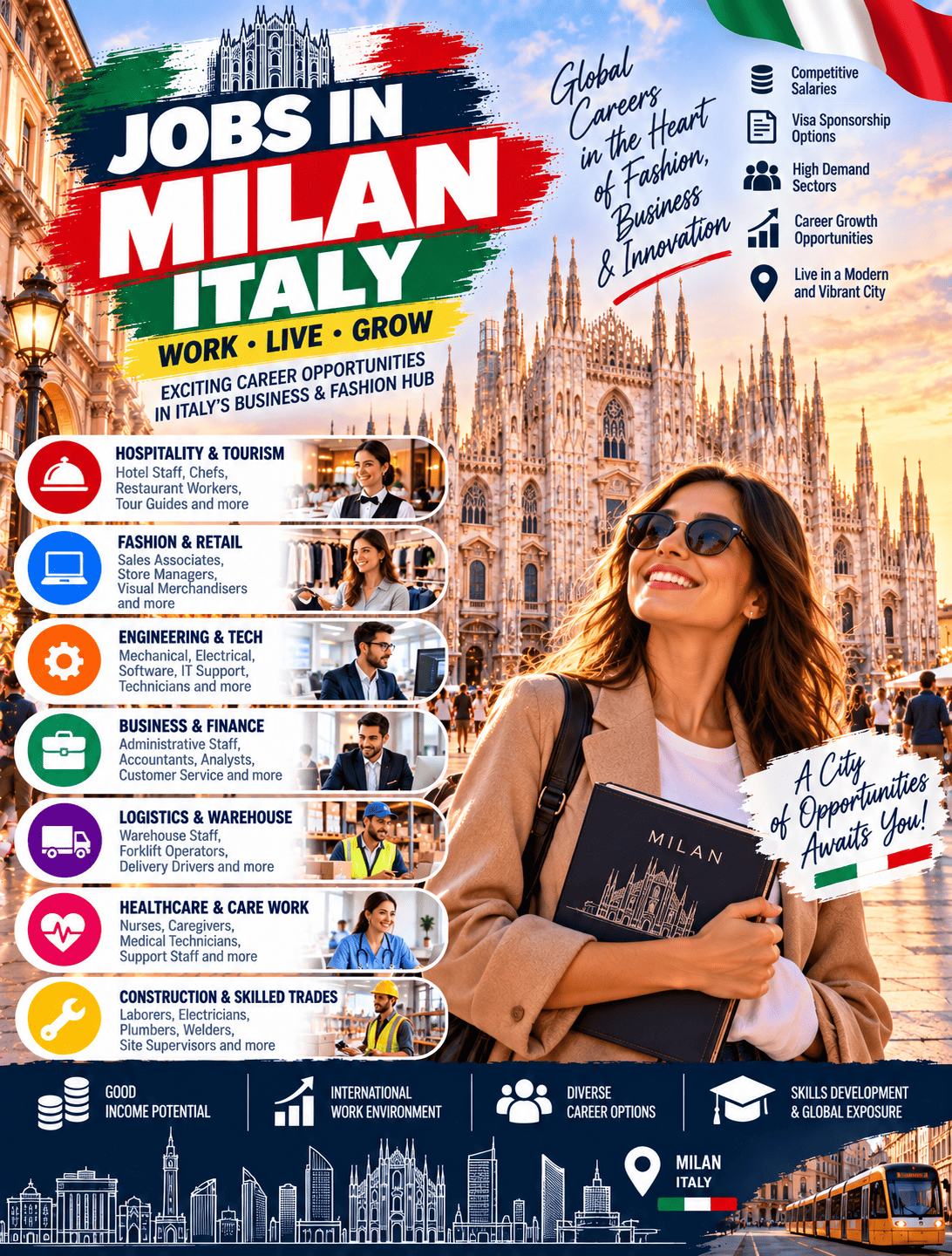
Milan is one of the most important employment centers in Italy and one of the strongest business cities in Southern Europe. It is the capital of Lombardy, Italy’s most economically productive region, and is particularly well known for finance, fashion, technology, professional services, manufacturing, healthcare, logistics, tourism and international business.
For job seekers, Milan offers opportunities ranging from entry-level hospitality and warehouse positions to highly skilled careers in finance, engineering, software development, healthcare and management.
The city’s labor market is also relatively strong compared with many other parts of Italy. In the first quarter of 2026, Lombardy had approximately 4.63 million employed people, with an employment rate of 70.3% for people aged 15–64 and an unemployment rate of just 2.8%. Employment was 0.8% higher than a year earlier.
Milan itself has a particularly diverse economy, which means job seekers can find opportunities in both traditional industries and modern professional sectors.
Why Work in Milan?
Milan attracts workers from across Italy and from other countries because it combines a large corporate sector with thousands of small and medium-sized businesses.
Some of the biggest advantages include:
- Large international companies
- Strong finance and banking sector
- Technology and digital jobs
- Fashion and luxury industries
- Manufacturing and engineering
- Healthcare opportunities
- Hotels and restaurants
- Logistics and transportation
- Construction
- Retail
- Professional services
- International business environment
- Universities and research institutions
The wider Lombardy economy has particularly strong employment concentrations in industry, commerce, professional and scientific activities, business-support services, construction, and accommodation and food services. Financial activities, information and communications, business services, professional activities and manufacturing are also highly specialized in the region.
This makes Milan especially attractive for people with professional qualifications, technical skills or experience in customer-facing industries.
Most In-Demand Jobs in Milan
The best job for you will depend on your education, work experience, Italian-language ability and immigration status.
Here are some of the major categories worth considering.
1. Healthcare Jobs
Healthcare is an important employment sector throughout Milan and Lombardy.
Potential positions include:
- Registered nurses
- Nursing assistants
- Healthcare assistants
- Care workers
- Elderly care workers
- Physiotherapists
- Medical technicians
- Laboratory technicians
- Pharmacists
- Doctors
- Administrative healthcare staff
- Home-care workers
Healthcare professionals should pay particular attention to professional recognition and licensing requirements.
For foreign-qualified professionals, having a degree or qualification does not automatically mean that you can immediately practice a regulated profession in Italy.
2. IT and Technology Jobs
Milan is one of Italy’s leading technology and business centers.
Technology companies, banks, consulting firms, startups and international corporations regularly need people with digital skills.
Common positions include:
- Software developers
- Web developers
- Mobile developers
- Data analysts
- Data engineers
- Cybersecurity specialists
- Cloud engineers
- DevOps engineers
- IT support technicians
- System administrators
- Product managers
- UX/UI designers
- Digital marketing specialists
- SEO specialists
- Business analysts
English-language positions are more common in international technology companies than in many traditional Italian businesses.
However, learning Italian can substantially increase the number of employers you can approach.
3. Finance and Banking Jobs
Milan is Italy’s major financial center and is one of the best Italian cities for finance-related careers.
Possible jobs include:
- Accountants
- Financial analysts
- Investment analysts
- Bank employees
- Risk analysts
- Compliance officers
- Auditors
- Financial controllers
- Tax specialists
- Insurance professionals
- Credit analysts
- Relationship managers
- Investment banking professionals
- Corporate finance specialists
People with degrees in finance, economics, accounting or business administration may find Milan particularly attractive.
Knowledge of Italian is often important for client-facing and domestic financial positions, while international companies may have more English-speaking opportunities.
4. Fashion and Luxury Jobs
Milan is internationally famous for fashion and luxury brands.
The sector creates opportunities beyond designers.
Jobs can include:
- Fashion designers
- Graphic designers
- Product developers
- Fashion buyers
- Merchandisers
- Retail sales associates
- Store managers
- Marketing specialists
- Social media managers
- Photographers
- Production coordinators
- Tailors
- Garment workers
- Quality-control staff
- Warehouse workers
- E-commerce specialists
People interested in fashion should not assume that becoming a designer is the only career route.
Milan’s fashion ecosystem also requires people in logistics, administration, retail, marketing, manufacturing, technology and customer service.
5. Hospitality and Restaurant Jobs
Tourism and hospitality provide some of the most accessible jobs for people without university degrees.
Potential positions include:
- Hotel receptionists
- Housekeeping staff
- Waiters
- Restaurant servers
- Chefs
- Kitchen assistants
- Bartenders
- Baristas
- Hotel supervisors
- Restaurant managers
- Guest-relations staff
- Catering workers
- Event staff
- Kitchen cleaners
Hospitality can be a useful entry point for workers who already have practical experience.
However, customer-facing jobs generally become easier to obtain when you can communicate in Italian.
6. Construction Jobs
Construction is another important employment area in Lombardy.
Possible jobs include:
- Construction laborers
- Electricians
- Plumbers
- Welders
- Bricklayers
- Carpenters
- Painters
- Tile installers
- HVAC technicians
- Heavy-equipment operators
- Site supervisors
- Construction managers
- Surveying technicians
The wider Lombardy region recorded particularly strong construction employment growth in early 2026, with construction employment increasing by 17.6% year over year according to regional analysis.
Skilled trades can therefore be worth considering for workers who have practical experience but do not have a university degree.
7. Logistics and Warehouse Jobs
Milan’s location and economic importance make logistics another significant source of employment.
Jobs include:
- Warehouse workers
- Pickers and packers
- Forklift operators
- Delivery drivers
- Logistics assistants
- Inventory clerks
- Dispatch coordinators
- Supply-chain assistants
- Transport planners
- Logistics managers
Experience with warehouse management systems, inventory software and forklifts can improve your prospects.
The wider Milan metropolitan area also connects important commercial and industrial areas around the city, creating demand for transportation and distribution workers.
8. Sales and Retail Jobs
Milan has a large retail sector, ranging from supermarkets and everyday retail to luxury fashion.
Common positions include:
- Sales assistants
- Retail associates
- Cashiers
- Store supervisors
- Store managers
- Customer service representatives
- Luxury sales consultants
- E-commerce assistants
- Visual merchandisers
Foreign-language skills can be particularly valuable in Milan’s luxury retail and tourism-related businesses.
Someone who speaks Italian plus English and another major language may have an advantage in customer-facing positions.
9. Engineering Jobs
Milan and the surrounding Lombardy region have a strong industrial and manufacturing base.
Engineering opportunities can include:
- Mechanical engineers
- Electrical engineers
- Civil engineers
- Industrial engineers
- Automation engineers
- Manufacturing engineers
- Quality engineers
- Process engineers
- Automotive engineers
- Environmental engineers
Engineers with experience in automation, manufacturing, energy, robotics or industrial technology may find opportunities across the wider Milan metropolitan area rather than only inside the city center.
10. Marketing and Business Jobs
Milan’s large corporate sector creates demand for professionals in business and communications.
Potential positions include:
- Marketing executives
- Digital marketers
- SEO specialists
- Content managers
- Social media managers
- Sales executives
- Business development managers
- Account managers
- Project managers
- HR specialists
- Recruitment consultants
- Administrative assistants
- Customer-success specialists
International businesses may recruit candidates who can work comfortably in English, although Italian remains highly valuable.
Jobs in Milan Without a University Degree
A university degree is not necessary for every job in Milan.
People without degrees can look at positions such as:
- Warehouse worker
- Delivery driver
- Construction worker
- Cleaner
- Hotel housekeeper
- Kitchen assistant
- Waiter
- Retail assistant
- Factory worker
- Production operator
- Care worker
- Security worker
- Forklift operator
- Skilled tradesperson
- Maintenance technician
- Customer service worker
However, “no degree required” does not mean “no skills required.”
Employers may still expect:
- Previous work experience
- Vocational training
- Italian language skills
- Driving licenses
- Technical certifications
- Computer skills
- Customer-service skills
- Physical ability for manual jobs
- Safety training
For skilled trades, practical experience can sometimes be more valuable than academic qualifications.
Best Areas for Jobs in Milan
Milan is a large metropolitan employment market, so job seekers should not limit their search to the historic city center.
Milan City Center
Central Milan has many opportunities in:
- Finance
- Luxury retail
- Hotels
- Restaurants
- Consulting
- Professional services
- Marketing
- Technology
- Corporate offices
Porta Nuova
The Porta Nuova area is known for modern offices, international companies, finance and business services.
CityLife
CityLife is another major business district with corporate offices, retail and professional services.
Sesto San Giovanni
Sesto San Giovanni, immediately north of Milan, has a strong industrial and business history and remains relevant for manufacturing, services and technical employment.
Rho and the Northwest
The Rho area and surrounding municipalities provide opportunities in:
- Logistics
- Manufacturing
- Events
- Warehousing
- Transportation
- Business services
Greater Milan Metropolitan Area
It is often sensible to search the wider metropolitan area rather than restricting yourself to Milan’s municipal boundaries.
A job located outside central Milan may offer lower rent and easier access to industrial or logistics employment.
Do You Need to Speak Italian to Work in Milan?
Italian is one of the most important factors affecting your employment prospects.
You can find some jobs where English is the primary working language, particularly in:
- Technology
- International companies
- Finance
- Consulting
- Research
- Some startups
- International education
- Certain hospitality positions
But Italian significantly expands your options.
For entry-level jobs, learning conversational Italian can make a major difference.
A useful target is:
A2: Basic communication
B1: Functional everyday workplace communication
B2: Stronger professional communication
For highly skilled professional positions, employers may specifically request B2 or higher Italian, or English plus Italian depending on the company.
Jobs in Milan for Foreign Workers
Foreign workers can work in Milan, but finding a job and obtaining legal authorization to work are two different things.
If you are a non-EU citizen living outside Italy, you generally need an appropriate immigration route before you can legally start employment.
Italy’s 2026–2028 Decreto Flussi program provides for 497,550 entries of third-country nationals over the three-year period:
- 164,850 in 2026
- 165,850 in 2027
- 166,850 in 2028
The program covers seasonal and non-seasonal employment and self-employment under the applicable categories.
For workers applying from abroad under the quota system, an Italian employer generally plays a central role in the process by submitting the required application for authorization to employ the foreign worker.
The Italian Ministry of Labour explains that non-EU workers can enter from abroad within the applicable quotas after the employer submits the required request for a nulla osta, or work authorization.
Some categories can enter outside the ordinary quotas, including certain highly qualified workers, EU Blue Card holders, managers, researchers, university professors and some other specifically regulated categories.
Therefore, foreign applicants should never assume that receiving a job offer automatically gives them permission to work in Italy.
How the Milan Work Visa Process Generally Works
For a non-EU worker outside Italy, the process generally involves several stages.
Step 1: Find an employer
You first need a genuine Italian employer willing and legally able to employ you.
Step 2: Employer applies for authorization
For applicable non-EU employment, the employer submits the required application through the Italian immigration system.
Step 3: Nulla Osta
If approved, the relevant work authorization is issued.
Step 4: Apply for the visa
The worker applies through the Italian consular authority in their country of residence.
Step 5: Enter Italy
After the visa is granted, the worker can travel to Italy.
Step 6: Complete residence procedures
After entering Italy, additional procedures are required to obtain the appropriate residence permit.
Milan’s official Study & Work guidance explains that, for subordinate employment, the employer is responsible for the initial entry-clearance application, followed by the worker’s visa application and post-arrival residence procedures.
Because immigration rules and administrative procedures can change, applicants should always verify the current requirements with Italian government or consular authorities before paying an agent or making travel arrangements.
How to Find Jobs in Milan
A successful Milan job search should use multiple channels.
1. Search Italian Job Websites
Use major Italian employment platforms and search for:
- “lavoro Milano”
- “offerte lavoro Milano”
- “assunzioni Milano”
- “operaio Milano”
- “magazziniere Milano”
- “cameriere Milano”
- “autista Milano”
- “impiegato Milano”
- “developer Milano”
- “engineer Milano”
Using Italian keywords can reveal vacancies that do not appear in English-language searches.
2. Search Company Career Pages
Large companies often publish vacancies directly on their websites.
Target:
- Banks
- Hotels
- Retail companies
- Fashion companies
- Logistics companies
- Manufacturing companies
- Technology companies
- Consulting firms
- Healthcare organizations
3. Use LinkedIn
Keep your LinkedIn profile professional and clearly state:
- Current occupation
- Years of experience
- Skills
- Certifications
- Languages
- Location
- Work authorization status
If you are outside Italy, clearly explain your location and whether you require employer support for immigration.
4. Use Employment Agencies
Recruitment agencies can be particularly useful for:
- Warehouse work
- Manufacturing
- Hospitality
- Administration
- Temporary work
- Customer service
- Skilled trades
How to Prepare a CV for Milan Jobs
Your CV should generally be concise and easy to read.
Include:
- Full name
- Contact details
- Location
- Professional summary
- Work experience
- Education
- Certifications
- Technical skills
- Languages
- Relevant achievements
If you are applying for an international company, an English CV may be appropriate.
For many Italian employers, however, an Italian-language CV can be advantageous.
Do not send exactly the same CV to every employer.
Instead, adjust your CV according to the vacancy.
For example, a warehouse application should emphasize:
- Warehouse experience
- Inventory systems
- Forklift certification
- Picking/packing
- Safety
- Shift availability
A software developer application should instead emphasize:
- Programming languages
- Frameworks
- Projects
- Cloud experience
- Databases
- Professional achievements
Salary Expectations in Milan
Salaries vary significantly depending on:
- Profession
- Education
- Experience
- Industry
- Company
- Contract type
- Italian-language ability
- Professional certification
A junior hospitality employee and a senior financial analyst obviously cannot be compared using the same salary expectations.
Likewise, a highly experienced engineer may earn substantially more than an entry-level technician.
When evaluating an offer, look beyond the headline salary.
Check:
- Gross annual salary
- Net monthly salary
- Number of payments
- Working hours
- Overtime
- Bonuses
- Holiday entitlement
- Contract type
- Probation period
- Transportation benefits
- Meal vouchers
- Health benefits
- Relocation support
This is especially important in Milan because housing and everyday living costs can be higher than in many other Italian cities.
Is Milan Expensive for Workers?
Milan is generally one of Italy’s more expensive cities.
Rent can be one of the biggest expenses.
Someone earning a relatively modest salary may therefore find it difficult to live alone in the most expensive neighborhoods.
Many young workers reduce costs by:
- Sharing an apartment
- Living outside central Milan
- Using public transportation
- Choosing neighborhoods with good train or metro connections
- Looking for employer-provided accommodation where available
For workers considering a job offer, calculate your expected net salary minus housing, transportation, food and utilities rather than looking only at gross salary.
Best Jobs in Milan for International Applicants
For people coming from outside the EU, some areas may be particularly worth researching:
Highly skilled
- Software development
- Engineering
- Finance
- Data analysis
- Cybersecurity
- Healthcare
- Research
- Management
Skilled trades
- Electricians
- Welders
- Plumbers
- Construction technicians
- Maintenance technicians
- Industrial mechanics
Service sector
- Hotel workers
- Chefs
- Restaurant staff
- Care workers
- Cleaning workers
Logistics
- Warehouse workers
- Logistics coordinators
- Delivery workers
- Transport professionals
The availability of sponsorship or legal entry routes varies significantly by occupation and immigration category.
A vacancy saying “international candidates welcome” does not necessarily mean the employer will sponsor a work permit.
Common Mistakes Job Seekers Make in Milan
Avoid these mistakes:
Applying with an English-only CV everywhere
Some Italian employers prefer Italian-language applications.
Ignoring Italian
Even basic Italian can expand your opportunities.
Applying for regulated professions without checking recognition
Healthcare and other regulated occupations may require formal recognition or authorization.
Looking only in central Milan
Some major employers are located throughout the metropolitan area.
Focusing only on salary
A higher gross salary does not necessarily mean a better financial situation after rent and taxes.
Paying someone for a “guaranteed job”
Legitimate employers do not normally require applicants to pay large sums simply to receive a job offer.
Beware of Milan Job Scams
Foreign job seekers are particularly vulnerable to fake recruitment offers.
Be cautious if someone:
- Guarantees a visa
- Guarantees a job without an interview
- Requests large upfront payments
- Offers unusually high wages for simple work
- Requests your passport unnecessarily
- Uses a personal email instead of a company address
- Refuses to provide a written contract
- Says you must pay money to “reserve” a quota
- Promises permanent residency immediately
Always verify the employer independently.
If immigration authorization is involved, verify the process through official Italian government or consular channels.
Frequently Asked Questions About Jobs in Milan
Is Milan a good city for finding a job?
Yes. Milan is one of Italy’s strongest employment markets, particularly for finance, technology, professional services, fashion, manufacturing, hospitality and international business.
Can foreigners get jobs in Milan?
Yes. Foreign nationals can work in Milan if they meet the applicable immigration and employment requirements. Non-EU workers may require employer-supported authorization and an appropriate visa.
Can I work in Milan without speaking Italian?
It is possible, particularly in some international companies and highly skilled sectors. However, Italian significantly increases the number of available jobs.
What jobs are available without a university degree?
Warehouse, hospitality, construction, cleaning, retail, logistics, manufacturing, delivery and some skilled-trade positions can be available without a university degree.
Is Milan good for IT jobs?
Yes. Milan is one of Italy’s major technology and business centers, with opportunities in software development, data, cybersecurity, cloud, digital marketing and IT services.
Can I get a job in Milan from Pakistan?
Potentially, yes. A Pakistani citizen can seek employment in Milan, but obtaining a job is only one part of the process. As a non-EU citizen, you generally need the appropriate Italian immigration authorization and visa before beginning employment.
Does Italy sponsor foreign workers?
Italy permits employers to hire eligible non-EU workers under applicable immigration programs. The 2026–2028 Decreto Flussi provides hundreds of thousands of entry places over three years, while some categories of highly qualified workers can use routes outside ordinary quotas.
What is the best sector for a foreign worker in Milan?
There is no single best sector. Technology, engineering, healthcare, skilled trades, hospitality, logistics and professional services can all provide opportunities depending on qualifications and immigration eligibility.
Final Thoughts
Milan is one of the most attractive employment destinations in Italy for people who want access to a large, diversified job market.
The city’s strengths include finance, technology, fashion, manufacturing, engineering, healthcare, logistics, hospitality and professional services. The wider Lombardy region entered 2026 with strong employment indicators, including approximately 4.63 million employed people and a 2.8% unemployment rate in the first quarter.
For job seekers, the most effective strategy is to combine the right skills with realistic expectations.
If you are a professional, focus on specialized roles and international companies. If you do not have a university degree, investigate skilled trades, hospitality, logistics, construction, manufacturing and service-sector positions. If you are applying from outside the EU, understand the immigration process before accepting an offer or paying an intermediary.
Most importantly, do not treat Milan as a single job market. Search across the entire metropolitan area, learn Italian, customize your CV for each position and verify every employer before sharing documents or money.
For international applicants, the strongest combination is usually a genuine employer + useful skills + Italian-language ability + correct immigration documentation. That combination can significantly improve your chances of building a legitimate career in Milan.
Leave a Reply