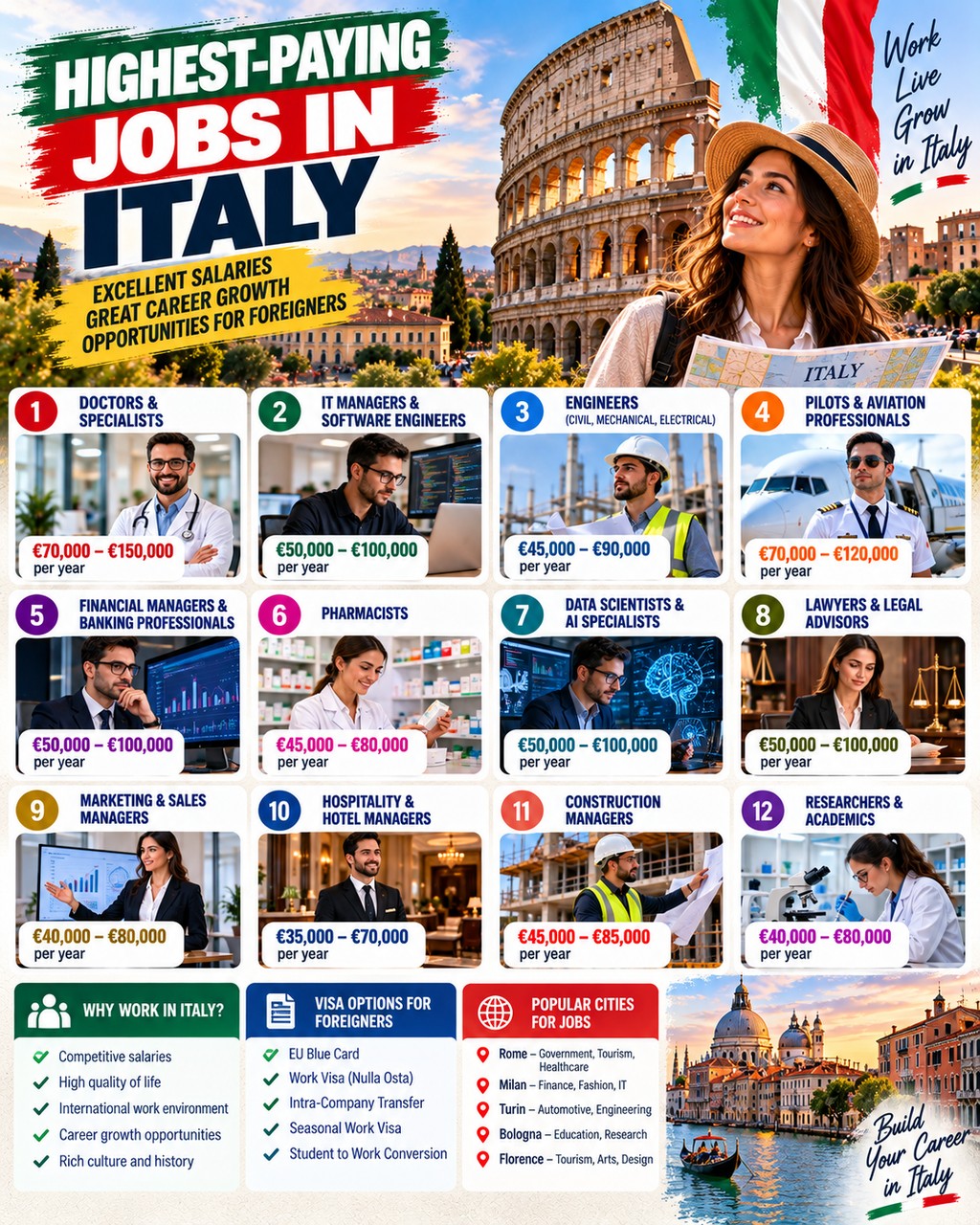
Italy has world-famous companies, hospitals, banks, design houses and engineering firms, so many people assume salaries are high. For most workers they are not. The country’s average pay sits below the European average, and a large share of income goes to tax and social contributions. Still, some careers pay much more than the average, and a few are open to skilled foreigners.
This guide covers the best-paid jobs in Italy in 2026, realistic salary ranges, which are accessible to non-Italians, how Italian pay and tax work, and how to avoid being misled by headline figures.
The Starting Point: What Italians Earn on Average
The average gross annual salary in Italy was about €33,523 in 2024 according to Eurostat figures, compared with an EU average of about €39,808. A single worker with no children takes home about €24,207 a year on that average.
Other measures give a similar picture. Private-sector employees average about €30,284 a year, managers about €55,632, and public-sector workers about €37,073, according to JobPricing data. Regionally, the highest average salaries are in Lombardy (€33,452), Lazio (€32,360) and Liguria (€32,156). Another analysis found that Lombardy pays about €6,400 more a year than Basilicata, a reminder of the north-south divide.
So a salary of €50,000 or more puts you well above the typical Italian worker, and €80,000 or more is a top-tier income.
How to Read an Italian Salary Offer
Italian offers are usually quoted as RAL, the gross annual salary. A few points make a big difference:
- 13th and 14th months. Many contracts pay the annual salary in 13 or 14 instalments. Confirm whether a quoted monthly figure assumes 12 payments or more.
- No statutory minimum wage. Italy has no single national minimum wage. Pay floors are set by sector collective agreements, so check which one applies.
- Social contributions. Employee contributions to INPS run at about 9.19% to 9.49% of gross salary, and the employer pays much more on top.
- Income tax (IRPEF) in 2026. The national rates are 23% on income up to €28,000, 33% on €28,001 to €50,000, and 43% above €50,000, after the 2026 budget law cut the middle rate from 35%. Regional surcharges range from about 1.23% to 3.33%, and municipal surcharges are up to 0.9%.
Combined with surcharges, the top marginal rate can exceed 47%, so each extra euro above €50,000 is taxed heavily. That is why net pay can feel disappointing at higher salaries.
The Highest-Paying Jobs in Italy
The figures below are gross annual salaries from recent 2025 to 2026 sources. They are averages or typical ranges, and real pay depends on region, employer and experience.
1. Notaries (about €265,000)
Notaries top the ranking, with an average gross income of about €265,000. However, this is a closed, state-regulated profession that, as far as I know, requires Italian citizenship and a competitive state exam, so it is realistically not open to foreign workers.
2. Doctors and medical managers (€60,000 to €144,000)
Medicine is one of the best-paid fields. A hospital manager-level doctor averages about €102,000, a family doctor about €89,000, and a medical specialist about €75,000. Another ranking puts the range for physicians at €60,000 to €144,000 with a median of about €81,000.
The details depend on the job:
- A newly hired doctor in a public hospital typically starts at about €60,000 gross, and a doctor with more than five years of experience earns roughly €80,000 to €105,000.
- A newly hired surgeon in the public health service earns about €55,000 to €60,000, rising to about €75,000 to €90,000 after 10 to 15 years. Private practice can add €15,000 to €30,000.
- Family doctors are self-employed contractors, and their gross income ranges from about €52,500 to over €105,000 depending on how many patients they have.
- Private and church-run hospitals pay roughly 20% to 30% less than the public health service.
A new public-sector doctors’ contract signed in February 2026 gave an average pay rise of about 7.27%. Compared with other countries, though, one comparison found Italian doctors earn well below their German counterparts.
3. Senior managers and executives (€55,000 to €140,000+)
Engineering managers earn between €58,000 and €141,000, with a median of about €79,000. Sales and marketing managers also appear in the top ranks, with marketing managers ranging from about €49,000 to €117,000. Average pay for managers across the private sector is lower, around €55,600, but heads of large firms in Milan and Rome earn far more.
4. Finance and banking (€48,000 to €123,000)
Finance and insurance are among the highest-paid sectors. One ranking puts investment banking analysts at €51,000 to €123,000 and quantitative analysts at €48,000 to €116,000. Milan, Italy’s financial centre, pays the most.
5. Technology, data and AI (€45,000 to €112,000)
Demand for tech skills keeps pay rising. Senior and lead developers typically earn about €55,000 to €85,000 or more, data scientists €45,000 to €65,000, AI and machine learning engineers €50,000 to €75,000, and security architects €60,000 to €90,000. Another ranking shows machine learning engineers reaching up to about €112,000 at the top end. Senior software engineers at multinationals in Milan can earn €60,000 to €90,000.
6. Lawyers (€45,000 to €109,000)
Lawyers have a median of about €61,000 with a top range around €109,000. To practise in Italy, you generally need Italian bar admission, which makes it hard for foreign lawyers unless they qualify locally.
7. Airline pilots (about €74,000)
Pilots average about €74,000 a year, with captains at larger airlines earning more. Licences from outside the EU usually need conversion, and the aviation sector has strict requirements.
8. Consulting, sustainability and engineering specialists (€44,000 to €121,000)
Strategy consultants earn about €44,000 to €107,000 and sustainability managers €50,000 to €121,000. Specialist engineers in aerospace, automation and energy are also well paid, particularly in northern industrial regions, and the Hays Italy salary guide shows pay across sectors from about €22,000 to more than €120,000.
What You Actually Take Home
Gross pay and take-home pay are very different in Italy. For an illustration, here is a rough estimate for someone earning €60,000 gross, using the 2026 brackets and a typical INPS rate. It ignores tax credits and deductions, which would raise the result:
- INPS contributions: about €5,500
- IRPEF on the rest: roughly €15,600
- Regional and municipal surcharges: roughly €1,100 to €2,200
- Approximate net: €37,000 to €39,000 a year, or about 62% to 65% of gross
For lower and middle incomes, tax credits make the share larger. The average worker takes home about 72% of gross, based on the Eurostat net and gross figures above. Treat these numbers as rough guides and use a payroll calculator or ask the employer for a net estimate before you accept.
Which of These Jobs Are Open to Foreigners?
Some are, and some effectively are not:
- Accessible with the right qualifications: Technology, data, engineering, finance, consulting and management roles, especially at multinationals that hire internationally. Many of these salaries are above the EU Blue Card threshold, which sources put at roughly €35,000 to €38,000 gross in 2026.
- Possible with recognition and language: Doctors and other regulated professionals must have their qualifications recognised and usually need strong Italian, which can take months or years.
- Closed or very difficult: Notaries and most public-sector posts that require Italian or EU citizenship.
- Remote workers: Non-EU professionals earning from clients or employers abroad may qualify for the digital nomad visa, which needs an income of about €28,000 a year.
Italy also offers special tax regimes for new residents, including a reduction on taxable income for qualifying workers who move their tax residence to Italy. The rules and eligibility have changed over time, so get advice from a qualified Italian tax professional before relying on them.
Where Salaries Are Highest
Northern Italy pays the most, because that is where industry, finance and multinational headquarters are concentrated. Lombardy leads, with Milan paying a premium over the rest of the country, followed by regions such as Lazio (Rome), Emilia-Romagna, Veneto and Piedmont.
The catch is cost of living. Milan has the highest rents, and Rome is cheaper but still expensive, with a one-bedroom in the centre averaging about €1,223 a month. A €50,000 salary can feel comfortable in a mid-sized northern city and tight in central Milan.
How to Land a Higher-Paying Job in Italy
- Target in-demand skills. Data, AI, cybersecurity, engineering, finance and healthcare are consistently among the best-paid and hardest to fill.
- Learn Italian. English is enough for some multinational roles, but pay and promotion improve with Italian.
- Aim for multinationals and large firms in Milan, Rome, Bologna and Turin, which pay more and often hire foreigners.
- Use specialist recruiters such as Hays, plus LinkedIn and company career pages.
- Negotiate the right things. Ask about RAL, the number of monthly payments, the collective agreement level, bonuses, meal vouchers, welfare benefits, remote work, the probation period and the notice period.
- Get your qualifications recognised early if your profession is regulated.
- Get the offer in writing before you resign or move.
These tips on negotiation and contract details come from general knowledge of Italian employment practice rather than from my searches, so confirm them with a labour consultant or union.
Avoiding Scams
High-paying offers attract fraud. Be cautious of:
- Recruiters who promise a high salary and a visa for a fee.
- Employers who cannot be traced or who offer no written contract.
- “Quota place” or “work permit” sales, which are well documented as scams in Italy. Employers must apply for work authorisation and pay their own costs.
- Remote job offers that ask you to buy equipment or pay for training.
- Offers requiring cash payments or payment into personal accounts.
Check the company’s registration, verify the recruiter’s identity and use official government sources for visas.
Common Mistakes
- Comparing gross Italian salaries with net salaries elsewhere.
- Forgetting that salaries may be paid over 13 or 14 months.
- Ignoring the income tax and surcharges when deciding whether an offer is high enough.
- Assuming a high-paying profession is open to foreigners without checking licensing.
- Moving to Milan without budgeting for rent.
- Paying anyone for a job or a visa.
Frequently Asked Questions
What is the highest-paying job in Italy?
Notaries top the list, but the profession is closed to most foreigners. Among open professions, senior doctors, managers, finance specialists and senior tech professionals are among the best paid.
What is a good salary in Italy?
Above €35,000 gross is above average, €50,000 is comfortable in most cities, and above €80,000 is a high income.
Do tech workers earn well in Italy?
Reasonably well, with senior and specialist roles reaching €60,000 to €90,000 or more, though pay is lower than in countries like Germany, the Netherlands or the United States.
How much of my salary will I keep after tax?
Roughly 62% to 72%, depending on income, region, family situation and tax credits.
Is Milan or Rome better for pay?
Milan generally pays more, especially in finance and tech, but it is also more expensive.
Final Thoughts
Italy is not the highest-paying country in Europe, but skilled professionals in medicine, management, finance, technology and engineering can earn well, and the lifestyle is a draw for many. The key is to read offers carefully, understand the difference between gross and net, check whether your profession is accessible to foreigners, and never pay for a job. With the right skills, language and expectations, a well-paid career in Italy is realistic.
Disclaimer: This article is for general information only and is not legal, financial, tax or immigration advice. Salaries, tax rates and thresholds change often, and the figures here are averages and ranges from published sources. Confirm current details with official sources or a qualified professional before making decisions.
Before you publish:
- The salary ranges come from several different sources that use different methods (Eurostat, JobPricing, salary sites and news reports), so they do not match exactly. Treat them as indicative and keep the “ranges” wording.
- My take-home estimate for €60,000 is my own approximation from the sourced tax rates, ignoring credits and deductions. Please check it with a payroll calculator before publishing.
- The points on notaries, lawyers and public posts requiring Italian or EU citizenship, pilot licence conversion, and the negotiation tips came from general knowledge, not the searches. Please verify them.
- The special tax regime for new residents is described loosely because sources disagreed on its length and rules. You may want to cut it or link to an official page.
- The Blue Card thresholds differed across sources (about €35,000 to €38,000), so confirm the current figure.
Leave a Reply