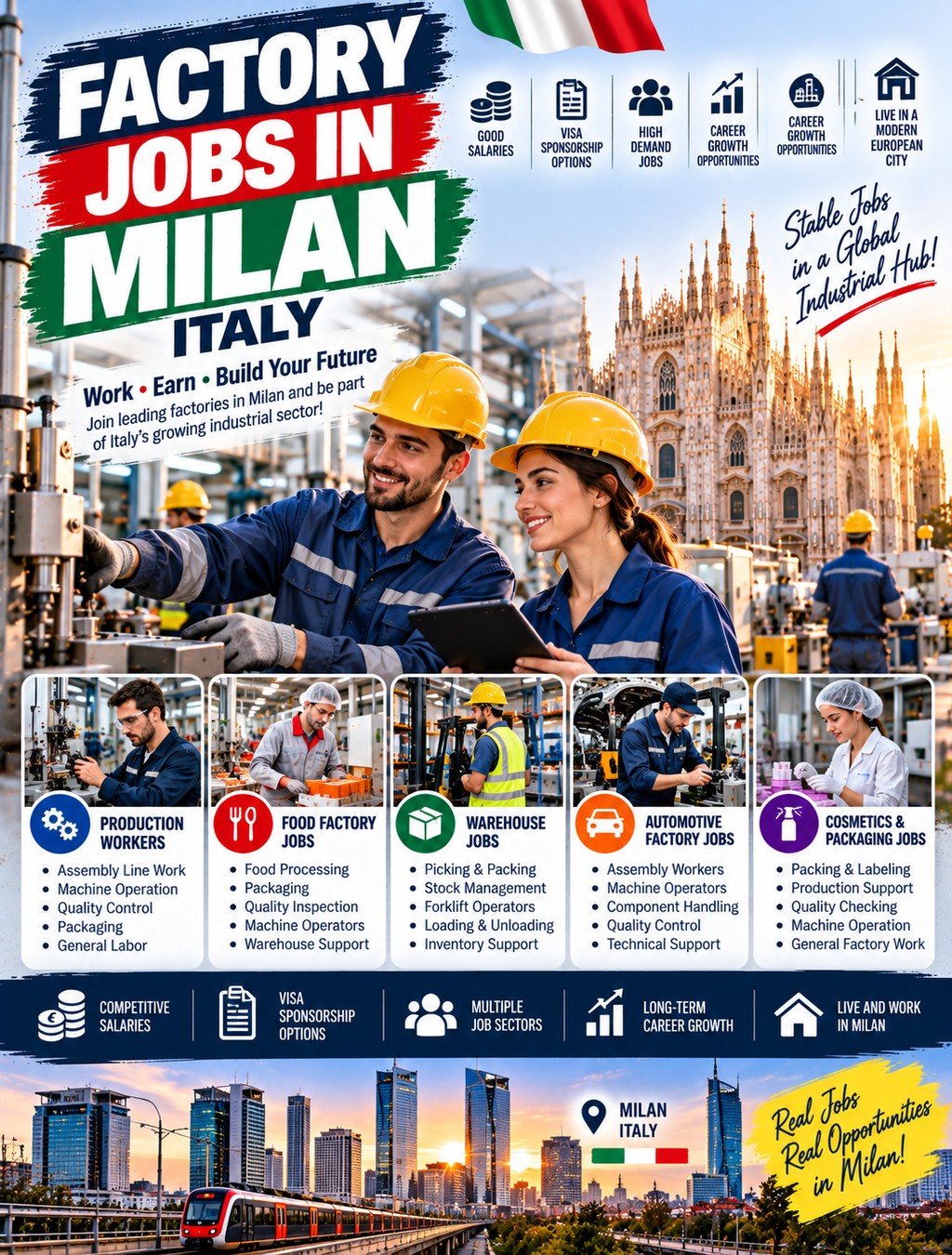
Milan is one of Italy’s strongest employment markets, and its industrial economy extends well beyond the city itself into the wider metropolitan area and neighboring parts of Lombardy. For people searching for factory jobs in Milan, opportunities can be found in manufacturing, automotive components, machinery, food production, pharmaceuticals, chemicals, packaging, electronics, plastics, textiles and other industrial activities.
Factory work in Milan can be particularly attractive for people who do not have a university degree. Many production positions are based on practical skills, previous experience, vocational training and the ability to work shifts rather than an academic degree.
The wider Lombardy economy also has one of Italy’s strongest employment markets. In the first quarter of 2026, Lombardy had approximately 4.628 million employed people, up 39,000 from the same period of 2025. The employment rate for people aged 15–64 reached 70.3%, well above the Italian national average.
Manufacturing remains an important part of that economy. In the first quarter of 2026, Lombardy’s industrial production increased 0.5% from the previous quarter and 2.4% year over year, while industrial turnover increased 2.8% year over year. The strongest-performing industrial sectors included transport equipment, mechanical engineering, steel, wood and furniture, leather and footwear and other manufacturing.
For someone looking for factory employment, these figures matter because Milan sits inside one of Europe’s largest industrial and commercial regions.
Why Look for Factory Jobs in Milan?
Milan is often associated with finance, fashion and technology, but the wider metropolitan area also has a large industrial workforce.
Factories and industrial businesses around Milan operate in areas such as:
- Automotive components
- Mechanical engineering
- Machinery
- Electronics
- Pharmaceuticals
- Chemicals
- Food production
- Packaging
- Plastics
- Metalworking
- Furniture
- Textiles
- Fashion manufacturing
- Medical products
- Industrial equipment
- Logistics and distribution
The advantage of searching around Milan rather than only inside the city center is that many factories are located in surrounding municipalities and industrial zones.
This means a search for “factory jobs in Milan” should really include the Milan metropolitan area and nearby Lombardy industrial districts.
Types of Factory Jobs in Milan
There are many different types of factory employment.
Your best option will depend on your previous experience, technical ability and Italian-language skills.
1. Production Worker
Production workers are among the most common factory employees.
Typical responsibilities include:
- Operating production equipment
- Assembling products
- Loading materials
- Checking finished products
- Packaging
- Following production instructions
- Maintaining workplace cleanliness
- Following safety procedures
Some employers provide training for new workers.
Others require previous manufacturing experience.
2. Assembly Line Worker
Assembly workers build products or components through a structured production process.
Jobs can involve:
- Mechanical assembly
- Electrical assembly
- Automotive components
- Consumer products
- Industrial equipment
- Electronics
- Packaging
Employers may test:
- Manual dexterity
- Accuracy
- Ability to follow instructions
- Production speed
- Safety awareness
Previous factory experience is useful but not always essential.
3. Machine Operator
Machine operators are responsible for running industrial equipment.
Possible equipment includes:
- Presses
- Cutting machines
- Packaging machines
- CNC machinery
- Injection-molding equipment
- Industrial processing machines
- Automated production systems
Employers may require technical training or previous experience.
Workers who can understand machine settings, detect faults and perform basic maintenance can often qualify for more specialized positions.
4. CNC Machine Operator
CNC operators are more specialized than general production workers.
CNC stands for Computer Numerical Control.
CNC operators may work with:
- Milling machines
- Lathes
- Cutting machines
- Precision machinery
- Automated machining systems
Useful skills include:
- Reading technical drawings
- Measuring components
- Understanding tolerances
- Operating CNC controls
- Tool changes
- Quality inspection
CNC experience can be valuable throughout Lombardy’s manufacturing sector.
5. Factory Maintenance Technician
Factories depend on technicians to keep equipment operating.
Possible roles include:
- Mechanical maintenance technician
- Electrical maintenance technician
- Industrial mechanic
- Automation technician
- Plant maintenance worker
- Electromechanical technician
Responsibilities can include:
- Preventive maintenance
- Troubleshooting
- Equipment repairs
- Electrical checks
- Mechanical repairs
- Machine installation
- Emergency maintenance
Technical qualifications can significantly improve employment prospects.
6. Quality-Control Worker
Quality-control employees make sure products meet required specifications.
Their work may include:
- Inspecting finished products
- Measuring components
- Recording defects
- Performing visual inspections
- Using testing equipment
- Completing quality reports
- Monitoring production standards
Experience with quality-management systems can be useful.
For more advanced positions, employers may request technical qualifications or experience with standards such as ISO systems.
7. Warehouse and Factory Logistics Jobs
Factories need workers to move materials throughout the production process.
Potential positions include:
- Warehouse worker
- Material handler
- Picker
- Packer
- Forklift operator
- Inventory assistant
- Loading/unloading worker
- Dispatch worker
- Logistics assistant
These positions can be particularly suitable for people who do not have university degrees.
Forklift certification can make a candidate more competitive.
8. Packaging Jobs
Packaging is an important part of many manufacturing industries.
Packaging workers may:
- Pack finished products
- Operate packaging machinery
- Label products
- Inspect packaging
- Prepare shipments
- Load cartons
- Record production quantities
Industries using packaging workers include:
- Food
- Pharmaceuticals
- Cosmetics
- Consumer products
- Manufacturing
- Retail products
9. Food Factory Jobs
Lombardy has a substantial food-processing industry.
Potential jobs include:
- Food-production worker
- Packaging operator
- Bakery worker
- Machine operator
- Food-quality worker
- Warehouse worker
- Production assistant
- Food-processing technician
Workers may need to follow strict hygiene and food-safety procedures.
Experience in food production can therefore be useful when applying to factories around Milan.
10. Pharmaceutical Factory Jobs
Milan and Lombardy have a significant pharmaceutical and life-sciences ecosystem.
Potential roles include:
- Production operator
- Packaging operator
- Laboratory technician
- Quality-control assistant
- Warehouse worker
- Machine operator
- Maintenance technician
- Production supervisor
Pharmaceutical manufacturing can have stricter requirements than general factory work.
Depending on the position, employers may require:
- Technical education
- Pharmaceutical experience
- Laboratory knowledge
- Quality-control experience
- Hygiene and safety training
11. Automotive Manufacturing Jobs
The wider Lombardy region has a large automotive and industrial supply chain.
Potential jobs include:
- Automotive assembly worker
- Component-production worker
- CNC operator
- Quality inspector
- Mechanical technician
- Maintenance technician
- Warehouse worker
- Production planner
- Automotive engineer
The industry increasingly combines traditional mechanical manufacturing with electronics, automation and software.
Workers with technical skills can therefore target both traditional production and advanced manufacturing positions.
12. Metalworking Jobs
Metalworking remains an important industrial activity around Milan and Lombardy.
Potential jobs include:
- Metalworker
- Welder
- CNC operator
- Machine operator
- Metal cutter
- Fabricator
- Mechanical assembler
- Quality inspector
- Industrial mechanic
Skilled workers with welding, machining or fabrication experience can potentially access more specialized positions than general production workers.
13. Electronics Factory Jobs
Electronics manufacturing can include:
- Component assembly
- Circuit-board production
- Testing
- Quality control
- Packaging
- Equipment assembly
- Technical maintenance
Workers with electronics training may qualify for technician-level positions.
14. Textile and Fashion Manufacturing Jobs
Milan is one of the world’s major fashion capitals.
Although many fashion companies focus on design, retail and marketing, the broader industry also creates manufacturing employment.
Potential positions include:
- Textile worker
- Sewing machine operator
- Garment worker
- Production operator
- Quality-control worker
- Pattern-production assistant
- Warehouse worker
- Packaging worker
Workers with sewing and garment-production experience should search both Milan and the wider Lombardy fashion-manufacturing network.
15. Chemical and Plastics Factory Jobs
Chemical and plastics companies can employ:
- Production operators
- Machine operators
- Packaging workers
- Laboratory assistants
- Quality-control workers
- Maintenance technicians
- Warehouse workers
These jobs may have stricter safety requirements than ordinary manufacturing.
Applicants should carefully review the required qualifications and working conditions before accepting an offer.
Factory Jobs in Milan Without a University Degree
One of the biggest advantages of factory employment is that many positions do not require a university degree.
Possible jobs include:
- Production worker
- Assembly worker
- Packaging worker
- Warehouse worker
- Machine operator
- Factory cleaner
- Material handler
- Food-production worker
- Loading/unloading worker
- Forklift operator
- General factory worker
However, no university degree does not mean no qualifications.
Employers may still require:
- Secondary education
- Previous factory experience
- Technical training
- Italian language skills
- Forklift certification
- Safety training
- Machine-operation experience
- Ability to work shifts
For technical jobs, vocational qualifications can be more valuable than a general university degree.
Skilled Factory Jobs That Can Pay Better
Workers who develop technical skills can generally target more specialized positions.
Examples include:
CNC Operator
Requires machining knowledge and the ability to work with precision equipment.
Industrial Maintenance Technician
Requires mechanical and/or electrical knowledge.
Automation Technician
Works with automated production systems, robotics and industrial controls.
Quality Technician
Performs detailed inspections and quality checks.
Industrial Electrician
Maintains factory electrical systems.
Welding Specialist
Performs specialized metal joining and fabrication.
Production Supervisor
Coordinates workers, production schedules, quality and safety.
Industrial Engineer
Improves production systems, processes and efficiency.
The more specialized your skills become, the less you compete directly with general labor applicants.
Factory Shift Work in Milan
Many factories operate in shifts.
You may encounter:
- Morning shift
- Afternoon shift
- Night shift
- Two-shift systems
- Three-shift systems
- Weekend shifts
A three-shift factory may operate continuously across:
Morning → Afternoon → Night
Before accepting a factory job, ask about:
- Shift rotation
- Night work
- Weekend work
- Overtime
- Breaks
- Transport
- Shift allowances
- Contract hours
Shift work can sometimes provide additional compensation, but it can also make commuting more difficult.
Factory Jobs Around Milan
Do not search only within central Milan.
Many manufacturing employers operate in surrounding industrial areas.
Search locations such as:
- Sesto San Giovanni
- Cinisello Balsamo
- Rho
- Pero
- Segrate
- San Donato Milanese
- San Giuliano Milanese
- Rozzano
- Assago
- Corsico
- Buccinasco
- Legnano
- Monza
- Lodi
- Bergamo
- Brescia
Some of these are outside the municipality of Milan, but they are part of the broader employment market that Milan-area job seekers can access.
A wider geographic search can significantly increase the number of vacancies available.
Current Manufacturing Conditions in Lombardy
The manufacturing sector in Lombardy remains important, although employers are operating in an uncertain economic environment.
In the first quarter of 2026, industrial production increased 2.4% year over year and industrial turnover increased 2.8%. The transport-equipment and mechanical sectors were among the stronger-performing industrial categories.
At the same time, regional economic monitoring reported uncertainty related to raw-material costs, energy prices, geopolitical instability and trade tariffs. Business expectations for the following quarter were more cautious even though the employment balance in industry remained positive.
This means the manufacturing market should be viewed realistically: there are opportunities, but demand can vary by industry and company.
How Much Can Factory Workers Earn in Milan?
There is no single salary for factory workers.
Pay depends on:
- Industry
- Job title
- Experience
- Technical qualifications
- Shift pattern
- Contract type
- Collective labor agreement
- Overtime
- Employer
- Location
For example, a current Milan-area production vacancy advertised through a recruitment agency offers a particular role at €25,000–€30,000 gross annual salary. That is an example of one advertised position, not an average salary for all factory workers in Milan. (umana.it)
Technical positions can command more depending on skills and experience.
When comparing offers, check:
- Gross annual salary
- Expected net salary
- Working hours
- Overtime
- Shift allowances
- Bonuses
- Contract duration
- Probation
- Paid holidays
- Meal vouchers
- Transportation benefits
Cost of Living and Factory Salaries in Milan
Milan is one of Italy’s more expensive cities, particularly for housing.
This is important for factory workers because entry-level manufacturing salaries may not always provide enough income to comfortably rent an apartment alone in central Milan.
Before accepting an offer, calculate:
Net salary − rent − utilities − food − transportation − other expenses
Workers can reduce costs by:
- Sharing accommodation
- Living outside central Milan
- Choosing a location close to public transportation
- Living in nearby municipalities
- Sharing transportation with colleagues
A factory job outside Milan with cheaper accommodation can sometimes produce a better financial outcome than a slightly higher-paying job in the city.
Do You Need Italian for Factory Jobs?
Italian is important, even when the job is not customer-facing.
Factory workers need to understand:
- Safety instructions
- Machine instructions
- Workplace rules
- Supervisors
- Training
- Emergency procedures
- Colleagues
Some multinational companies may use English for technical positions, but entry-level factory workers should not assume that English alone will be sufficient.
A useful target is:
A2: Basic workplace communication
B1: Practical communication with supervisors and colleagues
B2: Strong professional communication
Learning Italian before moving to Milan can make your job search substantially easier.
Factory Jobs in Milan for Foreign Workers
Foreign nationals can work in Milan if they have the appropriate legal authorization.
For EU citizens, the process is generally different from that for non-EU citizens.
For non-EU workers outside Italy, an employer may need to use an applicable immigration route, including quota-based employment where relevant.
Italy’s 2026–2028 Decreto Flussi provides for 497,550 entries of third-country nationals over the three-year period.
However, the existence of immigration quotas does not mean that every factory job qualifies for sponsorship.
The specific:
- Occupation
- Employer
- Contract
- Immigration category
- Annual quota
- Application procedure
must be considered.
The Italian Ministry of Labour explains the rules governing entry and residence for employment and maintains official information on immigration-related employment procedures.
The key principle is:
A factory vacancy is not automatically a visa-sponsored vacancy.
Foreign applicants should verify the employer’s willingness and legal ability to employ a non-EU worker before paying an agent or making travel arrangements.
Can Pakistani Workers Get Factory Jobs in Milan?
Yes, Pakistani citizens can potentially work in Italian factories if they obtain the appropriate legal authorization.
Potential roles include:
- Production worker
- Machine operator
- Warehouse worker
- Welder
- Electrician
- Maintenance technician
- Food-production worker
- Packaging worker
- CNC operator
- Quality-control worker
Applicants with technical experience should emphasize those skills rather than applying only for general labor positions.
For example, a person with five years of CNC experience should search for:
“CNC operator jobs Milan”
rather than simply:
“factory jobs Milan.”
A specialized search can lead to better-matched vacancies.
How to Find Factory Jobs in Milan
1. Use the Official Milan Employment Resources
The Metropolitan City of Milan’s 2026 labor bulletin analyzes employment, hiring, professional qualifications, online vacancy requirements and expected labor demand.
Lombardy also launched the Vetrina Pubblica IDO in October 2026, a public-facing employment-vacancy service designed to make job opportunities easier for citizens to access.
These are useful resources to monitor alongside commercial job portals.
2. Search Using Italian Job Titles
Use searches such as:
- “operaio produzione Milano”
- “operaio fabbrica Milano”
- “addetto produzione Milano”
- “operaio metalmeccanico Milano”
- “operatore macchina Milano”
- “addetto assemblaggio Milano”
- “magazziniere Milano”
- “carrellista Milano”
- “manutentore industriale Milano”
- “operatore CNC Milano”
- “controllo qualità Milano”
- “operaio alimentare Milano”
- “addetto confezionamento Milano”
Italian keywords can produce significantly more relevant results than simply searching in English.
3. Use Recruitment Agencies
Recruitment agencies are an important route into factory employment in Italy.
They frequently recruit for:
- Production
- Logistics
- Manufacturing
- Maintenance
- Warehousing
- Packaging
- Administration
Current Milan-area recruitment listings show vacancies across production and logistics categories.
When dealing with an agency, verify that it is a legitimate registered recruitment business.
4. Apply Directly to Manufacturers
Create a list of manufacturers around Milan and search their career pages.
Target companies in:
- Automotive
- Pharmaceuticals
- Food
- Machinery
- Electronics
- Chemicals
- Packaging
- Metalworking
- Fashion
- Logistics
Direct applications can be particularly useful for skilled workers.
How to Prepare a CV for Factory Jobs in Milan
Your CV should be simple and practical.
Include:
Personal details
- Name
- Phone
- Location
Professional summary
Example:
Production worker with five years of manufacturing experience specializing in assembly, quality control and shift-based production environments.
Work experience
Include:
- Company
- Job title
- Dates
- Machinery used
- Responsibilities
- Production achievements
Technical skills
For example:
- CNC
- Welding
- Mechanical assembly
- Forklift operation
- Quality control
- Machine operation
- Maintenance
- Packaging machinery
Certifications
Include:
- Forklift certification
- Welding certification
- Electrical qualification
- Safety training
- Technical diplomas
Languages
Clearly state your Italian and English levels.
Example Factory CV Skills
If you are applying for a general production position, useful skills may include:
- Production-line operation
- Assembly
- Packaging
- Quality inspection
- Manual handling
- Workplace safety
- Shift work
- Inventory
- Basic machinery operation
For a technical position:
- CNC operation
- Technical drawings
- Preventive maintenance
- Electrical troubleshooting
- Mechanical repair
- Automation
- PLC systems
- Industrial machinery
Factory Job Interviews in Milan
Expect questions such as:
“Tell me about your previous factory experience.”
“Which machines have you operated?”
“Can you work shifts?”
“Can you work nights?”
“Do you have safety training?”
“Do you have forklift certification?”
“Have you worked in a production environment before?”
“Can you understand technical instructions in Italian?”
Prepare specific examples.
Instead of saying:
“I am a hard worker.”
Explain what you actually did:
“I worked on a three-shift production line, operated packaging machinery and completed quality checks before products were moved to dispatch.”
Specific information is much more convincing.
Factory Work Safety
Factory employment can involve machinery, chemicals, electricity, heavy materials and moving equipment.
Before starting work, make sure you understand:
- Safety procedures
- Emergency exits
- Personal protective equipment
- Machine safety
- Chemical handling
- Manual lifting rules
- Forklift areas
- Accident reporting
- Emergency procedures
Never operate equipment you have not been trained to use.
Factory Job Scams in Milan
Foreign workers should be particularly careful with online job offers.
Be suspicious if someone promises:
- Guaranteed factory employment
- Guaranteed Italian work visa
- Extremely high wages for basic work
- Employment without an interview
- Immediate visa approval
- A job in exchange for a large upfront payment
- A “guaranteed Decreto Flussi quota”
Never assume that paying an agent guarantees employment.
Verify:
- Employer’s legal name
- Company address
- Company website
- Recruiter’s identity
- Written employment contract
- Salary
- Working hours
- Immigration procedure
If an employer or agent asks you to transfer a large amount of money simply to secure a job, treat it as a major warning sign.
Advantages of Factory Jobs in Milan
Factory employment can offer several advantages.
No university degree required for many positions
Practical experience can be enough for numerous production roles.
Opportunities for skill development
Workers can progress from general production to technical positions.
Shift opportunities
Some factories operate multiple shifts, increasing the range of available schedules.
Career progression
A worker may progress from:
Production worker → machine operator → skilled operator → technician → supervisor
Transferable skills
Manufacturing skills can be useful throughout Italy and other European countries.
Disadvantages to Consider
Factory employment also has challenges.
Shift work
Night and weekend shifts can be difficult.
Physical demands
Many jobs require standing, lifting or repetitive movement.
Workplace safety
Machinery and industrial environments require strict safety compliance.
Commuting
Factories may be outside central Milan.
Housing costs
Milan’s housing market can make entry-level salaries challenging.
Contract uncertainty
Some jobs begin as temporary contracts before potentially becoming permanent.
Read the employment contract carefully.
Frequently Asked Questions About Factory Jobs in Milan
Are there factory jobs in Milan?
Yes. Milan and the wider Lombardy region have a substantial manufacturing economy covering machinery, automotive components, food, pharmaceuticals, metalworking, electronics, packaging, fashion and other industries.
Can I get a factory job in Milan without a degree?
Yes. Production, assembly, packaging, warehouse and general factory positions can often be accessed without a university degree, although employers may require experience, training or language skills.
What factory jobs pay the most?
Specialized positions such as CNC operators, industrial maintenance technicians, automation technicians, skilled welders, quality technicians, supervisors and industrial engineers can generally offer stronger earning potential than basic production positions.
Do factory workers need to speak Italian?
Usually, at least basic Italian is highly useful because workers must understand safety instructions, supervisors and workplace procedures.
Can foreigners get factory jobs in Milan?
Yes, provided they have the appropriate legal right to work in Italy.
Can Pakistani citizens get factory jobs in Milan?
Potentially. Pakistani citizens can apply for legitimate Italian factory positions, but they need the correct immigration and work authorization before beginning employment.
Does Italy sponsor factory workers?
Some non-EU workers can enter Italy for employment through applicable immigration routes, including quota-based programs where the occupation and employer qualify. However, not every factory vacancy provides sponsorship.
Is Milan good for manufacturing jobs?
Yes. Milan sits within Lombardy, one of Italy’s most important industrial regions. Lombardy’s industrial production grew 2.4% year over year in the first quarter of 2026.
Where should I search for factory jobs around Milan?
Search Milan as well as nearby industrial areas such as Sesto San Giovanni, Rho, Segrate, San Donato Milanese, San Giuliano Milanese, Assago, Rozzano, Corsico and other municipalities in the metropolitan area.
Final Thoughts
Factory jobs in Milan can be a practical employment option for people with or without university degrees.
The city’s manufacturing economy is much broader than traditional factory assembly. Opportunities exist in:
- Automotive components
- Machinery
- Food production
- Pharmaceuticals
- Electronics
- Packaging
- Metalworking
- Chemicals
- Fashion manufacturing
- Logistics
- Industrial maintenance
Lombardy’s manufacturing sector remains a major part of the regional economy. Industrial production increased 2.4% year over year in the first quarter of 2026, while employment in the region also reached a record level in the available series.
For someone without a degree, the easiest starting points may include production, packaging, assembly, warehouse and general factory work.
For workers with technical experience, better opportunities may be available in:
CNC machining → industrial maintenance → electrical systems → automation → quality control → technical supervision.
The most important strategy is to develop a specific skill rather than remaining a general laborer indefinitely.
If you are applying from Pakistan or another country outside the EU, remember that finding a factory vacancy is only the first step. You must also determine whether the employer can legally employ a non-EU worker and whether the position fits an applicable Italian immigration route.
For the best results:
Learn Italian → develop a practical manufacturing skill → prepare an Italian CV → search the wider Milan metropolitan area → use Italian job keywords → contact legitimate recruitment agencies → verify employers → understand immigration requirements before paying anyone.
Instead of searching only for “Factory Jobs in Milan,” try more specific searches such as:
- Production jobs in Milan
- Manufacturing jobs in Milan
- CNC operator jobs in Milan
- Warehouse jobs in Milan
- Factory worker jobs in Milan
- Automotive jobs in Milan
- Food factory jobs in Milan
- Pharmaceutical factory jobs in Milan
- Factory jobs in Milan for foreigners
- Factory jobs in Milan with visa sponsorship
A targeted search will give you a much better chance of finding a position that matches your actual skills, experience and eligibility.
Leave a Reply