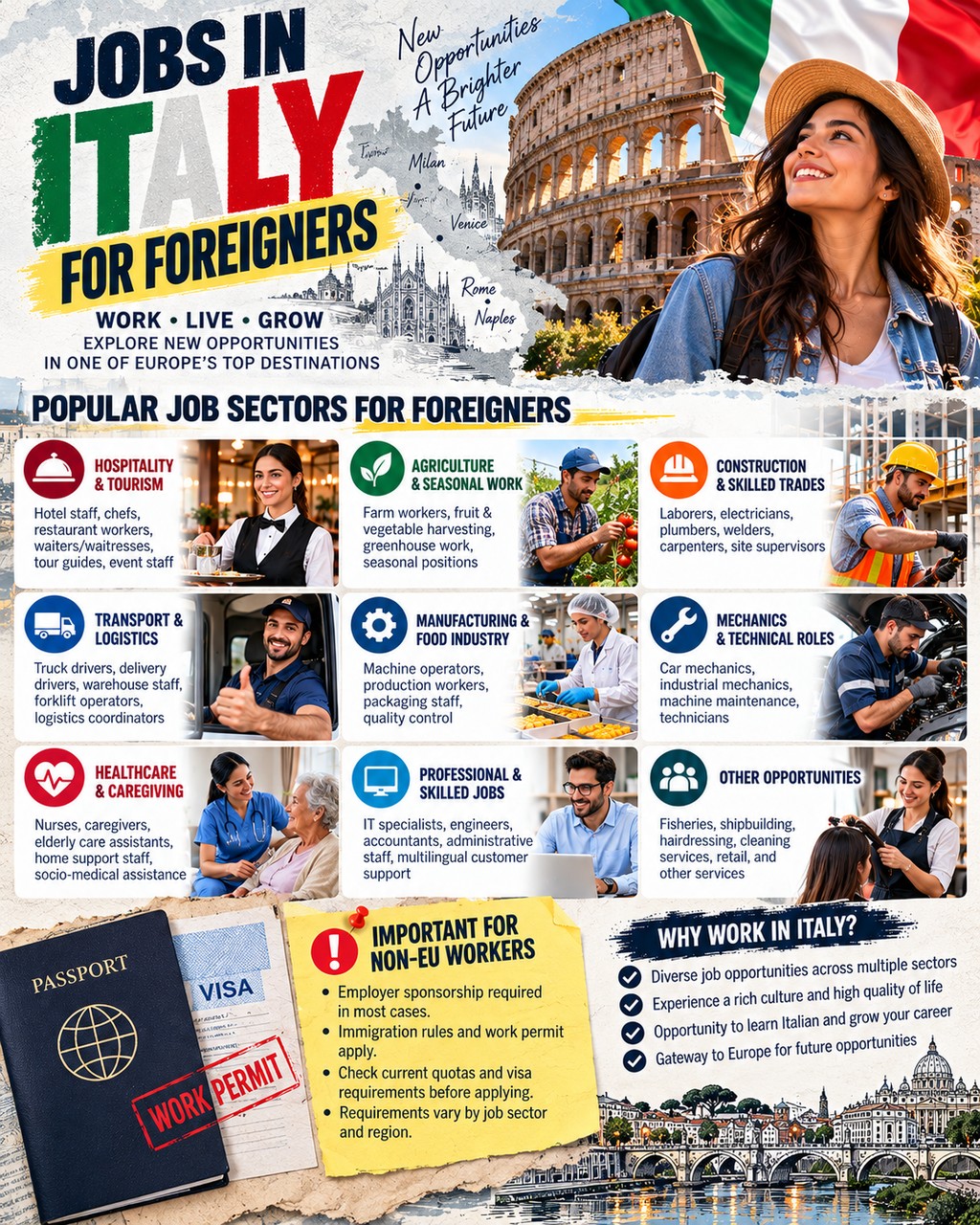
Italy is known for food, fashion, history and beaches, but it is also a large industrial economy with hotels, factories, farms, hospitals, shops and a growing technology sector. Every year, businesses struggle to fill jobs and the government opens legal channels for hundreds of thousands of workers from outside Europe.
At the same time, Italy’s immigration system is complicated, wages are lower than in many countries, and fraudsters regularly sell fake job offers to people hoping to work there. This guide explains how the job market works, who can work in Italy, the main visa routes, which sectors and regions are hiring, what jobs pay, and how to protect yourself.
Italy at a Glance
- Italy’s unemployment rate was 6.2% in August 2026, a 15-month high, with youth unemployment at 20.3%. Earlier in 2026 the rate had touched record lows.
- Most non-EU workers need an employer to apply for them before they arrive.
- The main entry system is the annual Decreto Flussi quota, plus the EU Blue Card for higher earners.
- Italian language skills matter in most jobs.
- Contracts, pay and rights are shaped by Italian labour law and sector collective agreements.
- Paying anyone for a job offer or a quota place is the clearest sign of a scam.
The Italian Job Market in 2026
Italy’s labour market reached historic highs earlier this year. The employment rate hit 62.7% in the first quarter of 2026, the highest since the statistics began in 2004, and unemployment dropped to 5.3%, the lowest ever recorded. Since then it has edged back up, reaching 6.2% in August.
Hiring demand is large but selective. According to the Excelsior system run by Unioncamere and the Ministry of Labour, businesses planned about 565,000 hires for September 2026 and roughly 1.5 million over the September to November quarter. Services account for about 65.6% of planned hires, industry including construction for 26.5% and agriculture and related sectors for 7.9%. Companies reported difficulty finding about 44% of the profiles they wanted, usually because of too few candidates and sometimes because of weak training.
Several features of this market matter for foreigners:
- Experience counts. About 65% of planned hires require specific professional experience or experience in the same sector, and only about 18.5% target people with a university-level qualification.
- Contracts are often temporary. Only about 22% of planned contracts in the Excelsior data were permanent or apprenticeship-based.
- Foreign workers are part of the picture. The same data indicate that foreign workers account for roughly 23% of the profiles businesses were seeking.
Who Can Work in Italy
EU, EEA and Swiss citizens can live and work in Italy without a visa. They register with local authorities, get a tax code and can apply for jobs like Italian citizens.
Non-EU citizens generally need a visa that matches a specific type of work, and in most cases an Italian employer must start the process. The main routes are below.
1. Decreto Flussi (annual quota)
The Decreto Flussi sets how many non-EU workers can enter Italy for work each year. The 2026 to 2028 plan authorises 497,550 entries over three years, with 164,850 for 2026, 165,850 for 2027 and 166,850 for 2028. For 2026, about 88,000 places were for seasonal work in agriculture and tourism and 76,200 for non-seasonal employed work, including 13,600 for family assistance and care workers.
Here is how it works in practice:
- An Italian employer applies online on a fixed “click day.” In 2026 the dates were in January for agricultural seasonal work and in February for other categories, after a pre-filling period in late 2025.
- If the application is accepted, the authorities issue a work authorisation called the nulla osta.
- The worker applies for a visa at an Italian consulate in their home country.
- After arriving, the worker signs a residence contract and applies for a residence permit.
Some sources estimate that the whole process takes between two and six months, but timing varies. Popular categories can fill within hours. You cannot apply yourself, because the employer must file the request. The government has also said it wants to move away from the click-day system and encourage more entries outside the quotas.
2. EU Blue Card
Highly qualified non-EU workers with a university degree or equivalent experience and a job offer can use the EU Blue Card, which does not depend on the Decreto Flussi quota. The salary threshold is set by law and updated. Sources vary on the exact figure, from about €35,000 to €38,000 gross a year for 2026. One Italian law firm reported an update to about €36,300, and a lower threshold of roughly €28,000 to €29,000 may apply for shortage occupations such as information technology and healthcare. The contract or binding offer must last at least six months.
The qualification usually needs to be formally recognised, and one guide estimates one to three months for the declaration of value, up to three months for the work authorisation and two to three weeks for the visa.
3. Other routes outside the quota
Some categories are also outside the Decreto Flussi quota, including intra-company transfers of managers and specialists. Eligibility rules are strict, so check with the Italian consulate or the Ministry of the Interior.
4. Seasonal work
Hotels, restaurants, farms and tourism businesses hire seasonal workers under the quota, though a share of the places are reserved for certain nationalities. Seasonal work can lead to repeat entries but does not automatically lead to permanent residence.
5. Digital nomad visa
Non-EU remote workers who are highly skilled and employed by or freelancing for clients outside Italy can apply for the digital nomad visa. Sources differ on exactly when the programme began operating, but Italian consulates have been accepting applications in 2026. The income requirement is about €28,000 a year from remote work, although one consulate cites a lower figure of about €24,789. Applicants typically need six or more months of work history, bank statements and proof of housing in Italy, since short-term rentals are generally not accepted. You apply through the consulate that covers your country of legal residence.
This visa lets you live in Italy and work remotely for non-Italian clients or employers. It does not give you the right to take a job with an Italian company.
Sectors and Regions Hiring
Tourism, hotels and restaurants. This is the biggest source of vacancies. In February 2026, accommodation, restaurants and tourist services planned about 71,000 hires in a single month, followed by retail with about 57,000.
Industry and manufacturing. Mechanical engineering, metalworking, textiles, furniture and food production employ many workers, and companies report difficulty finding enough of them. In one summer report, construction, fashion, wood furniture, metallurgy and mechatronics were among the sectors with the biggest recruitment problems.
Technicians, engineers and healthcare. The hardest profiles to find include technicians and engineers, healthcare professionals and electrical and electronic maintenance workers. Healthcare workers need their qualifications recognised in Italy and usually need good Italian.
Agriculture. Seasonal farm work is a major route for quota workers, but also a sector with serious exploitation problems, covered in the scams section.
Care work. Family assistance and elder care is a recognised category under the quota, usually requiring work in private homes.
Technology and professional services. Concentrated in the large northern cities and Rome, with many roles requiring English and sometimes Italian.
Regions. Lombardy leads the country in planned hires, with about 114,480 in September 2026, followed by Lazio, which includes Rome, with about 58,790 and Veneto with about 51,610. Earlier in the year the South and the islands led planned hires in one quarter, followed closely by the north-west. Wages and living costs are generally higher in the north than in the south, though jobs are not always easier to find there.
What Jobs Pay in Italy
Italian salaries are generally lower than in North America or Northern Europe, so it helps to understand how pay is structured.
- Collective agreements: Italy does not have one national minimum wage. Pay floors are usually set by sector collective agreements, known as CCNL. Always check which agreement applies to your job.
- Thirteenth and fourteenth months: Many contracts include extra monthly payments, so compare annual totals.
- TFR: Employees accumulate a severance fund paid when they leave.
- Contract types: Fixed-term, permanent and apprenticeship contracts carry different rights.
These points are general features of Italian labour law, so confirm details with a union, a labour consultant or the Ministry of Labour before signing.
As a reference point, one cost survey puts the average net monthly salary in Rome at about €1,842. Rome is the more expensive end of Italy outside Milan, and salaries in many southern regions are lower. Hospitality and care jobs often start near the collective agreement minimum, while engineers, IT specialists and managers earn more.
Be careful with very low offers. Some listings aimed at foreigners pay little or require applicants to work as freelancers with their own tax number, which means no employee protections.
Language
English-speaking jobs exist, especially in tourism, international organisations, schools, multinational companies and some technology roles, but your options and your pay improve a great deal with Italian. Employers in tourism and customer service generally expect at least basic to intermediate Italian, and daily life, from landlords to doctors, usually runs in Italian. Learn the language before you go, and consider a recognised certificate such as CILS or CELI.
Recognising Your Qualifications
For regulated professions such as nursing, medicine, engineering, teaching and law, foreign qualifications generally need to be recognised before you can practise, which can take months and may require Italian exams. For a Blue Card, a formal declaration of value of your degree is typically needed. Start early, and ask the relevant Italian professional body or the consulate which documents to prepare. Italy’s qualification recognition rules and the names of the bodies are general knowledge in this guide, so verify them with an official source.
Where to Look for Jobs
- Employer career pages and hotel groups: Many hire directly, especially for seasonal work.
- LinkedIn and Indeed Italia: For corporate, technical and professional roles.
- Recruitment agencies: Large agencies place workers in factories, logistics and hospitality.
- Public employment centres and EURES: Italy’s public job centres and the European job portal list vacancies, mostly for people already in Europe.
- English-language boards: Wanted in Rome and similar sites list jobs for English speakers, including teaching and hospitality.
- International organisations: UN agencies in Rome and other bodies post jobs on their own portals.
Keep in mind that most real opportunities for non-EU workers require an employer willing to complete the sponsorship paperwork, which makes a verified direct employer much safer than a middleman.
CVs and Interviews in Italy
Italian CVs are usually one to two pages. A photo is common but optional, and a line authorising the processing of personal data under privacy law is standard. If the job is in Italian, write the CV and cover letter in Italian. Interviews are often more relationship-driven than in North America, so punctuality, polite formality and a few words of Italian go a long way.
Scams: The Biggest Risk
Fraud around Italian work visas is widespread and well documented, so take this section seriously.
- Paid job offers that turned out to be fake. The Philippine Consulate in Milan reported that 269 Filipinos paid at least €3,000 each for jobs under the Decreto Flussi that turned out not to exist, and complaints of aggravated fraud were filed against the consultancy involved.
- Fake employers. In 2025, the CGIL trade union in Campania described about 400 Bangladeshi workers who arrived in Italy to find that their supposed employers could not be traced, leaving them without papers. The union said such workers are defrauded twice, because they cannot find the employer and are not entitled to a residence permit.
- Large-scale cancellations. Italian authorities blocked and revoked 3,339 Decreto Flussi applications filed by 142 companies, mostly in agriculture, construction and home care, after prosecutors found the hiring requests were false. Investigations of similar schemes have continued, including in southern Italy in 2026.
How to protect yourself:
- Never pay for a job offer, a quota place or a click-day slot. The employer applies and pays its own costs.
- Check the employer. Ask for the company’s registration number and address, verify them independently and be wary if the business cannot be traced.
- Get a written contract that states pay, hours, job title and the applicable collective agreement, in a language you understand.
- Be suspicious of guarantees. Nobody can guarantee a visa.
- Use official sources only: the Ministry of the Interior, the Ministry of Foreign Affairs and the Italian consulate in your country.
- Never work without a contract. Undeclared work leaves you without legal protection and can end your right to stay.
- Report fraud to your local police and to your country’s embassy or consulate.
A Step-by-Step Plan
- Identify your route: EU citizen, Blue Card candidate, quota worker, remote worker or someone eligible to convert a student permit.
- Check your qualifications and start the recognition process if needed.
- Learn Italian and get a recognised certificate if you can.
- Look for employers in your sector and region, and focus on verified direct employers.
- Get a written offer and check the contract against the collective agreement.
- Let the employer handle the application, and never pay for it.
- Plan your finances for rent, deposits and the first month before your first salary.
- After arrival, complete the residence permit, tax code and registration steps promptly.
Common Mistakes
- Paying a “consultant” or “agent” for a job offer or quota place.
- Arriving in Italy hoping to find sponsorship on the spot.
- Ignoring Italian.
- Accepting cash work or freelance terms when you need an employment contract.
- Choosing a job without checking the rent in that city.
- Missing deadlines for the residence permit after arrival.
Frequently Asked Questions
Can foreigners work in Italy without a visa?
EU, EEA and Swiss citizens can. Most other nationals need a work visa, and in most cases an employer must apply first.
How many foreign workers does Italy admit each year?
The 2026 to 2028 plan allows 497,550 entries over three years, with 164,850 in 2026.
Can I apply for the Decreto Flussi myself?
No. The employer files the request on your behalf.
Do I need to speak Italian?
Not for every job, but Italian greatly improves your chances and your pay.
What is the best visa for a skilled professional?
The EU Blue Card is usually the main route for highly qualified workers who meet the salary threshold.
Can I work remotely from Italy?
Non-EU remote workers need a digital nomad visa, which has an income threshold of about €28,000 a year.
Which Italian cities have the most jobs?
Lombardy, which includes Milan, leads in planned hires, followed by Lazio, which includes Rome, and Veneto.
Final Thoughts
Italy offers real opportunities, especially in hospitality, industry, healthcare, engineering and technology, and its legal channels for foreign workers are among the largest in Europe. But the system is bureaucratic, wages are modest, and fraud is common. The best approach is to prepare your qualifications and language, find a genuine employer, insist on a written contract and never pay for a job. Done carefully, Italy can be a rewarding place to build a career.
Disclaimer: This article is for general information only and is not legal, financial or immigration advice. Visa quotas, salary thresholds and labour rules change often. Confirm current details with the Italian Ministry of the Interior, the nearest Italian consulate or a licensed professional before making decisions.
Leave a Reply