Blog

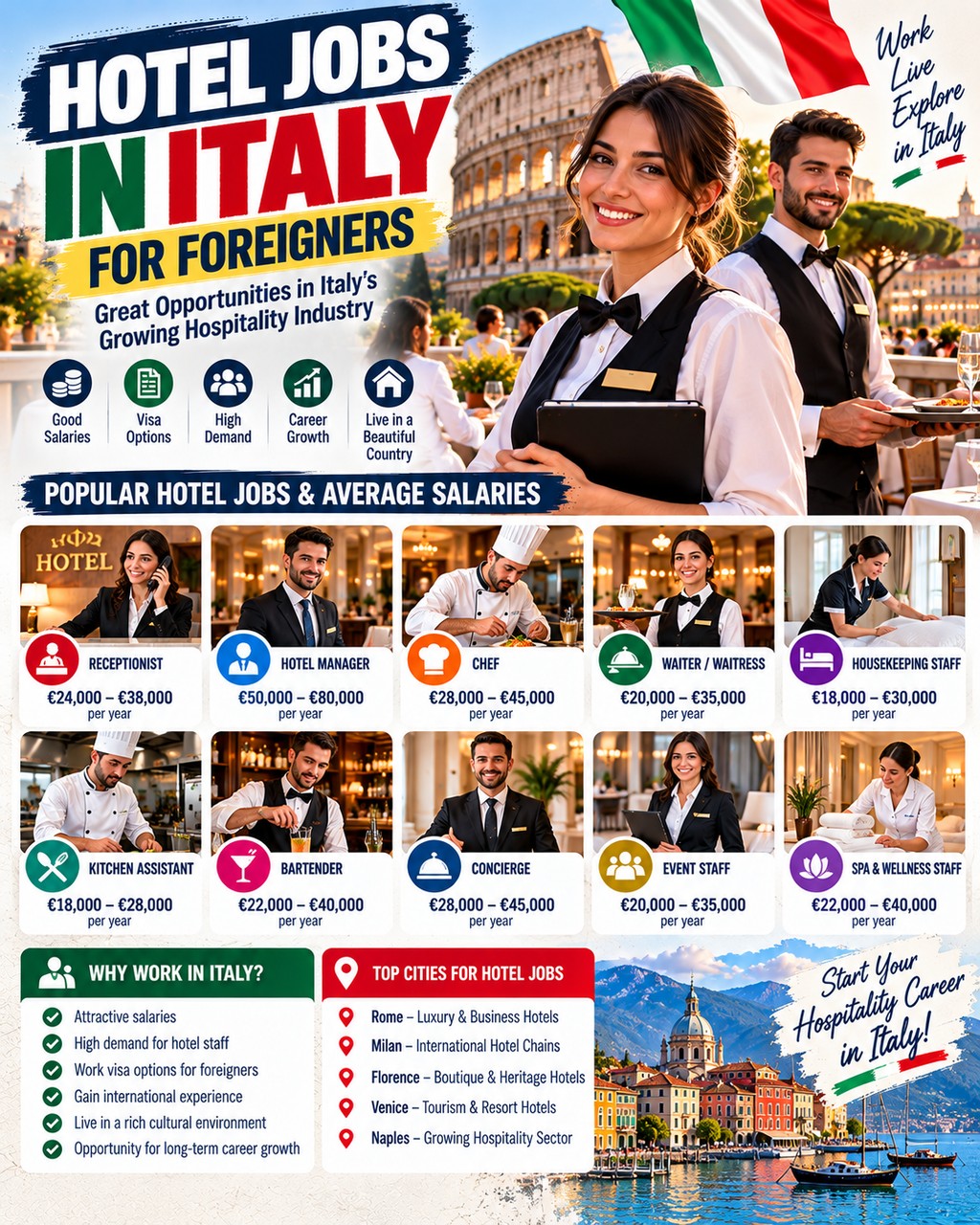
  • Hotel Jobs in Italy for Foreign Workers: Complete Guide to Finding Hotel Employment

    Hotel Jobs in Italy for Foreign Workers: Complete Guide to Finding Hotel Employment

    Italy is one of Europe’s most popular tourism destinations, creating employment opportunities across hotels, resorts, restaurants, guesthouses, hostels, holiday properties and other accommodation businesses.

    For foreign workers, hotel jobs in Italy can provide opportunities at different skill levels. Experienced professionals can apply for positions such as hotel managers, chefs, receptionists and guest-relations specialists, while workers without a university degree can explore housekeeping, kitchen assistance, laundry, cleaning, restaurant service and maintenance positions.

    Italy’s tourism industry continues to generate substantial demand. During the first quarter of 2026, Italy recorded approximately 23 million tourist arrivals and 71.6 million overnight stays. Overnight stays increased 7.5% compared with the same period of 2025, while overnight stays by foreign visitors increased 12.3%.

    This international tourism base is particularly relevant to foreign workers because hotels often need employees who can communicate with guests from different countries.

    However, there is an important distinction for anyone applying from outside the European Union:

    Finding a hotel vacancy does not automatically give you the right to work in Italy.

    Non-EU workers must meet Italy’s immigration and work-authorization requirements. Italy’s current foreign-worker system includes specific routes for seasonal and non-seasonal employment, and hotel and tourism positions can fall within relevant categories depending on the occupation, employer and applicable quotas.


    Why Are Hotel Jobs Popular in Italy?

    Italy has a huge accommodation industry because of its combination of:

    • Historic cities
    • Beaches
    • Mountain resorts
    • Cultural attractions
    • Religious tourism
    • Business tourism
    • Food tourism
    • Luxury tourism
    • Cruise tourism
    • Rural tourism
    • Summer resorts
    • Winter resorts

    Hotels therefore operate in many different environments.

    You can find accommodation businesses in:

    • Rome
    • Milan
    • Venice
    • Florence
    • Naples
    • Bologna
    • Turin
    • Verona
    • Palermo
    • Sardinia
    • Sicily
    • Tuscany
    • Lake Como
    • Amalfi Coast
    • Italian Alpine resorts
    • Adriatic coastal resorts

    This geographic diversity means foreign workers should not restrict their search to the largest cities.


    Hotel Jobs Available in Italy

    The hotel industry employs far more people than receptionists.

    Major job categories include:

    • Hotel receptionist
    • Front-desk employee
    • Housekeeper
    • Room attendant
    • Housekeeping supervisor
    • Hotel cleaner
    • Laundry worker
    • Porter
    • Bell attendant
    • Concierge
    • Guest-relations officer
    • Reservation agent
    • Chef
    • Sous chef
    • Commis chef
    • Kitchen assistant
    • Dishwasher
    • Waiter
    • Barista
    • Bartender
    • Food and beverage supervisor
    • Hotel manager
    • Maintenance technician
    • Electrician
    • Plumber
    • HVAC technician
    • Administrative employee
    • Sales and marketing employee

    The best position for a foreign applicant depends heavily on experience and language skills.


    1. Hotel Receptionist Jobs

    Reception is one of the most popular hotel careers.

    A receptionist may be responsible for:

    • Checking guests in
    • Checking guests out
    • Handling reservations
    • Answering telephone calls
    • Responding to emails
    • Providing tourist information
    • Handling payments
    • Solving guest problems
    • Coordinating with housekeeping
    • Arranging transportation

    Typical requirements

    Employers may look for:

    • Previous hotel experience
    • Customer-service experience
    • Italian
    • English
    • Computer skills
    • Reservation-system knowledge
    • Professional communication

    Speaking additional languages can be an advantage.

    For foreign workers, hotel reception can be particularly attractive if they speak Italian + English + another international language.


    2. Housekeeping Jobs

    Housekeeping is one of the most accessible hotel employment categories.

    Common positions include:

    • Room attendant
    • Housekeeper
    • Public-area cleaner
    • Housekeeping assistant
    • Housekeeping supervisor

    Responsibilities can include:

    • Cleaning rooms
    • Changing bedding
    • Cleaning bathrooms
    • Replacing towels
    • Replenishing amenities
    • Preparing rooms for new guests
    • Reporting maintenance problems
    • Maintaining hygiene standards

    A university degree is generally not required.

    However, employers may still want:

    • Previous hotel experience
    • Basic Italian
    • Physical fitness
    • Reliability
    • Attention to detail

    Housekeeping can also provide a route into hotel management.

    A possible career path is:

    Room Attendant → Senior Room Attendant → Housekeeping Supervisor → Housekeeping Manager


    3. Hotel Cleaner Jobs

    Hotels require cleaning staff for:

    • Guest rooms
    • Corridors
    • Lobbies
    • Restaurants
    • Conference rooms
    • Public bathrooms
    • Staff areas

    Cleaning positions can be suitable for people without university degrees.

    The work can be physically demanding, however, and may involve early mornings, weekends and public holidays.


    4. Hotel Chef Jobs

    Italy has one of the world’s most famous food cultures, so skilled chefs can find opportunities throughout the hospitality industry.

    Potential positions include:

    • Executive chef
    • Head chef
    • Sous chef
    • Chef de partie
    • Commis chef
    • Pastry chef
    • Breakfast chef
    • Pizza chef
    • Kitchen supervisor

    Hotels may offer employment in:

    • Restaurants
    • Breakfast operations
    • Banquet kitchens
    • Events
    • Room service
    • Bars
    • Catering

    Experienced chefs should prepare a CV that clearly lists their culinary specialties, previous hotels or restaurants and professional qualifications.


    5. Kitchen Assistant Jobs

    Kitchen assistant positions can be an entry point for people with limited experience.

    Responsibilities may include:

    • Preparing ingredients
    • Washing vegetables
    • Supporting chefs
    • Cleaning kitchen equipment
    • Organizing ingredients
    • Maintaining hygiene
    • Assisting during busy services

    A university degree is generally unnecessary.

    However, basic Italian can be very useful because kitchen environments are fast-paced and instructions need to be understood quickly.


    6. Waiter Jobs in Italian Hotels

    Many hotels have restaurants, bars and banquet facilities.

    Waiters may:

    • Welcome guests
    • Take orders
    • Serve food
    • Serve drinks
    • Prepare tables
    • Process bills
    • Explain menus
    • Handle customer requests

    Italian is highly useful.

    English is also valuable because hotel restaurants frequently serve international guests.


    7. Barista Jobs

    Italy has a strong coffee culture, and hotels employ baristas in:

    • Hotel cafés
    • Breakfast areas
    • Bars
    • Restaurants
    • Lobby lounges

    Skills can include:

    • Espresso preparation
    • Cappuccino preparation
    • Customer service
    • Cash handling
    • POS systems
    • Food preparation
    • Cleaning coffee equipment

    Previous barista experience can help, but some employers provide training.


    8. Concierge Jobs

    Concierge positions are generally more specialized.

    Responsibilities may include:

    • Restaurant reservations
    • Tour arrangements
    • Transportation
    • Airport transfers
    • Attraction tickets
    • Local recommendations
    • VIP services
    • Special guest requests

    Concierge employees benefit from:

    • Excellent communication
    • Strong Italian
    • Excellent English
    • Local knowledge
    • Additional languages
    • Customer-service experience

    Luxury hotels may require previous five-star experience.


    9. Guest Relations Jobs

    Guest-relations employees focus on improving the guest experience.

    Responsibilities may include:

    • Welcoming VIP guests
    • Managing complaints
    • Handling special requests
    • Collecting feedback
    • Coordinating hotel departments
    • Organizing guest experiences

    These positions are particularly suitable for people with strong communication skills and previous hospitality experience.


    10. Hotel Maintenance Jobs

    Hotels also require skilled technical workers.

    Potential positions include:

    • Electrician
    • Plumber
    • HVAC technician
    • General maintenance technician
    • Mechanical technician
    • Painter
    • Building maintenance worker

    These positions can be overlooked by people searching for hotel work, but they are essential to hotel operations.

    A qualified electrician or HVAC technician may therefore find employment within the hospitality sector without having a traditional hotel background.


    11. Hotel Management Jobs

    Experienced professionals can target management positions such as:

    • Front-office manager
    • Housekeeping manager
    • Food and beverage manager
    • Revenue manager
    • Operations manager
    • Hotel manager
    • General manager

    Management roles generally require:

    • Several years of experience
    • Leadership ability
    • Financial knowledge
    • Staff-management skills
    • Strong communication
    • Hotel-management systems

    Italian and English are highly valuable.


    Hotel Jobs in Italy Without a University Degree

    One of the biggest advantages of the hotel industry is that many positions do not require a university degree.

    Potential jobs include:

    • Housekeeper
    • Room attendant
    • Hotel cleaner
    • Kitchen assistant
    • Dishwasher
    • Waiter
    • Barista
    • Laundry worker
    • Porter
    • Maintenance assistant
    • Restaurant worker
    • Catering assistant

    However, no degree does not mean no requirements.

    Employers may still ask for:

    • Previous experience
    • Italian-language ability
    • English
    • Customer-service skills
    • Food-safety training
    • Technical qualifications
    • Driving license
    • Ability to work shifts

    Practical experience can be extremely valuable.


    Best Italian Cities for Hotel Jobs

    Foreign workers should consider several destinations rather than focusing on one city.

    Rome

    Rome is one of Italy’s largest tourism markets.

    Opportunities include:

    • Hotels
    • Restaurants
    • Luxury accommodation
    • Guesthouses
    • Tour operations
    • Events

    Milan

    Milan is especially strong in:

    • Business hotels
    • Luxury hotels
    • Fashion-related tourism
    • Corporate events
    • International hospitality

    Venice

    Venice has an enormous tourism economy.

    Potential jobs include:

    • Hotel reception
    • Housekeeping
    • Restaurants
    • Guest relations
    • Tourism
    • Concierge

    Florence

    Florence is an important cultural-tourism destination.

    Hotels and restaurants serve visitors throughout the year.

    Naples

    Naples combines city tourism with access to:

    • Pompeii
    • Amalfi Coast
    • Capri
    • Ischia

    This creates opportunities in hotels, restaurants and tourism services.

    Bologna

    Bologna is important for:

    • Business tourism
    • Conferences
    • Universities
    • Food tourism

    Turin

    Turin has:

    • Business hotels
    • Events
    • Tourism
    • Corporate travel
    • Sporting events

    Lake Como

    Luxury tourism creates demand for experienced:

    • Hotel staff
    • Chefs
    • Waiters
    • Housekeepers
    • Concierge employees

    Sardinia and Sicily

    Island destinations can have strong seasonal demand for:

    • Resort workers
    • Hotel employees
    • Restaurant staff
    • Housekeepers
    • Chefs
    • Bar staff

    Seasonal Hotel Jobs in Italy

    Seasonal employment is particularly important in Italian tourism.

    Summer destinations may recruit more workers for:

    • Hotels
    • Resorts
    • Beach properties
    • Restaurants
    • Bars
    • Housekeeping
    • Catering

    Winter destinations may recruit for:

    • Alpine hotels
    • Ski resorts
    • Restaurants
    • Mountain lodges

    This can create opportunities for foreign workers who are willing to relocate temporarily.

    EURES runs recruitment initiatives specifically connecting workers with tourism, hospitality and catering employers and provides information about seasonal work and worker rights.


    Italy’s Work Visa System for Foreign Hotel Workers

    This is one of the most important sections for international applicants.

    If you are an EU citizen, you generally have the right to work in Italy without a work permit, subject to applicable rules.

    For non-EU citizens, the situation is different.

    The Italian Ministry of Labour states that third-country nationals can access the Italian labor market through several routes, including employment from abroad under the applicable entry quotas.

    For the 2026–2028 period, Italy has established a total of 497,550 planned entries for third-country nationals for subordinate seasonal employment, subordinate non-seasonal employment and self-employment:

    • 164,850 in 2026
    • 165,850 in 2027
    • 166,850 in 2028

    For 2026, the tourism-sector seasonal applications had a designated application date of 9 February 2026, while the government subsequently allocated an additional 3,476 tourism-sector seasonal quotas in April 2026.

    This is important because hotel and tourism employers may use applicable seasonal-worker routes when the occupation and employer meet the requirements.

    But a quota does not mean every hotel can automatically sponsor any foreign applicant.


    How the Italian Hotel Work Visa Process Generally Works

    For a non-EU worker applying from outside Italy, the process generally works like this:

    Step 1: Find a genuine employer

    You need an actual Italian hotel or hospitality employer.

    Step 2: Receive an employment offer

    The employer must be willing and legally able to hire a foreign worker.

    Step 3: Employer applies for the required authorization

    For applicable quota-based employment, the employer submits the required application through the Italian immigration system.

    Step 4: Nulla Osta

    If approved, the relevant authorization to employ the worker is issued.

    Step 5: Apply for the visa

    The worker applies for the appropriate Italian visa through the competent consular authority.

    Step 6: Travel to Italy

    After receiving the visa, the worker can enter Italy according to the conditions of the visa.

    Step 7: Complete residence procedures

    The worker must complete the required post-arrival immigration procedures.

    The Italian Ministry of Labour specifically explains that, for workers entering from abroad under applicable quotas, the employer submits the request for the required work authorization to the Sportello Unico per l’Immigrazione.


    Can Pakistani Citizens Get Hotel Jobs in Italy?

    Yes, Pakistani citizens can potentially obtain hotel employment in Italy.

    Potential positions include:

    • Housekeeper
    • Room attendant
    • Hotel cleaner
    • Kitchen assistant
    • Chef
    • Waiter
    • Barista
    • Hotel maintenance worker
    • Restaurant worker
    • Laundry worker
    • Porter

    However, the applicant must meet the applicable immigration requirements.

    For someone applying from Pakistan, the strongest application usually combines:

    Relevant experience + Italian language + English + professional CV + genuine employer + correct immigration route.

    Do not assume that an online job advertisement means that the employer will sponsor a visa.

    Always ask the employer directly whether they can legally employ a non-EU candidate under the applicable Italian immigration route.


    Do You Need Italian to Work in an Italian Hotel?

    Italian is one of the most valuable skills you can have.

    The importance depends on the position.

    Housekeeping

    Basic Italian may be sufficient for some positions.

    Kitchen

    Basic to intermediate Italian is useful for understanding instructions.

    Restaurant service

    Intermediate Italian is usually more important because of customer interaction.

    Reception

    Strong Italian is generally important.

    Concierge

    Strong Italian and English are highly valuable.

    Management

    Advanced Italian can be important.

    A practical target for many hospitality workers is B1 Italian.

    For customer-facing professional positions, B2 or higher can be a significant advantage.


    Is English Enough?

    Sometimes, but don’t rely on it.

    English may be sufficient for some positions in:

    • International hotel chains
    • Luxury hotels
    • Tourist resorts
    • International restaurants
    • Certain seasonal positions

    But Italian expands your opportunities significantly.

    For a foreign worker, the combination:

    Italian + English

    is much stronger than English alone.

    Adding a third language can be especially useful for reception, concierge and guest-relations positions.


    How Much Can Hotel Workers Earn in Italy?

    Hotel salaries vary substantially depending on:

    • City
    • Hotel category
    • Position
    • Experience
    • Contract
    • Working hours
    • Collective agreement
    • Seasonal/permanent status
    • Overtime
    • Night work
    • Employer

    Do not rely on one internet salary figure as a guaranteed amount.

    Instead, look carefully at the actual employment contract.

    Check whether the advertised salary is:

    • Gross or net
    • Hourly or annual
    • Full-time or part-time
    • Inclusive of overtime
    • Subject to shift allowances
    • Subject to bonuses

    Also check the applicable collective labor agreement.


    Hotel Working Hours in Italy

    Hospitality does not normally operate on a simple Monday-to-Friday schedule.

    Hotel employees may work:

    • Early mornings
    • Evenings
    • Nights
    • Weekends
    • Public holidays
    • Split shifts

    Before accepting a job, ask:

    • How many hours per week?
    • What are the shifts?
    • Are nights required?
    • Are weekends required?
    • How is overtime paid?
    • How many days off?
    • Is accommodation provided?
    • Is food provided?
    • Is transportation provided?

    These details can make a significant difference to the value of a hotel job.


    Hotel Jobs With Accommodation

    Some seasonal hotels and resorts may offer accommodation or help employees find housing.

    This can be particularly valuable for foreign workers.

    If accommodation is offered, clarify:

    • Is it free?
    • Is rent deducted from salary?
    • Is it shared?
    • How many people share the room?
    • Are utilities included?
    • How far is it from the hotel?
    • Is transportation provided?
    • Is accommodation available for the entire contract?

    Never assume that “accommodation provided” means free private housing.

    Get the arrangement in writing.


    How to Find Hotel Jobs in Italy

    1. Use EURES

    EURES is an official European employment network and is particularly useful for international job seekers.

    It provides:

    • Job vacancies
    • Employment information
    • Country information
    • Mobility advice
    • CV assistance
    • Recruitment events
    • Support from EURES advisers

    EURES specifically recommends using public employment services, private employment agencies, internet searches and direct applications to companies.

    EURES – Find Jobs in Europe


    2. Use Cliclavoro

    Italy’s Ministry of Labour operates the Cliclavoro employment portal.

    It provides information and employment opportunities across Italy.

    EURES identifies Cliclavoro as one of the main national resources for finding Italian vacancies.

    Cliclavoro – Italian Ministry of Labour Job Portal


    3. Search Hotel Career Pages

    Create a list of hotel chains and independent hotels.

    Search for:

    • “Lavora con noi”
    • “Careers”
    • “Posizioni aperte”
    • “Recruitment”
    • “Opportunità di lavoro”

    Italian companies commonly use “Lavora con noi” for their careers pages.


    4. Search Using Italian Keywords

    This is extremely important.

    Instead of searching only:

    “Hotel jobs Italy”

    try:

    • “lavoro hotel Italia”
    • “offerte lavoro hotel”
    • “receptionist hotel”
    • “cameriere hotel”
    • “cameriera ai piani”
    • “addetto housekeeping”
    • “cuoco hotel”
    • “commis di cucina”
    • “barista hotel”
    • “portiere d’albergo”
    • “lavoro albergo”
    • “lavoro turismo”
    • “stagionale hotel Italia”

    Using Italian keywords is especially important because EURES warns that vacancy titles and descriptions are often published in the employer’s national language, meaning an English-only keyword search may miss relevant jobs.


    5. Apply Directly to Hotels

    Do not rely only on job portals.

    Find hotels in your target city and send your CV directly through their careers pages.

    Target:

    • International chains
    • Four-star hotels
    • Five-star hotels
    • Boutique hotels
    • Independent hotels
    • Resorts
    • Hostels
    • Business hotels
    • Holiday properties

    For international applicants, direct applications can also help you identify which employers are genuinely open to international recruitment.


    6. Use Recruitment Agencies

    Private employment agencies are another route.

    They can recruit for:

    • Housekeeping
    • Restaurant staff
    • Chefs
    • Reception
    • Temporary hospitality
    • Seasonal tourism
    • Hotel maintenance

    However, verify that the agency is legitimate.


    Best Italian Regions for Hotel Jobs

    If your main goal is to obtain hospitality work rather than live in a particular city, consider several regions.

    Lazio

    Major destination:

    Rome

    Strong for:

    • Hotels
    • Tourism
    • Events
    • Business travel

    Lombardy

    Major destinations:

    • Milan
    • Lake Como

    Strong for:

    • Business hotels
    • Luxury hospitality
    • International tourism

    Veneto

    Major destinations:

    • Venice
    • Verona

    Strong for:

    • International tourism
    • Hotels
    • Restaurants
    • Luxury hospitality

    Tuscany

    Major destinations:

    • Florence
    • Siena
    • Rural Tuscany

    Strong for:

    • Cultural tourism
    • Luxury hotels
    • Agriturismo
    • Food and wine tourism

    Campania

    Major destinations:

    • Naples
    • Amalfi Coast
    • Capri
    • Ischia

    Strong for:

    • Coastal tourism
    • Hotels
    • Restaurants
    • Seasonal employment

    Sicily

    Strong for:

    • Resorts
    • Coastal tourism
    • Restaurants
    • Seasonal hospitality

    Sardinia

    Particularly attractive for:

    • Luxury resorts
    • Seasonal hotel employment
    • Restaurants
    • Beach tourism

    Trentino-Alto Adige

    Strong for:

    • Mountain hotels
    • Ski resorts
    • Winter tourism
    • Summer tourism

    Best Hotel Jobs for Foreign Workers

    If you have little experience:

    • Housekeeper
    • Room attendant
    • Kitchen assistant
    • Dishwasher
    • Cleaner
    • Laundry worker

    If you have hospitality experience:

    • Waiter
    • Chef
    • Receptionist
    • Barista
    • Bartender
    • Guest-relations employee

    If you have technical experience:

    • Maintenance technician
    • Electrician
    • Plumber
    • HVAC technician

    If you have management experience:

    • Front-office manager
    • Housekeeping manager
    • Food and beverage manager
    • Hotel operations manager
    • General manager

    How to Prepare Your CV for Italian Hotels

    Your CV should normally be concise and targeted.

    Include:

    Personal information

    • Name
    • Phone
    • Email
    • Current location

    Professional summary

    Briefly explain your hospitality experience.

    Work experience

    List:

    • Hotel/restaurant
    • Position
    • Dates
    • Responsibilities
    • Achievements

    Languages

    Clearly state your level of:

    • Italian
    • English
    • Other languages

    Skills

    Examples:

    • Opera PMS
    • Fidelio
    • POS systems
    • Housekeeping
    • Guest relations
    • Food preparation
    • Reservation management
    • Customer service

    Certifications

    Include:

    • Hospitality qualifications
    • Food-safety training
    • First-aid training
    • Technical certifications

    Example Career Path in Italian Hotels

    A hotel career does not have to remain at entry level.

    For example:

    Housekeeper → Senior Housekeeper → Housekeeping Supervisor → Housekeeping Manager

    Another route:

    Kitchen Assistant → Commis Chef → Chef de Partie → Sous Chef → Head Chef

    Another:

    Reception Assistant → Receptionist → Front Office Supervisor → Front Office Manager

    And:

    Waiter → Senior Waiter → Restaurant Supervisor → Restaurant Manager

    Experience, language ability and professional development can open opportunities for advancement.


    Hotel Job Interview Questions

    Prepare for questions such as:

    “Tell me about your hotel experience.”

    “Why do you want to work in Italy?”

    “Which languages do you speak?”

    “Can you work weekends?”

    “Can you work night shifts?”

    “How do you deal with an unhappy guest?”

    “Have you used hotel reservation software?”

    “Are you available for seasonal employment?”

    “Do you require work authorization?”

    If you are applying from outside the EU, answer the last question honestly.

    Do not claim that you have work authorization if you do not.


    Hotel Job Scams in Italy

    Foreign workers are particularly vulnerable to fake employment offers.

    Be extremely cautious if someone promises:

    • Guaranteed Italian hotel job
    • Guaranteed work visa
    • Guaranteed residence permit
    • Guaranteed Decreto Flussi quota
    • €3,000–€5,000 monthly salary for basic hotel work
    • Employment without interview
    • Visa approval after payment

    Other warning signs include:

    • Personal email instead of company email
    • No verifiable hotel
    • Fake contract
    • Pressure to pay quickly
    • Requests for large deposits
    • Requests for unnecessary financial information

    EURES provides free employment-mobility services and warns that non-EU applicants still have to satisfy national work and residence requirements even if they find a job through EURES.

    Never pay an unknown person simply because they claim to have access to Italian hotel jobs.


    Know Your Rights as a Seasonal Hotel Worker

    Seasonal workers should understand the terms of their contract.

    Pay attention to:

    • Working hours
    • Overtime
    • Rest periods
    • Days off
    • Holidays
    • Accommodation
    • Meals
    • Social-security contributions
    • Contract duration
    • Termination conditions

    EURES highlights specific resources for seasonal tourism workers covering contracts, working time, leave, remuneration and social-security rights.

    If an employer asks you to work substantially more hours than your contract allows without proper compensation, seek advice from the relevant employment or worker-support authority.


    Frequently Asked Questions

    Can foreigners get hotel jobs in Italy?

    Yes. Foreign nationals can work in Italian hotels if they have the appropriate legal right to work. Non-EU citizens may need an employer-supported immigration route.

    Can I get a hotel job in Italy without a degree?

    Yes. Housekeeping, kitchen assistance, cleaning, waiting, laundry and some maintenance positions generally do not require a university degree.

    Can Pakistani citizens work in Italian hotels?

    Yes, potentially. Pakistani citizens can apply for legitimate Italian hotel positions but must satisfy the applicable immigration and work-authorization requirements.

    Does Italy give hotel work visas?

    Italy has legal immigration routes for eligible non-EU workers. Hotel and tourism positions can potentially fall within applicable seasonal or non-seasonal employment routes, depending on the job and immigration rules.

    Can I get an Italian hotel job from Pakistan?

    It is possible to apply from Pakistan, but you should first identify a genuine employer and determine whether the employer can legally hire you under an applicable immigration route.

    Do I need Italian?

    For most hotel jobs, Italian is highly useful. Customer-facing positions usually require stronger Italian than back-of-house roles.

    Is English enough for hotel jobs?

    Sometimes, especially at international hotels and tourist resorts. However, Italian + English is a much stronger combination.

    Which Italian cities have the most hotel jobs?

    Rome, Milan, Venice, Florence and Naples are major markets, while coastal, island and mountain destinations can offer significant seasonal employment.

    Can hotel jobs provide accommodation?

    Some seasonal employers may offer accommodation or accommodation assistance, but this varies. Always confirm whether accommodation is free, shared or deducted from salary.

    Can hotel jobs lead to permanent employment?

    Yes. Some workers begin with seasonal or temporary contracts and later progress to longer-term employment, although this is never guaranteed.


    Final Thoughts

    Hotel jobs in Italy for foreign workers can be a realistic employment option for people with hospitality experience, practical skills or a willingness to start in an entry-level role.

    Italy’s tourism economy is large and diverse, with opportunities in:

    • Hotels
    • Resorts
    • Restaurants
    • Housekeeping
    • Reception
    • Food and beverage
    • Tourism
    • Events
    • Catering
    • Maintenance

    The country’s strong international tourism market continues to support hospitality employment. Foreign tourism has been particularly important, with international visitors accounting for more than half of overnight stays in Italy during the first quarter of 2026.

    For people without a university degree, hotel housekeeping, cleaning, kitchen assistance, waiting, laundry and other operational jobs can provide possible entry points.

    For experienced workers, better career options may include:

    • Hotel reception
    • Chef
    • Concierge
    • Guest relations
    • Food and beverage management
    • Housekeeping management
    • Hotel operations
    • Revenue management

    For international applicants, language ability is one of the biggest advantages you can develop. Italian makes you much more employable, while English is particularly valuable in hotels serving international visitors.

    The immigration side is equally important. Italy’s 2026–2028 foreign-worker program provides for 497,550 planned entries from third countries across three years, with specific quotas and procedures for different employment categories. Tourism-sector seasonal employment is specifically included in the system.

    But remember:

    A job offer is not the same as a work visa.

    If you are applying from Pakistan, India, Bangladesh, Nepal or another non-EU country, your safest strategy is:

    Learn Italian → gain hospitality experience → prepare a professional CV → search Italian and European job portals → contact hotels directly → verify the employer → confirm the immigration route → never pay for a “guaranteed visa.”

    For the best results, don’t search only for “hotel jobs in Italy.”

    Search for specific positions such as:

    • Hotel jobs in Italy for foreigners
    • Housekeeping jobs in Italy
    • Hotel receptionist jobs in Italy
    • Chef jobs in Italy
    • Waiter jobs in Italy
    • Kitchen assistant jobs in Italy
    • Seasonal hotel jobs in Italy
    • Hotel jobs in Italy with accommodation
    • Hotel jobs in Italy with visa sponsorship
    • Hotel jobs in Italy for Pakistani workers

    The more specific your search, the easier it becomes to identify genuine vacancies that match your skills, experience and immigration eligibility.
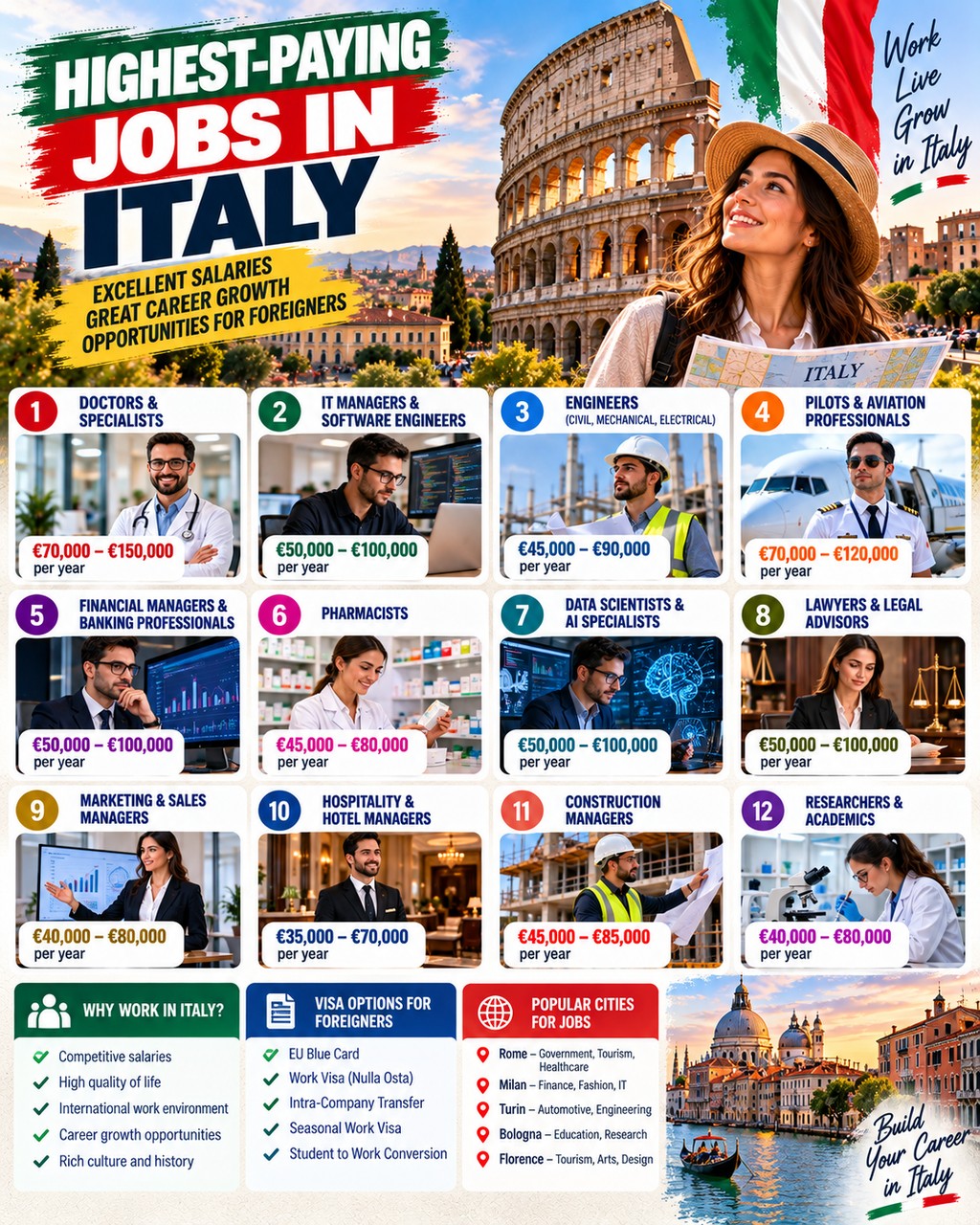

  • Highest-Paying Jobs in Italy in 2026: Salaries, Requirements and What You Actually Take Home

    Highest-Paying Jobs in Italy in 2026: Salaries, Requirements and What You Actually Take Home

    Italy has world-famous companies, hospitals, banks, design houses and engineering firms, so many people assume salaries are high. For most workers they are not. The country’s average pay sits below the European average, and a large share of income goes to tax and social contributions. Still, some careers pay much more than the average, and a few are open to skilled foreigners.

    This guide covers the best-paid jobs in Italy in 2026, realistic salary ranges, which are accessible to non-Italians, how Italian pay and tax work, and how to avoid being misled by headline figures.

    The Starting Point: What Italians Earn on Average

    The average gross annual salary in Italy was about €33,523 in 2024 according to Eurostat figures, compared with an EU average of about €39,808. A single worker with no children takes home about €24,207 a year on that average.

    Other measures give a similar picture. Private-sector employees average about €30,284 a year, managers about €55,632, and public-sector workers about €37,073, according to JobPricing data. Regionally, the highest average salaries are in Lombardy (€33,452), Lazio (€32,360) and Liguria (€32,156). Another analysis found that Lombardy pays about €6,400 more a year than Basilicata, a reminder of the north-south divide.

    So a salary of €50,000 or more puts you well above the typical Italian worker, and €80,000 or more is a top-tier income.

    How to Read an Italian Salary Offer

    Italian offers are usually quoted as RAL, the gross annual salary. A few points make a big difference:

    • 13th and 14th months. Many contracts pay the annual salary in 13 or 14 instalments. Confirm whether a quoted monthly figure assumes 12 payments or more.
    • No statutory minimum wage. Italy has no single national minimum wage. Pay floors are set by sector collective agreements, so check which one applies.
    • Social contributions. Employee contributions to INPS run at about 9.19% to 9.49% of gross salary, and the employer pays much more on top.
    • Income tax (IRPEF) in 2026. The national rates are 23% on income up to €28,000, 33% on €28,001 to €50,000, and 43% above €50,000, after the 2026 budget law cut the middle rate from 35%. Regional surcharges range from about 1.23% to 3.33%, and municipal surcharges are up to 0.9%.

    Combined with surcharges, the top marginal rate can exceed 47%, so each extra euro above €50,000 is taxed heavily. That is why net pay can feel disappointing at higher salaries.

    The Highest-Paying Jobs in Italy

    The figures below are gross annual salaries from recent 2025 to 2026 sources. They are averages or typical ranges, and real pay depends on region, employer and experience.

    1. Notaries (about €265,000)

    Notaries top the ranking, with an average gross income of about €265,000. However, this is a closed, state-regulated profession that, as far as I know, requires Italian citizenship and a competitive state exam, so it is realistically not open to foreign workers.

    2. Doctors and medical managers (€60,000 to €144,000)

    Medicine is one of the best-paid fields. A hospital manager-level doctor averages about €102,000, a family doctor about €89,000, and a medical specialist about €75,000. Another ranking puts the range for physicians at €60,000 to €144,000 with a median of about €81,000.

    The details depend on the job:

    • A newly hired doctor in a public hospital typically starts at about €60,000 gross, and a doctor with more than five years of experience earns roughly €80,000 to €105,000.
    • A newly hired surgeon in the public health service earns about €55,000 to €60,000, rising to about €75,000 to €90,000 after 10 to 15 years. Private practice can add €15,000 to €30,000.
    • Family doctors are self-employed contractors, and their gross income ranges from about €52,500 to over €105,000 depending on how many patients they have.
    • Private and church-run hospitals pay roughly 20% to 30% less than the public health service.

    A new public-sector doctors’ contract signed in February 2026 gave an average pay rise of about 7.27%. Compared with other countries, though, one comparison found Italian doctors earn well below their German counterparts.

    3. Senior managers and executives (€55,000 to €140,000+)

    Engineering managers earn between €58,000 and €141,000, with a median of about €79,000. Sales and marketing managers also appear in the top ranks, with marketing managers ranging from about €49,000 to €117,000. Average pay for managers across the private sector is lower, around €55,600, but heads of large firms in Milan and Rome earn far more.

    4. Finance and banking (€48,000 to €123,000)

    Finance and insurance are among the highest-paid sectors. One ranking puts investment banking analysts at €51,000 to €123,000 and quantitative analysts at €48,000 to €116,000. Milan, Italy’s financial centre, pays the most.

    5. Technology, data and AI (€45,000 to €112,000)

    Demand for tech skills keeps pay rising. Senior and lead developers typically earn about €55,000 to €85,000 or more, data scientists €45,000 to €65,000, AI and machine learning engineers €50,000 to €75,000, and security architects €60,000 to €90,000. Another ranking shows machine learning engineers reaching up to about €112,000 at the top end. Senior software engineers at multinationals in Milan can earn €60,000 to €90,000.

    6. Lawyers (€45,000 to €109,000)

    Lawyers have a median of about €61,000 with a top range around €109,000. To practise in Italy, you generally need Italian bar admission, which makes it hard for foreign lawyers unless they qualify locally.

    7. Airline pilots (about €74,000)

    Pilots average about €74,000 a year, with captains at larger airlines earning more. Licences from outside the EU usually need conversion, and the aviation sector has strict requirements.

    8. Consulting, sustainability and engineering specialists (€44,000 to €121,000)

    Strategy consultants earn about €44,000 to €107,000 and sustainability managers €50,000 to €121,000. Specialist engineers in aerospace, automation and energy are also well paid, particularly in northern industrial regions, and the Hays Italy salary guide shows pay across sectors from about €22,000 to more than €120,000.

    What You Actually Take Home

    Gross pay and take-home pay are very different in Italy. For an illustration, here is a rough estimate for someone earning €60,000 gross, using the 2026 brackets and a typical INPS rate. It ignores tax credits and deductions, which would raise the result:

    • INPS contributions: about €5,500
    • IRPEF on the rest: roughly €15,600
    • Regional and municipal surcharges: roughly €1,100 to €2,200
    • Approximate net: €37,000 to €39,000 a year, or about 62% to 65% of gross

    For lower and middle incomes, tax credits make the share larger. The average worker takes home about 72% of gross, based on the Eurostat net and gross figures above. Treat these numbers as rough guides and use a payroll calculator or ask the employer for a net estimate before you accept.

    Which of These Jobs Are Open to Foreigners?

    Some are, and some effectively are not:

    • Accessible with the right qualifications: Technology, data, engineering, finance, consulting and management roles, especially at multinationals that hire internationally. Many of these salaries are above the EU Blue Card threshold, which sources put at roughly €35,000 to €38,000 gross in 2026.
    • Possible with recognition and language: Doctors and other regulated professionals must have their qualifications recognised and usually need strong Italian, which can take months or years.
    • Closed or very difficult: Notaries and most public-sector posts that require Italian or EU citizenship.
    • Remote workers: Non-EU professionals earning from clients or employers abroad may qualify for the digital nomad visa, which needs an income of about €28,000 a year.

    Italy also offers special tax regimes for new residents, including a reduction on taxable income for qualifying workers who move their tax residence to Italy. The rules and eligibility have changed over time, so get advice from a qualified Italian tax professional before relying on them.

    Where Salaries Are Highest

    Northern Italy pays the most, because that is where industry, finance and multinational headquarters are concentrated. Lombardy leads, with Milan paying a premium over the rest of the country, followed by regions such as Lazio (Rome), Emilia-Romagna, Veneto and Piedmont.

    The catch is cost of living. Milan has the highest rents, and Rome is cheaper but still expensive, with a one-bedroom in the centre averaging about €1,223 a month. A €50,000 salary can feel comfortable in a mid-sized northern city and tight in central Milan.

    How to Land a Higher-Paying Job in Italy

    1. Target in-demand skills. Data, AI, cybersecurity, engineering, finance and healthcare are consistently among the best-paid and hardest to fill.
    2. Learn Italian. English is enough for some multinational roles, but pay and promotion improve with Italian.
    3. Aim for multinationals and large firms in Milan, Rome, Bologna and Turin, which pay more and often hire foreigners.
    4. Use specialist recruiters such as Hays, plus LinkedIn and company career pages.
    5. Negotiate the right things. Ask about RAL, the number of monthly payments, the collective agreement level, bonuses, meal vouchers, welfare benefits, remote work, the probation period and the notice period.
    6. Get your qualifications recognised early if your profession is regulated.
    7. Get the offer in writing before you resign or move.

    These tips on negotiation and contract details come from general knowledge of Italian employment practice rather than from my searches, so confirm them with a labour consultant or union.

    Avoiding Scams

    High-paying offers attract fraud. Be cautious of:

    • Recruiters who promise a high salary and a visa for a fee.
    • Employers who cannot be traced or who offer no written contract.
    • “Quota place” or “work permit” sales, which are well documented as scams in Italy. Employers must apply for work authorisation and pay their own costs.
    • Remote job offers that ask you to buy equipment or pay for training.
    • Offers requiring cash payments or payment into personal accounts.

    Check the company’s registration, verify the recruiter’s identity and use official government sources for visas.

    Common Mistakes

    • Comparing gross Italian salaries with net salaries elsewhere.
    • Forgetting that salaries may be paid over 13 or 14 months.
    • Ignoring the income tax and surcharges when deciding whether an offer is high enough.
    • Assuming a high-paying profession is open to foreigners without checking licensing.
    • Moving to Milan without budgeting for rent.
    • Paying anyone for a job or a visa.

    Frequently Asked Questions

    What is the highest-paying job in Italy?
    Notaries top the list, but the profession is closed to most foreigners. Among open professions, senior doctors, managers, finance specialists and senior tech professionals are among the best paid.

    What is a good salary in Italy?
    Above €35,000 gross is above average, €50,000 is comfortable in most cities, and above €80,000 is a high income.

    Do tech workers earn well in Italy?
    Reasonably well, with senior and specialist roles reaching €60,000 to €90,000 or more, though pay is lower than in countries like Germany, the Netherlands or the United States.

    How much of my salary will I keep after tax?
    Roughly 62% to 72%, depending on income, region, family situation and tax credits.

    Is Milan or Rome better for pay?
    Milan generally pays more, especially in finance and tech, but it is also more expensive.

    Final Thoughts

    Italy is not the highest-paying country in Europe, but skilled professionals in medicine, management, finance, technology and engineering can earn well, and the lifestyle is a draw for many. The key is to read offers carefully, understand the difference between gross and net, check whether your profession is accessible to foreigners, and never pay for a job. With the right skills, language and expectations, a well-paid career in Italy is realistic.

    Disclaimer: This article is for general information only and is not legal, financial, tax or immigration advice. Salaries, tax rates and thresholds change often, and the figures here are averages and ranges from published sources. Confirm current details with official sources or a qualified professional before making decisions.


    Before you publish:

    • The salary ranges come from several different sources that use different methods (Eurostat, JobPricing, salary sites and news reports), so they do not match exactly. Treat them as indicative and keep the “ranges” wording.
    • My take-home estimate for €60,000 is my own approximation from the sourced tax rates, ignoring credits and deductions. Please check it with a payroll calculator before publishing.
    • The points on notaries, lawyers and public posts requiring Italian or EU citizenship, pilot licence conversion, and the negotiation tips came from general knowledge, not the searches. Please verify them.
    • The special tax regime for new residents is described loosely because sources disagreed on its length and rules. You may want to cut it or link to an official page.
    • The Blue Card thresholds differed across sources (about €35,000 to €38,000), so confirm the current figure.
  • Jobs in Italy for Foreigners 2026: The Complete Guide to Visas, Salaries, Sectors and Getting Hired

    Jobs in Italy for Foreigners 2026: The Complete Guide to Visas, Salaries, Sectors and Getting Hired

    Italy is known for food, fashion, history and beaches, but it is also a large industrial economy with hotels, factories, farms, hospitals, shops and a growing technology sector. Every year, businesses struggle to fill jobs and the government opens legal channels for hundreds of thousands of workers from outside Europe.

    At the same time, Italy’s immigration system is complicated, wages are lower than in many countries, and fraudsters regularly sell fake job offers to people hoping to work there. This guide explains how the job market works, who can work in Italy, the main visa routes, which sectors and regions are hiring, what jobs pay, and how to protect yourself.

    Italy at a Glance

    • Italy’s unemployment rate was 6.2% in August 2026, a 15-month high, with youth unemployment at 20.3%. Earlier in 2026 the rate had touched record lows.
    • Most non-EU workers need an employer to apply for them before they arrive.
    • The main entry system is the annual Decreto Flussi quota, plus the EU Blue Card for higher earners.
    • Italian language skills matter in most jobs.
    • Contracts, pay and rights are shaped by Italian labour law and sector collective agreements.
    • Paying anyone for a job offer or a quota place is the clearest sign of a scam.

    The Italian Job Market in 2026

    Italy’s labour market reached historic highs earlier this year. The employment rate hit 62.7% in the first quarter of 2026, the highest since the statistics began in 2004, and unemployment dropped to 5.3%, the lowest ever recorded. Since then it has edged back up, reaching 6.2% in August.

    Hiring demand is large but selective. According to the Excelsior system run by Unioncamere and the Ministry of Labour, businesses planned about 565,000 hires for September 2026 and roughly 1.5 million over the September to November quarter. Services account for about 65.6% of planned hires, industry including construction for 26.5% and agriculture and related sectors for 7.9%. Companies reported difficulty finding about 44% of the profiles they wanted, usually because of too few candidates and sometimes because of weak training.

    Several features of this market matter for foreigners:

    • Experience counts. About 65% of planned hires require specific professional experience or experience in the same sector, and only about 18.5% target people with a university-level qualification.
    • Contracts are often temporary. Only about 22% of planned contracts in the Excelsior data were permanent or apprenticeship-based.
    • Foreign workers are part of the picture. The same data indicate that foreign workers account for roughly 23% of the profiles businesses were seeking.

    Who Can Work in Italy

    EU, EEA and Swiss citizens can live and work in Italy without a visa. They register with local authorities, get a tax code and can apply for jobs like Italian citizens.

    Non-EU citizens generally need a visa that matches a specific type of work, and in most cases an Italian employer must start the process. The main routes are below.

    1. Decreto Flussi (annual quota)

    The Decreto Flussi sets how many non-EU workers can enter Italy for work each year. The 2026 to 2028 plan authorises 497,550 entries over three years, with 164,850 for 2026, 165,850 for 2027 and 166,850 for 2028. For 2026, about 88,000 places were for seasonal work in agriculture and tourism and 76,200 for non-seasonal employed work, including 13,600 for family assistance and care workers.

    Here is how it works in practice:

    1. An Italian employer applies online on a fixed “click day.” In 2026 the dates were in January for agricultural seasonal work and in February for other categories, after a pre-filling period in late 2025.
    2. If the application is accepted, the authorities issue a work authorisation called the nulla osta.
    3. The worker applies for a visa at an Italian consulate in their home country.
    4. After arriving, the worker signs a residence contract and applies for a residence permit.

    Some sources estimate that the whole process takes between two and six months, but timing varies. Popular categories can fill within hours. You cannot apply yourself, because the employer must file the request. The government has also said it wants to move away from the click-day system and encourage more entries outside the quotas.

    2. EU Blue Card

    Highly qualified non-EU workers with a university degree or equivalent experience and a job offer can use the EU Blue Card, which does not depend on the Decreto Flussi quota. The salary threshold is set by law and updated. Sources vary on the exact figure, from about €35,000 to €38,000 gross a year for 2026. One Italian law firm reported an update to about €36,300, and a lower threshold of roughly €28,000 to €29,000 may apply for shortage occupations such as information technology and healthcare. The contract or binding offer must last at least six months.

    The qualification usually needs to be formally recognised, and one guide estimates one to three months for the declaration of value, up to three months for the work authorisation and two to three weeks for the visa.

    3. Other routes outside the quota

    Some categories are also outside the Decreto Flussi quota, including intra-company transfers of managers and specialists. Eligibility rules are strict, so check with the Italian consulate or the Ministry of the Interior.

    4. Seasonal work

    Hotels, restaurants, farms and tourism businesses hire seasonal workers under the quota, though a share of the places are reserved for certain nationalities. Seasonal work can lead to repeat entries but does not automatically lead to permanent residence.

    5. Digital nomad visa

    Non-EU remote workers who are highly skilled and employed by or freelancing for clients outside Italy can apply for the digital nomad visa. Sources differ on exactly when the programme began operating, but Italian consulates have been accepting applications in 2026. The income requirement is about €28,000 a year from remote work, although one consulate cites a lower figure of about €24,789. Applicants typically need six or more months of work history, bank statements and proof of housing in Italy, since short-term rentals are generally not accepted. You apply through the consulate that covers your country of legal residence.

    This visa lets you live in Italy and work remotely for non-Italian clients or employers. It does not give you the right to take a job with an Italian company.

    Sectors and Regions Hiring

    Tourism, hotels and restaurants. This is the biggest source of vacancies. In February 2026, accommodation, restaurants and tourist services planned about 71,000 hires in a single month, followed by retail with about 57,000.

    Industry and manufacturing. Mechanical engineering, metalworking, textiles, furniture and food production employ many workers, and companies report difficulty finding enough of them. In one summer report, construction, fashion, wood furniture, metallurgy and mechatronics were among the sectors with the biggest recruitment problems.

    Technicians, engineers and healthcare. The hardest profiles to find include technicians and engineers, healthcare professionals and electrical and electronic maintenance workers. Healthcare workers need their qualifications recognised in Italy and usually need good Italian.

    Agriculture. Seasonal farm work is a major route for quota workers, but also a sector with serious exploitation problems, covered in the scams section.

    Care work. Family assistance and elder care is a recognised category under the quota, usually requiring work in private homes.

    Technology and professional services. Concentrated in the large northern cities and Rome, with many roles requiring English and sometimes Italian.

    Regions. Lombardy leads the country in planned hires, with about 114,480 in September 2026, followed by Lazio, which includes Rome, with about 58,790 and Veneto with about 51,610. Earlier in the year the South and the islands led planned hires in one quarter, followed closely by the north-west. Wages and living costs are generally higher in the north than in the south, though jobs are not always easier to find there.

    What Jobs Pay in Italy

    Italian salaries are generally lower than in North America or Northern Europe, so it helps to understand how pay is structured.

    • Collective agreements: Italy does not have one national minimum wage. Pay floors are usually set by sector collective agreements, known as CCNL. Always check which agreement applies to your job.
    • Thirteenth and fourteenth months: Many contracts include extra monthly payments, so compare annual totals.
    • TFR: Employees accumulate a severance fund paid when they leave.
    • Contract types: Fixed-term, permanent and apprenticeship contracts carry different rights.

    These points are general features of Italian labour law, so confirm details with a union, a labour consultant or the Ministry of Labour before signing.

    As a reference point, one cost survey puts the average net monthly salary in Rome at about €1,842. Rome is the more expensive end of Italy outside Milan, and salaries in many southern regions are lower. Hospitality and care jobs often start near the collective agreement minimum, while engineers, IT specialists and managers earn more.

    Be careful with very low offers. Some listings aimed at foreigners pay little or require applicants to work as freelancers with their own tax number, which means no employee protections.

    Language

    English-speaking jobs exist, especially in tourism, international organisations, schools, multinational companies and some technology roles, but your options and your pay improve a great deal with Italian. Employers in tourism and customer service generally expect at least basic to intermediate Italian, and daily life, from landlords to doctors, usually runs in Italian. Learn the language before you go, and consider a recognised certificate such as CILS or CELI.

    Recognising Your Qualifications

    For regulated professions such as nursing, medicine, engineering, teaching and law, foreign qualifications generally need to be recognised before you can practise, which can take months and may require Italian exams. For a Blue Card, a formal declaration of value of your degree is typically needed. Start early, and ask the relevant Italian professional body or the consulate which documents to prepare. Italy’s qualification recognition rules and the names of the bodies are general knowledge in this guide, so verify them with an official source.

    Where to Look for Jobs

    • Employer career pages and hotel groups: Many hire directly, especially for seasonal work.
    • LinkedIn and Indeed Italia: For corporate, technical and professional roles.
    • Recruitment agencies: Large agencies place workers in factories, logistics and hospitality.
    • Public employment centres and EURES: Italy’s public job centres and the European job portal list vacancies, mostly for people already in Europe.
    • English-language boards: Wanted in Rome and similar sites list jobs for English speakers, including teaching and hospitality.
    • International organisations: UN agencies in Rome and other bodies post jobs on their own portals.

    Keep in mind that most real opportunities for non-EU workers require an employer willing to complete the sponsorship paperwork, which makes a verified direct employer much safer than a middleman.

    CVs and Interviews in Italy

    Italian CVs are usually one to two pages. A photo is common but optional, and a line authorising the processing of personal data under privacy law is standard. If the job is in Italian, write the CV and cover letter in Italian. Interviews are often more relationship-driven than in North America, so punctuality, polite formality and a few words of Italian go a long way.

    Scams: The Biggest Risk

    Fraud around Italian work visas is widespread and well documented, so take this section seriously.

    • Paid job offers that turned out to be fake. The Philippine Consulate in Milan reported that 269 Filipinos paid at least €3,000 each for jobs under the Decreto Flussi that turned out not to exist, and complaints of aggravated fraud were filed against the consultancy involved.
    • Fake employers. In 2025, the CGIL trade union in Campania described about 400 Bangladeshi workers who arrived in Italy to find that their supposed employers could not be traced, leaving them without papers. The union said such workers are defrauded twice, because they cannot find the employer and are not entitled to a residence permit.
    • Large-scale cancellations. Italian authorities blocked and revoked 3,339 Decreto Flussi applications filed by 142 companies, mostly in agriculture, construction and home care, after prosecutors found the hiring requests were false. Investigations of similar schemes have continued, including in southern Italy in 2026.

    How to protect yourself:

    1. Never pay for a job offer, a quota place or a click-day slot. The employer applies and pays its own costs.
    2. Check the employer. Ask for the company’s registration number and address, verify them independently and be wary if the business cannot be traced.
    3. Get a written contract that states pay, hours, job title and the applicable collective agreement, in a language you understand.
    4. Be suspicious of guarantees. Nobody can guarantee a visa.
    5. Use official sources only: the Ministry of the Interior, the Ministry of Foreign Affairs and the Italian consulate in your country.
    6. Never work without a contract. Undeclared work leaves you without legal protection and can end your right to stay.
    7. Report fraud to your local police and to your country’s embassy or consulate.

    A Step-by-Step Plan

    1. Identify your route: EU citizen, Blue Card candidate, quota worker, remote worker or someone eligible to convert a student permit.
    2. Check your qualifications and start the recognition process if needed.
    3. Learn Italian and get a recognised certificate if you can.
    4. Look for employers in your sector and region, and focus on verified direct employers.
    5. Get a written offer and check the contract against the collective agreement.
    6. Let the employer handle the application, and never pay for it.
    7. Plan your finances for rent, deposits and the first month before your first salary.
    8. After arrival, complete the residence permit, tax code and registration steps promptly.

    Common Mistakes

    • Paying a “consultant” or “agent” for a job offer or quota place.
    • Arriving in Italy hoping to find sponsorship on the spot.
    • Ignoring Italian.
    • Accepting cash work or freelance terms when you need an employment contract.
    • Choosing a job without checking the rent in that city.
    • Missing deadlines for the residence permit after arrival.

    Frequently Asked Questions

    Can foreigners work in Italy without a visa?
    EU, EEA and Swiss citizens can. Most other nationals need a work visa, and in most cases an employer must apply first.

    How many foreign workers does Italy admit each year?
    The 2026 to 2028 plan allows 497,550 entries over three years, with 164,850 in 2026.

    Can I apply for the Decreto Flussi myself?
    No. The employer files the request on your behalf.

    Do I need to speak Italian?
    Not for every job, but Italian greatly improves your chances and your pay.

    What is the best visa for a skilled professional?
    The EU Blue Card is usually the main route for highly qualified workers who meet the salary threshold.

    Can I work remotely from Italy?
    Non-EU remote workers need a digital nomad visa, which has an income threshold of about €28,000 a year.

    Which Italian cities have the most jobs?
    Lombardy, which includes Milan, leads in planned hires, followed by Lazio, which includes Rome, and Veneto.

    Final Thoughts

    Italy offers real opportunities, especially in hospitality, industry, healthcare, engineering and technology, and its legal channels for foreign workers are among the largest in Europe. But the system is bureaucratic, wages are modest, and fraud is common. The best approach is to prepare your qualifications and language, find a genuine employer, insist on a written contract and never pay for a job. Done carefully, Italy can be a rewarding place to build a career.

    Disclaimer: This article is for general information only and is not legal, financial or immigration advice. Visa quotas, salary thresholds and labour rules change often. Confirm current details with the Italian Ministry of the Interior, the nearest Italian consulate or a licensed professional before making decisions.

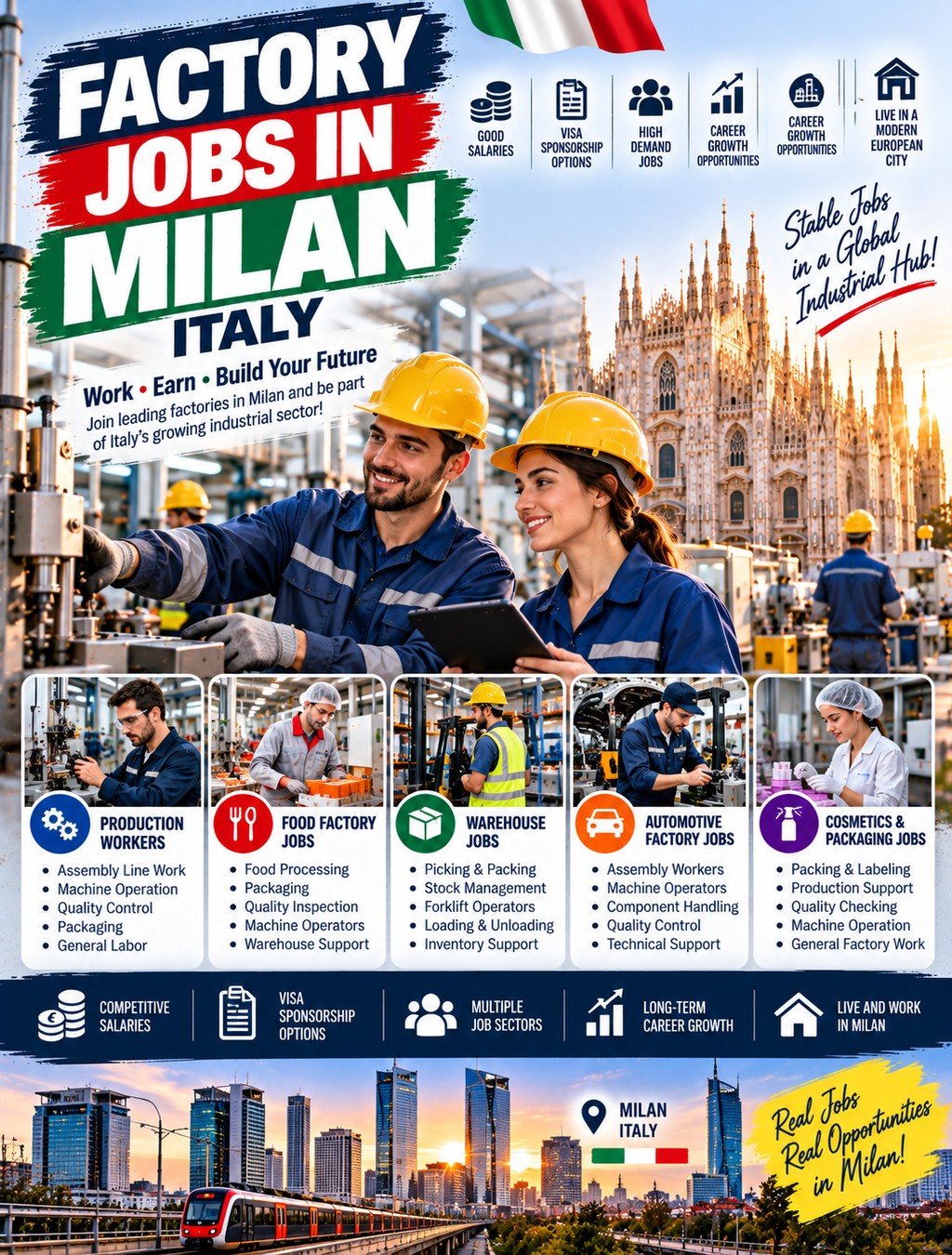
  • Factory Jobs in Milan: Complete Guide to Manufacturing Jobs in Milan, Italy

    Factory Jobs in Milan: Complete Guide to Manufacturing Jobs in Milan, Italy

    Milan is one of Italy’s strongest employment markets, and its industrial economy extends well beyond the city itself into the wider metropolitan area and neighboring parts of Lombardy. For people searching for factory jobs in Milan, opportunities can be found in manufacturing, automotive components, machinery, food production, pharmaceuticals, chemicals, packaging, electronics, plastics, textiles and other industrial activities.

    Factory work in Milan can be particularly attractive for people who do not have a university degree. Many production positions are based on practical skills, previous experience, vocational training and the ability to work shifts rather than an academic degree.

    The wider Lombardy economy also has one of Italy’s strongest employment markets. In the first quarter of 2026, Lombardy had approximately 4.628 million employed people, up 39,000 from the same period of 2025. The employment rate for people aged 15–64 reached 70.3%, well above the Italian national average.

    Manufacturing remains an important part of that economy. In the first quarter of 2026, Lombardy’s industrial production increased 0.5% from the previous quarter and 2.4% year over year, while industrial turnover increased 2.8% year over year. The strongest-performing industrial sectors included transport equipment, mechanical engineering, steel, wood and furniture, leather and footwear and other manufacturing.

    For someone looking for factory employment, these figures matter because Milan sits inside one of Europe’s largest industrial and commercial regions.


    Why Look for Factory Jobs in Milan?

    Milan is often associated with finance, fashion and technology, but the wider metropolitan area also has a large industrial workforce.

    Factories and industrial businesses around Milan operate in areas such as:

    • Automotive components
    • Mechanical engineering
    • Machinery
    • Electronics
    • Pharmaceuticals
    • Chemicals
    • Food production
    • Packaging
    • Plastics
    • Metalworking
    • Furniture
    • Textiles
    • Fashion manufacturing
    • Medical products
    • Industrial equipment
    • Logistics and distribution

    The advantage of searching around Milan rather than only inside the city center is that many factories are located in surrounding municipalities and industrial zones.

    This means a search for “factory jobs in Milan” should really include the Milan metropolitan area and nearby Lombardy industrial districts.


    Types of Factory Jobs in Milan

    There are many different types of factory employment.

    Your best option will depend on your previous experience, technical ability and Italian-language skills.

    1. Production Worker

    Production workers are among the most common factory employees.

    Typical responsibilities include:

    • Operating production equipment
    • Assembling products
    • Loading materials
    • Checking finished products
    • Packaging
    • Following production instructions
    • Maintaining workplace cleanliness
    • Following safety procedures

    Some employers provide training for new workers.

    Others require previous manufacturing experience.


    2. Assembly Line Worker

    Assembly workers build products or components through a structured production process.

    Jobs can involve:

    • Mechanical assembly
    • Electrical assembly
    • Automotive components
    • Consumer products
    • Industrial equipment
    • Electronics
    • Packaging

    Employers may test:

    • Manual dexterity
    • Accuracy
    • Ability to follow instructions
    • Production speed
    • Safety awareness

    Previous factory experience is useful but not always essential.


    3. Machine Operator

    Machine operators are responsible for running industrial equipment.

    Possible equipment includes:

    • Presses
    • Cutting machines
    • Packaging machines
    • CNC machinery
    • Injection-molding equipment
    • Industrial processing machines
    • Automated production systems

    Employers may require technical training or previous experience.

    Workers who can understand machine settings, detect faults and perform basic maintenance can often qualify for more specialized positions.


    4. CNC Machine Operator

    CNC operators are more specialized than general production workers.

    CNC stands for Computer Numerical Control.

    CNC operators may work with:

    • Milling machines
    • Lathes
    • Cutting machines
    • Precision machinery
    • Automated machining systems

    Useful skills include:

    • Reading technical drawings
    • Measuring components
    • Understanding tolerances
    • Operating CNC controls
    • Tool changes
    • Quality inspection

    CNC experience can be valuable throughout Lombardy’s manufacturing sector.


    5. Factory Maintenance Technician

    Factories depend on technicians to keep equipment operating.

    Possible roles include:

    • Mechanical maintenance technician
    • Electrical maintenance technician
    • Industrial mechanic
    • Automation technician
    • Plant maintenance worker
    • Electromechanical technician

    Responsibilities can include:

    • Preventive maintenance
    • Troubleshooting
    • Equipment repairs
    • Electrical checks
    • Mechanical repairs
    • Machine installation
    • Emergency maintenance

    Technical qualifications can significantly improve employment prospects.


    6. Quality-Control Worker

    Quality-control employees make sure products meet required specifications.

    Their work may include:

    • Inspecting finished products
    • Measuring components
    • Recording defects
    • Performing visual inspections
    • Using testing equipment
    • Completing quality reports
    • Monitoring production standards

    Experience with quality-management systems can be useful.

    For more advanced positions, employers may request technical qualifications or experience with standards such as ISO systems.


    7. Warehouse and Factory Logistics Jobs

    Factories need workers to move materials throughout the production process.

    Potential positions include:

    • Warehouse worker
    • Material handler
    • Picker
    • Packer
    • Forklift operator
    • Inventory assistant
    • Loading/unloading worker
    • Dispatch worker
    • Logistics assistant

    These positions can be particularly suitable for people who do not have university degrees.

    Forklift certification can make a candidate more competitive.


    8. Packaging Jobs

    Packaging is an important part of many manufacturing industries.

    Packaging workers may:

    • Pack finished products
    • Operate packaging machinery
    • Label products
    • Inspect packaging
    • Prepare shipments
    • Load cartons
    • Record production quantities

    Industries using packaging workers include:

    • Food
    • Pharmaceuticals
    • Cosmetics
    • Consumer products
    • Manufacturing
    • Retail products

    9. Food Factory Jobs

    Lombardy has a substantial food-processing industry.

    Potential jobs include:

    • Food-production worker
    • Packaging operator
    • Bakery worker
    • Machine operator
    • Food-quality worker
    • Warehouse worker
    • Production assistant
    • Food-processing technician

    Workers may need to follow strict hygiene and food-safety procedures.

    Experience in food production can therefore be useful when applying to factories around Milan.


    10. Pharmaceutical Factory Jobs

    Milan and Lombardy have a significant pharmaceutical and life-sciences ecosystem.

    Potential roles include:

    • Production operator
    • Packaging operator
    • Laboratory technician
    • Quality-control assistant
    • Warehouse worker
    • Machine operator
    • Maintenance technician
    • Production supervisor

    Pharmaceutical manufacturing can have stricter requirements than general factory work.

    Depending on the position, employers may require:

    • Technical education
    • Pharmaceutical experience
    • Laboratory knowledge
    • Quality-control experience
    • Hygiene and safety training

    11. Automotive Manufacturing Jobs

    The wider Lombardy region has a large automotive and industrial supply chain.

    Potential jobs include:

    • Automotive assembly worker
    • Component-production worker
    • CNC operator
    • Quality inspector
    • Mechanical technician
    • Maintenance technician
    • Warehouse worker
    • Production planner
    • Automotive engineer

    The industry increasingly combines traditional mechanical manufacturing with electronics, automation and software.

    Workers with technical skills can therefore target both traditional production and advanced manufacturing positions.


    12. Metalworking Jobs

    Metalworking remains an important industrial activity around Milan and Lombardy.

    Potential jobs include:

    • Metalworker
    • Welder
    • CNC operator
    • Machine operator
    • Metal cutter
    • Fabricator
    • Mechanical assembler
    • Quality inspector
    • Industrial mechanic

    Skilled workers with welding, machining or fabrication experience can potentially access more specialized positions than general production workers.


    13. Electronics Factory Jobs

    Electronics manufacturing can include:

    • Component assembly
    • Circuit-board production
    • Testing
    • Quality control
    • Packaging
    • Equipment assembly
    • Technical maintenance

    Workers with electronics training may qualify for technician-level positions.


    14. Textile and Fashion Manufacturing Jobs

    Milan is one of the world’s major fashion capitals.

    Although many fashion companies focus on design, retail and marketing, the broader industry also creates manufacturing employment.

    Potential positions include:

    • Textile worker
    • Sewing machine operator
    • Garment worker
    • Production operator
    • Quality-control worker
    • Pattern-production assistant
    • Warehouse worker
    • Packaging worker

    Workers with sewing and garment-production experience should search both Milan and the wider Lombardy fashion-manufacturing network.


    15. Chemical and Plastics Factory Jobs

    Chemical and plastics companies can employ:

    • Production operators
    • Machine operators
    • Packaging workers
    • Laboratory assistants
    • Quality-control workers
    • Maintenance technicians
    • Warehouse workers

    These jobs may have stricter safety requirements than ordinary manufacturing.

    Applicants should carefully review the required qualifications and working conditions before accepting an offer.


    Factory Jobs in Milan Without a University Degree

    One of the biggest advantages of factory employment is that many positions do not require a university degree.

    Possible jobs include:

    • Production worker
    • Assembly worker
    • Packaging worker
    • Warehouse worker
    • Machine operator
    • Factory cleaner
    • Material handler
    • Food-production worker
    • Loading/unloading worker
    • Forklift operator
    • General factory worker

    However, no university degree does not mean no qualifications.

    Employers may still require:

    • Secondary education
    • Previous factory experience
    • Technical training
    • Italian language skills
    • Forklift certification
    • Safety training
    • Machine-operation experience
    • Ability to work shifts

    For technical jobs, vocational qualifications can be more valuable than a general university degree.


    Skilled Factory Jobs That Can Pay Better

    Workers who develop technical skills can generally target more specialized positions.

    Examples include:

    CNC Operator

    Requires machining knowledge and the ability to work with precision equipment.

    Industrial Maintenance Technician

    Requires mechanical and/or electrical knowledge.

    Automation Technician

    Works with automated production systems, robotics and industrial controls.

    Quality Technician

    Performs detailed inspections and quality checks.

    Industrial Electrician

    Maintains factory electrical systems.

    Welding Specialist

    Performs specialized metal joining and fabrication.

    Production Supervisor

    Coordinates workers, production schedules, quality and safety.

    Industrial Engineer

    Improves production systems, processes and efficiency.

    The more specialized your skills become, the less you compete directly with general labor applicants.


    Factory Shift Work in Milan

    Many factories operate in shifts.

    You may encounter:

    • Morning shift
    • Afternoon shift
    • Night shift
    • Two-shift systems
    • Three-shift systems
    • Weekend shifts

    A three-shift factory may operate continuously across:

    Morning → Afternoon → Night

    Before accepting a factory job, ask about:

    • Shift rotation
    • Night work
    • Weekend work
    • Overtime
    • Breaks
    • Transport
    • Shift allowances
    • Contract hours

    Shift work can sometimes provide additional compensation, but it can also make commuting more difficult.


    Factory Jobs Around Milan

    Do not search only within central Milan.

    Many manufacturing employers operate in surrounding industrial areas.

    Search locations such as:

    • Sesto San Giovanni
    • Cinisello Balsamo
    • Rho
    • Pero
    • Segrate
    • San Donato Milanese
    • San Giuliano Milanese
    • Rozzano
    • Assago
    • Corsico
    • Buccinasco
    • Legnano
    • Monza
    • Lodi
    • Bergamo
    • Brescia

    Some of these are outside the municipality of Milan, but they are part of the broader employment market that Milan-area job seekers can access.

    A wider geographic search can significantly increase the number of vacancies available.


    Current Manufacturing Conditions in Lombardy

    The manufacturing sector in Lombardy remains important, although employers are operating in an uncertain economic environment.

    In the first quarter of 2026, industrial production increased 2.4% year over year and industrial turnover increased 2.8%. The transport-equipment and mechanical sectors were among the stronger-performing industrial categories.

    At the same time, regional economic monitoring reported uncertainty related to raw-material costs, energy prices, geopolitical instability and trade tariffs. Business expectations for the following quarter were more cautious even though the employment balance in industry remained positive.

    This means the manufacturing market should be viewed realistically: there are opportunities, but demand can vary by industry and company.


    How Much Can Factory Workers Earn in Milan?

    There is no single salary for factory workers.

    Pay depends on:

    • Industry
    • Job title
    • Experience
    • Technical qualifications
    • Shift pattern
    • Contract type
    • Collective labor agreement
    • Overtime
    • Employer
    • Location

    For example, a current Milan-area production vacancy advertised through a recruitment agency offers a particular role at €25,000–€30,000 gross annual salary. That is an example of one advertised position, not an average salary for all factory workers in Milan. (umana.it)

    Technical positions can command more depending on skills and experience.

    When comparing offers, check:

    • Gross annual salary
    • Expected net salary
    • Working hours
    • Overtime
    • Shift allowances
    • Bonuses
    • Contract duration
    • Probation
    • Paid holidays
    • Meal vouchers
    • Transportation benefits

    Cost of Living and Factory Salaries in Milan

    Milan is one of Italy’s more expensive cities, particularly for housing.

    This is important for factory workers because entry-level manufacturing salaries may not always provide enough income to comfortably rent an apartment alone in central Milan.

    Before accepting an offer, calculate:

    Net salary − rent − utilities − food − transportation − other expenses

    Workers can reduce costs by:

    • Sharing accommodation
    • Living outside central Milan
    • Choosing a location close to public transportation
    • Living in nearby municipalities
    • Sharing transportation with colleagues

    A factory job outside Milan with cheaper accommodation can sometimes produce a better financial outcome than a slightly higher-paying job in the city.


    Do You Need Italian for Factory Jobs?

    Italian is important, even when the job is not customer-facing.

    Factory workers need to understand:

    • Safety instructions
    • Machine instructions
    • Workplace rules
    • Supervisors
    • Training
    • Emergency procedures
    • Colleagues

    Some multinational companies may use English for technical positions, but entry-level factory workers should not assume that English alone will be sufficient.

    A useful target is:

    A2: Basic workplace communication

    B1: Practical communication with supervisors and colleagues

    B2: Strong professional communication

    Learning Italian before moving to Milan can make your job search substantially easier.


    Factory Jobs in Milan for Foreign Workers

    Foreign nationals can work in Milan if they have the appropriate legal authorization.

    For EU citizens, the process is generally different from that for non-EU citizens.

    For non-EU workers outside Italy, an employer may need to use an applicable immigration route, including quota-based employment where relevant.

    Italy’s 2026–2028 Decreto Flussi provides for 497,550 entries of third-country nationals over the three-year period.

    However, the existence of immigration quotas does not mean that every factory job qualifies for sponsorship.

    The specific:

    • Occupation
    • Employer
    • Contract
    • Immigration category
    • Annual quota
    • Application procedure

    must be considered.

    The Italian Ministry of Labour explains the rules governing entry and residence for employment and maintains official information on immigration-related employment procedures.

    The key principle is:

    A factory vacancy is not automatically a visa-sponsored vacancy.

    Foreign applicants should verify the employer’s willingness and legal ability to employ a non-EU worker before paying an agent or making travel arrangements.


    Can Pakistani Workers Get Factory Jobs in Milan?

    Yes, Pakistani citizens can potentially work in Italian factories if they obtain the appropriate legal authorization.

    Potential roles include:

    • Production worker
    • Machine operator
    • Warehouse worker
    • Welder
    • Electrician
    • Maintenance technician
    • Food-production worker
    • Packaging worker
    • CNC operator
    • Quality-control worker

    Applicants with technical experience should emphasize those skills rather than applying only for general labor positions.

    For example, a person with five years of CNC experience should search for:

    “CNC operator jobs Milan”

    rather than simply:

    “factory jobs Milan.”

    A specialized search can lead to better-matched vacancies.


    How to Find Factory Jobs in Milan

    1. Use the Official Milan Employment Resources

    The Metropolitan City of Milan’s 2026 labor bulletin analyzes employment, hiring, professional qualifications, online vacancy requirements and expected labor demand.

    Lombardy also launched the Vetrina Pubblica IDO in October 2026, a public-facing employment-vacancy service designed to make job opportunities easier for citizens to access.

    These are useful resources to monitor alongside commercial job portals.

    2. Search Using Italian Job Titles

    Use searches such as:

    • “operaio produzione Milano”
    • “operaio fabbrica Milano”
    • “addetto produzione Milano”
    • “operaio metalmeccanico Milano”
    • “operatore macchina Milano”
    • “addetto assemblaggio Milano”
    • “magazziniere Milano”
    • “carrellista Milano”
    • “manutentore industriale Milano”
    • “operatore CNC Milano”
    • “controllo qualità Milano”
    • “operaio alimentare Milano”
    • “addetto confezionamento Milano”

    Italian keywords can produce significantly more relevant results than simply searching in English.


    3. Use Recruitment Agencies

    Recruitment agencies are an important route into factory employment in Italy.

    They frequently recruit for:

    • Production
    • Logistics
    • Manufacturing
    • Maintenance
    • Warehousing
    • Packaging
    • Administration

    Current Milan-area recruitment listings show vacancies across production and logistics categories.

    When dealing with an agency, verify that it is a legitimate registered recruitment business.


    4. Apply Directly to Manufacturers

    Create a list of manufacturers around Milan and search their career pages.

    Target companies in:

    • Automotive
    • Pharmaceuticals
    • Food
    • Machinery
    • Electronics
    • Chemicals
    • Packaging
    • Metalworking
    • Fashion
    • Logistics

    Direct applications can be particularly useful for skilled workers.


    How to Prepare a CV for Factory Jobs in Milan

    Your CV should be simple and practical.

    Include:

    Personal details

    • Name
    • Phone
    • Email
    • Location

    Professional summary

    Example:

    Production worker with five years of manufacturing experience specializing in assembly, quality control and shift-based production environments.

    Work experience

    Include:

    • Company
    • Job title
    • Dates
    • Machinery used
    • Responsibilities
    • Production achievements

    Technical skills

    For example:

    • CNC
    • Welding
    • Mechanical assembly
    • Forklift operation
    • Quality control
    • Machine operation
    • Maintenance
    • Packaging machinery

    Certifications

    Include:

    • Forklift certification
    • Welding certification
    • Electrical qualification
    • Safety training
    • Technical diplomas

    Languages

    Clearly state your Italian and English levels.


    Example Factory CV Skills

    If you are applying for a general production position, useful skills may include:

    • Production-line operation
    • Assembly
    • Packaging
    • Quality inspection
    • Manual handling
    • Workplace safety
    • Shift work
    • Inventory
    • Basic machinery operation

    For a technical position:

    • CNC operation
    • Technical drawings
    • Preventive maintenance
    • Electrical troubleshooting
    • Mechanical repair
    • Automation
    • PLC systems
    • Industrial machinery

    Factory Job Interviews in Milan

    Expect questions such as:

    “Tell me about your previous factory experience.”

    “Which machines have you operated?”

    “Can you work shifts?”

    “Can you work nights?”

    “Do you have safety training?”

    “Do you have forklift certification?”

    “Have you worked in a production environment before?”

    “Can you understand technical instructions in Italian?”

    Prepare specific examples.

    Instead of saying:

    “I am a hard worker.”

    Explain what you actually did:

    “I worked on a three-shift production line, operated packaging machinery and completed quality checks before products were moved to dispatch.”

    Specific information is much more convincing.


    Factory Work Safety

    Factory employment can involve machinery, chemicals, electricity, heavy materials and moving equipment.

    Before starting work, make sure you understand:

    • Safety procedures
    • Emergency exits
    • Personal protective equipment
    • Machine safety
    • Chemical handling
    • Manual lifting rules
    • Forklift areas
    • Accident reporting
    • Emergency procedures

    Never operate equipment you have not been trained to use.


    Factory Job Scams in Milan

    Foreign workers should be particularly careful with online job offers.

    Be suspicious if someone promises:

    • Guaranteed factory employment
    • Guaranteed Italian work visa
    • Extremely high wages for basic work
    • Employment without an interview
    • Immediate visa approval
    • A job in exchange for a large upfront payment
    • A “guaranteed Decreto Flussi quota”

    Never assume that paying an agent guarantees employment.

    Verify:

    • Employer’s legal name
    • Company address
    • Company website
    • Recruiter’s identity
    • Written employment contract
    • Salary
    • Working hours
    • Immigration procedure

    If an employer or agent asks you to transfer a large amount of money simply to secure a job, treat it as a major warning sign.


    Advantages of Factory Jobs in Milan

    Factory employment can offer several advantages.

    No university degree required for many positions

    Practical experience can be enough for numerous production roles.

    Opportunities for skill development

    Workers can progress from general production to technical positions.

    Shift opportunities

    Some factories operate multiple shifts, increasing the range of available schedules.

    Career progression

    A worker may progress from:

    Production worker → machine operator → skilled operator → technician → supervisor

    Transferable skills

    Manufacturing skills can be useful throughout Italy and other European countries.


    Disadvantages to Consider

    Factory employment also has challenges.

    Shift work

    Night and weekend shifts can be difficult.

    Physical demands

    Many jobs require standing, lifting or repetitive movement.

    Workplace safety

    Machinery and industrial environments require strict safety compliance.

    Commuting

    Factories may be outside central Milan.

    Housing costs

    Milan’s housing market can make entry-level salaries challenging.

    Contract uncertainty

    Some jobs begin as temporary contracts before potentially becoming permanent.

    Read the employment contract carefully.


    Frequently Asked Questions About Factory Jobs in Milan

    Are there factory jobs in Milan?

    Yes. Milan and the wider Lombardy region have a substantial manufacturing economy covering machinery, automotive components, food, pharmaceuticals, metalworking, electronics, packaging, fashion and other industries.

    Can I get a factory job in Milan without a degree?

    Yes. Production, assembly, packaging, warehouse and general factory positions can often be accessed without a university degree, although employers may require experience, training or language skills.

    What factory jobs pay the most?

    Specialized positions such as CNC operators, industrial maintenance technicians, automation technicians, skilled welders, quality technicians, supervisors and industrial engineers can generally offer stronger earning potential than basic production positions.

    Do factory workers need to speak Italian?

    Usually, at least basic Italian is highly useful because workers must understand safety instructions, supervisors and workplace procedures.

    Can foreigners get factory jobs in Milan?

    Yes, provided they have the appropriate legal right to work in Italy.

    Can Pakistani citizens get factory jobs in Milan?

    Potentially. Pakistani citizens can apply for legitimate Italian factory positions, but they need the correct immigration and work authorization before beginning employment.

    Does Italy sponsor factory workers?

    Some non-EU workers can enter Italy for employment through applicable immigration routes, including quota-based programs where the occupation and employer qualify. However, not every factory vacancy provides sponsorship.

    Is Milan good for manufacturing jobs?

    Yes. Milan sits within Lombardy, one of Italy’s most important industrial regions. Lombardy’s industrial production grew 2.4% year over year in the first quarter of 2026.

    Where should I search for factory jobs around Milan?

    Search Milan as well as nearby industrial areas such as Sesto San Giovanni, Rho, Segrate, San Donato Milanese, San Giuliano Milanese, Assago, Rozzano, Corsico and other municipalities in the metropolitan area.


    Final Thoughts

    Factory jobs in Milan can be a practical employment option for people with or without university degrees.

    The city’s manufacturing economy is much broader than traditional factory assembly. Opportunities exist in:

    • Automotive components
    • Machinery
    • Food production
    • Pharmaceuticals
    • Electronics
    • Packaging
    • Metalworking
    • Chemicals
    • Fashion manufacturing
    • Logistics
    • Industrial maintenance

    Lombardy’s manufacturing sector remains a major part of the regional economy. Industrial production increased 2.4% year over year in the first quarter of 2026, while employment in the region also reached a record level in the available series.

    For someone without a degree, the easiest starting points may include production, packaging, assembly, warehouse and general factory work.

    For workers with technical experience, better opportunities may be available in:

    CNC machining → industrial maintenance → electrical systems → automation → quality control → technical supervision.

    The most important strategy is to develop a specific skill rather than remaining a general laborer indefinitely.

    If you are applying from Pakistan or another country outside the EU, remember that finding a factory vacancy is only the first step. You must also determine whether the employer can legally employ a non-EU worker and whether the position fits an applicable Italian immigration route.

    For the best results:

    Learn Italian → develop a practical manufacturing skill → prepare an Italian CV → search the wider Milan metropolitan area → use Italian job keywords → contact legitimate recruitment agencies → verify employers → understand immigration requirements before paying anyone.

    Instead of searching only for “Factory Jobs in Milan,” try more specific searches such as:

    • Production jobs in Milan
    • Manufacturing jobs in Milan
    • CNC operator jobs in Milan
    • Warehouse jobs in Milan
    • Factory worker jobs in Milan
    • Automotive jobs in Milan
    • Food factory jobs in Milan
    • Pharmaceutical factory jobs in Milan
    • Factory jobs in Milan for foreigners
    • Factory jobs in Milan with visa sponsorship

    A targeted search will give you a much better chance of finding a position that matches your actual skills, experience and eligibility.

  • Hospitality Jobs in Rome: Complete Guide to Hotel, Restaurant and Tourism Jobs

    Hospitality Jobs in Rome: Complete Guide to Hotel, Restaurant and Tourism Jobs

    Rome is one of Europe’s most important tourism destinations and one of Italy’s largest hospitality employment markets. Hotels, restaurants, cafés, bars, tour companies, catering businesses, event companies and other tourism-related businesses employ thousands of workers across the city.

    For people looking for hospitality jobs in Rome, opportunities range from entry-level housekeeping and kitchen positions to professional careers in hotel management, culinary arts, guest relations, tourism, events and food and beverage management.

    The market is supported by strong tourism demand. Italy recorded 23 million tourist arrivals and 71.6 million overnight stays during the first quarter of 2026, with tourist overnight stays increasing 7.5% year over year. Foreign visitors accounted for 54.6% of total overnight stays, with foreign overnight stays increasing 12.3%.

    Rome is particularly attractive because international visitors create demand for workers who can provide customer service in multiple languages.

    At the same time, hospitality is not an easy industry simply because there are many jobs. Working hours can include evenings, weekends and holidays, and entry-level salaries can be modest compared with Rome’s housing costs. Applicants should therefore evaluate the entire employment package rather than looking only at the advertised salary.


    Why Hospitality Is a Major Employer in Rome

    Rome has several characteristics that support a large hospitality industry:

    • International tourism
    • Business travel
    • Religious tourism
    • Cultural tourism
    • Museums and historical attractions
    • Conferences and events
    • Restaurants and food tourism
    • Luxury hotels
    • Airport traffic
    • Cruise and regional tourism connections
    • International organizations and diplomatic activity

    The city’s attractions bring visitors throughout the year.

    This creates employment not only in hotels but also across the wider hospitality ecosystem.

    A tourist staying in Rome may interact with:

    • Hotel receptionists
    • Housekeepers
    • Restaurant staff
    • Baristas
    • Tour guides
    • Drivers
    • Concierge staff
    • Reservation agents
    • Event workers
    • Kitchen employees
    • Retail employees

    As a result, hospitality job seekers should think beyond simply searching for “hotel jobs.”


    Current Hospitality Job Market in Rome

    The Lazio regional employment portal provides a useful indication of the types of hospitality positions being recruited.

    The official employment system continuously publishes vacancies managed by employment centers, employment agencies, private companies and the EURES network.

    Recent Rome vacancies have included:

    • Hotel housekeepers
    • Hotel kitchen staff
    • Restaurant workers
    • Reception-related positions
    • Catering and food-service roles
    • Bar and restaurant employees

    For example, a current Lazio listing advertised 10 hotel housekeeping positions in Rome, involving cleaning and preparing rooms in four- and five-star hotels. The vacancy required previous hotel-housekeeping experience and Italian at B1 level, with an advertised gross hourly base of approximately €7 for that particular contract.

    Another Rome hotel vacancy sought a breakfast commis chef with at least two years of four-star hotel experience and B1 English. The particular vacancy offered a three-month full-time contract under the tourism collective agreement with an advertised gross annual salary of €23,740.

    These examples demonstrate an important point:

    Hospitality salaries and requirements vary substantially by role, experience, hotel category and contract.


    1. Hotel Receptionist Jobs in Rome

    Hotel reception is one of the most visible hospitality careers.

    Typical responsibilities include:

    • Checking guests in and out
    • Handling reservations
    • Answering telephone calls
    • Responding to emails
    • Providing information
    • Handling guest complaints
    • Processing payments
    • Coordinating with housekeeping
    • Communicating with tour operators
    • Providing local recommendations

    Employers commonly look for:

    • Good communication skills
    • Customer-service experience
    • Computer skills
    • Professional appearance
    • Italian language
    • English language
    • Additional languages

    For international hotels, English can be extremely useful.

    Speaking languages such as French, Spanish, German, Arabic or other widely spoken languages may also be an advantage depending on the hotel’s customer base.


    2. Hotel Housekeeping Jobs

    Housekeeping is one of the more accessible areas of hotel employment.

    Typical jobs include:

    • Room attendant
    • Housekeeper
    • Public-area cleaner
    • Laundry attendant
    • Housekeeping supervisor
    • Hotel cleaner

    Responsibilities may include:

    • Cleaning guest rooms
    • Changing bedding
    • Cleaning bathrooms
    • Replacing amenities
    • Vacuuming
    • Preparing rooms for new guests
    • Reporting maintenance problems
    • Maintaining cleanliness standards

    Some positions do not require a university degree.

    However, previous hotel experience can be important.

    A current Rome vacancy for hotel housekeepers specifically requires previous experience in the occupation and B1 Italian.

    This is a good example of why applicants should not assume that entry-level hospitality means no experience or language requirements.


    3. Restaurant Waiter Jobs

    Rome’s restaurant industry creates substantial demand for servers.

    Common responsibilities include:

    • Welcoming customers
    • Taking orders
    • Serving food and drinks
    • Processing bills
    • Maintaining tables
    • Explaining menu items
    • Handling customer requests

    Useful skills include:

    • Italian
    • English
    • Customer service
    • Communication
    • Product knowledge
    • Basic POS-system skills

    Restaurants in heavily visited tourist areas may particularly value employees who can communicate with international customers.


    4. Chef Jobs in Rome

    Rome offers opportunities for chefs across:

    • Hotels
    • Restaurants
    • Catering companies
    • Private dining
    • Resorts
    • Event venues

    Positions include:

    • Executive chef
    • Sous chef
    • Chef de partie
    • Commis chef
    • Pastry chef
    • Breakfast chef
    • Pizza chef
    • Kitchen supervisor

    Professional culinary experience can be more important than a university degree.

    A culinary qualification, food-safety training and previous kitchen experience can strengthen an application.


    5. Kitchen Assistant Jobs

    Kitchen assistant positions can provide an entry point into hospitality.

    Typical duties include:

    • Preparing ingredients
    • Washing vegetables
    • Supporting chefs
    • Cleaning equipment
    • Preparing simple dishes
    • Organizing supplies
    • Maintaining hygiene standards

    These jobs can be suitable for applicants who have limited professional experience and want to build a hospitality career.

    However, candidates should expect physically demanding work and busy shifts.


    6. Barista Jobs

    Coffee culture is an important part of Italian life, making barista work another potential career path.

    A barista may be responsible for:

    • Preparing espresso
    • Preparing cappuccino
    • Serving customers
    • Handling payments
    • Cleaning equipment
    • Preparing snacks
    • Maintaining the counter

    Experience with Italian coffee preparation can be valuable.

    Customer-facing positions generally require Italian, although tourist-focused businesses may also value English.


    7. Bartender Jobs

    Rome has a large evening and nightlife economy.

    Bartenders can work in:

    • Hotels
    • Restaurants
    • Cocktail bars
    • Tourist areas
    • Events
    • Nightclubs
    • Rooftop bars

    Employers may look for:

    • Cocktail preparation
    • Customer service
    • POS experience
    • Product knowledge
    • Responsible alcohol-service practices
    • Italian and English communication

    Previous experience can significantly improve your chances.


    8. Concierge Jobs

    Concierge positions are generally more specialized than basic hospitality roles.

    Responsibilities can include:

    • Restaurant reservations
    • Transportation arrangements
    • Tour bookings
    • Attraction recommendations
    • Airport transfers
    • Guest requests
    • VIP services

    Strong communication skills are essential.

    Luxury hotels may expect candidates to have:

    • Previous five-star hotel experience
    • Excellent English
    • Italian
    • Additional languages
    • Local destination knowledge
    • Professional customer-service skills

    9. Guest Relations Jobs

    Guest-relations employees focus heavily on the customer experience.

    Their responsibilities may include:

    • Welcoming VIP guests
    • Handling complaints
    • Organizing special requests
    • Gathering guest feedback
    • Coordinating with hotel departments
    • Improving customer satisfaction

    These positions usually require stronger communication and hospitality experience.

    Foreign-language ability can be a major advantage.


    10. Hotel Management Jobs

    Experienced hospitality professionals can target management positions.

    Potential careers include:

    • Front-office manager
    • Housekeeping manager
    • Food and beverage manager
    • Hotel operations manager
    • Revenue manager
    • General manager
    • Guest-relations manager

    Management jobs typically require:

    • Several years of hospitality experience
    • Leadership skills
    • Financial understanding
    • Staff-management experience
    • Strong communication
    • Knowledge of hotel systems

    Italian and English are particularly valuable.


    11. Tourism and Tour Guide Jobs

    Hospitality overlaps heavily with tourism in Rome.

    Possible jobs include:

    • Tour guide
    • Tour coordinator
    • Travel consultant
    • Tourist information employee
    • Excursion assistant
    • Reservation agent
    • Museum-related tourism worker
    • Destination specialist

    Tour guides and other regulated tourism professionals may require specific qualifications or authorizations, so applicants should check the legal requirements for the particular role.


    12. Event and Conference Jobs

    Rome hosts:

    • Conferences
    • Exhibitions
    • Weddings
    • Corporate events
    • Cultural events
    • International meetings
    • Religious events

    Potential jobs include:

    • Event assistant
    • Event coordinator
    • Catering staff
    • Banquet server
    • Conference assistant
    • Event manager
    • Venue coordinator

    Events can also create temporary and seasonal employment opportunities.


    13. Catering Jobs

    Catering companies provide hospitality services at:

    • Weddings
    • Conferences
    • Hotels
    • Corporate events
    • Private parties
    • Sporting events

    Positions include:

    • Catering assistant
    • Waiter
    • Chef
    • Kitchen assistant
    • Bartender
    • Event supervisor
    • Catering manager

    Catering can be particularly suitable for people looking for flexible or event-based work.


    14. Hotel Maintenance Jobs

    Hospitality businesses also require technical workers.

    Potential positions include:

    • Maintenance technician
    • Electrician
    • Plumber
    • HVAC technician
    • Painter
    • General maintenance worker
    • Appliance technician

    These jobs may be overlooked by people searching only for “hospitality jobs,” but hotels need technical staff to keep rooms and facilities operating.

    Technical qualifications can therefore create opportunities within the hotel industry without requiring a hospitality degree.


    Hospitality Jobs in Rome Without a University Degree

    One of the advantages of hospitality is that many positions do not require a university degree.

    Potential options include:

    • Housekeeper
    • Room attendant
    • Kitchen assistant
    • Dishwasher
    • Waiter
    • Barista
    • Bartender
    • Hotel cleaner
    • Restaurant worker
    • Porter
    • Catering assistant
    • Laundry worker
    • Maintenance assistant

    However, some employers may still require:

    • Previous experience
    • Italian
    • English
    • Food-safety training
    • Customer-service experience
    • Technical certification

    For example, current official vacancies in Rome demonstrate requirements ranging from middle-school education for housekeeping to significant hotel experience for culinary positions.


    Hospitality Jobs in Rome for Foreign Workers

    Rome’s international tourism industry can make it attractive to foreign workers.

    Foreign-language skills are especially useful because hotels and restaurants regularly serve international customers.

    Useful language combinations can include:

    • Italian + English
    • Italian + French
    • Italian + Spanish
    • Italian + German
    • Italian + Arabic
    • Italian + another major international language

    However, non-EU applicants need to distinguish between being qualified for a job and being legally authorized to work in Italy.

    Italy’s 2026–2028 foreign-worker program provides for 497,550 entries of third-country nationals over the three-year period, distributed among different employment categories. Hospitality and tourism can be relevant to applicable seasonal and non-seasonal employment categories, depending on the specific program rules and vacancy.

    The Italian Ministry of Labour explains that eligible non-EU workers entering from abroad under applicable quotas generally require an employer to initiate the relevant work-authorization process before the worker applies for the appropriate visa.

    Some highly qualified and specifically regulated categories can use different immigration routes.

    Therefore:

    A hotel offering you a job does not automatically mean you have permission to work in Italy.

    Always check the applicable immigration route.


    Hospitality Jobs in Rome for Pakistani Workers

    Pakistani workers can potentially find hospitality employment in Rome, provided they satisfy the applicable Italian immigration requirements.

    Potential positions to research include:

    • Hotel housekeeping
    • Kitchen assistant
    • Chef
    • Waiter
    • Restaurant worker
    • Hotel maintenance
    • Cleaning
    • Catering
    • Warehouse/hotel logistics
    • Food-service positions

    Experience matters.

    Someone with five years of hotel housekeeping experience should target housekeeping vacancies rather than applying randomly for unrelated jobs.

    Likewise, an experienced chef should build a culinary-focused CV.

    For workers applying from Pakistan, it is particularly important to verify whether the employer is actually able and willing to employ a non-EU worker through an applicable legal route.


    Do You Need Italian for Hospitality Jobs in Rome?

    In most cases, yes.

    Italian is particularly important for:

    • Reception
    • Restaurant service
    • Concierge
    • Guest relations
    • Housekeeping supervision
    • Management
    • Customer service

    Some back-of-house jobs may require less Italian.

    However, learning Italian can significantly increase your opportunities.

    A useful target is:

    A2: Basic workplace communication

    B1: Practical communication with customers and colleagues

    B2: Strong professional communication

    English is also highly valuable in Rome because of international tourism.

    For hotel reception, concierge and guest-relations positions, Italian + English is a particularly useful combination.


    Best Areas of Rome for Hospitality Jobs

    Hospitality vacancies are distributed throughout the city.

    Historic Center

    Central Rome has a very high concentration of:

    • Hotels
    • Restaurants
    • Cafés
    • Tour operators
    • Tourist services

    Potential locations include areas around major attractions and historic districts.

    Termini Area

    The area around Roma Termini is important for:

    • Hotels
    • Hostels
    • Restaurants
    • Transportation-related hospitality
    • Budget accommodation

    Vatican Area

    The Vatican and surrounding districts support:

    • Hotels
    • Restaurants
    • Tour services
    • Guesthouses
    • Religious tourism

    Trastevere

    Trastevere has a strong restaurant and nightlife economy.

    EUR

    EUR is particularly relevant for:

    • Business hotels
    • Conferences
    • Corporate events
    • Restaurants
    • Professional hospitality

    A current official Rome hotel vacancy, for example, is located in the EUR/Fonte Meravigliosa area.

    Fiumicino and Airport Area

    The airport area is important for:

    • Airport hotels
    • Restaurants
    • Catering
    • Transportation
    • Guest services
    • Aviation-related hospitality

    Applicants should search both Rome and nearby municipalities.


    Seasonal Hospitality Jobs in Rome

    Hospitality can involve seasonal work, although Rome’s tourism economy operates throughout much of the year.

    Seasonal opportunities may increase around:

    • Spring tourism
    • Summer travel
    • Major events
    • Religious events
    • Christmas and New Year
    • Conferences
    • Holiday periods

    EURES also organized its 2026 “Seize the Summer” recruitment event specifically for tourism, hospitality, restaurant and entertainment jobs, connecting employers with candidates through European Job Days.

    This demonstrates how seasonal hospitality recruitment can extend beyond traditional local job searches.


    How to Find Hospitality Jobs in Rome

    1. Use the Lazio Employment Portal

    The Lazio regional employment database is one of the most useful official resources.

    It includes vacancies managed by:

    • Public employment centers
    • Recruitment agencies
    • Private companies
    • EURES

    The database is continuously updated.

    Search using terms such as:

    • Hotel
    • Albergo
    • Cameriere
    • Cuoco
    • Receptionist
    • Cameriera ai piani
    • Addetto ristorazione
    • Barista
    • Pizzaiolo
    • Lavapiatti
    • Commis di cucina

    2. Use Italian Job Keywords

    Searching in Italian is extremely important.

    Try:

    “lavoro hotel Roma”

    “offerte lavoro albergo Roma”

    “cameriere Roma”

    “cuoco Roma”

    “receptionist hotel Roma”

    “cameriera ai piani Roma”

    “commis di cucina Roma”

    “barista Roma”

    “lavapiatti Roma”

    “addetto ristorazione Roma”

    “lavoro turismo Roma”

    These searches can reveal vacancies that English searches miss.


    3. Apply Directly to Hotels

    Create a list of hotels in Rome and visit their official career pages.

    Target:

    • Four-star hotels
    • Five-star hotels
    • International hotel chains
    • Boutique hotels
    • Independent hotels
    • Hostels
    • Resorts
    • Business hotels

    Do not apply only to famous luxury hotels.

    Smaller hotels can provide useful opportunities for people building their careers.


    4. Use LinkedIn

    Your LinkedIn profile should clearly show:

    • Hospitality experience
    • Current job title
    • Languages
    • Certifications
    • Hotel systems you know
    • Customer-service experience
    • Location
    • Work authorization

    If you are outside Italy, make your immigration situation clear rather than allowing employers to guess.


    5. Use EURES

    EURES is particularly useful for people seeking employment opportunities across Europe.

    It can also connect hospitality employers with candidates for seasonal recruitment.


    How to Write a Hospitality CV for Rome

    Your CV should normally be short and targeted.

    Include:

    Personal information

    • Name
    • Phone
    • Email
    • Location

    Professional summary

    Explain your experience in two or three lines.

    Work experience

    Include:

    • Hotel/restaurant name
    • Job title
    • Dates
    • Responsibilities
    • Achievements

    Languages

    Clearly state:

    • Italian
    • English
    • Other languages

    Skills

    For example:

    • Opera PMS
    • POS systems
    • Food preparation
    • Housekeeping
    • Guest relations
    • Reservation management
    • Customer service

    Certifications

    Include relevant:

    • Food-safety training
    • Hospitality qualifications
    • First-aid training
    • Technical certifications

    Hospitality Interview Tips

    A Rome hotel or restaurant may ask questions such as:

    “Tell me about your previous hotel experience.”

    “How do you deal with an unhappy customer?”

    “Can you work weekends?”

    “Can you work night shifts?”

    “What languages do you speak?”

    “Have you used a hotel reservation system?”

    “How do you handle a busy service?”

    Prepare examples from your previous employment.

    For customer-service positions, demonstrate that you can remain calm and professional when dealing with difficult customers.


    Working Hours in Rome Hospitality

    Hospitality does not usually follow a standard Monday-to-Friday office schedule.

    You may be required to work:

    • Early mornings
    • Evenings
    • Nights
    • Weekends
    • Public holidays
    • Split shifts

    Before accepting a position, ask about:

    • Weekly hours
    • Shift schedule
    • Overtime
    • Night work
    • Weekend requirements
    • Public-holiday work
    • Breaks
    • Days off

    This is particularly important for hotel and restaurant positions.


    Salary Expectations for Hospitality Jobs in Rome

    Hospitality salaries vary considerably.

    Factors include:

    • Hotel category
    • Job title
    • Experience
    • Contract
    • Collective agreement
    • Working hours
    • Overtime
    • Night shifts
    • Language skills
    • Employer

    A current official Rome hotel housekeeping vacancy advertises a gross hourly base of approximately €7, but this is a specific temporary part-time vacancy and should not be treated as the average salary for all hotel workers in Rome.

    A separate current hotel commis-chef vacancy advertises €23,740 gross annual salary for that specific full-time three-month contract.

    When comparing jobs, always ask whether the figure is:

    • Gross
    • Net
    • Hourly
    • Monthly
    • Annual
    • Full-time
    • Part-time

    Also check the applicable collective labor agreement.


    Is Hospitality Work in Rome Worth It?

    It can be, especially for people who want to build a career in:

    • Hotels
    • Tourism
    • Restaurants
    • Food and beverage
    • Events
    • Travel
    • Guest relations

    The industry can also provide a pathway from entry-level positions into supervisory and management roles.

    For example:

    Kitchen assistant → Commis chef → Chef de partie → Sous chef → Head chef

    Or:

    Housekeeper → Senior room attendant → Housekeeping supervisor → Housekeeping manager

    Or:

    Reception assistant → Receptionist → Front-office supervisor → Front-office manager

    Career progression depends on skills, performance, language ability and the employer.


    Hospitality Job Scams in Rome

    Foreign workers should be especially careful with fake recruitment offers.

    Be suspicious if someone promises:

    • Guaranteed hotel employment
    • Guaranteed visa
    • Guaranteed residence permit
    • Very high salary for basic work
    • Job without interview
    • Immediate employment after payment

    Never pay a large amount simply to receive a supposed hotel job.

    Verify:

    • Hotel name
    • Company website
    • Recruiter’s email
    • Physical address
    • Employment contract
    • Salary
    • Working hours
    • Immigration process

    If immigration is involved, verify the process through official Italian authorities.


    Frequently Asked Questions

    Are there many hospitality jobs in Rome?

    Yes. Rome’s tourism economy supports employment across hotels, restaurants, bars, catering, events, tourism and related services. The Lazio employment system regularly publishes hospitality vacancies.

    Can I work in a Rome hotel without a university degree?

    Yes. Many housekeeping, kitchen, restaurant, cleaning and entry-level hospitality jobs do not require a university degree.

    Do I need Italian?

    For many hospitality jobs, yes. B1 Italian can already be useful for practical workplace communication, while stronger Italian is advantageous for customer-facing and management roles. A current Rome housekeeping vacancy, for example, requires B1 Italian.

    Is English enough for hotel jobs in Rome?

    Sometimes, particularly in international hotels or positions serving international tourists. However, Italian + English is generally a much stronger combination.

    Can foreigners get hospitality jobs in Rome?

    Yes, if they have the legal right to work in Italy. Non-EU workers must follow the applicable immigration process.

    Can Pakistani citizens get hospitality jobs in Rome?

    Potentially, yes. Pakistani citizens can apply for legitimate Italian hospitality employment, but obtaining the appropriate work authorization and visa is a separate requirement.

    What hospitality jobs are easiest to enter?

    Housekeeping, kitchen assistance, dishwashing, restaurant support, cleaning and some entry-level food-service positions can be accessible without a university degree, although employers may still require experience or language skills.

    Can hospitality jobs lead to a career?

    Yes. Hospitality can provide a progression from entry-level roles to supervisory and management positions.

    Are hotel jobs in Rome seasonal?

    Some are seasonal, but Rome has year-round tourism. Seasonal recruitment also occurs for hotels, resorts, restaurants and tourism businesses. EURES ran a 2026 European recruitment event specifically for tourism, hospitality, restaurants and entertainment.


    Final Thoughts

    Hospitality jobs in Rome can be an attractive option for people who want to enter Italy’s tourism industry.

    The city offers opportunities across:

    • Hotels
    • Restaurants
    • Bars
    • Cafés
    • Catering
    • Tourism
    • Events
    • Housekeeping
    • Guest relations
    • Culinary work
    • Hotel management

    The market is supported by strong international tourism. Italy’s first-quarter 2026 tourism figures showed 71.6 million overnight stays nationally, with foreign tourism growing particularly strongly.

    For people without a university degree, hospitality can offer practical entry points through housekeeping, kitchen work, restaurant service, cleaning, bar work and other operational positions.

    For experienced professionals, Rome offers more advanced opportunities in hotel management, revenue management, food and beverage management, guest relations, culinary leadership and tourism operations.

    Language ability is one of the most important advantages you can develop. Italian + English is a particularly useful combination for Rome’s hospitality market.

    If you are applying from outside Italy, particularly from Pakistan or another non-EU country, do not confuse a job vacancy with a work visa. You need to establish whether the employer can legally hire you and whether your occupation qualifies for an applicable immigration route.

    The smartest strategy is:

    Learn Italian → gain hospitality experience → prepare a targeted CV → search in Italian → apply directly to hotels and restaurants → use official employment resources → verify the employer → understand immigration requirements before paying anyone.

    For job seekers, don’t search only for “hospitality jobs in Rome.” Search for the exact position you want:

    • Hotel jobs in Rome
    • Housekeeping jobs in Rome
    • Hotel receptionist jobs in Rome
    • Chef jobs in Rome
    • Waiter jobs in Rome
    • Kitchen assistant jobs in Rome
    • Barista jobs in Rome
    • Restaurant jobs in Rome
    • Hotel jobs in Rome for foreigners
    • Hospitality jobs in Rome with visa sponsorship

    The more specific your search, the easier it becomes to match your experience with real employers and vacancies.

  • Jobs in Turin: Complete Guide to Finding Work in Turin, Italy

    Jobs in Turin: Complete Guide to Finding Work in Turin, Italy

    Turin, known as Torino in Italian, is one of Italy’s most important industrial, technological and cultural cities. Located in the Piedmont region in northwestern Italy, Turin has a long history in automotive manufacturing, engineering and industry, but its economy has expanded considerably into technology, aerospace, logistics, healthcare, tourism, food production, professional services and education.

    For people searching for jobs in Turin, the city offers opportunities for both university graduates and workers without a degree. Skilled trades, manufacturing, logistics, hospitality and food production can provide opportunities for people with practical experience, while engineering, IT, finance, healthcare and research offer career paths for qualified professionals.

    The wider Turin metropolitan area is particularly important because many employers are located outside the city center. Job seekers who search across the entire province can therefore find considerably more opportunities than someone who searches only for jobs within central Turin.

    Current regional and local employment resources show a broad range of vacancies. Turin’s official employment information system currently lists hundreds of opportunities, while recruitment agencies advertise positions across manufacturing, logistics, maintenance, engineering, healthcare, retail, construction, hospitality and administration.


    Why Work in Turin?

    Turin has one of Italy’s strongest industrial identities.

    The city is particularly associated with:

    • Automotive
    • Mechanical engineering
    • Manufacturing
    • Aerospace
    • Information technology
    • Robotics
    • Logistics
    • Food production
    • Healthcare
    • Construction
    • Retail
    • Tourism
    • Education
    • Research
    • Professional services

    The city’s economy has evolved beyond traditional manufacturing. Today, technology, innovation, research, mobility and advanced manufacturing are important parts of Turin’s economic identity.

    Turin can therefore be an attractive destination for both experienced industrial workers and younger professionals looking to enter technology or engineering.


    Most In-Demand Jobs in Turin

    The best opportunities depend on your qualifications, work experience, Italian-language ability and legal right to work.

    Here are some of the major employment categories worth considering.

    1. Automotive Jobs

    Automotive manufacturing remains one of Turin’s most recognizable industries.

    The city has a long association with vehicle production, automotive engineering, component manufacturing and mobility.

    Potential jobs include:

    • Automotive engineer
    • Mechanical engineer
    • Production operator
    • Assembly worker
    • CNC machine operator
    • Quality-control technician
    • Automotive technician
    • Maintenance technician
    • Industrial electrician
    • Warehouse worker
    • Supply-chain specialist
    • Production supervisor
    • Research and development specialist

    Automotive employment is not limited to vehicle assembly.

    The wider supply chain includes thousands of businesses involved in:

    • Components
    • Electronics
    • Plastics
    • Metalworking
    • Industrial machinery
    • Logistics
    • Engineering
    • Software
    • Testing
    • Research

    This creates opportunities for people with both technical and practical skills.


    2. Manufacturing Jobs

    Manufacturing is one of the strongest employment categories in Turin and Piedmont.

    Current recruitment listings around Turin include a substantial number of production positions. One recruitment agency’s current Turin-area listings include hundreds of vacancies in production, along with large numbers in logistics, maintenance, engineering, construction and retail.

    Potential manufacturing jobs include:

    • Production worker
    • Machine operator
    • Assembly worker
    • Packaging worker
    • CNC operator
    • Quality-control worker
    • Industrial mechanic
    • Maintenance technician
    • Welding technician
    • Production supervisor
    • Factory worker

    Some manufacturing jobs require only secondary education and previous experience, while technical positions may require vocational qualifications.

    For example, current listings around Turin include food-production operators requiring secondary-school education and experience, with advertised annual gross salaries in the €26,000–€28,000 range for a particular vacancy. This is an example of one advertised position, not a citywide salary average.


    3. Engineering Jobs

    Turin is an excellent city to investigate if you have an engineering background.

    Potential careers include:

    • Mechanical engineer
    • Automotive engineer
    • Electrical engineer
    • Electronics engineer
    • Industrial engineer
    • Aerospace engineer
    • Civil engineer
    • Manufacturing engineer
    • Robotics engineer
    • Automation engineer
    • Software engineer
    • Process engineer
    • Quality engineer
    • Research engineer

    Engineers may find opportunities in:

    • Automotive
    • Aerospace
    • Manufacturing
    • Energy
    • Robotics
    • Electronics
    • Transportation
    • Research
    • Consulting

    People with experience in automation, robotics, electric vehicles and advanced manufacturing can be particularly well positioned.


    4. Aerospace Jobs

    Turin and Piedmont have an important aerospace and advanced-engineering ecosystem.

    Potential jobs include:

    • Aerospace engineer
    • Mechanical engineer
    • Electrical engineer
    • Electronics technician
    • Production technician
    • Quality-control specialist
    • CAD designer
    • Manufacturing technician
    • Researcher
    • Software developer
    • Project manager

    Aerospace positions are generally more specialized than entry-level manufacturing roles.

    Applicants should expect employers to place significant emphasis on technical education, engineering qualifications, software skills and previous industry experience.


    5. IT and Technology Jobs

    Turin has developed a growing technology and innovation sector.

    Possible jobs include:

    • Software developer
    • Web developer
    • Mobile developer
    • Data analyst
    • Data engineer
    • Cybersecurity specialist
    • Cloud engineer
    • DevOps engineer
    • IT support technician
    • Systems administrator
    • UX/UI designer
    • Product manager
    • Business analyst
    • Digital marketing specialist

    Technology workers may also benefit from Turin’s connection with manufacturing.

    Modern factories increasingly require:

    • Industrial software
    • Automation
    • Robotics
    • Artificial intelligence
    • Data systems
    • Cybersecurity
    • IoT
    • Digital manufacturing

    This means technology professionals do not necessarily have to work for a traditional software company.


    6. Logistics and Warehouse Jobs

    Turin’s industrial economy creates demand for logistics and supply-chain workers.

    Potential jobs include:

    • Warehouse worker
    • Picker
    • Packer
    • Forklift operator
    • Inventory clerk
    • Logistics assistant
    • Dispatch worker
    • Delivery driver
    • Transport coordinator
    • Supply-chain assistant
    • Warehouse supervisor

    Current Turin-area recruitment listings show particularly strong representation in logistics, transport and warehouse categories.

    People with forklift qualifications or previous warehouse experience may have an advantage.


    7. Construction Jobs

    Construction provides opportunities for workers with practical skills.

    Possible jobs include:

    • Construction laborer
    • Bricklayer
    • Carpenter
    • Electrician
    • Plumber
    • Painter
    • Tiler
    • Welder
    • HVAC technician
    • Maintenance worker
    • Site supervisor

    Construction can be particularly attractive for workers who do not have university degrees but have vocational training or several years of practical experience.

    Applicants should keep records of:

    • Trade qualifications
    • Safety training
    • Previous projects
    • Equipment experience
    • Professional licenses

    8. Healthcare Jobs

    Turin has a large healthcare sector serving the city and wider Piedmont region.

    Potential positions include:

    • Registered nurses
    • Nursing assistants
    • Healthcare assistants
    • Doctors
    • Physiotherapists
    • Laboratory technicians
    • Radiology technicians
    • Pharmacists
    • Elderly-care workers
    • Home-care workers
    • Healthcare administrators
    • Medical receptionists

    Foreign healthcare professionals must be particularly careful about qualification recognition.

    A foreign medical or nursing qualification does not automatically authorize someone to practice a regulated healthcare profession in Italy.

    Professional recognition, registration and language requirements should be checked before accepting a position.


    9. Food Production Jobs

    Piedmont is famous for its food industry, and Turin benefits from the region’s strong food and beverage economy.

    Potential jobs include:

    • Food-production worker
    • Bakery worker
    • Packaging operator
    • Production operator
    • Quality-control worker
    • Warehouse worker
    • Food technician
    • Machine operator
    • Restaurant worker
    • Chef
    • Kitchen assistant

    Food manufacturing can be a useful option for people seeking jobs without a university degree.


    10. Restaurant and Hospitality Jobs

    Tourism and hospitality provide additional employment opportunities in Turin.

    Possible jobs include:

    • Hotel receptionist
    • Housekeeper
    • Hotel cleaner
    • Waiter
    • Chef
    • Kitchen assistant
    • Barista
    • Bartender
    • Restaurant supervisor
    • Concierge
    • Guest-relations employee
    • Event staff

    Turin may not have the same international tourism volume as Rome or Venice, but its museums, sporting events, business activity, food culture and proximity to the Alps support a substantial hospitality market.

    The city’s official employment resources specifically provide information about tourism and hotel-sector work.


    11. Retail Jobs

    Turin has a large retail market serving both local residents and visitors.

    Common jobs include:

    • Sales assistant
    • Cashier
    • Store associate
    • Stockroom worker
    • Customer-service representative
    • Store supervisor
    • Store manager
    • Visual merchandising assistant

    Italian is usually important for customer-facing retail jobs.

    English and other languages can be an advantage in tourist-oriented stores and international retail businesses.


    12. Maintenance and Technical Jobs

    Technical maintenance is an important area in an industrial city like Turin.

    Potential jobs include:

    • Mechanical maintenance technician
    • Electrical technician
    • Industrial electrician
    • HVAC technician
    • Machinery technician
    • Plant maintenance worker
    • Industrial mechanic
    • Automation technician

    Current recruitment listings around Turin show particularly strong demand categories for installation and maintenance work.

    These jobs can be attractive because they often rely on practical skills and vocational qualifications rather than university degrees.


    13. Administration and Office Jobs

    Turin has opportunities in administrative and business-support roles.

    Possible jobs include:

    • Administrative assistant
    • Office assistant
    • Receptionist
    • Secretary
    • Accounting assistant
    • HR assistant
    • Customer-service representative
    • Data-entry clerk
    • Sales administrator
    • Purchasing assistant

    Strong Italian communication skills are usually important.

    Applicants should also be comfortable using:

    • Microsoft Office
    • Excel
    • Email
    • Business software
    • Customer-management systems
    • Online administrative platforms

    14. Finance and Accounting Jobs

    Turin’s corporate sector also supports financial and accounting positions.

    Potential roles include:

    • Accountant
    • Financial analyst
    • Accounting assistant
    • Auditor
    • Tax assistant
    • Financial controller
    • Credit analyst
    • Banking employee
    • Insurance employee
    • Payroll specialist

    Italian language skills are particularly important when dealing with domestic accounting, taxation and Italian customers.


    15. Research and Education Jobs

    Turin is home to major universities and research institutions.

    Potential careers include:

    • University researcher
    • Research assistant
    • Laboratory technician
    • Professor
    • Teacher
    • Language instructor
    • Education administrator
    • Technical researcher

    Highly qualified candidates may find opportunities connected with engineering, science, technology and research.

    For academic positions, Italian requirements vary according to the institution and role.


    Jobs in Turin Without a University Degree

    A university degree is not required for many jobs in Turin.

    Possible options include:

    • Factory worker
    • Production operator
    • Warehouse worker
    • Forklift operator
    • Construction worker
    • Cleaner
    • Hotel worker
    • Restaurant worker
    • Delivery driver
    • Retail assistant
    • Maintenance technician
    • Machine operator
    • Food-production worker
    • Skilled tradesperson

    Current recruitment listings around Turin include opportunities across production, logistics, construction, maintenance, retail, cleaning and tourism.

    However, “no degree required” does not mean “no qualifications required.”

    Employers may still request:

    • Work experience
    • Italian language
    • Technical certificates
    • Driving licenses
    • Forklift certification
    • Safety training
    • Vocational education
    • Computer skills

    Best Areas to Look for Jobs in Turin

    Do not limit your search to the city center.

    Central Turin

    Central Turin has opportunities in:

    • Retail
    • Tourism
    • Restaurants
    • Hotels
    • Professional services
    • Administration
    • Customer service

    Lingotto

    Lingotto has a strong connection with Turin’s industrial and business history.

    The area can be relevant for:

    • Automotive
    • Manufacturing
    • Offices
    • Retail
    • Events
    • Technology

    Mirafiori

    Mirafiori is historically associated with automotive manufacturing and remains important when searching for industrial and technical employment.

    Potential areas include:

    • Automotive
    • Manufacturing
    • Engineering
    • Maintenance
    • Logistics

    Northern Turin

    Northern parts of the city and nearby municipalities have opportunities in:

    • Manufacturing
    • Logistics
    • Warehousing
    • Construction
    • Services

    Collegno, Rivoli and Other Metropolitan Municipalities

    Job seekers should also search surrounding municipalities.

    Current recruitment listings for the Turin area include vacancies in places such as Collegno, Venaria Reale, Caselle Torinese and other municipalities around Turin.

    A wider search can therefore make a significant difference.


    Do You Need to Speak Italian to Work in Turin?

    Italian is highly valuable.

    You may find English-speaking opportunities in:

    • IT
    • Engineering
    • Research
    • International companies
    • Some hospitality businesses
    • Certain multinational companies

    But Italian is important for most local positions.

    This is particularly true for:

    • Construction
    • Retail
    • Healthcare
    • Restaurants
    • Manufacturing
    • Administration
    • Customer service
    • Care work

    A useful progression is:

    A1–A2: Basic communication

    B1: Functional workplace communication

    B2: Strong professional communication

    C1: Advanced professional communication

    If you are planning to move to Turin, starting Italian before arriving can substantially improve your chances of finding employment.


    Jobs in Turin for Foreign Workers

    Foreign workers can legally work in Turin if they meet Italy’s applicable immigration and employment requirements.

    For non-EU citizens, the route depends on:

    • Type of job
    • Employer
    • Qualification
    • Whether the worker is already in Italy
    • Immigration category
    • Whether the occupation is covered by an applicable quota

    Italy’s 2026–2028 Decreto Flussi provides for 497,550 entries of third-country nationals over the three-year period:

    • 164,850 in 2026
    • 165,850 in 2027
    • 166,850 in 2028

    The program covers seasonal and non-seasonal employment and self-employment under specified categories.

    For applicable quota-based employment from abroad, the employer generally has to initiate the required authorization process.

    Some categories of workers can enter through routes outside the ordinary quota system, depending on the applicable Italian immigration rules. The Italian Ministry of Labour maintains the official framework and regulations governing employment-related immigration.

    The most important point is:

    A job offer is not the same thing as legal work authorization.

    Foreign applicants should confirm the appropriate immigration route before paying an intermediary or making travel arrangements.


    Can Someone From Pakistan Get a Job in Turin?

    Yes, a Pakistani citizen can potentially work in Turin if the appropriate legal requirements are met.

    A typical overseas employment process can involve:

    1. Finding a genuine Italian employer.
    2. Receiving a legitimate employment offer.
    3. Employer completing the required immigration procedure.
    4. Obtaining the applicable work authorization.
    5. Applying for the appropriate Italian visa.
    6. Entering Italy legally.
    7. Completing post-arrival residence requirements.

    The exact process depends on the occupation and immigration category.

    People applying from Pakistan should be especially careful with recruitment agents claiming to have guaranteed jobs or visas.


    How to Find Jobs in Turin

    There are several useful routes.

    1. Use Piemonte Tu

    The regional employment system provides access to vacancies collected by employment centers and jobs published directly by companies.

    Agenzia Piemonte Lavoro directs job seekers to Piemonte Tu, where thousands of employment opportunities can be searched.

    2. Use Turin’s Employment Services

    Turin provides public employment services through:

    • Centri per l’Impiego
    • Poli dell’Occupabilità
    • EURES
    • Recruitment services
    • Employment agencies

    These services are available to job seekers and can help with job-search support.

    3. Attend IOLAVORO

    Turin’s IOLAVORO employment fair is one of the major recruitment events in Piedmont.

    The 2026 edition is scheduled for 14–15 October 2026 at Inalpi Arena in Turin.

    These events can be particularly useful because candidates can meet employers and recruitment organizations directly.

    4. Search Using Italian Keywords

    Useful searches include:

    • “lavoro Torino”
    • “offerte lavoro Torino”
    • “assunzioni Torino”
    • “operaio Torino”
    • “magazziniere Torino”
    • “manutentore Torino”
    • “elettricista Torino”
    • “meccanico Torino”
    • “autista Torino”
    • “cameriere Torino”
    • “cuoco Torino”
    • “pulizie Torino”
    • “ingegnere Torino”
    • “sviluppatore Torino”

    5. Use LinkedIn

    Your LinkedIn profile should clearly show:

    • Professional title
    • Experience
    • Education
    • Certifications
    • Skills
    • Languages
    • Location
    • Work authorization

    If you are applying from outside Italy, clearly state that you are an international candidate.


    How to Prepare a CV for Turin Jobs

    Your CV should be tailored to the position.

    Include:

    • Full name
    • Contact information
    • Location
    • Professional summary
    • Work history
    • Education
    • Certifications
    • Technical skills
    • Languages

    An Italian-language CV can be useful for local employers.

    An English CV may be appropriate for international companies.

    For manufacturing jobs

    Emphasize:

    • Machine operation
    • Production experience
    • Quality control
    • Safety
    • Shift work
    • Technical qualifications

    For logistics jobs

    Emphasize:

    • Warehouse systems
    • Inventory
    • Picking and packing
    • Forklift operation
    • Loading and unloading
    • Dispatch

    For engineering jobs

    Emphasize:

    • Engineering degree
    • CAD
    • Technical software
    • Industry experience
    • Projects
    • Certifications

    For hospitality jobs

    Emphasize:

    • Customer service
    • Hotel or restaurant experience
    • Languages
    • POS systems
    • Food-service skills

    Salary Expectations in Turin

    There is no single salary for jobs in Turin.

    Pay depends on:

    • Occupation
    • Experience
    • Qualifications
    • Industry
    • Contract
    • Employer
    • Working hours
    • Collective labor agreement

    Always determine whether an advertised salary is:

    • Gross or net
    • Monthly or annual
    • Full-time or part-time
    • Inclusive of overtime
    • Inclusive of bonuses

    For example, a current Turin-area food-production vacancy advertises a €26,000–€28,000 gross annual salary, but that figure applies to that particular role and should not be interpreted as the average salary for Turin.

    When comparing offers, also examine:

    • Paid holidays
    • Overtime
    • Bonuses
    • Meal vouchers
    • Transportation
    • Contract duration
    • Probation
    • Shift allowances
    • Employer benefits

    Cost of Living in Turin

    Turin is generally worth comparing with other major Italian cities when considering both salary and living expenses.

    Before accepting a job, calculate:

    Net salary − rent − utilities − food − transportation − other expenses

    You may be able to reduce expenses by:

    • Sharing accommodation
    • Living outside the city center
    • Choosing housing near public transport
    • Comparing multiple neighborhoods
    • Living in a nearby municipality

    For workers earning entry-level salaries, housing can make a significant difference to the amount of money left at the end of each month.


    Best Jobs in Turin for Foreign Applicants

    International applicants can consider several categories.

    Highly skilled

    • Engineers
    • Software developers
    • IT specialists
    • Healthcare professionals
    • Researchers
    • Data specialists
    • Technical managers

    Skilled trades

    • Electricians
    • Mechanics
    • Welders
    • Plumbers
    • Maintenance technicians
    • CNC operators
    • Industrial technicians

    Manufacturing

    • Production workers
    • Assembly workers
    • Machine operators
    • Quality-control workers
    • Packaging workers

    Logistics

    • Warehouse workers
    • Forklift operators
    • Logistics assistants
    • Drivers
    • Supply-chain workers

    Hospitality

    • Hotel workers
    • Chefs
    • Waiters
    • Kitchen assistants
    • Housekeepers
    • Baristas

    The possibility of employer support for immigration varies by employer and occupation.


    Common Mistakes When Searching for Jobs in Turin

    1. Searching only for “Turin jobs”

    Use specific Italian job titles.

    For example, search for “operaio produzione Torino” rather than only “jobs in Turin.”

    2. Ignoring nearby municipalities

    Some major employers are outside the city center.

    3. Applying without learning Italian

    Even basic Italian can significantly expand your options.

    4. Assuming every employer sponsors foreigners

    Most vacancies do not automatically include immigration sponsorship.

    5. Applying for regulated jobs without checking recognition

    Healthcare and other regulated professions may require formal recognition.

    6. Looking only at gross salary

    Always calculate your likely net income and living expenses.


    Beware of Fake Turin Job Offers

    Foreign applicants should be careful when dealing with online recruiters.

    Warning signs include:

    • Guaranteed Italian work visa
    • Guaranteed job without interview
    • Large upfront payment
    • Fake employment contracts
    • Requests for money to reserve a work quota
    • Unusually high salary for basic work
    • Pressure to send money immediately
    • Unverified employer
    • Requests for unnecessary passport or financial information

    A legitimate job opportunity should be independently verifiable.

    For immigration procedures, use official Italian government and consular sources rather than relying solely on an agent.


    Frequently Asked Questions About Jobs in Turin

    Is Turin a good city for jobs?

    Yes. Turin has a diversified economy with particular strengths in automotive, manufacturing, engineering, aerospace, technology, logistics, healthcare, food production and professional services.

    What are the biggest industries in Turin?

    Major employment areas include automotive, manufacturing, engineering, logistics, technology, aerospace, healthcare, food production, construction and services.

    Can I work in Turin without a university degree?

    Yes. Manufacturing, logistics, construction, hospitality, retail, food production, maintenance and some skilled trades offer potential opportunities without a university degree.

    Can foreigners work in Turin?

    Yes, provided they meet the applicable Italian immigration and employment requirements.

    Can I get a job in Turin from Pakistan?

    Potentially, yes. Pakistani citizens can seek employment in Italy, but they need the appropriate legal immigration route before beginning work.

    Do I need Italian to work in Turin?

    Italian is not required for every position, but it is highly valuable. English-only opportunities are more likely in certain international companies, technology, engineering and research roles.

    Does Italy sponsor foreign workers?

    Italy has legal routes for eligible non-EU workers. The 2026–2028 Decreto Flussi provides 497,550 planned entries across three years, subject to the relevant categories and procedures.

    What jobs are best for foreigners in Turin?

    Engineering, IT, healthcare, manufacturing, skilled trades, logistics, hospitality and technical maintenance can all provide opportunities depending on qualifications and legal eligibility.

    Where can I find official jobs in Turin?

    Useful resources include Piemonte Tu, Agenzia Piemonte Lavoro, Turin’s employment services, EURES and local employment agencies.


    Final Thoughts

    Turin is one of the strongest Italian cities to consider if your career interests involve automotive, engineering, manufacturing, technology, aerospace, logistics or technical trades.

    Its industrial heritage remains an important part of the local economy, but the employment market is broader than traditional factory work. Modern Turin also provides opportunities in software, research, digital technology, healthcare, professional services, tourism and food production.

    For workers without university degrees, manufacturing, logistics, construction, maintenance, food production and hospitality can be practical areas to investigate. For graduates and experienced professionals, engineering, IT, healthcare, aerospace, research and advanced manufacturing may offer more specialized career paths.

    The current job market also demonstrates the importance of looking at the wider Turin metropolitan area. Official and private recruitment platforms currently show opportunities across production, logistics, maintenance, engineering, construction, retail, healthcare and hospitality.

    Turin is also a good example of why learning Italian matters. Someone who speaks Italian can access far more local opportunities than someone who relies exclusively on English.

    For international applicants, particularly people applying from countries such as Pakistan, the most important distinction is between finding employment and obtaining legal authorization to work. Italy’s 2026–2028 foreign-worker program provides significant legal entry opportunities, but applicants still need to meet the specific requirements of the applicable route.

    The best strategy is therefore straightforward:

    Develop a useful skill → learn Italian → prepare a targeted CV → search across Turin and its surrounding municipalities → verify the employer → understand the immigration process before paying anyone.

    Instead of searching only for “Jobs in Turin,” consider specific searches such as:

    • Automotive jobs in Turin
    • Factory jobs in Turin
    • Manufacturing jobs in Turin
    • Engineering jobs in Turin
    • IT jobs in Turin
    • Warehouse jobs in Turin
    • Construction jobs in Turin
    • Hospitality jobs in Turin
    • Jobs in Turin for foreigners
    • Jobs in Turin with visa sponsorship

    A targeted approach gives you a much better chance of finding vacancies that actually match your skills, experience and legal eligibility.

  • Jobs in Naples: Complete Guide to Finding Work in Naples, Italy

    Jobs in Naples: Complete Guide to Finding Work in Naples, Italy

    Naples, or Napoli, is one of the most important cities in southern Italy and the capital of the Campania region. It has a diverse economy built around tourism, hospitality, food production, transportation, logistics, shipping, healthcare, construction, retail, manufacturing and professional services.

    For people looking for jobs in Naples, the city offers opportunities at several skill levels. There are entry-level positions in hotels, restaurants, cleaning, retail and logistics, while skilled workers can find opportunities in construction, maintenance, transportation, manufacturing and technical services. Professionals can target healthcare, IT, engineering, administration, finance and other specialized fields.

    Naples can also be interesting for foreign workers because of its large tourism economy, international connections and position as a major Mediterranean port. However, non-EU citizens must understand that finding a vacancy and obtaining legal permission to work in Italy are separate processes.

    Italy’s overall employment market continued to improve during 2026. In the second quarter, Italy had approximately 24.36 million employed people, with the national employment rate reaching 63.1%. Employment was up by 1.0% compared with the same quarter of 2025.

    For someone specifically interested in Naples, however, it is important to look beyond national statistics and understand the industries that actually create jobs in Campania.


    Why Work in Naples?

    Naples has several economic advantages that make it an important employment center in southern Italy.

    Major industries include:

    • Tourism
    • Hotels and hospitality
    • Restaurants and food services
    • Retail
    • Construction
    • Healthcare
    • Logistics
    • Shipping and maritime services
    • Manufacturing
    • Food production
    • Transportation
    • Information technology
    • Education
    • Customer service
    • Agriculture in the wider Campania region

    The city’s location on the Mediterranean makes its port and transportation infrastructure particularly important.

    Tourism is another major source of employment. Naples is a gateway to destinations including Pompeii, the Amalfi Coast, Capri, Ischia and other attractions throughout Campania.

    This creates opportunities not only inside hotels and restaurants but also in transportation, tour operations, retail, cleaning, catering and customer service.


    Most In-Demand Jobs in Naples

    The best job for you will depend on your experience, education, Italian-language ability and legal status.

    Here are some of the major employment categories to consider.

    1. Hospitality and Hotel Jobs

    Hospitality is one of the most accessible sectors for people looking for jobs in Naples.

    Potential positions include:

    • Hotel receptionist
    • Housekeeper
    • Hotel cleaner
    • Concierge
    • Guest-relations staff
    • Reservation agent
    • Hotel supervisor
    • Restaurant employee
    • Kitchen assistant
    • Hotel manager
    • Event staff

    People with previous hotel experience should highlight customer service, reservation systems, foreign-language skills and previous international experience on their CV.

    Speaking English can be particularly useful because Naples receives international tourists.


    2. Restaurant Jobs

    Naples is internationally famous for its food and particularly its pizza.

    The restaurant sector creates jobs ranging from entry-level positions to professional culinary careers.

    Common vacancies include:

    • Waiter
    • Kitchen assistant
    • Dishwasher
    • Barista
    • Bartender
    • Pizza maker
    • Chef
    • Sous chef
    • Pastry chef
    • Restaurant manager
    • Catering worker
    • Food preparation worker

    In 2026, Campania’s regional employment service organized recruitment events where employers were looking for profiles including cooks, restaurant-service workers, cashiers, sales advisers, butchers, waiters and receptionists.

    This demonstrates the variety of service-sector opportunities available in the region.


    3. Construction Jobs

    Construction is another important employment area in Naples and the surrounding Campania region.

    Potential jobs include:

    • Construction laborer
    • Bricklayer
    • Carpenter
    • Electrician
    • Plumber
    • Painter
    • Tiler
    • Welder
    • HVAC technician
    • Maintenance technician
    • Heavy-equipment operator
    • Site supervisor

    Construction can be particularly interesting for workers who do not have a university degree but have practical experience.

    A skilled electrician, plumber, welder or carpenter can have a stronger employment profile than someone with a general academic qualification but no practical experience.

    Workers should keep copies of relevant vocational certificates and safety training records.


    4. Healthcare Jobs

    Healthcare is an important source of employment throughout Campania.

    Potential jobs include:

    • Nurses
    • Healthcare assistants
    • Nursing assistants
    • Elderly-care workers
    • Home-care workers
    • Physiotherapists
    • Medical technicians
    • Laboratory technicians
    • Pharmacists
    • Doctors
    • Healthcare administrators
    • Medical receptionists

    Foreign healthcare professionals need to pay particular attention to qualification recognition and professional registration.

    A nursing or medical degree obtained outside Italy does not automatically authorize someone to practice a regulated healthcare profession in Italy.

    Applicants should verify recognition, language and registration requirements before accepting employment.


    5. Caregiver and Elderly-Care Jobs

    Care work can be an important employment route for people with appropriate experience.

    Potential positions include:

    • Elderly caregiver
    • Home-care worker
    • Personal care assistant
    • Nursing assistant
    • Domestic care worker
    • Disability support worker

    The work can involve:

    • Helping with daily activities
    • Preparing meals
    • Household assistance
    • Companionship
    • Personal care
    • Supporting elderly people with mobility

    Italian communication skills are especially important because caregivers need to communicate directly with clients and families.


    6. Logistics and Warehouse Jobs

    Naples is an important transportation and commercial center.

    This supports employment in:

    • Warehouses
    • Distribution centers
    • Delivery companies
    • Freight operations
    • Retail logistics
    • Port-related logistics
    • Food distribution

    Potential jobs include:

    • Warehouse worker
    • Picker
    • Packer
    • Forklift operator
    • Inventory assistant
    • Dispatch worker
    • Logistics assistant
    • Delivery driver
    • Transport coordinator
    • Warehouse supervisor

    Forklift certification and previous warehouse experience can improve your chances of finding work.


    7. Shipping and Maritime Jobs

    One of Naples’ unique advantages is its maritime economy.

    The city’s port supports employment connected with:

    • Passenger shipping
    • Cargo
    • Cruise operations
    • Ferry services
    • Port logistics
    • Marine maintenance
    • Catering
    • Tourism

    Jobs can include:

    • Port worker
    • Ship maintenance worker
    • Marine electrician
    • Deckhand
    • Cleaner
    • Kitchen worker
    • Cruise staff
    • Reception staff
    • Maritime logistics employee
    • Mechanical technician

    Campania’s employment service held a 2026 Career Day with Grimaldi Lines in Naples, advertising roles including apprentice electricians, onboard maintenance workers, onboard plumbers, deckhands, cleaners, kitchen assistants, baristas, waiters and pizza makers.

    This is a useful example of how maritime companies can create opportunities across both technical and hospitality occupations.


    8. Retail Jobs

    Naples has a large retail economy serving both residents and tourists.

    Potential positions include:

    • Sales assistant
    • Cashier
    • Store associate
    • Stockroom worker
    • Customer-service representative
    • Store supervisor
    • Store manager
    • Luxury retail consultant
    • Visual merchandising assistant

    Foreign-language skills can be valuable in tourist areas.

    Someone who speaks Italian and English, for example, may have an advantage when applying for jobs involving international customers.


    9. Tourism Jobs

    Tourism creates employment throughout Naples and the surrounding region.

    Possible careers include:

    • Tour guide
    • Travel consultant
    • Hotel employee
    • Reservation agent
    • Tourist information worker
    • Tour coordinator
    • Driver
    • Excursion assistant
    • Event worker
    • Museum-related roles
    • Customer-service employee

    Tourism can also provide seasonal opportunities.

    Applicants who speak several languages may have a competitive advantage.


    10. IT and Technology Jobs

    Naples is not Italy’s biggest technology market, but the city has a growing digital and technology ecosystem.

    Potential positions include:

    • Software developer
    • Web developer
    • IT support technician
    • Data analyst
    • Cybersecurity specialist
    • Systems administrator
    • Cloud technician
    • Database administrator
    • Digital marketing specialist
    • UX/UI designer
    • Business analyst

    Some international companies may advertise positions in English.

    However, Italian remains valuable for many local employers.


    11. Manufacturing Jobs

    The wider Campania region has an industrial base that creates opportunities for production and technical workers.

    Potential jobs include:

    • Production operator
    • Factory worker
    • Machine operator
    • Quality-control worker
    • Maintenance technician
    • Industrial electrician
    • Mechanical technician
    • Production supervisor
    • Packaging worker
    • Assembly worker

    A 2026 regional employment selection event listed positions such as pharmaceutical operators, production supervisors, production workers, technical employees, administrative employees, warehouse workers and maintenance staff.

    These roles demonstrate that manufacturing opportunities extend well beyond basic factory work.


    12. Food Production Jobs

    Campania is famous for its food industry.

    Potential employment areas include:

    • Food factories
    • Bakeries
    • Pasta production
    • Dairy production
    • Pizza production
    • Food packaging
    • Quality control
    • Food logistics
    • Restaurants
    • Catering

    Jobs can include:

    • Food-production worker
    • Packaging operator
    • Machine operator
    • Quality-control assistant
    • Bakery worker
    • Kitchen worker
    • Food warehouse worker

    Food-industry experience can therefore be useful both inside Naples and throughout Campania.


    13. Driving and Delivery Jobs

    The growth of e-commerce, food delivery and logistics creates demand for drivers.

    Possible jobs include:

    • Delivery driver
    • Van driver
    • Courier
    • Logistics driver
    • Commercial driver
    • Transport assistant

    Applicants should verify Italian requirements concerning driving licenses and professional qualifications.

    If you are coming from another country, do not assume that your existing driving license automatically allows you to perform every professional driving job in Italy.


    14. Administrative Jobs

    Businesses across Naples require administrative employees.

    Potential positions include:

    • Administrative assistant
    • Office assistant
    • Receptionist
    • Secretary
    • Data-entry worker
    • Accounting assistant
    • HR assistant
    • Customer-service representative
    • Sales administrator

    These positions usually require good Italian communication skills.

    Computer knowledge is also important, especially:

    • Microsoft Word
    • Excel
    • Email
    • Online administration systems
    • Accounting software
    • Customer-management systems

    15. Education Jobs

    Naples has universities, schools, private educational institutions and language centers.

    Potential jobs include:

    • Teacher
    • English teacher
    • Language instructor
    • Teaching assistant
    • Tutor
    • Education administrator
    • Research assistant
    • University researcher

    Foreign teachers should check the specific qualification and recognition requirements for the position.

    Private language schools may have different requirements from public schools.


    Jobs in Naples Without a University Degree

    You do not necessarily need a university degree to work in Naples.

    Possible options include:

    • Restaurant worker
    • Waiter
    • Kitchen assistant
    • Cleaner
    • Hotel housekeeper
    • Warehouse worker
    • Construction worker
    • Factory worker
    • Delivery driver
    • Retail assistant
    • Care worker
    • Maintenance worker
    • Skilled tradesperson
    • Barista
    • Pizza maker
    • Food-production worker

    However, no degree does not mean no requirements.

    Employers may still look for:

    • Previous experience
    • Italian-language skills
    • Vocational training
    • Safety certification
    • Driving license
    • Technical skills
    • Customer-service experience
    • Professional certification

    Practical skills can be extremely valuable.


    Best Areas for Jobs in Naples

    Job seekers should not restrict themselves to one neighborhood.

    Naples City Center

    Central Naples has many opportunities in:

    • Tourism
    • Restaurants
    • Hotels
    • Retail
    • Customer service
    • Transportation

    Centro Direzionale

    Naples’ business district is important for:

    • Offices
    • Professional services
    • Administration
    • Corporate employment
    • Technology
    • Finance-related services

    Port Area

    The port area is relevant for:

    • Shipping
    • Logistics
    • Passenger transportation
    • Maritime services
    • Tourism
    • Cruise operations

    Airport Area

    Naples International Airport and surrounding businesses create employment in:

    • Aviation
    • Airport services
    • Hotels
    • Transportation
    • Catering
    • Retail
    • Logistics

    Greater Naples

    One of the most important tips is to search beyond Naples city itself.

    The metropolitan area includes numerous municipalities with employment opportunities in:

    • Manufacturing
    • Logistics
    • Construction
    • Retail
    • Hospitality
    • Food production

    Expanding your search radius can substantially increase the number of vacancies available.


    Do You Need to Speak Italian to Work in Naples?

    For most jobs, Italian is very important.

    English may be enough for some jobs in:

    • International companies
    • Technology
    • Tourism
    • International education
    • Certain hospitality businesses

    But Italian is especially important for:

    • Retail
    • Construction
    • Healthcare
    • Care work
    • Restaurants
    • Administration
    • Customer service
    • Driving
    • Local businesses

    A practical target is:

    A1–A2: Basic communication

    B1: Functional workplace communication

    B2: Strong professional communication

    If you are planning to move to Naples, learning Italian before arriving can significantly improve your employment prospects.


    Jobs in Naples for Foreign Workers

    Foreign nationals can work in Naples if they meet Italy’s immigration and employment requirements.

    For non-EU citizens, the route depends on the person’s circumstances and the type of job.

    The Italian Ministry of Labour states that third-country nationals can access the Italian labor market if they are already in Italy with a valid residence permit allowing employment or, when applying from abroad, through applicable immigration routes.

    For workers outside Italy, an Italian employer can request the necessary work authorization through the applicable Decreto Flussi process when the job falls within the relevant quotas.

    Italy’s 2026–2028 program provides for 497,550 entries of non-EU workers over three years, across different employment categories.

    Some categories can enter outside the ordinary quota system. These include certain highly qualified workers, EU Blue Card holders, managers, researchers, university professors, nurses and other categories specifically provided for under Italian immigration law.

    Naples has a local Sportello Unico per l’Immigrazione, which handles matters including work-related nulla osta applications for eligible non-EU workers.

    The key point for foreign applicants is:

    A job offer does not automatically give you permission to work in Italy.

    You must have the correct immigration status and authorization.


    Can Someone From Pakistan Get a Job in Naples?

    Yes, a Pakistani citizen can potentially obtain employment in Naples, provided the appropriate immigration requirements are met.

    A typical overseas employment route may involve:

    1. Finding a genuine Italian employer.
    2. Receiving a legitimate employment offer.
    3. Employer submitting the required immigration application.
    4. Obtaining the applicable work authorization.
    5. Applying for the relevant visa.
    6. Entering Italy legally.
    7. Completing post-arrival residence procedures.

    The exact process depends on the occupation, immigration category and circumstances of the applicant.

    Never assume that an agent who promises a “guaranteed Italy visa” is legitimate.


    How to Find Jobs in Naples

    A strong job search should use several channels.

    1. Use the Campania Employment System

    The Campania regional employment service provides information on employment programs, recruitment events, training and employment agencies.

    Its current employment portal continues to publish recruitment activities and training opportunities.

    This is one of the best places to monitor official employment initiatives in the region.

    2. Search Using Italian Keywords

    Useful searches include:

    • “lavoro Napoli”
    • “offerte lavoro Napoli”
    • “assunzioni Napoli”
    • “operaio Napoli”
    • “magazziniere Napoli”
    • “cameriere Napoli”
    • “cuoco Napoli”
    • “pizzaiolo Napoli”
    • “autista Napoli”
    • “pulizie Napoli”
    • “badante Napoli”
    • “muratore Napoli”
    • “elettricista Napoli”
    • “manutentore Napoli”

    Using Italian keywords can reveal vacancies that do not appear in English-language searches.

    3. Use LinkedIn

    Your profile should clearly show:

    • Job title
    • Experience
    • Education
    • Skills
    • Certifications
    • Languages
    • Current location
    • Work authorization

    If you are applying from Pakistan or another country outside Italy, clearly explain that you are an international candidate.

    4. Contact Recruitment Agencies

    Recruitment agencies can be useful for:

    • Hospitality
    • Manufacturing
    • Warehousing
    • Administration
    • Temporary work
    • Customer service
    • Construction

    5. Apply Directly

    Search the career pages of:

    • Hotels
    • Restaurants
    • Hospitals
    • Logistics companies
    • Shipping companies
    • Manufacturers
    • Retail companies
    • Technology companies
    • Construction companies

    How to Prepare a CV for Jobs in Naples

    Your CV should be concise and focused on the specific position.

    Include:

    • Full name
    • Contact details
    • Location
    • Professional summary
    • Work experience
    • Education
    • Certifications
    • Technical skills
    • Languages

    An Italian-language CV can be useful when applying to local employers.

    For international companies, an English CV may be appropriate.

    Tailor the CV for each position.

    For example, a warehouse CV should emphasize:

    • Picking and packing
    • Inventory
    • Warehouse systems
    • Forklift certification
    • Loading and unloading
    • Safety

    A restaurant CV should emphasize:

    • Customer service
    • Food preparation
    • POS systems
    • Kitchen experience
    • Languages
    • Restaurant experience

    Salary Expectations in Naples

    There is no single salary for jobs in Naples.

    Pay varies according to:

    • Industry
    • Experience
    • Qualifications
    • Contract
    • Working hours
    • Employer
    • Skill level
    • Collective labor agreement

    When comparing jobs, determine whether the advertised figure is:

    • Gross salary
    • Net salary
    • Monthly salary
    • Annual salary
    • Full-time or part-time
    • Inclusive of overtime
    • Inclusive of bonuses

    Also check:

    • Paid holidays
    • Working hours
    • Overtime
    • Contract duration
    • Probation
    • Benefits
    • Meal vouchers
    • Transportation assistance

    A lower salary in Naples may sometimes provide a better overall financial situation than a higher salary in a significantly more expensive city, depending on housing and commuting costs.


    Cost of Living in Naples

    Naples can be more affordable than Italy’s most expensive northern employment centers, although housing costs vary significantly by neighborhood.

    Before accepting a job, calculate:

    Net salary − rent − utilities − transportation − food − other expenses

    Workers can reduce costs by:

    • Sharing accommodation
    • Living outside the most expensive central neighborhoods
    • Choosing housing close to public transportation
    • Using public transit
    • Comparing several neighborhoods before signing a lease

    For entry-level workers, accommodation is particularly important when comparing job offers.


    Best Jobs in Naples for Foreign Applicants

    For international workers, several sectors are worth researching.

    Highly skilled

    • Healthcare
    • Software development
    • Engineering
    • IT
    • Research
    • International business

    Skilled trades

    • Electricians
    • Plumbers
    • Welders
    • Maintenance technicians
    • Construction workers
    • Mechanical technicians

    Hospitality

    • Hotel workers
    • Chefs
    • Waiters
    • Kitchen assistants
    • Baristas
    • Housekeepers

    Logistics and maritime

    • Warehouse workers
    • Logistics assistants
    • Port workers
    • Ship maintenance workers
    • Cruise staff

    The availability of immigration sponsorship varies considerably by occupation and employer.


    Common Mistakes When Searching for Jobs in Naples

    Avoid these mistakes:

    Applying only for English-language jobs

    Many local vacancies are advertised only in Italian.

    Ignoring the wider Campania region

    Important employers operate outside Naples city.

    Assuming every vacancy sponsors foreign workers

    Most vacancies do not automatically include immigration sponsorship.

    Applying for regulated professions without checking qualification recognition

    Healthcare and other regulated careers may require formal recognition.

    Focusing only on the salary

    Consider rent, transportation, working hours and benefits.

    Paying for a guaranteed job

    Legitimate recruitment does not mean paying large sums to receive a guaranteed job or visa.


    Beware of Fake Naples Job Offers

    Foreign workers should be particularly careful when dealing with online recruiters.

    Warning signs include:

    • Guaranteed visa
    • Guaranteed job without interview
    • Requests for large upfront payments
    • Fake contracts
    • Requests for money to “reserve” a work quota
    • Extremely high salaries for basic jobs
    • Unverified employers
    • Pressure to send money quickly
    • Requests for unnecessary personal documents

    Verify the employer independently.

    For immigration matters, use official Italian government sources and consular authorities.


    Frequently Asked Questions About Jobs in Naples

    Is Naples a good city for jobs?

    Naples has a diverse employment market, particularly in tourism, hospitality, food services, logistics, shipping, healthcare, construction, retail and manufacturing.

    Can foreigners work in Naples?

    Yes. Foreign nationals can work legally if they have the appropriate immigration status and employment authorization.

    Can I work in Naples without speaking Italian?

    Some English-language jobs exist, particularly in tourism and international companies. However, Italian is extremely useful for most local employment.

    What jobs can I get in Naples without a degree?

    Possible options include hospitality, restaurants, cleaning, construction, warehouse work, retail, food production, logistics, delivery, maintenance and some skilled trades.

    Can I get a job in Naples from Pakistan?

    Potentially, yes. Pakistani citizens can seek employment in Italy, but they need the appropriate legal immigration route before beginning work.

    Does Italy sponsor foreign workers?

    Italy has immigration routes allowing eligible non-EU workers to enter for employment. Some routes operate through the Decreto Flussi, while certain highly qualified and specifically regulated categories can use routes outside ordinary quotas.

    What jobs are best for foreigners in Naples?

    Healthcare, IT, engineering, hospitality, skilled trades, logistics, shipping and food-related industries can all offer opportunities depending on qualifications and legal eligibility.

    Where can I find official employment information?

    The Campania regional employment service publishes information about jobs, employment programs, training, recruitment events and employment agencies.


    Final Thoughts

    Naples offers a different employment opportunity from northern Italian cities such as Milan.

    Its strongest advantages are its tourism economy, hospitality industry, food sector, port and maritime activity, construction, healthcare, logistics and regional manufacturing base.

    The city can be particularly interesting for workers who have practical skills. Construction workers, electricians, plumbers, maintenance technicians, cooks, pizza makers, warehouse workers, caregivers and hospitality employees can all find relevant categories of employment to explore.

    Professionals can target healthcare, IT, engineering, administration, education, research and international organizations.

    The regional employment system is also worth following closely. In 2026, Campania’s employment services organized recruitment events involving employers looking for positions ranging from programmers, production operators and warehouse workers to electricians, maintenance staff, cooks, baristas, waiters and receptionists.

    For foreign workers, the most important thing to remember is that getting a job and getting permission to work are two different things. Non-EU applicants must follow the applicable immigration process, which may involve an employer-sponsored nulla osta and the relevant visa or another qualifying immigration route.

    If you are applying from outside Italy, improve your Italian, build a targeted CV, search using Italian job titles and investigate employers carefully.

    For the best results, don’t search only for “Jobs in Naples.” Search for specific opportunities such as:

    • Hotel jobs in Naples
    • Restaurant jobs in Naples
    • Construction jobs in Naples
    • Warehouse jobs in Naples
    • Caregiver jobs in Naples
    • IT jobs in Naples
    • Jobs in Naples for foreigners
    • Jobs in Naples with visa sponsorship

    A targeted search makes it much easier to identify the employers, qualifications and immigration requirements that match your situation.

  • Jobs in Milan: Complete Guide to Finding Work in Milan, Italy

    Jobs in Milan: Complete Guide to Finding Work in Milan, Italy

    Milan is one of the most important employment centers in Italy and one of the strongest business cities in Southern Europe. It is the capital of Lombardy, Italy’s most economically productive region, and is particularly well known for finance, fashion, technology, professional services, manufacturing, healthcare, logistics, tourism and international business.

    For job seekers, Milan offers opportunities ranging from entry-level hospitality and warehouse positions to highly skilled careers in finance, engineering, software development, healthcare and management.

    The city’s labor market is also relatively strong compared with many other parts of Italy. In the first quarter of 2026, Lombardy had approximately 4.63 million employed people, with an employment rate of 70.3% for people aged 15–64 and an unemployment rate of just 2.8%. Employment was 0.8% higher than a year earlier.

    Milan itself has a particularly diverse economy, which means job seekers can find opportunities in both traditional industries and modern professional sectors.

    Why Work in Milan?

    Milan attracts workers from across Italy and from other countries because it combines a large corporate sector with thousands of small and medium-sized businesses.

    Some of the biggest advantages include:

    • Large international companies
    • Strong finance and banking sector
    • Technology and digital jobs
    • Fashion and luxury industries
    • Manufacturing and engineering
    • Healthcare opportunities
    • Hotels and restaurants
    • Logistics and transportation
    • Construction
    • Retail
    • Professional services
    • International business environment
    • Universities and research institutions

    The wider Lombardy economy has particularly strong employment concentrations in industry, commerce, professional and scientific activities, business-support services, construction, and accommodation and food services. Financial activities, information and communications, business services, professional activities and manufacturing are also highly specialized in the region.

    This makes Milan especially attractive for people with professional qualifications, technical skills or experience in customer-facing industries.


    Most In-Demand Jobs in Milan

    The best job for you will depend on your education, work experience, Italian-language ability and immigration status.

    Here are some of the major categories worth considering.

    1. Healthcare Jobs

    Healthcare is an important employment sector throughout Milan and Lombardy.

    Potential positions include:

    • Registered nurses
    • Nursing assistants
    • Healthcare assistants
    • Care workers
    • Elderly care workers
    • Physiotherapists
    • Medical technicians
    • Laboratory technicians
    • Pharmacists
    • Doctors
    • Administrative healthcare staff
    • Home-care workers

    Healthcare professionals should pay particular attention to professional recognition and licensing requirements.

    For foreign-qualified professionals, having a degree or qualification does not automatically mean that you can immediately practice a regulated profession in Italy.


    2. IT and Technology Jobs

    Milan is one of Italy’s leading technology and business centers.

    Technology companies, banks, consulting firms, startups and international corporations regularly need people with digital skills.

    Common positions include:

    • Software developers
    • Web developers
    • Mobile developers
    • Data analysts
    • Data engineers
    • Cybersecurity specialists
    • Cloud engineers
    • DevOps engineers
    • IT support technicians
    • System administrators
    • Product managers
    • UX/UI designers
    • Digital marketing specialists
    • SEO specialists
    • Business analysts

    English-language positions are more common in international technology companies than in many traditional Italian businesses.

    However, learning Italian can substantially increase the number of employers you can approach.


    3. Finance and Banking Jobs

    Milan is Italy’s major financial center and is one of the best Italian cities for finance-related careers.

    Possible jobs include:

    • Accountants
    • Financial analysts
    • Investment analysts
    • Bank employees
    • Risk analysts
    • Compliance officers
    • Auditors
    • Financial controllers
    • Tax specialists
    • Insurance professionals
    • Credit analysts
    • Relationship managers
    • Investment banking professionals
    • Corporate finance specialists

    People with degrees in finance, economics, accounting or business administration may find Milan particularly attractive.

    Knowledge of Italian is often important for client-facing and domestic financial positions, while international companies may have more English-speaking opportunities.


    4. Fashion and Luxury Jobs

    Milan is internationally famous for fashion and luxury brands.

    The sector creates opportunities beyond designers.

    Jobs can include:

    • Fashion designers
    • Graphic designers
    • Product developers
    • Fashion buyers
    • Merchandisers
    • Retail sales associates
    • Store managers
    • Marketing specialists
    • Social media managers
    • Photographers
    • Production coordinators
    • Tailors
    • Garment workers
    • Quality-control staff
    • Warehouse workers
    • E-commerce specialists

    People interested in fashion should not assume that becoming a designer is the only career route.

    Milan’s fashion ecosystem also requires people in logistics, administration, retail, marketing, manufacturing, technology and customer service.


    5. Hospitality and Restaurant Jobs

    Tourism and hospitality provide some of the most accessible jobs for people without university degrees.

    Potential positions include:

    • Hotel receptionists
    • Housekeeping staff
    • Waiters
    • Restaurant servers
    • Chefs
    • Kitchen assistants
    • Bartenders
    • Baristas
    • Hotel supervisors
    • Restaurant managers
    • Guest-relations staff
    • Catering workers
    • Event staff
    • Kitchen cleaners

    Hospitality can be a useful entry point for workers who already have practical experience.

    However, customer-facing jobs generally become easier to obtain when you can communicate in Italian.


    6. Construction Jobs

    Construction is another important employment area in Lombardy.

    Possible jobs include:

    • Construction laborers
    • Electricians
    • Plumbers
    • Welders
    • Bricklayers
    • Carpenters
    • Painters
    • Tile installers
    • HVAC technicians
    • Heavy-equipment operators
    • Site supervisors
    • Construction managers
    • Surveying technicians

    The wider Lombardy region recorded particularly strong construction employment growth in early 2026, with construction employment increasing by 17.6% year over year according to regional analysis.

    Skilled trades can therefore be worth considering for workers who have practical experience but do not have a university degree.


    7. Logistics and Warehouse Jobs

    Milan’s location and economic importance make logistics another significant source of employment.

    Jobs include:

    • Warehouse workers
    • Pickers and packers
    • Forklift operators
    • Delivery drivers
    • Logistics assistants
    • Inventory clerks
    • Dispatch coordinators
    • Supply-chain assistants
    • Transport planners
    • Logistics managers

    Experience with warehouse management systems, inventory software and forklifts can improve your prospects.

    The wider Milan metropolitan area also connects important commercial and industrial areas around the city, creating demand for transportation and distribution workers.


    8. Sales and Retail Jobs

    Milan has a large retail sector, ranging from supermarkets and everyday retail to luxury fashion.

    Common positions include:

    • Sales assistants
    • Retail associates
    • Cashiers
    • Store supervisors
    • Store managers
    • Customer service representatives
    • Luxury sales consultants
    • E-commerce assistants
    • Visual merchandisers

    Foreign-language skills can be particularly valuable in Milan’s luxury retail and tourism-related businesses.

    Someone who speaks Italian plus English and another major language may have an advantage in customer-facing positions.


    9. Engineering Jobs

    Milan and the surrounding Lombardy region have a strong industrial and manufacturing base.

    Engineering opportunities can include:

    • Mechanical engineers
    • Electrical engineers
    • Civil engineers
    • Industrial engineers
    • Automation engineers
    • Manufacturing engineers
    • Quality engineers
    • Process engineers
    • Automotive engineers
    • Environmental engineers

    Engineers with experience in automation, manufacturing, energy, robotics or industrial technology may find opportunities across the wider Milan metropolitan area rather than only inside the city center.


    10. Marketing and Business Jobs

    Milan’s large corporate sector creates demand for professionals in business and communications.

    Potential positions include:

    • Marketing executives
    • Digital marketers
    • SEO specialists
    • Content managers
    • Social media managers
    • Sales executives
    • Business development managers
    • Account managers
    • Project managers
    • HR specialists
    • Recruitment consultants
    • Administrative assistants
    • Customer-success specialists

    International businesses may recruit candidates who can work comfortably in English, although Italian remains highly valuable.


    Jobs in Milan Without a University Degree

    A university degree is not necessary for every job in Milan.

    People without degrees can look at positions such as:

    • Warehouse worker
    • Delivery driver
    • Construction worker
    • Cleaner
    • Hotel housekeeper
    • Kitchen assistant
    • Waiter
    • Retail assistant
    • Factory worker
    • Production operator
    • Care worker
    • Security worker
    • Forklift operator
    • Skilled tradesperson
    • Maintenance technician
    • Customer service worker

    However, “no degree required” does not mean “no skills required.”

    Employers may still expect:

    • Previous work experience
    • Vocational training
    • Italian language skills
    • Driving licenses
    • Technical certifications
    • Computer skills
    • Customer-service skills
    • Physical ability for manual jobs
    • Safety training

    For skilled trades, practical experience can sometimes be more valuable than academic qualifications.


    Best Areas for Jobs in Milan

    Milan is a large metropolitan employment market, so job seekers should not limit their search to the historic city center.

    Milan City Center

    Central Milan has many opportunities in:

    • Finance
    • Luxury retail
    • Hotels
    • Restaurants
    • Consulting
    • Professional services
    • Marketing
    • Technology
    • Corporate offices

    Porta Nuova

    The Porta Nuova area is known for modern offices, international companies, finance and business services.

    CityLife

    CityLife is another major business district with corporate offices, retail and professional services.

    Sesto San Giovanni

    Sesto San Giovanni, immediately north of Milan, has a strong industrial and business history and remains relevant for manufacturing, services and technical employment.

    Rho and the Northwest

    The Rho area and surrounding municipalities provide opportunities in:

    • Logistics
    • Manufacturing
    • Events
    • Warehousing
    • Transportation
    • Business services

    Greater Milan Metropolitan Area

    It is often sensible to search the wider metropolitan area rather than restricting yourself to Milan’s municipal boundaries.

    A job located outside central Milan may offer lower rent and easier access to industrial or logistics employment.


    Do You Need to Speak Italian to Work in Milan?

    Italian is one of the most important factors affecting your employment prospects.

    You can find some jobs where English is the primary working language, particularly in:

    • Technology
    • International companies
    • Finance
    • Consulting
    • Research
    • Some startups
    • International education
    • Certain hospitality positions

    But Italian significantly expands your options.

    For entry-level jobs, learning conversational Italian can make a major difference.

    A useful target is:

    A2: Basic communication

    B1: Functional everyday workplace communication

    B2: Stronger professional communication

    For highly skilled professional positions, employers may specifically request B2 or higher Italian, or English plus Italian depending on the company.


    Jobs in Milan for Foreign Workers

    Foreign workers can work in Milan, but finding a job and obtaining legal authorization to work are two different things.

    If you are a non-EU citizen living outside Italy, you generally need an appropriate immigration route before you can legally start employment.

    Italy’s 2026–2028 Decreto Flussi program provides for 497,550 entries of third-country nationals over the three-year period:

    • 164,850 in 2026
    • 165,850 in 2027
    • 166,850 in 2028

    The program covers seasonal and non-seasonal employment and self-employment under the applicable categories.

    For workers applying from abroad under the quota system, an Italian employer generally plays a central role in the process by submitting the required application for authorization to employ the foreign worker.

    The Italian Ministry of Labour explains that non-EU workers can enter from abroad within the applicable quotas after the employer submits the required request for a nulla osta, or work authorization.

    Some categories can enter outside the ordinary quotas, including certain highly qualified workers, EU Blue Card holders, managers, researchers, university professors and some other specifically regulated categories.

    Therefore, foreign applicants should never assume that receiving a job offer automatically gives them permission to work in Italy.


    How the Milan Work Visa Process Generally Works

    For a non-EU worker outside Italy, the process generally involves several stages.

    Step 1: Find an employer

    You first need a genuine Italian employer willing and legally able to employ you.

    Step 2: Employer applies for authorization

    For applicable non-EU employment, the employer submits the required application through the Italian immigration system.

    Step 3: Nulla Osta

    If approved, the relevant work authorization is issued.

    Step 4: Apply for the visa

    The worker applies through the Italian consular authority in their country of residence.

    Step 5: Enter Italy

    After the visa is granted, the worker can travel to Italy.

    Step 6: Complete residence procedures

    After entering Italy, additional procedures are required to obtain the appropriate residence permit.

    Milan’s official Study & Work guidance explains that, for subordinate employment, the employer is responsible for the initial entry-clearance application, followed by the worker’s visa application and post-arrival residence procedures.

    Because immigration rules and administrative procedures can change, applicants should always verify the current requirements with Italian government or consular authorities before paying an agent or making travel arrangements.


    How to Find Jobs in Milan

    A successful Milan job search should use multiple channels.

    1. Search Italian Job Websites

    Use major Italian employment platforms and search for:

    • “lavoro Milano”
    • “offerte lavoro Milano”
    • “assunzioni Milano”
    • “operaio Milano”
    • “magazziniere Milano”
    • “cameriere Milano”
    • “autista Milano”
    • “impiegato Milano”
    • “developer Milano”
    • “engineer Milano”

    Using Italian keywords can reveal vacancies that do not appear in English-language searches.

    2. Search Company Career Pages

    Large companies often publish vacancies directly on their websites.

    Target:

    • Banks
    • Hotels
    • Retail companies
    • Fashion companies
    • Logistics companies
    • Manufacturing companies
    • Technology companies
    • Consulting firms
    • Healthcare organizations

    3. Use LinkedIn

    Keep your LinkedIn profile professional and clearly state:

    • Current occupation
    • Years of experience
    • Skills
    • Certifications
    • Languages
    • Location
    • Work authorization status

    If you are outside Italy, clearly explain your location and whether you require employer support for immigration.

    4. Use Employment Agencies

    Recruitment agencies can be particularly useful for:

    • Warehouse work
    • Manufacturing
    • Hospitality
    • Administration
    • Temporary work
    • Customer service
    • Skilled trades

    How to Prepare a CV for Milan Jobs

    Your CV should generally be concise and easy to read.

    Include:

    • Full name
    • Contact details
    • Location
    • Professional summary
    • Work experience
    • Education
    • Certifications
    • Technical skills
    • Languages
    • Relevant achievements

    If you are applying for an international company, an English CV may be appropriate.

    For many Italian employers, however, an Italian-language CV can be advantageous.

    Do not send exactly the same CV to every employer.

    Instead, adjust your CV according to the vacancy.

    For example, a warehouse application should emphasize:

    • Warehouse experience
    • Inventory systems
    • Forklift certification
    • Picking/packing
    • Safety
    • Shift availability

    A software developer application should instead emphasize:

    • Programming languages
    • Frameworks
    • Projects
    • Cloud experience
    • Databases
    • Professional achievements

    Salary Expectations in Milan

    Salaries vary significantly depending on:

    • Profession
    • Education
    • Experience
    • Industry
    • Company
    • Contract type
    • Italian-language ability
    • Professional certification

    A junior hospitality employee and a senior financial analyst obviously cannot be compared using the same salary expectations.

    Likewise, a highly experienced engineer may earn substantially more than an entry-level technician.

    When evaluating an offer, look beyond the headline salary.

    Check:

    • Gross annual salary
    • Net monthly salary
    • Number of payments
    • Working hours
    • Overtime
    • Bonuses
    • Holiday entitlement
    • Contract type
    • Probation period
    • Transportation benefits
    • Meal vouchers
    • Health benefits
    • Relocation support

    This is especially important in Milan because housing and everyday living costs can be higher than in many other Italian cities.


    Is Milan Expensive for Workers?

    Milan is generally one of Italy’s more expensive cities.

    Rent can be one of the biggest expenses.

    Someone earning a relatively modest salary may therefore find it difficult to live alone in the most expensive neighborhoods.

    Many young workers reduce costs by:

    • Sharing an apartment
    • Living outside central Milan
    • Using public transportation
    • Choosing neighborhoods with good train or metro connections
    • Looking for employer-provided accommodation where available

    For workers considering a job offer, calculate your expected net salary minus housing, transportation, food and utilities rather than looking only at gross salary.


    Best Jobs in Milan for International Applicants

    For people coming from outside the EU, some areas may be particularly worth researching:

    Highly skilled

    • Software development
    • Engineering
    • Finance
    • Data analysis
    • Cybersecurity
    • Healthcare
    • Research
    • Management

    Skilled trades

    • Electricians
    • Welders
    • Plumbers
    • Construction technicians
    • Maintenance technicians
    • Industrial mechanics

    Service sector

    • Hotel workers
    • Chefs
    • Restaurant staff
    • Care workers
    • Cleaning workers

    Logistics

    • Warehouse workers
    • Logistics coordinators
    • Delivery workers
    • Transport professionals

    The availability of sponsorship or legal entry routes varies significantly by occupation and immigration category.

    A vacancy saying “international candidates welcome” does not necessarily mean the employer will sponsor a work permit.


    Common Mistakes Job Seekers Make in Milan

    Avoid these mistakes:

    Applying with an English-only CV everywhere

    Some Italian employers prefer Italian-language applications.

    Ignoring Italian

    Even basic Italian can expand your opportunities.

    Applying for regulated professions without checking recognition

    Healthcare and other regulated occupations may require formal recognition or authorization.

    Looking only in central Milan

    Some major employers are located throughout the metropolitan area.

    Focusing only on salary

    A higher gross salary does not necessarily mean a better financial situation after rent and taxes.

    Paying someone for a “guaranteed job”

    Legitimate employers do not normally require applicants to pay large sums simply to receive a job offer.


    Beware of Milan Job Scams

    Foreign job seekers are particularly vulnerable to fake recruitment offers.

    Be cautious if someone:

    • Guarantees a visa
    • Guarantees a job without an interview
    • Requests large upfront payments
    • Offers unusually high wages for simple work
    • Requests your passport unnecessarily
    • Uses a personal email instead of a company address
    • Refuses to provide a written contract
    • Says you must pay money to “reserve” a quota
    • Promises permanent residency immediately

    Always verify the employer independently.

    If immigration authorization is involved, verify the process through official Italian government or consular channels.


    Frequently Asked Questions About Jobs in Milan

    Is Milan a good city for finding a job?

    Yes. Milan is one of Italy’s strongest employment markets, particularly for finance, technology, professional services, fashion, manufacturing, hospitality and international business.

    Can foreigners get jobs in Milan?

    Yes. Foreign nationals can work in Milan if they meet the applicable immigration and employment requirements. Non-EU workers may require employer-supported authorization and an appropriate visa.

    Can I work in Milan without speaking Italian?

    It is possible, particularly in some international companies and highly skilled sectors. However, Italian significantly increases the number of available jobs.

    What jobs are available without a university degree?

    Warehouse, hospitality, construction, cleaning, retail, logistics, manufacturing, delivery and some skilled-trade positions can be available without a university degree.

    Is Milan good for IT jobs?

    Yes. Milan is one of Italy’s major technology and business centers, with opportunities in software development, data, cybersecurity, cloud, digital marketing and IT services.

    Can I get a job in Milan from Pakistan?

    Potentially, yes. A Pakistani citizen can seek employment in Milan, but obtaining a job is only one part of the process. As a non-EU citizen, you generally need the appropriate Italian immigration authorization and visa before beginning employment.

    Does Italy sponsor foreign workers?

    Italy permits employers to hire eligible non-EU workers under applicable immigration programs. The 2026–2028 Decreto Flussi provides hundreds of thousands of entry places over three years, while some categories of highly qualified workers can use routes outside ordinary quotas.

    What is the best sector for a foreign worker in Milan?

    There is no single best sector. Technology, engineering, healthcare, skilled trades, hospitality, logistics and professional services can all provide opportunities depending on qualifications and immigration eligibility.


    Final Thoughts

    Milan is one of the most attractive employment destinations in Italy for people who want access to a large, diversified job market.

    The city’s strengths include finance, technology, fashion, manufacturing, engineering, healthcare, logistics, hospitality and professional services. The wider Lombardy region entered 2026 with strong employment indicators, including approximately 4.63 million employed people and a 2.8% unemployment rate in the first quarter.

    For job seekers, the most effective strategy is to combine the right skills with realistic expectations.

    If you are a professional, focus on specialized roles and international companies. If you do not have a university degree, investigate skilled trades, hospitality, logistics, construction, manufacturing and service-sector positions. If you are applying from outside the EU, understand the immigration process before accepting an offer or paying an intermediary.

    Most importantly, do not treat Milan as a single job market. Search across the entire metropolitan area, learn Italian, customize your CV for each position and verify every employer before sharing documents or money.

    For international applicants, the strongest combination is usually a genuine employer + useful skills + Italian-language ability + correct immigration documentation. That combination can significantly improve your chances of building a legitimate career in Milan.

  • Jobs in Italy: Best Opportunities, In-Demand Careers, Salaries and How to Find Work in 2026

    Jobs in Italy: Best Opportunities, In-Demand Careers, Salaries and How to Find Work in 2026

    Italy is one of Europe’s largest economies and an important destination for workers looking for employment in manufacturing, tourism, healthcare, construction, logistics, technology, agriculture and professional services.

    From the industrial cities of northern Italy to the tourism centers of Rome, Milan, Florence and Venice, the country offers employment opportunities across a wide range of industries. For international job seekers, Italy can also be an attractive destination because the government has established legal pathways for non-EU workers to enter the country for employment under its immigration quota system.

    However, finding a job in Italy requires more than simply looking at vacancies. Applicants should understand regional differences, language requirements, salary expectations, professional qualifications and, for non-EU nationals, the legal process for obtaining authorization to work.

    Italy’s labor market has been improving in several respects. According to Italy’s National Institute of Statistics, 24.36 million people were employed in the second quarter of 2026, an increase of approximately 155,000 from the previous quarter. The employment rate reached 63.1%, while the unemployment rate was 5.6%.

    More recent provisional data for August 2026 showed approximately 63.0% employment and 6.2% unemployment, while the number of employed people remained more than 1% higher than a year earlier.

    These figures show an active labor market, although opportunities vary substantially depending on occupation and region.


    Understanding the Italian Job Market

    Italy’s employment market is highly regional.

    Northern Italy generally has a stronger concentration of industrial, manufacturing, engineering, technology, logistics and business-services employment.

    Central Italy has significant opportunities in government, tourism, services, culture, technology, education and manufacturing.

    Southern Italy and the islands have important opportunities in tourism, agriculture, food production, construction, logistics and services, although employment conditions can differ considerably from the north.

    Major employment centers include:

    • Milan
    • Rome
    • Turin
    • Bologna
    • Florence
    • Naples
    • Venice
    • Genoa
    • Verona
    • Padua
    • Bari
    • Palermo
    • Catania

    Therefore, someone searching for “jobs in Italy” should also search for a specific city and occupation.

    For example:

    Software developer + Milan

    Hotel worker + Rome

    Factory worker + Bologna

    Construction worker + Turin

    Agricultural worker + Sicily

    This approach can produce much more relevant results.


    1. Healthcare Jobs in Italy

    Healthcare is an important employment sector in Italy, particularly because of the country’s aging population and ongoing need for healthcare and care services.

    Potential positions include:

    • Nurses
    • Doctors
    • Healthcare assistants
    • Elderly-care workers
    • Physiotherapists
    • Medical technicians
    • Pharmacists
    • Laboratory technicians
    • Care workers
    • Healthcare administrators

    Healthcare professionals generally need to satisfy Italian professional-recognition and licensing requirements.

    For foreign healthcare workers, this can be one of the most important parts of the employment process.

    A qualification obtained outside Italy does not automatically mean that the holder can practice a regulated profession in Italy.

    Applicants should investigate:

    • Recognition of qualifications
    • Professional registration
    • Italian-language requirements
    • Professional licensing
    • Employer requirements
    • Immigration authorization

    For highly qualified healthcare workers, Italy also has immigration routes outside some ordinary quota mechanisms. The Italian Ministry of Labour specifically identifies certain highly qualified workers, including nurses, among categories that can have special entry procedures outside ordinary numerical quotas.


    2. Manufacturing Jobs in Italy

    Manufacturing is one of Italy’s most important economic sectors.

    The country has major industrial clusters involving:

    • Automotive
    • Machinery
    • Industrial equipment
    • Electronics
    • Chemicals
    • Pharmaceuticals
    • Food production
    • Furniture
    • Textiles
    • Fashion
    • Metalworking

    Potential jobs include:

    • Production worker
    • Machine operator
    • CNC operator
    • Welder
    • Industrial electrician
    • Mechanical technician
    • Quality-control technician
    • Maintenance technician
    • Production supervisor
    • Industrial engineer

    Northern Italy is particularly important for manufacturing.

    Cities and regions around:

    • Milan
    • Turin
    • Bologna
    • Brescia
    • Bergamo
    • Modena
    • Verona

    can offer opportunities in industrial production and engineering.

    Technical skills can be especially valuable in manufacturing because employers need people who can operate, maintain and troubleshoot modern equipment.


    3. Construction Jobs in Italy

    Construction provides opportunities for both skilled and semi-skilled workers.

    Possible jobs include:

    • Construction laborer
    • Bricklayer
    • Carpenter
    • Electrician
    • Plumber
    • Welder
    • Painter
    • Tiler
    • Heavy equipment operator
    • HVAC technician
    • Site supervisor
    • Construction technician

    Workers with practical experience can find opportunities in residential construction, commercial projects, renovation, infrastructure and building maintenance.

    Italian construction jobs can also be relevant to foreign workers because certain non-seasonal worker categories are included within Italy’s legal immigration framework.

    However, applicants should distinguish between legitimate employer-sponsored recruitment and agencies promising guaranteed work permits.


    4. Tourism and Hospitality Jobs

    Tourism is one of Italy’s most recognizable industries.

    International visitors travel to Italy for:

    • Rome
    • Venice
    • Florence
    • Milan
    • Naples
    • Amalfi Coast
    • Sicily
    • Sardinia
    • Tuscany
    • Lake Como
    • Dolomites

    This creates employment in:

    • Hotels
    • Restaurants
    • Cafes
    • Resorts
    • Tourism companies
    • Travel services
    • Catering
    • Events

    Common positions include:

    • Hotel receptionist
    • Housekeeper
    • Waiter
    • Chef
    • Kitchen assistant
    • Bartender
    • Barista
    • Concierge
    • Tour assistant
    • Restaurant manager
    • Hotel manager

    Seasonal tourism employment is particularly important.

    Italy’s 2026 immigration planning includes specific quotas for seasonal workers in sectors including tourism and agriculture. For 2026, the government authorized 88,000 seasonal-worker entries, with applications for seasonal tourism workers scheduled from February 9, 2026 under the relevant quota procedure.


    5. Agriculture Jobs in Italy

    Agriculture is an important source of seasonal employment.

    Potential jobs include:

    • Farm worker
    • Fruit picker
    • Vegetable worker
    • Vineyard worker
    • Olive-harvest worker
    • Greenhouse worker
    • Agricultural laborer
    • Farm equipment operator
    • Food-processing worker

    Seasonal agricultural work can be concentrated in particular regions and periods of the year.

    Italy’s 2026 immigration program includes seasonal agricultural workers, with applications under the relevant quota scheduled from January 12, 2026.

    For international workers, seasonal agriculture can therefore be one of the areas where legal recruitment pathways are particularly relevant.


    6. Logistics and Warehouse Jobs

    Italy’s location in southern Europe makes logistics important to manufacturing, retail and international trade.

    Potential jobs include:

    • Warehouse worker
    • Forklift operator
    • Logistics assistant
    • Inventory clerk
    • Shipping clerk
    • Delivery driver
    • Truck driver
    • Supply-chain coordinator
    • Warehouse supervisor
    • Logistics manager

    Major logistics activity exists around industrial and commercial centers such as:

    • Milan
    • Turin
    • Bologna
    • Verona
    • Genoa
    • Rome

    People with warehouse, inventory-management, transportation or supply-chain experience may find opportunities in this sector.

    Forklift certifications and relevant driving licenses can be valuable depending on the position.


    7. Truck Driving Jobs in Italy

    Transportation companies need professional drivers to move goods throughout Italy and across European borders.

    Potential jobs include:

    • Heavy truck driver
    • Long-distance driver
    • Distribution driver
    • Delivery driver
    • Refrigerated-truck driver
    • Tanker driver
    • International freight driver

    Drivers may need appropriate Italian or EU-recognized driving qualifications depending on their status and the vehicle.

    Foreign applicants should not assume that a driving license from their home country automatically permits them to operate commercial vehicles professionally in Italy.

    The required license, conversion process and professional qualifications can depend on the applicant’s nationality and the type of license.


    8. Information Technology Jobs

    Italy’s technology sector provides opportunities for people with specialized digital skills.

    Potential careers include:

    • Software developer
    • Web developer
    • Data analyst
    • Cybersecurity analyst
    • Cloud engineer
    • DevOps engineer
    • IT support specialist
    • Systems administrator
    • Database administrator
    • Project manager
    • UX/UI designer

    Milan is particularly important for technology, finance and business services, while technology companies and digital employers are also present in Rome, Turin, Bologna and other cities.

    International technology professionals should consider whether their employer can offer an appropriate immigration route.

    Highly qualified workers can potentially use specialized immigration pathways, including the EU Blue Card framework where applicable. Italy’s Ministry of Labour identifies highly qualified workers holding EU Blue Cards among categories that can enter outside the ordinary numerical quota system.


    9. Engineering Jobs

    Italy’s manufacturing and infrastructure sectors create demand for engineering professionals.

    Potential fields include:

    • Mechanical engineering
    • Electrical engineering
    • Civil engineering
    • Industrial engineering
    • Automotive engineering
    • Automation
    • Electronics
    • Chemical engineering
    • Energy engineering

    Turin is particularly associated with automotive and industrial engineering.

    Northern industrial regions can offer opportunities in mechanical engineering, automation and manufacturing.

    Foreign engineers should determine whether their occupation is regulated and whether formal recognition of qualifications is required.


    10. Automotive Jobs

    Italy has a long-established automotive industry and supply chain.

    Employment can be found in:

    • Vehicle manufacturing
    • Automotive components
    • Mechanical systems
    • Electronics
    • Maintenance
    • Engineering
    • Automotive design
    • Quality control
    • Logistics

    Turin and surrounding areas have historically been important automotive centers.

    Potential positions include:

    • Automotive technician
    • Mechanic
    • Production worker
    • CNC operator
    • Quality-control inspector
    • Mechanical engineer
    • Automotive engineer
    • Assembly worker

    Practical automotive experience can be valuable, particularly for technical roles.


    11. Food Production Jobs

    Italy’s food industry creates employment in manufacturing, agriculture, packaging, logistics and hospitality.

    Possible jobs include:

    • Food production worker
    • Packaging worker
    • Machine operator
    • Quality-control worker
    • Warehouse worker
    • Bakery worker
    • Food-processing technician
    • Production supervisor

    Food production is spread across different regions because Italy has strong agricultural and food-processing industries.

    Applicants should search by both occupation and region.


    12. Fashion and Textile Jobs

    Italy is internationally recognized for fashion, luxury goods, textiles and footwear.

    Potential jobs include:

    • Tailor
    • Sewing-machine operator
    • Pattern maker
    • Textile worker
    • Quality inspector
    • Fashion production worker
    • Warehouse worker
    • Fashion designer
    • Product developer
    • Retail associate

    Major fashion and luxury employment centers include:

    • Milan
    • Florence
    • Prato
    • Turin
    • Veneto

    Some positions require specialized craftsmanship rather than a university degree.

    Experienced textile and garment workers can therefore find opportunities in production as well as fashion-related supply chains.


    13. Finance and Business Services

    Milan is Italy’s most important financial and business center.

    Potential careers include:

    • Accountant
    • Financial analyst
    • Auditor
    • Banking employee
    • Risk analyst
    • Compliance specialist
    • Business analyst
    • Sales professional
    • Marketing specialist
    • Human-resources professional

    These careers usually require stronger Italian-language ability, although multinational companies may use English extensively.

    Candidates with international business experience can investigate multinational companies based in Milan and other major cities.


    14. Education and Teaching Jobs

    Italy has opportunities in:

    • Schools
    • Universities
    • Language schools
    • Private education
    • International schools
    • Vocational education

    English-language teaching is one area that attracts international applicants, although requirements vary considerably.

    Applicants should distinguish between:

    • Public-school teaching
    • Private language schools
    • International schools
    • University positions

    Formal qualifications and recognition requirements can be different for each.


    15. Elderly Care and Personal Care Jobs

    Italy has a significant need for care services.

    Potential positions include:

    • Elderly caregiver
    • Home-care assistant
    • Personal care worker
    • Residential care worker
    • Family caregiver

    These jobs can involve assisting with:

    • Daily activities
    • Household tasks
    • Mobility
    • Personal care
    • Companionship

    Italian-language ability can be extremely important because caregivers need to communicate with the person receiving care and often with family members and healthcare professionals.

    For international applicants, care work should be approached through legitimate employers and legal immigration channels.


    Best Cities in Italy for Jobs

    Milan

    Milan is one of the strongest employment centers in Italy.

    Major sectors include:

    • Finance
    • Technology
    • Fashion
    • Consulting
    • Manufacturing
    • Retail
    • Hospitality
    • Professional services

    It is particularly relevant for highly skilled professionals.

    Rome

    Rome offers employment in:

    • Tourism
    • Government
    • Hospitality
    • Healthcare
    • Education
    • Professional services
    • Technology

    The city has a particularly large tourism and service economy.

    Turin

    Turin is associated with:

    • Automotive
    • Manufacturing
    • Engineering
    • Technology
    • Logistics

    It can be particularly interesting for mechanical and industrial professionals.

    Bologna

    Bologna has opportunities in:

    • Manufacturing
    • Automotive
    • Food production
    • Logistics
    • Healthcare
    • Education
    • Technology

    Its location makes it an important transportation and industrial center.

    Florence

    Florence is heavily influenced by:

    • Tourism
    • Hospitality
    • Fashion
    • Retail
    • Culture
    • Education

    Seasonal tourism employment can be important.

    Venice

    Venice has a strong tourism and hospitality economy.

    Jobs include:

    • Hotels
    • Restaurants
    • Tourism
    • Transportation
    • Retail
    • Visitor services

    Naples

    Naples and the surrounding region offer opportunities in:

    • Tourism
    • Hospitality
    • Logistics
    • Manufacturing
    • Retail
    • Healthcare
    • Food services

    Jobs in Italy for Foreign Workers

    Italy has established formal procedures allowing certain non-EU citizens to enter the country for employment.

    This is particularly important for applicants from countries such as Pakistan, India, Bangladesh, the Philippines and other non-EU countries.

    Italy’s government approved a three-year immigration-flow program for 2026–2028 covering 497,550 third-country nationals for seasonal and non-seasonal employment and self-employment.

    The annual quotas are:

    • 2026: 164,850
    • 2027: 165,850
    • 2028: 166,850

    For 2026 specifically, the government authorized:

    • 76,200 non-seasonal employed workers
    • 650 self-employed workers
    • 88,000 seasonal workers

    This is important for international job seekers because Italy’s system generally involves an employer initiating the relevant work-authorization process rather than a foreign applicant simply arriving in Italy and looking for work.


    How the Italy Work Visa Process Generally Works

    For a non-EU worker applying from outside Italy, the process generally involves several stages.

    Step 1: Find a legitimate Italian employer

    The employer must be willing and eligible to employ a non-EU worker.

    Step 2: Employer applies for authorization

    Where the job falls under the applicable immigration quota, the employer submits the relevant application for a work authorization, known as the nulla osta process.

    Step 3: Immigration authorities process the application

    The relevant Italian authorities review the application and quota availability.

    Step 4: Visa application

    Once the required authorization is issued, the worker can proceed with the applicable visa process through the Italian diplomatic authorities.

    Step 5: Travel to Italy

    After receiving the appropriate visa, the worker can travel to Italy.

    Step 6: Complete residence formalities

    After arrival, the worker must complete the applicable residence and employment formalities.

    The Italian Ministry of Labour states that non-EU workers can enter from abroad within the established quotas after the relevant immigration-flow decree has been published and the employer submits the required application.

    The exact procedure depends on the worker, occupation, nationality, employer and immigration category.


    Important: A Job Offer Is Not the Same as a Work Visa

    This is particularly important for people searching for jobs from outside Europe.

    A recruiter saying:

    “We have an Italy job for you.”

    does not necessarily mean:

    “You have permission to work in Italy.”

    The employer and worker must satisfy the applicable immigration requirements.

    Italy’s Ministry of Labour explicitly distinguishes between workers already legally present in Italy with work-authorized residence permits and workers entering from abroad under the applicable immigration-flow procedures.

    Therefore, applicants should verify:

    • Employer identity
    • Employment contract
    • Salary
    • Work location
    • Immigration category
    • Work authorization
    • Visa requirements
    • Residence requirements

    Italian Language Skills and Jobs

    One of the biggest factors affecting employment opportunities in Italy is language.

    For many jobs, Italian is highly valuable or essential.

    This is especially true for:

    • Healthcare
    • Construction
    • Retail
    • Hospitality
    • Elderly care
    • Customer service
    • Local transportation
    • Administrative jobs

    English can be sufficient for some positions in:

    • Multinational companies
    • Technology
    • International business
    • Tourism
    • Some academic environments

    However, learning Italian can substantially expand the number of jobs available to an international applicant.

    For someone planning to work in Italy long term, learning Italian should be treated as a career investment rather than simply a visa requirement.


    How to Find Jobs in Italy

    Job seekers can search through:

    • Italian government employment services
    • Employer career pages
    • LinkedIn
    • Indeed Italy
    • EURES
    • Italian recruitment agencies
    • Industry-specific job websites
    • Professional associations
    • Local employment centers

    Useful search terms include:

    “lavoro” — job/work

    “offerte di lavoro” — job offers

    “assunzione” — hiring/employment

    “operaio” — worker/laborer

    “autista” — driver

    “cuoco” — cook

    “cameriere” — waiter

    “muratore” — bricklayer

    “saldatore” — welder

    “infermiere” — nurse

    Combining Italian keywords with a city can produce more relevant results.

    For example:

    “offerte lavoro Milano”

    “autista lavoro Torino”

    “operaio Bologna”

    “cameriere Roma”


    Salaries in Italy

    Salary expectations in Italy vary considerably by occupation, region, experience and contract.

    Italy generally has lower average wage levels than some northern European countries, but living costs also vary considerably between cities.

    Milan, for example, can be substantially more expensive than smaller cities.

    Therefore, applicants should compare:

    • Gross salary
    • Net salary
    • Rent
    • Transportation
    • Food
    • Utilities
    • Taxes
    • Health-related expenses
    • Other deductions

    Eurostat reported that Italy’s hourly labor costs increased by approximately 3.2% in 2025.

    Rather than asking only “What is the salary?”, ask:

    “How much will I actually have left after tax and living expenses?”


    Italy Jobs Without a Degree

    Italy has many occupations where a traditional university degree is not necessarily required.

    Examples include:

    • Construction worker
    • Welder
    • Electrician
    • Plumber
    • Factory worker
    • Warehouse worker
    • Driver
    • Chef
    • Waiter
    • Hotel housekeeper
    • Agricultural worker
    • Care worker
    • Machine operator
    • Maintenance technician

    Technical training and practical experience can be extremely valuable.

    For skilled trades, applicants should check whether formal certification or licensing is required.


    How to Improve Your Chances of Getting a Job in Italy

    Learn Italian

    Even basic Italian can make a significant difference.

    Build a European-style CV

    Many employers expect a clear CV containing:

    • Personal information
    • Work history
    • Education
    • Skills
    • Languages
    • Certifications
    • Professional experience

    Highlight practical skills

    If you are applying for a technical job, list specific equipment and systems you can operate.

    Apply directly

    Whenever possible, apply through the employer’s official website.

    Research the employer

    Check:

    • Company website
    • Company registration information
    • Physical address
    • LinkedIn presence
    • Employee reviews
    • Contact details

    Understand your immigration route

    If you are outside Italy, determine whether the job falls under the appropriate immigration category before paying anyone.


    Italy Job Scams to Avoid

    International job seekers are particularly vulnerable to fake overseas employment offers.

    Be suspicious if someone promises:

    • Guaranteed Italy visa
    • Guaranteed work permit
    • Guaranteed job
    • Immediate work permit without employer involvement
    • Extremely high salary for unskilled work
    • Visa without proper documentation
    • Employment without an interview
    • A job in exchange for a large upfront payment

    A genuine Italian employment process should involve identifiable employers and official immigration procedures.

    The Italian government states that applications for workers entering under the quota system are submitted by employers through the relevant official procedures.

    Therefore, be extremely cautious if an agent says:

    “Just send money and we will arrange everything.”

    Verify every step independently.


    Frequently Asked Questions About Jobs in Italy

    Is Italy a good country for jobs?

    Italy has a large and diverse labor market, particularly in manufacturing, healthcare, tourism, construction, logistics, food production and professional services. Employment increased year over year in 2026, although the labor market remains regionally and occupationally uneven.

    Which jobs are in demand in Italy?

    Demand varies by region, but healthcare, construction, manufacturing, logistics, hospitality, agriculture, elderly care and technical occupations can provide opportunities.

    Can foreigners get jobs in Italy?

    Yes. Non-EU workers can enter Italy for employment through applicable immigration procedures, including quota-based programs and certain routes outside the ordinary quotas.

    How many foreign workers can enter Italy for work?

    For 2026, Italy authorized 164,850 total employment-related entries, including 76,200 non-seasonal employed workers, 650 self-employed workers and 88,000 seasonal workers.

    Can Pakistanis get jobs in Italy?

    Pakistani citizens can potentially work in Italy if they meet the requirements of an applicable employment and immigration pathway. The availability of a specific position, employer sponsorship and quota eligibility are separate questions.

    Do I need to speak Italian to work in Italy?

    Not always, but Italian is extremely useful and may be essential for many jobs. English-only opportunities are more common in certain multinational, technology, tourism and academic environments.

    Which Italian city has the most jobs?

    Milan is one of Italy’s most important employment centers, particularly for finance, technology, business services, fashion and professional careers. Rome is also a major center for government, tourism, healthcare and services.

    Can I get a job in Italy without a degree?

    Yes. Construction, manufacturing, hospitality, agriculture, logistics, driving, maintenance and care work can provide opportunities without a traditional university degree.

    Does Italy have seasonal jobs for foreigners?

    Yes. Italy’s 2026 immigration program includes seasonal employment quotas for agriculture and tourism.


    Final Thoughts

    Italy offers a broad range of employment opportunities, but the country’s job market should not be viewed as one single market.

    The strongest opportunities depend heavily on:

    Occupation + region + experience + language skills + legal work authorization

    For professionals, Milan, Rome, Turin and Bologna can offer opportunities in technology, engineering, finance, healthcare, manufacturing and business services.

    For hospitality workers, tourism centers such as Rome, Florence, Venice and coastal and resort destinations can offer employment.

    For skilled tradespeople, construction, manufacturing and industrial regions can provide opportunities.

    For seasonal workers, agriculture and tourism are particularly relevant.

    For international workers, Italy’s 2026–2028 immigration program is especially important. The government has established a total framework of 497,550 third-country worker entries over three years, including 164,850 in 2026.

    However, international applicants should never assume that a job advertisement automatically means they can obtain an Italian work visa.

    The safest approach is:

    Find a legitimate employer → Verify the job → Confirm the immigration category → Confirm work authorization → Complete the official visa process → Travel legally → Complete residence formalities

    Italy can provide genuine career opportunities for international workers, but successful applicants need more than a job search. They need the right skills, realistic salary expectations, appropriate language ability and, for non-EU workers, a legally valid route into the Italian labor market.

  • Best States for Construction Workers in the USA: Jobs, Salaries and Opportunities in 2026

    Best States for Construction Workers in the USA: Jobs, Salaries and Opportunities in 2026

    Construction is one of the largest employment sectors in the United States, providing opportunities for laborers, electricians, plumbers, carpenters, equipment operators, welders, roofers, HVAC technicians, supervisors, project managers and many other skilled workers.

    For people considering a career in construction, one of the most important decisions is where to work.

    Construction wages can vary dramatically between states. However, the state offering the highest hourly wage is not necessarily the best place for every worker. A construction worker also needs to consider the number of available jobs, demand for particular skills, housing costs, union opportunities, licensing requirements, weather, overtime and the types of projects being built.

    According to the U.S. Bureau of Labor Statistics, construction and extraction occupations employed approximately 6.4 million people in May 2025, representing about 4.1% of total U.S. employment. The national mean wage across construction and extraction occupations was approximately $65,360 per year.

    Recent 2026 industry analysis based on BLS data shows significant differences in construction wages between states. Washington, Hawaii, Illinois, Massachusetts, Alaska, New Jersey, California and New York are among the states with particularly high average construction wages, while Texas, California and Florida remain among the largest construction employment markets.

    That creates an important choice:

    Do you want the highest possible wage, the largest number of jobs, or the best balance between wages and employment opportunities?

    This guide looks at the states construction workers should consider in 2026.


    1. Washington

    Washington is one of the strongest states to consider if your priority is construction wages combined with a substantial construction workforce.

    BLS data for construction and extraction occupations showed Washington with approximately 173,070 workers and an annual mean wage of about $77,320 in the May 2023 state occupational data.

    More recent 2026 wage analysis places Washington among the highest-paying states for construction-sector workers, with an average hourly wage around $39.60 in the cited May 2025 data.

    Major construction activity can be found around:

    • Seattle
    • Bellevue
    • Tacoma
    • Everett
    • Spokane
    • Vancouver

    Washington offers opportunities in:

    • Commercial construction
    • Residential construction
    • Infrastructure
    • Electrical work
    • Plumbing
    • Heavy construction
    • Industrial projects
    • Transportation projects
    • Specialty contracting

    The Seattle metropolitan area is particularly important for construction workers because of its large population, commercial development and infrastructure needs.

    Best for:

    Experienced skilled tradespeople and workers targeting higher wages.


    2. Massachusetts

    Massachusetts is another state where construction workers can find relatively high wages.

    BLS’s May 2023 data showed approximately 136,120 construction and extraction workers in Massachusetts, with an annual mean wage of about $79,120.

    Recent BLS-based 2025 wage comparisons also place Massachusetts near the top of the national construction wage rankings.

    Boston is the state’s dominant construction market, but opportunities also exist in other communities.

    Important areas include:

    • Boston
    • Cambridge
    • Worcester
    • Springfield
    • Lowell

    Construction workers may find employment in:

    • Commercial buildings
    • Residential development
    • Healthcare facilities
    • Universities
    • Infrastructure
    • Renovation
    • Specialty trades

    Massachusetts can be particularly attractive for experienced workers with specialized skills.

    However, the high cost of living in the Boston area should be considered when comparing the state’s wages with other locations.

    Best for:

    Skilled tradespeople who can command higher metropolitan wages.


    3. Hawaii

    Hawaii is unusual because it combines relatively high construction wages with a geographically isolated labor market.

    BLS May 2023 data showed approximately 30,390 construction and extraction workers in Hawaii, with an annual mean wage of approximately $79,770.

    More recent BLS-based comparisons also place Hawaii at or near the top of construction wage rankings.

    Construction opportunities are closely connected with:

    • Tourism
    • Hotels
    • Residential development
    • Commercial buildings
    • Infrastructure
    • Renovation
    • Property maintenance

    The major employment market is Honolulu and the island of Oahu, although construction work exists throughout the state.

    The major challenge is cost of living.

    Housing, transportation and everyday expenses can be considerably higher than in many mainland states.

    Therefore, a high hourly wage does not automatically mean greater disposable income.

    Best for:

    Experienced workers who can secure strong compensation and have a realistic plan for Hawaii’s high living costs.


    4. New Jersey

    New Jersey is another high-paying construction state.

    BLS May 2023 data showed approximately 126,850 construction and extraction workers, with an annual mean wage of approximately $77,840.

    Its location between New York City and Philadelphia creates significant construction activity.

    Major markets include:

    • Newark
    • Jersey City
    • Paterson
    • Edison
    • Trenton
    • Atlantic City

    Workers can find projects involving:

    • Commercial construction
    • Residential development
    • Transportation infrastructure
    • Industrial facilities
    • Renovations
    • Utilities
    • Specialty trades

    One major advantage is access to the wider New York metropolitan construction market.

    Best for:

    Workers seeking access to major metropolitan construction projects in the Northeast.


    5. California

    California is one of the largest construction markets in America.

    BLS May 2023 data showed approximately 668,430 workers in construction and extraction occupations, the highest employment level among states in that dataset. The annual mean wage was approximately $74,240.

    Major construction markets include:

    • Los Angeles
    • San Diego
    • San Francisco
    • San Jose
    • Sacramento
    • Riverside
    • Fresno

    California’s construction industry includes:

    • Residential construction
    • Commercial construction
    • Infrastructure
    • Road projects
    • Public facilities
    • Renewable energy
    • Industrial construction
    • Remodeling
    • Specialty contracting

    California is especially attractive for workers who want volume of employment.

    However, housing costs can be extremely high in major metropolitan areas.

    Workers should compare wages with local living expenses rather than looking at salary alone.

    Best for:

    Workers who prioritize a very large construction job market and broad career options.


    6. New York

    New York combines a large construction workforce with relatively high wages.

    BLS May 2023 data showed approximately 338,430 construction and extraction workers, with an annual mean wage of approximately $73,550.

    New York City is one of the most significant construction markets in the country.

    Major opportunities include:

    • High-rise construction
    • Commercial buildings
    • Residential towers
    • Infrastructure
    • Transportation
    • Renovation
    • Public construction
    • Electrical work
    • Plumbing
    • HVAC

    Outside New York City, construction workers can also find opportunities in:

    • Buffalo
    • Rochester
    • Albany
    • Syracuse
    • Long Island
    • Hudson Valley

    New York can be particularly attractive for unionized skilled trades.

    Best for:

    Experienced tradespeople who want access to large urban construction projects.


    7. Illinois

    Illinois is another state worth considering, particularly for workers interested in the Chicago metropolitan area.

    BLS May 2023 data showed approximately 188,740 construction and extraction workers, with an annual mean wage of approximately $76,930.

    Chicago provides a large market for:

    • Commercial construction
    • Residential development
    • Infrastructure
    • Industrial projects
    • Electrical work
    • Plumbing
    • HVAC
    • Concrete
    • Heavy equipment

    Illinois also appears near the top of recent BLS-based construction wage comparisons.

    Best for:

    Skilled workers seeking a combination of large employment volume and relatively high wages.


    8. Alaska

    Alaska can offer high construction wages, but the state’s labor market is much smaller than California, Texas or Florida.

    Recent BLS-based comparisons place Alaska among the highest-paying states for construction workers.

    Construction activity is influenced by:

    • Infrastructure
    • Energy
    • Government projects
    • Housing
    • Transportation
    • Industrial development
    • Remote projects

    Working conditions can be demanding.

    Construction workers may encounter:

    • Cold weather
    • Remote locations
    • Long travel distances
    • Seasonal conditions
    • Limited access to services

    The potential for higher wages needs to be weighed against these factors.

    Best for:

    Experienced workers comfortable with remote locations and challenging weather conditions.


    9. Oregon

    Oregon is another Pacific Northwest state with relatively strong construction wages.

    Recent BLS-based data places Oregon among the higher-paying states for construction-sector workers.

    Major markets include:

    • Portland
    • Eugene
    • Salem
    • Bend
    • Medford

    Construction opportunities include:

    • Residential development
    • Commercial construction
    • Infrastructure
    • Renovation
    • Specialty trades
    • Green building
    • Industrial projects

    Portland is the largest employment center.

    The state can be attractive to workers who want Pacific Northwest opportunities but are also considering alternatives to Washington.

    Best for:

    Workers interested in Pacific Northwest construction markets.


    10. Minnesota

    Minnesota offers construction opportunities across residential, commercial, infrastructure and industrial projects.

    Minneapolis-St. Paul is the state’s largest construction market.

    Potential jobs include:

    • Carpenter
    • Electrician
    • Plumber
    • Heavy equipment operator
    • Laborer
    • HVAC technician
    • Welder
    • Construction supervisor

    Recent BLS-based comparisons place Minnesota among the higher-paying states for construction workers.

    One challenge is the climate.

    Minnesota winters can make outdoor construction difficult and may affect certain types of work.

    However, workers with specialized indoor construction or industrial skills can have opportunities throughout the year.

    Best for:

    Skilled workers who can handle seasonal weather and want a diversified regional construction market.


    11. Pennsylvania

    Pennsylvania is an important construction state with major metropolitan areas including:

    • Philadelphia
    • Pittsburgh
    • Allentown
    • Harrisburg
    • Erie

    BLS May 2023 data showed approximately 216,770 construction and extraction workers in Pennsylvania, with an annual mean wage of approximately $61,810.

    Construction activity includes:

    • Infrastructure
    • Residential buildings
    • Commercial development
    • Manufacturing
    • Energy
    • Renovation
    • Transportation

    Pennsylvania can be particularly interesting for workers who want access to large northeastern markets while avoiding some of the costs associated with New York City.

    Best for:

    Workers looking for a large regional market in the Northeast.


    12. Texas

    Texas deserves special attention because it is one of the largest construction employment markets in America.

    BLS May 2023 data showed approximately 639,170 construction and extraction workers in Texas, second only to California in employment.

    Major markets include:

    • Houston
    • Dallas-Fort Worth
    • Austin
    • San Antonio
    • Fort Worth
    • El Paso

    Texas construction is supported by:

    • Population growth
    • Housing development
    • Commercial construction
    • Energy
    • Manufacturing
    • Data centers
    • Transportation
    • Industrial projects

    Recent 2026 industry analysis using AGC employment data reported Texas among the states leading construction job growth over the previous 12 months.

    The major advantage of Texas is scale.

    Even if wages are not always among the nation’s highest, the sheer number of construction jobs creates many opportunities.

    Best for:

    Workers who prioritize job availability and a large, diversified construction market.


    13. Florida

    Florida is another major construction employment state.

    BLS May 2023 data showed approximately 446,940 construction and extraction workers, with an annual mean wage of about $51,280.

    Major markets include:

    • Miami
    • Orlando
    • Tampa
    • Jacksonville
    • Fort Lauderdale
    • Naples
    • Fort Myers
    • Sarasota

    Florida’s construction industry is supported by:

    • Population growth
    • Residential development
    • Tourism
    • Hotels
    • Commercial development
    • Infrastructure
    • Renovation
    • New businesses

    Florida’s construction employment market is therefore attractive for workers who prioritize job availability.

    Best for:

    Construction workers looking for a large and active market, particularly in residential and commercial development.


    14. North Carolina

    North Carolina has become an increasingly important construction market.

    Recent AGC employment data cited in 2026 showed North Carolina among the states leading construction job growth over the preceding year.

    Major markets include:

    • Charlotte
    • Raleigh
    • Durham
    • Greensboro
    • Wilmington
    • Asheville

    The state’s growth has created demand for:

    • Residential construction
    • Commercial buildings
    • Infrastructure
    • Manufacturing facilities
    • Data centers
    • Industrial construction

    Charlotte and the Research Triangle are particularly important employment centers.

    Best for:

    Workers interested in a growing Southeastern construction market.


    15. Ohio

    Ohio is another major construction state with a diversified economy.

    Major markets include:

    • Columbus
    • Cleveland
    • Cincinnati
    • Toledo
    • Dayton

    Construction employment is supported by:

    • Manufacturing
    • Healthcare
    • Infrastructure
    • Residential development
    • Commercial buildings
    • Industrial projects

    Ohio can be attractive for workers who want access to a large Midwestern labor market.

    Best for:

    Construction workers seeking manufacturing and infrastructure-related opportunities in the Midwest.


    Construction Jobs With the Highest Earning Potential

    The best state depends partly on the trade you perform.

    For example, an electrician may have a very different salary profile from a general construction laborer.

    High-value construction careers include:

    • Elevator installer
    • Construction supervisor
    • Electrician
    • Plumber
    • Pipefitter
    • HVAC technician
    • Industrial electrician
    • Crane operator
    • Heavy equipment operator
    • Boilermaker
    • Welder
    • Commercial carpenter
    • Construction manager
    • Specialized equipment technician

    BLS data for May 2025 shows some of the highest-paying construction and extraction occupations included elevator and escalator installers and repairers, first-line supervisors of construction trades and extraction workers, and terrazzo workers and finishers.

    This demonstrates an important career lesson:

    Learning a specialized construction trade can be more valuable than simply moving to a higher-paying state.


    Best States for Construction Laborers

    Construction laborers are one of the easiest construction occupations to enter compared with highly specialized trades.

    The BLS reported more than 1 million construction laborers nationally in its May 2025 data.

    Historical BLS state data showed the largest employment concentrations in states including:

    • Texas
    • California
    • Florida
    • New York
    • Pennsylvania

    For construction laborers specifically, some of the highest historical average wages were reported in Massachusetts, New Jersey, Illinois, Hawaii and New York.

    This again illustrates the trade-off between job volume and wages.

    Texas may provide many more openings, while Massachusetts may offer higher average pay.


    Best States for Electricians

    Electricians are needed throughout the country.

    However, some states provide particularly attractive opportunities because of:

    • New construction
    • Infrastructure projects
    • Industrial facilities
    • Data centers
    • Manufacturing
    • Renewable energy
    • Commercial development

    States worth researching include:

    • Washington
    • California
    • Massachusetts
    • New York
    • New Jersey
    • Illinois
    • Texas
    • Florida
    • Oregon

    Electricians should pay particular attention to state licensing requirements.

    A license in one state does not necessarily mean that you can automatically work independently as a licensed electrician in another state.


    Best States for Plumbers

    Plumbing is another trade with broad national demand.

    Potentially attractive markets include:

    • California
    • Washington
    • New York
    • New Jersey
    • Massachusetts
    • Illinois
    • Texas
    • Florida
    • Oregon

    Experienced plumbers can increase their earning potential by obtaining additional licenses and specializing in commercial, industrial or complex plumbing systems.


    Best States for Construction Workers Without a College Degree

    One of construction’s biggest advantages is that many jobs do not require a four-year university degree.

    Entry-level workers can potentially start as:

    • Construction laborers
    • Helpers
    • Apprentices
    • Equipment operators
    • Material handlers

    They can then develop specialized skills.

    For example:

    Laborer → Carpenter apprentice → Journeyman carpenter → Foreman

    Or:

    Helper → Electrician apprentice → Journeyman electrician → Master electrician

    Or:

    Laborer → Equipment operator → Senior operator → Site supervisor

    This means construction can provide a career ladder without requiring a traditional bachelor’s degree.


    Apprenticeships: One of the Best Ways Into Construction

    An apprenticeship can combine classroom education with practical experience.

    Depending on the trade, apprentices may learn:

    • Safety
    • Blueprint reading
    • Tools
    • Electrical systems
    • Plumbing systems
    • Welding
    • Equipment operation
    • Construction mathematics
    • Building codes
    • Materials
    • Installation techniques

    Apprenticeships can be particularly attractive because workers develop skills while gaining real-world experience.

    Search for apprenticeship programs